You text a friend “call me anytime” and then, in a work email, pause before writing “let me know if you need any time off.”
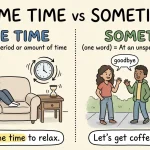
Here’s the quick answer: anytime, one word, is an adverb meaning “whenever.” Any time, two words, is a noun phrase referring to an amount or point of time — and it’s the only correct choice after a preposition like “at.”
Quick Answer Box
Anytime (one word) works as an adverb meaning “whenever,” as in “Call me anytime.” Any time (two words) is a noun phrase meaning “any amount of time” or “a point in time,” and it’s required after prepositions, as in “at any time.”
⚡ Quick Rule in 1 Line
One word for “whenever,” two words after a preposition or when talking about an amount of time.
Anytime as an Adverb
Anytime, written as one word, functions as an adverb and means “whenever” or “at any moment.” It’s commonly used in casual writing and speech, similar to how you’d use other adverbs like “often” or “quickly.” For example, “Stop by anytime” means “stop by whenever works for you.”
Any Time as a Noun Phrase
Any time, written as two words, is a noun phrase that refers to an amount of time or an unspecified point in time. It’s the correct choice whenever a preposition like “at,” “in,” or “for” comes before it, and also when you’re referring to a quantity, as in “I don’t have any time today.”
Comparison Table
| Form | Part of Speech | Function | Example |
|---|---|---|---|
| Anytime | Adverb | Means “whenever” | “Call me anytime.” |
| Any time | Noun phrase | Refers to an amount or point of time | “I don’t have any time today.” |
| Any time (after preposition) | Noun phrase | Required after “at,” “in,” “for” | “You can cancel at any time.” |
Example Sentences
Anytime (adverb):
- Feel free to reach out anytime if you need help.
- The bus should be here anytime now.
- You can call anytime, day or night.
- We can grab coffee anytime this week.
- Stop by anytime, our door is always open.
Any time (noun phrase):
- I don’t have any time to finish this today.
- You can cancel your subscription at any time.
- She didn’t waste any time starting the project.
- Do you have any time to talk this afternoon?
- We can reschedule for any time next week.
❌ Incorrect: “No visitors are allowed at anytime.” ✅ Correct: “No visitors are allowed at any time.”
❌ Incorrect: “I don’t have anytime today.” ✅ Correct: “I don’t have any time today.”
Common Mistakes
Using “anytime” directly after a preposition like “at,” where the two-word form is required — “at anytime” is always incorrect.
Using “any time” in casual adverb contexts where “anytime” would be simpler and more natural, like “call me any time” (technically fine but more formal).
Assuming the two forms are always interchangeable — they aren’t when a preposition is involved.
The Preposition Rule
This is the one rule that removes all guesswork: whenever a preposition comes directly before the phrase — “at any time,” “in any time,” “for any time” — you must use the two-word form. The one-word “anytime” can never follow a preposition.
Expert Tip 💡
If you’re unsure which to use, default to the two-word form, “any time” — according to ProWritingAid, it’s correct in every context, even where “anytime” would also work, making it the safer choice for formal writing.
Anytime or Any Time: Which One Is Correct?
Many people search “anytime or any time” or “any time or anytime” to settle this fast. The answer depends on how the phrase works in the sentence.
Anytime vs Any Time
The same question shows up in many forms. You may see “anytime vs any time,” “any time vs anytime,” “anytime v any time,” “anytime any time,” and “any time and anytime.”
Use “anytime” as an adverb meaning “whenever.” Use “any time” as a noun phrase.
Typos and Odd Searches
Some searches are typos, such as “anytime or anytime,” “anytime of any time,” and “any time of anytime.” Whichever form you meant, the rule above decides.
You may also see “time anytime” in a search box. It is usually a search for the phrase “any time.”
When to Use Anytime or Any Time
If you ask “when to use any time or anytime” or “when to use anytime or any time,” start with the preposition test. to If a preposition comes before it, write “any time.”
If it means “whenever” and no preposition comes before it, either form works. “Anytime” is more casual.
Anytime vs Any Time Meaning
For “anytime vs any time meaning” and “anytime or any time meaning,” the meaning is almost the same. The difference is grammar, not meaning.
Any Time vs Anytime Examples
Here are a few any time vs anytime examples:
- “Call me anytime.” (adverb)
- “Call me any time.” (also fine, more formal)
- “You can leave at any time.” (noun phrase after “at”)
Any Time in a Sentence
Here is any time in a sentence: “Do you have any time to talk?” Here, “any time” means “any amount of time.”
Anytime in a Sentence
Here is anytime in a sentence: “Visit anytime this week.” Here, “anytime” means “whenever.”
Any Time.
You may see “any time.” with a period, as in “Thanks. Any time.” The period ends the sentence and does not change the spelling.
Is Anytime One Word or Two?
Many readers ask “is anytime one word” or “is any time one word.” Both forms exist, and each has its own job.
Is Anytime One Word?
Yes, “anytime” is a real one-word adverb. If you ask “is anytime a proper word,” the answer is yes. Dictionaries list it.
Is Any Time One Word?
No, “any time” is two words when it works as a noun phrase. For “is any time one word,” the answer is no.
Anytime One or Two Words
For “is anytime one or two words,” “anytime one or two words,” “any time one word or two,” and “anytime one word,” the answer is both. Use one word for “whenever,” and two words after a preposition.
Anytime and Any Time Meaning and Definition
Many learners ask for a plain definition. Here is how each one works.
Anytime Definition
For anytime definition, “anytime” is an adverb that means “at any time” or “whenever.” For example, “Come anytime.”
You may also search “anytime define,” “define anytime,” and “definition anytime.” They all lead to this meaning.
Define Any Time and Any Time Meaning
For “define any time” and “any time meaning,” “any time” means any amount of time, or any point in time. For example, “I can meet at any time.”
What Does “Anytime” Mean?
“Anytime” means whenever you like. It can also be a reply to thanks, as in “Anytime!”
At Anytime Meaning
For “at anytime meaning,” the phrase “at anytime” is a common mistake for “at any time.” It means “at any moment.”
Any Time Now Meaning
For “any time now meaning,” “any time now” means very soon. For example, “The train should arrive any time now.”
It May Stop Working at Any Time Meaning
For “it may stop working at any time meaning,” the sentence means the item could stop working without warning. It can happen at any moment.
At Anytime or At Any Time?
This is the most common mistake. A preposition changes the rule.
At Any Time
“At any time” is correct. For example, “You may leave at any time.”
At Anytime or At Any Time
For “at anytime or at any time,” write “at any time.” The same goes for “at anytime” alone.
In Anytime or At Anytime
For “in anytime or at anytime,” neither is correct. Write “at any time” or “in any time.”
Anytime or At Anytime
For “anytime or at anytime,” use “anytime” as an adverb with no preposition. After “at,” use “any time.”
Anytime or Any Time in Everyday Messages
Many searches come from emails and texts. Here is how to choose in common cases.
I Am Available Anytime or Any Time
For “i am available anytime or any time,” both are acceptable. “I am available anytime” is common and natural.
For “i am available anytime today,” “anytime” is also fine.
Free Anytime or Any Time
For “free anytime or any time,” write “I’m free anytime this week” or “I’m free any time this week.” Both work.
Stop By Anytime or Any Time
For “stop by anytime or any time,” both are fine. “Stop by anytime” is the more casual choice.
Reach Out Any Time or Anytime
For “reach out any time or anytime,” both are accepted. “Reach out anytime” is common in emails.
Sure Anytime
For “sure anytime,” “sure, anytime” is a friendly reply. It means “I’m happy to help whenever.”
Anytime Is Fine and Anytime Would Work for Me
For “anytime is fine” and “anytime would work for me,” the phrase is the subject of the sentence. The careful form is “Any time is fine” and “Any time would work for me.”
Many people still write “anytime” in casual messages.
Any Time Available
For “any time available,” write “I have any time available” only when you mean an amount of time. For “whenever,” write “I’m available anytime.”
Any Time of the Day
For “any time of the day,” write “any time of the day” with two words. For example, “You can call any time of the day.”
Anytime After 12, Anytime Before, and Anytime Between
to For “anytime after 12” and “anytime before,” “anytime” works as an adverb. For example, “Come anytime after 12.”
For “anytime between 9 to 11,” the better wording is “anytime between 9 and 11.”
Anytime or Any Time After Thank You
Replies to thanks are a very common search.
Is It Anytime or Any Time for Thank You?
When someone says “thank you,” both replies are accepted. “Anytime” is the most common, and “any time” also appears.
No Problem Anytime or Any Time
For “no problem anytime or any time,” write “No problem, anytime.” It is casual and friendly.
Anytime or Any Time You’re Welcome
For “anytime or any time you’re welcome,” “You’re welcome, anytime” is common. “Any time” is a little more formal.
Happy to Help Anytime or Any Time
For “happy to help anytime or any time,” write “Happy to help anytime.” It means “whenever you need.”
Anytime or Any Time After 2pm
For “anytime or any time after 2pm,” both work. “Anytime after 2pm” is the common casual form.
Anytime or Any Time Soon
For “anytime or any time soon,” the common form is “any time soon,” as in “I don’t expect rain any time soon.” Writers usually keep it as two words.
Is It Any Time or Anytime on Friday?
Both appear. “Come by anytime on Friday” uses the adverb. “Any time on Friday works” uses the noun phrase as the subject.
FAQs
Is anytime one word or two?
Both forms exist. Use “anytime” as one word when it functions as an adverb meaning “whenever.” Use “any time” as two words when it’s a noun phrase or follows a preposition.
Can I use anytime after “at”?
No, “at anytime” is incorrect. Always use the two-word form after a preposition, as in “at any time.”
Is any time more formal than anytime?
Yes, “any time” as two words is generally considered more formal and is always grammatically safe, even in casual contexts.
Does Merriam-Webster accept anytime as one word?
Yes, Merriam-Webster lists “anytime” as a standard adverb, for example in the sentence “The bus should be here anytime now.”
What’s the difference in meaning between anytime and any time?
There’s little difference in meaning — the difference is grammatical, based on whether the phrase functions as an adverb or a noun phrase.
Is it correct to say “call me any time” instead of “anytime”?
Yes, both are correct in that context; “any time” is simply the more traditional, formal option.
Does British English follow the same rule?
Yes, the same adverb versus noun-phrase distinction applies in both American and British English.
When in doubt, which should I use?
Use the two-word form, “any time” — it’s correct in every situation, even where the one-word form would also be acceptable.
Is it anytime or any time for thank you?
Both are accepted. “Anytime” is the most common reply, and “any time” is a little more formal.
Is it any time or anytime on Friday?
Both appear. Use “anytime” as an adverb, as in “Come by anytime on Friday.” Use “any time” as a noun phrase, as in “Any time on Friday works.”
Is anytime a proper word?
Yes. “Anytime” is a real adverb listed in major dictionaries.
What does “anytime” mean?
“Anytime” means whenever or at any moment. It is also a casual reply to thanks.
Is anytime one word?
Yes, as an adverb meaning “whenever.” After a preposition, use “any time.”
Is any time one word?
No. “Any time” is two words when it works as a noun phrase.
Is “at anytime” correct?
No. Write “at any time.”
What does “any time now” mean?
It means very soon. For example, “The package should arrive any time now.”
What does “it may stop working at any time” mean?
It means the item could stop working at any moment, without warning.
Is “anytime” correct in “I am available anytime”?
Yes. It is common and natural, and “any time” is also accepted.
Is it “any time soon” or “anytime soon”?
“Any time soon” is the usual form, written as two words.
Is it “any time of the day”?
Yes. Write “any time of the day” with two words.
Is it “anytime between 9 to 11”?
Better wording is “anytime between 9 and 11.” Use “and” with “between.”
How do I reply to thank you: anytime or any time?
Either works. “Anytime” is the most common casual reply.
Can anytime be a noun?
Standard usage treats “anytime” as an adverb. When the phrase is a noun, write “any time.”
Conclusion
Anytime and any time aren’t strictly interchangeable, even though they sound identical.
Use “anytime” as an adverb meaning “whenever,” and switch to “any time” whenever a preposition comes before it or you’re referring to an amount of time.
When unsure, the two-word form is always a safe choice.

Hi, I’m Sophia Bennett. My goal is to make grammar easy, clear, and useful through simple explanations and real-life examples.