You’re describing a job interview.
‘It was so nerve-wracking’ or ‘nerve-racking’?
Both look believable, and spell checkers don’t always agree.
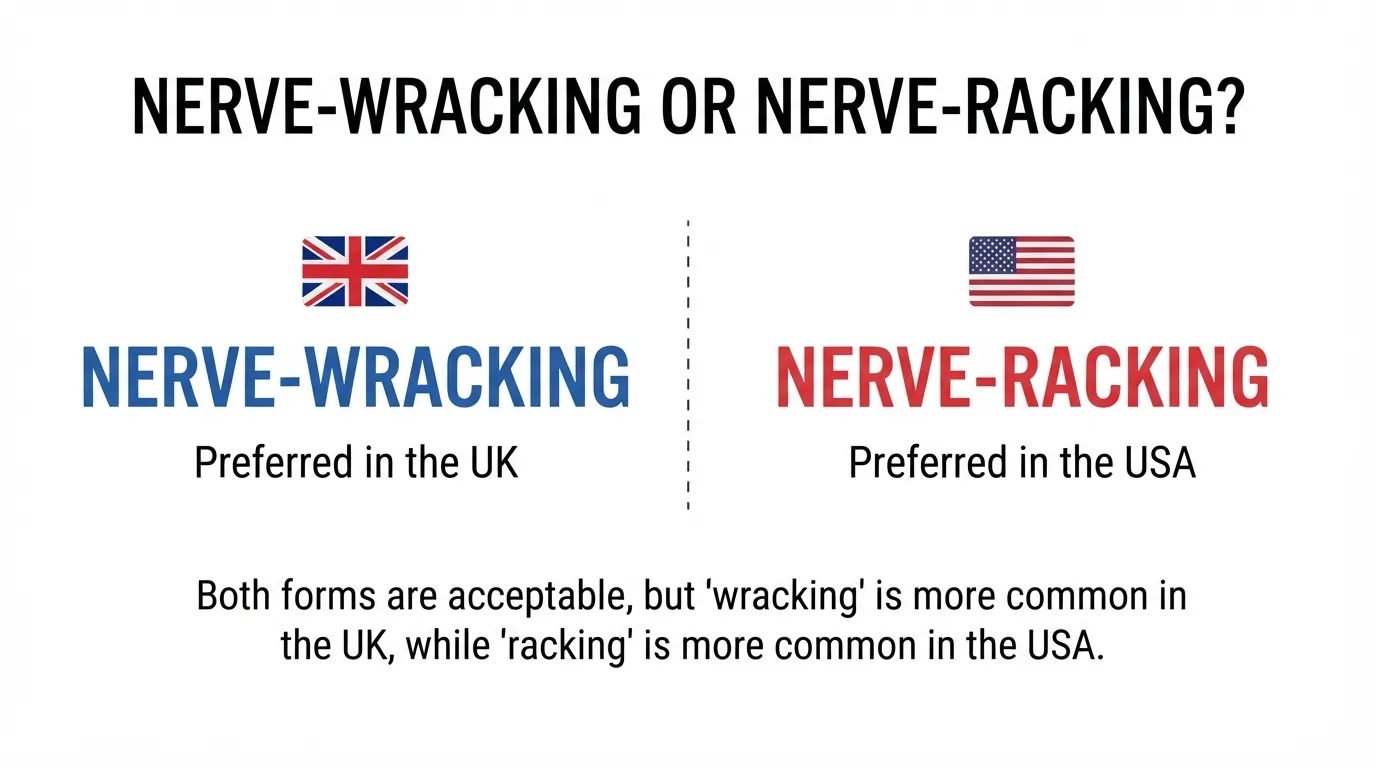
Here’s the quick answer: ‘nerve-racking’ is the original, preferred spelling.
‘Nerve-wracking’ is a widely used variant that most dictionaries now also accept.
Both are always hyphenated, no matter which spelling you choose.
Table of Contents
Did You Know?
Quick Answer Box
Quick Rule in One Line
Why Two Spellings Exist
Racking My Brain, Not Wracking It
Comparison Table
Memory Trick
Example Sentences
Common Mistakes
When to Use Each Form
Expert Tip
FAQs
Conclusion
Key Takeaways
Did You Know? 🔍
‘Rack’ and ‘wrack’ come from two entirely different Old English words.
‘Rack’ comes from ‘reccan,’ meaning to stretch, and is linked to the torture device called a rack.
‘Wrack’ comes from ‘wracu,’ meaning vengeance or misery, and is a close relative of ‘wreck.’
Because they sound identical and carry similarly painful meanings, ‘wrack’ has slowly crept into this phrase over time.
Quick Answer Box
‘Nerve-racking’ is the original and still preferred spelling, according to Merriam-Webster, meaning something that puts a severe strain on your nerves.
Most major dictionaries, including Merriam-Webster and the Oxford English Dictionary, list “nerve-wracking” as an accepted variant.
Both spellings are always hyphenated.
⚡ Quick Rule in One Line
Nerve-racking is the preferred spelling; nerve-wracking is an accepted, widely used variant.
Why Two Spellings Exist
‘Rack’ and ‘wrack’ are near-homophones with overlapping meanings, which is exactly why this confusion took hold.
‘Rack,’ the original word here, means to torture, strain, or cause anguish, matching the phrase’s meaning of intense stress.
‘Wrack’ more properly means to ruin, wreck, or destroy, a close cousin of ‘wreck,’ and it’s mostly archaic in modern English.
Because the two words sound the same and describe related painful ideas, “wrack” gradually replaced “rack” in this phrase. The newer form became so common that major dictionaries now recognize it as an accepted variant.
Racking My Brain, Not Wracking It
A closely related phrase, “racking my brain,” causes similar confusion. However, most writers consider “racking my brain” the standard form.
The phrase means trying very hard to remember or think of something. Many editors consider “wracking my brain” a less accepted variant and recommend “racking my brain” instead.
Unlike “nerve-racking,” where dictionaries recognize “nerve-wracking” as a well-established variant, “wracking my brain” remains less widely accepted in standard usage.
Comparison Table
| Feature | Nerve-Racking | Nerve-Wracking |
|---|---|---|
| Status | Original, preferred spelling | Widely accepted variant |
| Root word | Rack (to torture, strain) | Wrack (to ruin, destroy) |
| Dictionary status | Preferred in Merriam-Webster | Listed as a variant |
| Hyphenation | Always hyphenated | Always hyphenated |
Memory Trick
Think of a torture rack, the stretching device: that’s the original image behind ‘nerve-racking,’ your nerves being stretched to their limit.
‘Wrack,’ meaning to wreck or ruin, is the newer, accepted substitute, but the torture-rack image is the historically accurate one to remember.
Example Sentences
The job interview was nerve-racking from start to finish.
Waiting for the test results felt nerve-wracking.
Public speaking has always been nerve-racking for me.
The final exam was a nerve-wracking experience for the whole class.
It’s nerve-racking to wait for news like this.
Common Mistakes
There isn’t a strict error here since both spellings are accepted, but consistency and audience expectations matter.
❌ Switching between ‘nerve-racking’ and ‘nerve-wracking’ within the same document.
✅ Pick one spelling, ideally ‘nerve-racking’ for the most traditionally correct choice, and use it consistently.
❌ ‘It was nerve racking’ with no hyphen at all.
✅ ‘It was nerve-racking,’ always hyphenated.
When to Use Each Form
Use ‘nerve-racking’ if you want to follow the more traditional, dictionary-preferred spelling, especially in formal or edited writing.
“Nerve-wracking” works in most contexts today. Major dictionaries recognize it as a well-established variant, so you can use it confidently in everyday and formal writing.
Always keep the hyphen in either version.
Expert Tip 💡
If you follow a style guide or write for a publication that prefers traditional usage, choose “nerve-racking.” For everyday or casual writing, you can use either spelling because readers will generally understand both.
FAQs
Is ‘nerve-wracking’ wrong?
Not exactly. It’s considered a variant spelling, accepted by most major dictionaries, though ‘nerve-racking’ remains the more traditionally preferred form.
Why is this phrase always hyphenated?
Because ‘nerve’ and ‘racking’ or ‘wracking’ function together as a single compound adjective describing something that strains the nerves.
What’s the difference between ‘rack’ and ‘wrack’ generally?
‘Rack’ relates to stretching, straining, or torture; ‘wrack’ relates to ruin, wreck, or destruction. They sound alike but come from different roots.
Is ‘racking my brain’ or ‘wracking my brain’ correct?
‘Racking my brain’ is the more widely accepted correct version; ‘wracking my brain’ is generally still viewed as an error by careful editors.
Does Merriam-Webster prefer one spelling over the other?
Yes, Merriam-Webster lists ‘nerve-racking’ as the primary entry and ‘nerve-wracking’ as a recognized variant.
Conclusion
‘Nerve-racking’ is the original and still preferred spelling, tracing back to the image of the torture rack.
‘Nerve-wracking’ has become a widely accepted variant, recognized by major dictionaries, even though purists still favor the original.
Either way, always keep the hyphen, and try to stay consistent within the same piece of writing.

Hi, I’m Sophia Bennett. My goal is to make grammar easy, clear, and useful through simple explanations and real-life examples.