You post a photo of two paint colors in your group chat and caption it “yay or nay?”
Everyone instantly understands what you’re asking, no explanation needed.
But if you saw that same phrase in a Congressional transcript, it would look completely wrong.
This guide breaks down where “yay or nay” comes from, and how it differs from its more formal cousin, “yea or nay.”
Table of Contents
- Quick Answer
- Quick Rule in One Line
- What “Yay or Nay” Means
- “Yay” vs. “Yea”: The Real Difference
- What About “Aye”? A Related Voting Word
- How Do You Pronounce “Yay,” “Yea,” and “Nay”?
- Where Does “Yea or Nay” Come From?
- Synonyms for “Yay” and “Nay”
- Common Mistakes
- When to Use Each
- FAQs
Quick Answer Box
“Yay or nay” is a casual, modern way to ask for a quick opinion, meaning roughly “yes or no” or “good idea or bad idea.”
“Yea or nay” is the older, formal version, historically used in official voting.
Both are used today, but they belong in different settings.
⚡ Quick Rule in 1 Line
“Casual chat gets ‘yay,’ formal votes get ‘yea’ — same sound, different rooms.”
What “Yay or Nay” Means 📖
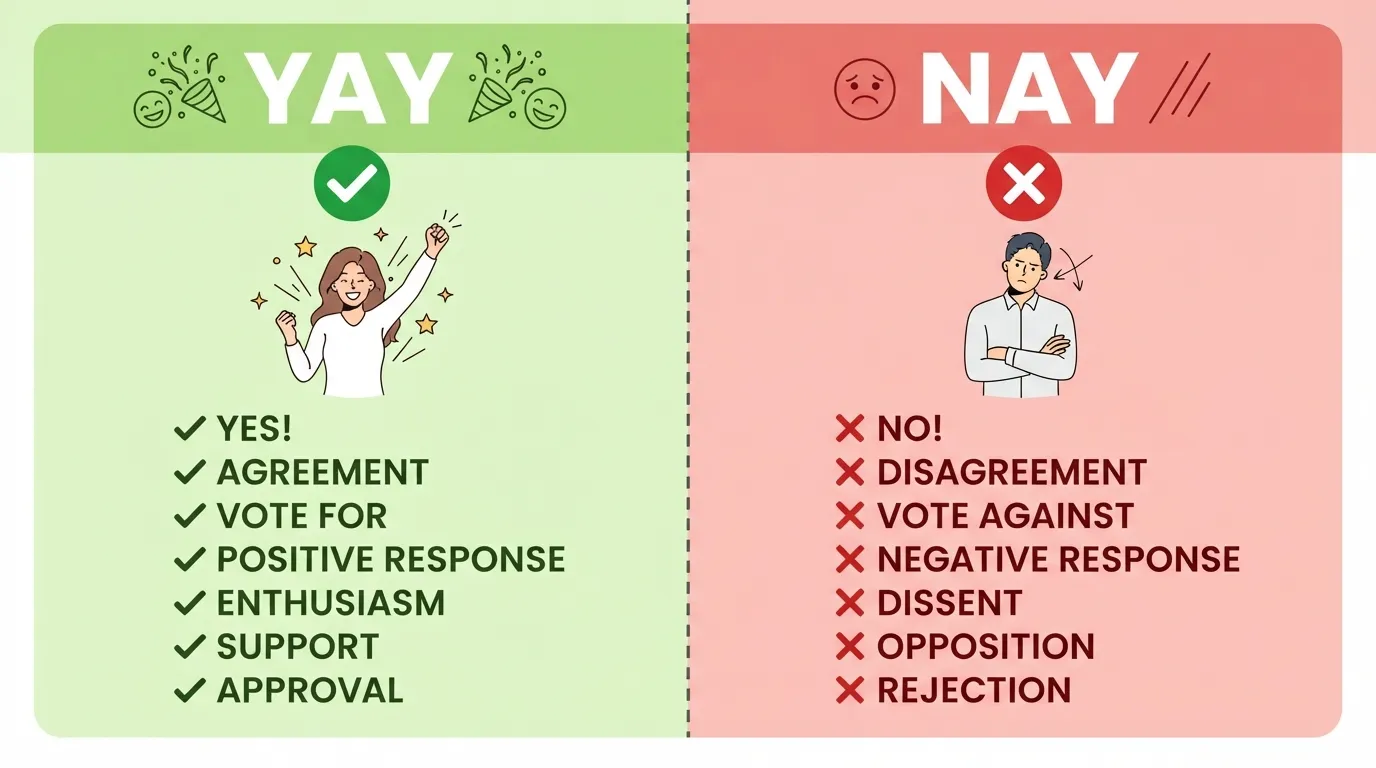
“Yay or nay” is informal shorthand for asking someone’s quick opinion on something, usually with a simple approve-or-reject answer expected.
“Yay” signals approval or excitement, borrowed from the exclamation people use when something good happens.
“Nay” signals disapproval or rejection, carried over from its older, more formal meaning of “no.”
Correct (casual context): New logo design, yay or nay?
Correct (casual context): Pineapple on pizza: yay or nay?
The phrase works especially well for quick, informal polls, whether in a text thread, a social media caption, or a casual meeting.
“Yay” vs “Yea”: The Real Difference 📖
This is where most of the confusion actually starts, since “yay” and “yea” sound identical when spoken aloud.
“Yea” (pronounced the same as “yay”) is the traditional, formal word for “yes,” historically used in official votes.
“Yay” is a newer, casual spelling that developed separately, mostly used as an exclamation of happiness or approval.
| Word | Register | Typical Use |
|---|---|---|
| Yea | Formal | Official votes: “All in favor, say yea.” |
| Nay | Formal | Official votes: “All opposed, say nay.” |
| Yay | Casual | Excitement or informal approval: “Yay, we won!” |
| Nay | Casual | Informal disapproval: “Yay or nay on the new schedule?” |
Interestingly, “nay” itself didn’t split into two spellings the way “yea/yay” did; it stayed the same in both formal and casual contexts.
Correct (formal): The motion passed with twelve yeas and three nays.
Incorrect (formal): The motion passed with twelve yays and three nays.
Correct (casual): New haircut, yay or nay?
Incorrect (casual, overly formal): New haircut, yea or nay?
What About “Aye”? A Related Voting Word
“Aye” is another formal word for “yes,” especially common in British and nautical English, and in some legislative votes alongside or instead of “yea.”
“Ayes and nays” works the same way as “yeas and nays” in formal voting contexts: “The ayes have it.”
Like “yea,” “aye” belongs in formal settings, not in a casual “yay or nay” text poll.
How Do You Pronounce “Yay,” “Yea,” and “Nay”?
“Yay” and “yea” are both pronounced the same way, rhyming with “day.”
“Nay” also rhymes with “day,” making all three words sound alike despite their different spellings and uses.
Since the sound gives no clue which spelling is correct, context and formality are what actually decide it.
Where Does “Yea or Nay” Come From?
“Yea” and “nay” trace back to Old English, used for centuries in formal English voting procedures.
This includes historic use in the UK Parliament and later in the US Congress, where “yea” and “nay” votes are still recorded today.
“Yay,” the casual spelling, emerged much later as informal written shorthand for excitement or approval, separate from this older voting tradition.
Synonyms for “Yay” and “Nay”
For “yay” (informal yes): sure, sounds good, I’m in.
For “nay” (informal no): nah, pass, not for me.
In formal contexts, “yea” and “nay” don’t typically have substitutes — they’re fixed, traditional voting terms.
Common Mistakes ❌ / ✅
❌ The committee voted twelve yays to three nays. (too casual for formal minutes)
✅ The committee voted twelve yeas to three nays.
❌ New logo, yea or nay? (too formal for a casual poll)
✅ New logo, yay or nay?
❌ She said “yea!” and jumped up excitedly. (wrong spelling for the exclamation)
✅ She said “yay!” and jumped up excitedly.
❌ We need a formal yay-or-nay vote on the budget. (mixing informal and formal register)
✅ We need a formal yea-or-nay vote on the budget.
When to Use Each
Reach for “yay or nay” in everyday, informal writing: texts, social captions, casual polls, and light-hearted questions among friends or coworkers.
Reach for “yea or nay” in formal or historical contexts: legislative votes, official meeting minutes, or writing that intentionally evokes a traditional, ceremonial tone.
If you’re unsure which fits, ask yourself: would this sentence sound natural in a courtroom or Congress? If yes, “yea.”
Expert Tip 💡
When writing meeting minutes or any official record of a vote, always default to “yea” and “nay,” never “yay.”
Even in modern organizations that otherwise use casual language, formal voting language has stayed remarkably consistent for this exact reason: clarity and tradition in official records.
Fun Fact 🎉
“Yay” as a standalone exclamation of joy is surprisingly recent.
Major dictionaries didn’t formally recognize it as distinct from “yea” until well into the 20th century, even though people had likely been saying it casually for decades before that.
FAQs ❓
Question: Is it “yay or nay” or “yea or nay”?
Answer: Both are correct, depending on context. “Yay or nay” is casual, while “yea or nay” is the formal, traditional version used in official voting.
Question: Do “yay” and “yea” sound different?
Answer: No, they’re pronounced identically. The difference is entirely in spelling and the formality of the context.
Question: Which one should I use in a work Slack poll?
Answer: “Yay or nay” fits better for a casual, informal team poll. Save “yea or nay” for genuinely formal decisions or votes.
Question: Is “nay” spelled differently in casual writing?
Answer: No. Unlike “yea/yay,” “nay” keeps the same spelling in both formal and casual contexts.
Question: Where does “yea or nay” come from?
Answer: It comes from traditional parliamentary and legislative voting language, still used today in bodies like the U.S. Congress.
Question: Is “yay” a real word in the dictionary?
Answer: Yes, it’s recognized as an informal exclamation of joy or approval, separate from the formal “yea.”
Question: Can I use “yay or nay” in professional writing?
Answer: It depends on tone. For casual internal communication, it’s fine. For formal reports or official records, use “yea or nay” instead.
Question: Why do people confuse the two spellings?
Answer: Because “yay” and “yea” are pronounced exactly the same way, so the spelling choice comes down entirely to context and formality, not sound.
Question: What does “nay” mean in a chat or text message?
Answer: In casual chat, “nay” simply means “no” or “I don’t like this,” used as the informal opposite of “yay.”
Question: Is “yay or nay” common on platforms like Reddit?
Answer: Yes, it’s widely used across casual online platforms, including Reddit, as shorthand for asking for quick opinions or informal votes.
Question: What’s the difference between “aye” and “yea”?
Answer: Both mean formal “yes” in voting. “Aye” is more common in British and nautical usage; “yea” is more associated with American legislative tradition.
Question: What does “yay or nay” mean in other languages or contexts?
Answer: It doesn’t translate directly — it’s an English idiom. The closest equivalent in any language is simply asking “yes or no?”
Conclusion
“Yay or nay” and “yea or nay” aren’t really competing spellings of the same phrase; they’re two different registers serving two different purposes.
“Yay” belongs in casual, everyday questions and exclamations, while “yea” carries the weight of formal, traditional voting language.
Once you match the spelling to the setting, this phrase becomes an easy, natural choice every time.

Hi, I’m Sophia Bennett. My goal is to make grammar easy, clear, and useful through simple explanations and real-life examples.