You posted “car for sell” in a local ad group, and within minutes, someone politely corrected it in the comments.
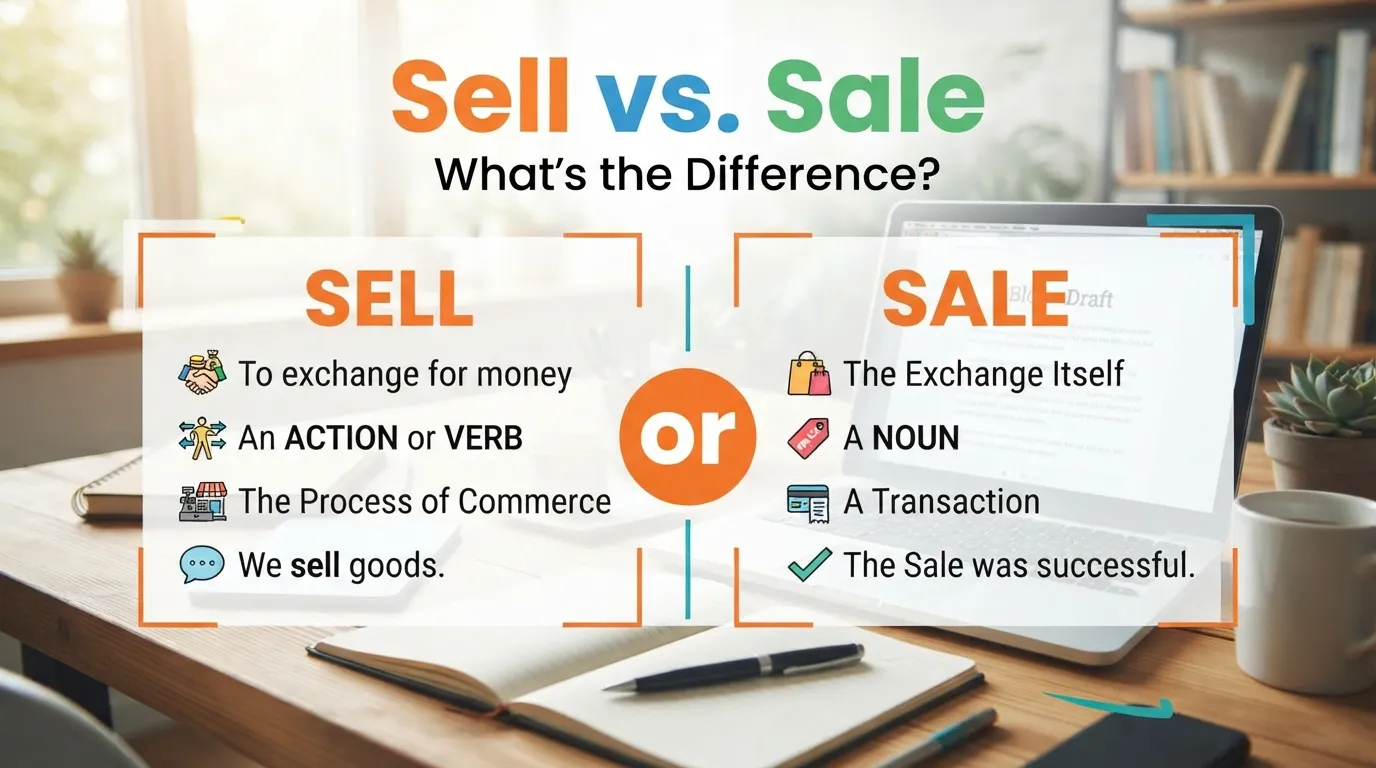
Here’s the quick fix: sell is a verb describing the action of exchanging something for money, while sale is a noun describing the event or instance of selling.
These two words are closely related in meaning, but they play completely different grammatical roles in a sentence.
Once you learn this verb-versus-noun distinction, phrases like “for sale” will never trip you up again.
Quick Answer
Sell is a verb meaning to exchange something for money (“I want to sell my old car”).
Sale is a noun referring to the act or event of selling something (“The store is having a big sale”).
If you need an action, use “sell.” If you need a thing or event, use “sale.”
⚡ Quick Rule
Sell is the action; sale is the event or thing — verb versus noun, action versus outcome.
Sell vs Sale: The Core Difference
The “Sell” describes the act of exchanging goods or services for payment, functioning as a verb.
“Sale” describes the event, occasion, or transaction of selling, functioning as a noun.
Say “I plan to sell my bike” (an action you’ll take), versus “The bike is for sale” (describing its current status or availability).
This action-versus-noun distinction is the entire foundation for using these words correctly.
Grammar Rule Explained
“Sell” conjugates like a typical verb: sell, sells, selling, sold — always describing an action happening.
“Sale” never conjugates as a verb — it remains a noun throughout, often paired with prepositions like “for” or “on.”
A simple test: if the sentence describes someone doing something, use “sell.” If it describes a state, event, or thing, use “sale.”
This action-versus-state test resolves nearly every mix-up between these two words.
Sell vs Sale Comparison Table
| Feature | Sell | Sale |
|---|---|---|
| Part of speech | Verb | Noun |
| Meaning | To exchange for money | An event or instance of selling |
| Example | She wants to sell her house. | The house is for sale. |
| Conjugates? | Yes (sell, sold, selling) | No |
Memory Trick
Remember: “Sell” rhymes with “tell,” both action words describing something you do.
“Sale” rhymes with “tale,” a noun describing a story, event, or thing that exists.
If you’re describing doing something, use “sell.” If you’re describing a thing or event, use “sale.”
Real Example Sentences
Using Sell (verb):
- I need to sell my old furniture before we move.
- The company sells handmade jewelry online.
- She sold her car last week.
- They’re trying to sell their house quickly.
- We sell fresh produce every weekend.
Using Sale (noun):
- The store is having a huge sale this weekend.
- The painting sold at a record sale price.
- Our house is officially for sale now.
- The sale ends on Friday at midnight.
- Everything in the shop is on sale today.
For Sale or For Sell? On Sale or On Sell?
“For sale” is always correct, describing something available to be purchased, as in “This car is for sale.”
“For sell” is never correct — since “sale” is the noun form needed after the preposition “for,” not the verb “sell.”
Similarly, “on sale” is correct, meaning discounted or available for purchase, while “on sell” is never a standard English phrase.
Prepositions like “for” and “on” are almost always followed by nouns, which is why “sale,” not “sell,” fits these common phrases.
Common Mistakes
1. Using “sell” instead of “sale” after a preposition Incorrect: This house is for sell. Correct: This house is for sale.
2. Using “sale” instead of “sell” as a verb Incorrect: I want to sale my old phone. Correct: I want to sell my old phone.
3. Misspelling “on sale” as “on sell” Incorrect: These shoes are on sell this week. Correct: These shoes are on sale this week.
4. Forgetting that prepositions need nouns, not verbs Since “for” and “on” are prepositions, they should be followed by “sale,” a noun, not the verb “sell.”
When to Use Each Word
Use Sell When:
- Describing the action of exchanging something for money
- The sentence needs a verb
- Conjugating with subjects like “I,” “she,” or “they”
Examples: sell a car, sell online, sell quickly
Use Sale When:
- Describing an event, transaction, or availability
- Following prepositions like “for” or “on”
- The sentence needs a noun
Examples: for sale, on sale, a big sale
FAQs
What’s the difference between sell and sale?
“Sell” is a verb describing the action of exchanging something for money. “Sale” is a noun describing the event or instance of selling.
Is it “for sale” or “for sell”?
It’s always “for sale,” since “sale” is the noun form required after the preposition “for.”
Is it “on sale” or “on sell”?
It’s always “on sale,” meaning discounted or available for purchase.
Can “sell” ever function as a noun?
No, “sell” is always a verb in standard English. The noun form is always “sale.”
Can “sale” ever function as a verb?
No, “sale” is always a noun. If you need a verb, use “sell” instead.
How do I remember which word to use?
“Sell” rhymes with “tell,” an action word. “Sale” rhymes with “tale,” a noun describing a thing or event.
Why do people confuse sell and sale so often?
Because they’re closely related in meaning and sound similar, even though they serve completely different grammatical roles.
What’s a quick way to test which word I need?
Ask if the sentence describes an action (sell) or a thing/event (sale) — that answer tells you which word fits.
Conclusion
Sell and sale are closely related in meaning, but they serve entirely different grammatical roles.
Sell is always a verb, describing an action. Sale is always a noun, describing an event or thing.
Remember that prepositions like “for” and “on” always need “sale,” never “sell,” and this pair will never confuse you again.

Hi, I’m Daniel Carter. I’m passionate about helping learners improve their English with practical grammar tips and clear writing advice.