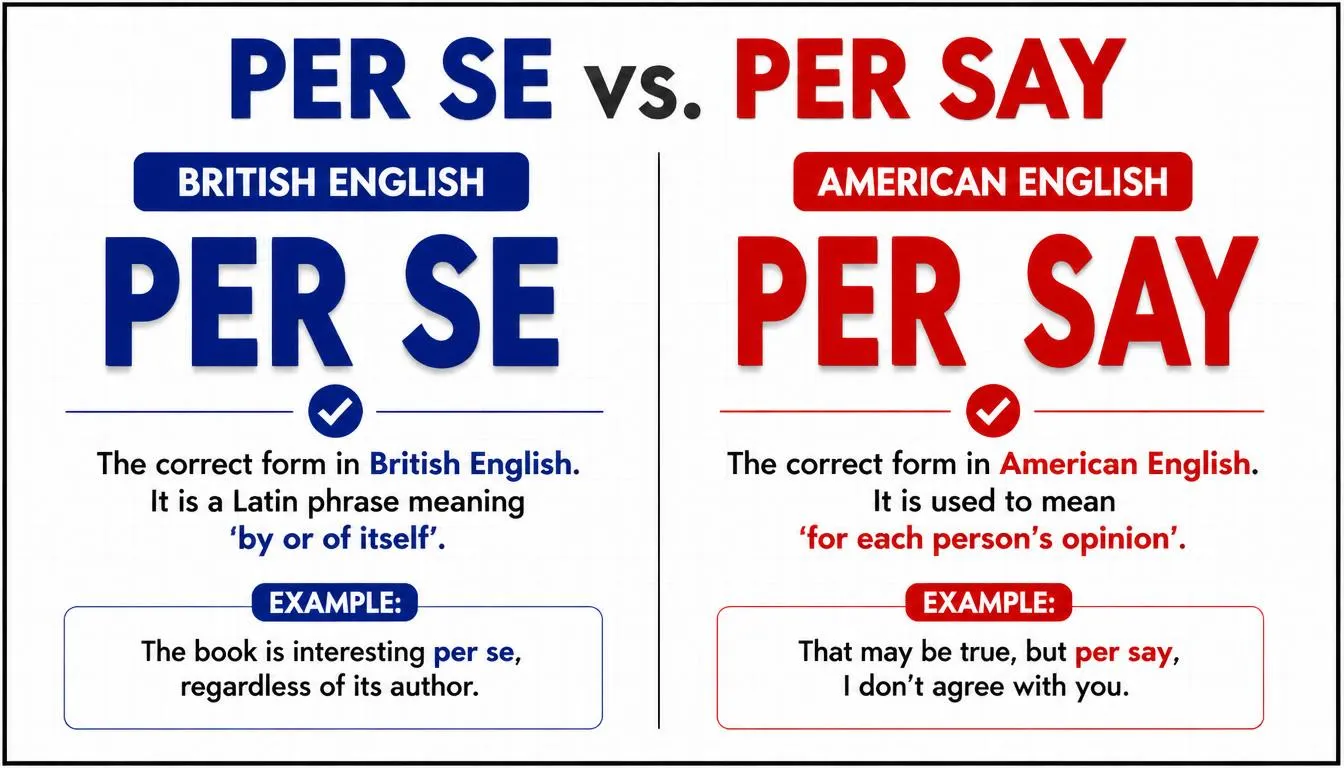
The correct expression is per se, meaning “by itself” or “in itself.” Per say is a common misspelling.
In this guide, you’ll learn the difference between per se and per say, their meanings, and how to use them correctly in sentences.
You’re drafting an email and want to sound precise: “The idea isn’t bad, per say, but it needs work.”
It looks right. It sounds right when you say it out loud.
But there’s a spelling hiding in plain sight that quietly undermines that polish.
This guide clears up the correct spelling, where it comes from, and exactly how to use it with confidence.
Table of Contents
- Quick Answer
- Quick Rule in One Line
- Why “Per Se” Is Correct
- How Do You Pronounce “Per Se”?
- Is “Perse” or “Persay” Ever Correct?
- What “Per Se” Actually Means
- Common Mistakes
- When to Use It
- FAQs
Quick Answer Box
The correct spelling is “per se,” not “per say.” Per se is a Latin phrase meaning “by itself” or “in itself,” used to isolate something from surrounding context. “Per say” is a common misspelling that comes from how the phrase sounds when spoken aloud.
⚡ Quick Rule in 1 Line
“It’s Latin, not English slang — always spell it per se, never per say.”
Why “Per Se” Is Correct 📖
“Per se” comes directly from Latin, where “per” means “by” or “through,” and “se” means “itself.”
Together, the phrase translates literally to “by itself,” and English adopted it centuries ago without changing the spelling.
The confusion happens purely because of pronunciation: the Latin “se” sounds exactly like the English word “say.”
Since most people hear the phrase spoken far more often than they see it written, the ear naturally guesses “say” instead of “se.”
But because it’s a fixed Latin phrase, not a regular English word, the spelling doesn’t shift to match pronunciation.
Correct: The plan isn’t bad per se, but it needs more detail. Incorrect: The plan isn’t bad per say, but it needs more detail.
Correct: I don’t dislike the movie per se; I just found it too long. Incorrect: I don’t dislike the movie per say; I just found it too long.
How Do You Pronounce “Per Se”?
It’s pronounced “pur-SAY” — the Latin “se” sounds exactly like the English word “say.” That identical sound is why the misspelling “per say” is so common.
Is “Perse” or “Persay” Ever Correct?
No. “Per se” is always two separate words. Writing it as one word — “perse” or “persay” — isn’t correct in English or Latin.
Variations like “per-se,” “per sae,” “per sey,” or “per see” are all misspellings too — the only correct form is “per se,” two words, spelled s-e.
What “Per Se” Actually Means 📖
“Per se” is used to say that something is true on its own, considered independently of outside factors.
It’s especially useful for softening a statement, showing that a quality doesn’t apply in an absolute sense.
“I don’t hate the food per se, I just have dietary restrictions” tells the listener the dislike isn’t about the food itself.
It shows up often in formal writing: legal documents, academic essays, journalism, and professional communication.
| Context | Example |
|---|---|
| Everyday speech | “It’s not expensive per se, but it adds up.” |
| Legal writing | “The action was illegal per se.” |
| Academic writing | “The theory isn’t flawed per se, but it lacks evidence.” |
| Business writing | “The policy isn’t restrictive per se, but it limits flexibility.” |
Common Mistakes ❌ / ✅
❌ I don’t hate dogs per say, I just prefer cats. ✅ I don’t hate dogs per se, I just prefer cats.
❌ The idea isn’t wrong per say. ✅ The idea isn’t wrong per se.
❌ There’s no dress code per say, but formality is expected. ✅ There’s no dress code per se, but formality is expected.
❌ This isn’t a rule per say, more of a guideline. ✅ This isn’t a rule per se, more of a guideline.
When to Use It
Use “per se” when you want to isolate one specific quality of something from its broader context, often to avoid overgeneralizing.
It works well right after the word or idea it’s modifying, usually set off by commas.
Avoid overusing it. Since it’s a formal, somewhat elevated phrase, sprinkling it into every sentence can feel forced rather than precise.
Should “per se” be italicized?
It’s optional. Because “per se” is now fully absorbed into English, most style guides no longer require italics. Some academic and legal styles still italicize foreign phrases, so follow your style guide if you have one.
Is “as per say” correct?
No. “As per say” isn’t a real phrase. People sometimes confuse it with “as per,” which means “according to” — as in “as per your request.” That’s a separate expression from “per se.”
Expert Tip 💡
If you’re ever unsure whether to trust your own spelling instinct, try substituting “in itself” into the sentence. If it still makes sense, “per se” is almost certainly the phrase you’re reaching for.
Fun Fact 🎉
The Oxford English Dictionary traces “per se” in English writing back to the 14th century, meaning this small Latin phrase has been quietly tripping up writers for over 600 years.
FAQs ❓
Is it “per se” or “per say”?
It’s always “per se.” “Per say” is a common misspelling based on how the Latin phrase sounds when spoken.
What does “per se” mean?
“Per se” means “by itself,” “in itself,” or “intrinsically,” used to isolate something from outside context or generalization.
Is “per say” ever correct in any context?
No. “Per say” has no recognized meaning in English or Latin; it’s simply a phonetic misspelling of “per se.”
Where does “per se” come from?
It comes from Latin, combining “per” (“by” or “through”) with “se” (“itself”), and has been used in English since at least the 14th century.
Is “per se” formal or casual?
It leans formal. You’ll see it often in legal, academic, and professional writing, though it also appears naturally in everyday conversation.
Why do so many people misspell it?
Because the Latin “se” is pronounced exactly like the English word “say,” and most people learn the phrase by ear before ever seeing it written.
Can “per se” start a sentence?
Yes, though it’s less common. “Per se, the method works” is grammatically correct, typically used for emphasis.
Is there a comma rule for “per se”?
There’s no strict rule, but it’s often set off by commas when used parenthetically, such as “The idea, per se, isn’t the problem.”
Does “per say” have a slang meaning?
No. “Per say” isn’t slang or informal usage — it’s simply a misspelling. The correct phrase is always “per se.”
Conclusion
“Per se” is the only correct spelling of this Latin phrase, despite how naturally “per say” seems to fit based on pronunciation alone.
Remembering its literal meaning, “by itself,” makes both the spelling and the usage far easier to hold onto.
Once you’ve caught the pattern, you’ll notice “per say” everywhere online, and you’ll know exactly why it’s wrong.
Lay vs Lie: The Rule That Trips Up Even Great Writers

Hi, I’m Daniel Carter. I’m passionate about helping learners improve their English with practical grammar tips and clear writing advice.