You tell your dog to “lay down,” then wonder if you just got it backward. You did — a little.
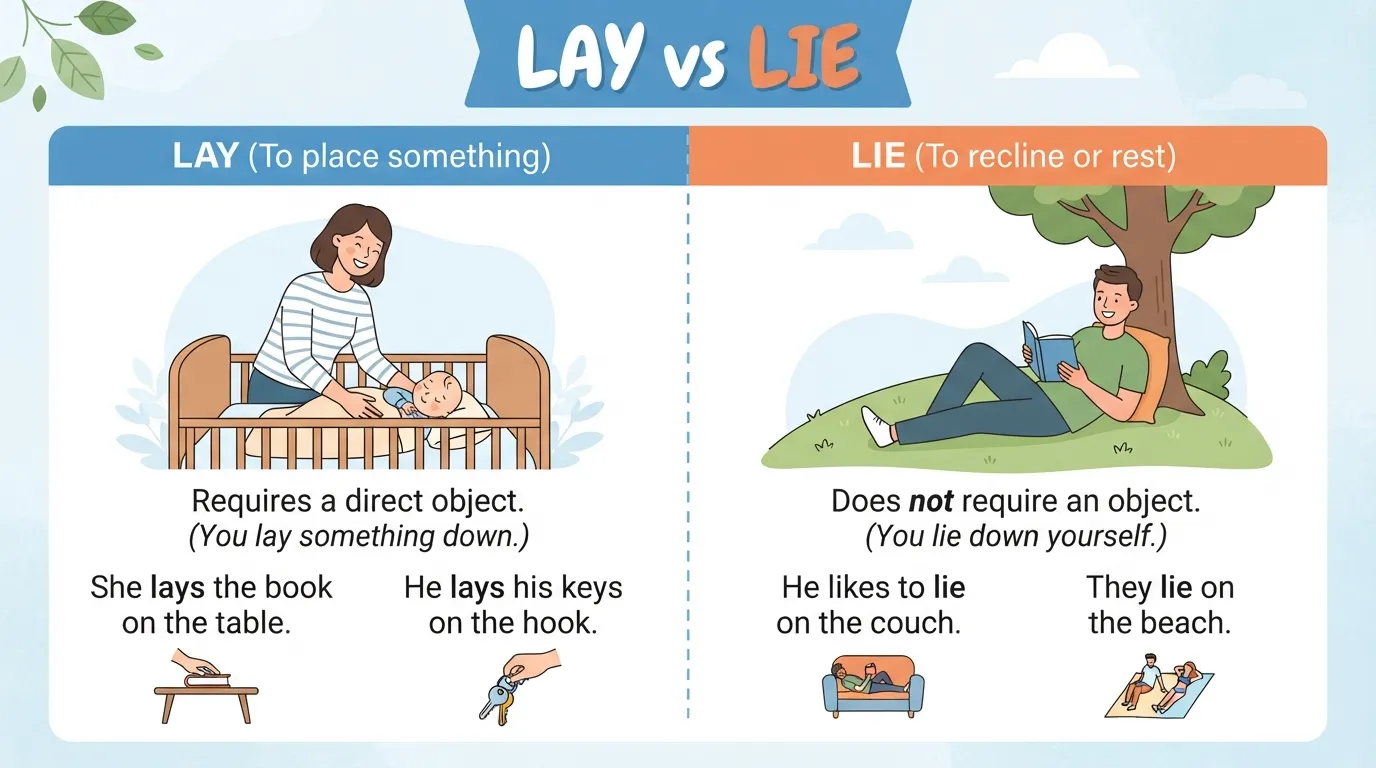
Here’s the quick answer: lie means to recline yourself, and it never takes an object. Lay means to place something down, and it always needs an object.
The confusion gets worse in the past tense, because the past tense of “lie” is spelled… “lay.” Once you see the pattern, the mix-up finally makes sense.
Table of Contents
- Did You Know?
- Quick Answer Box
- Quick Rule in One Line
- The Real Difference Between Lay and Lie
- The Grammar Rule (And Why the Past Tense Trips Everyone Up)
- Lay vs Lie Conjugation Table
- The Easiest Memory Trick
- 16 Real Example Sentences
- Common Mistakes
- When to Use Each Form
- Expert Tip
- Quick Quiz
- FAQs
- Conclusion
- Key Takeaways
Did You Know? 🔍
Merriam-Webster notes that using “lay” the way we use “lie” — as in “I’m going to lay down” — has actually been common since the 14th century. Grammar teachers have been correcting it since around 1770. So this isn’t a modern slip; people have been blending these two verbs for hundreds of years.
Quick Answer Box
Lie means to recline or rest, and it never takes a direct object — “I lie down.” Lay means to put or place something, and it always needs an object — “I lay the book down.” The real trap is the past tense: “lay” is also the past tense of “lie,” which is why “I lay down yesterday” is actually correct.
⚡ Quick Rule in One Line
“If there’s no object, you lie down; if you’re placing something, you lay it down.”
The Real Difference Between Lay and Lie
Lie is an intransitive verb — it describes something or someone resting, with no object involved. Lay is a transitive verb — it describes placing an object somewhere, and it always needs that object to make sense. “The cat lies on the rug” needs nothing else to complete the thought. “She lays the blanket on the bed” falls apart without “the blanket” — that’s the object doing the receiving.
A simple test: if you can swap in “place” or “put” and the sentence still makes sense, you need a form of lay. If the sentence is only about someone or something resting, you need lie.
The Grammar Rule (And Why the Past Tense Trips Everyone Up)
In the present tense, lie takes no object and lay always does — that part is simple. The real confusion starts in the past tense, because the past tense of “lie” is spelled “lay,” which looks exactly like the present tense of the other verb. This one coincidence causes most of the mix-ups people make with this pair.
Here’s where it gets genuinely tricky:
Yesterday, I lay on the beach for hours.
That’s correct — “lay” here is the past tense of “lie,” not a typo. Compare it to:
Yesterday, I laid the towel on the sand.
That’s also correct, but it’s the past tense of “lay,” with “the towel” as the object. Same-looking word, different verb, different job entirely.
The past participles separate cleanly, at least: “lie” becomes “lain” (I have lain here for hours), and “lay” becomes “laid” (I have laid the towel down). “Lain” sounds old-fashioned to a lot of ears, but it’s still the standard form in careful writing.
Lay vs Lie Conjugation Table
| Tense | Lie (to recline, no object) | Lay (to place, needs object) |
|---|---|---|
| Present | lie / lies | lay / lays |
| Present example | She lies on the couch. | She lays the keys on the counter. |
| Past | lay | laid |
| Past example | She lay on the couch yesterday. | She laid the keys on the counter. |
| Past Participle | lain | laid |
| Past Participle example | She has lain there for an hour. | She has laid the keys there before. |
| Present Participle | lying | laying |
| Present Participle example | She is lying on the couch. | She is laying the keys down. |
The Easiest Memory Trick
Ask yourself: “Am I placing something, or am I resting myself?” If you’re placing an object, it’s lay — think “lay it on the table.” If you (or something else) are simply resting, it’s lie — think “lie down and relax.”
For the past tense specifically, remember this: “Yesterday I lay down” sounds odd at first, but “lay” here isn’t a mistake — it’s simply the past form of “lie.” If that still feels unnatural, it’s fine to double-check with the conjugation table above until it sticks.
16 Real Example Sentences
Lie (no object) examples:
- I need to lie down for a few minutes.
- The dog lies by the door every afternoon.
- Yesterday, she lay in bed with a headache.
- He has lain awake for hours thinking about the meeting.
- The books were lying open on the desk.
- Please lie still while the doctor checks your arm.
- The town lay quiet after the storm passed.
- I’ve been lying here since sunrise.
Lay (needs an object) examples:
- Lay the folder on my desk, please.
- She lays out her clothes the night before.
- He laid the baby down gently in the crib.
- They have laid the foundation for the new house.
- I’m laying the tiles one row at a time.
- The waiter laid the plates on the table.
- Lay your worries aside for now.
- She had laid her keys on the counter before she left.
Common Mistakes
❌ “I’m going to lay down for a nap.” ✅ “I’m going to lie down for a nap.” (no object — you’re resting yourself)
❌ “She laid on the couch all afternoon.” ✅ “She lay on the couch all afternoon.” (past tense of lie, no object)
❌ “Lie the book on the table.” ✅ “Lay the book on the table.” (an object — “the book” — needs lay)
❌ “He has laid there for hours.” ✅ “He has lain there for hours.” (past participle of lie, no object)
When to Use Each Form
Use lie whenever the sentence is only about someone or something resting or reclining, with nothing else being placed — “the cat lies down,” “I lie awake at night.” Use lay whenever there’s an object being placed somewhere — “lay the towel down,” “she laid her bag on the chair.” When you land on the past tense and the sentence sounds like “lay” but means resting, don’t second-guess it — that’s correct, since “lay” doubles as the past tense of “lie.”
Expert Tip 💡
For resumes, reports, and formal writing, this pair is worth double-checking every time — it’s one of the most common grammar slips editors flag. In casual conversation, “lay down” for resting is extremely common and rarely raises eyebrows, but if you want to sound precise in writing, run the object test: no object, use “lie”; object present, use “lay.”
Quick Quiz
- “I ___ down for a nap yesterday.” (lay / laid)
- “Please ___ your coat on the chair.” (lay / lie)
- “The cat has ___ on that pillow for hours.” (lain / laid)
Answers: 1. lay (past tense of lie, no object) · 2. lay (object: “your coat”) · 3. lain (past participle of lie, no object)
FAQs
1. Is “lay down” ever correct for resting?
Only as a command directed at something else, like “lay the dog down gently.” For yourself, the correct form is “lie down.”
2. Why is the past tense of “lie” spelled “lay”?
It’s a historical coincidence in English verb conjugation — “lie” simply became “lay” in the past tense, which happens to match the present tense of the unrelated verb “lay.”
3. What’s the past participle of “lie”?
“Lain” — as in “I have lain here for an hour.”
4. What’s the past participle of “lay”?
“Laid” — as in “I have laid the papers on your desk.”
5. Is it “lying” or “laying” in the present participle?
“Lying” goes with lie (no object): “I’m lying down.” “Laying” goes with lay (needs an object): “I’m laying the blanket down.”
6. Does “lie” always mean to recline?
No — “lie” also means to tell an untruth, with a completely separate conjugation: lie, lied, lied. That “lie” isn’t related to the reclining verb at all.
7. Is mixing up lay and lie a big deal in casual speech?
Not really — it’s extremely common in spoken English. It matters more in formal or professional writing.
8. How can I quickly check which one I need?
Ask if there’s an object being placed. If yes, use a form of “lay.” If no, use a form of “lie.”
9. Is “laid” ever correct without an object?
No — “laid” always needs an object, since it’s the past tense and past participle of the transitive verb “lay.”
10. Does British English use lay and lie differently than American English?
No — the rule is the same in both American and British English; this isn’t a regional spelling difference.
Conclusion
The lay/lie mix-up comes down to one question: is something being placed, or is something simply resting? If there’s an object, you need a form of “lay.”
If there isn’t, you need a form of “lie” — and in the past tense, that form happens to be spelled “lay,” which is where most of the confusion starts.
Keep the conjugation table handy until the pattern feels automatic, and this pair stops being a guessing game for good.

Hi, I’m Ethan Brooks. I create easy-to-follow grammar guides, writing tips, and vocabulary resources to make English learning enjoyable for everyone.