You spell-checked your resume and colour got flagged red but your British friend swears that’s the correct spelling.
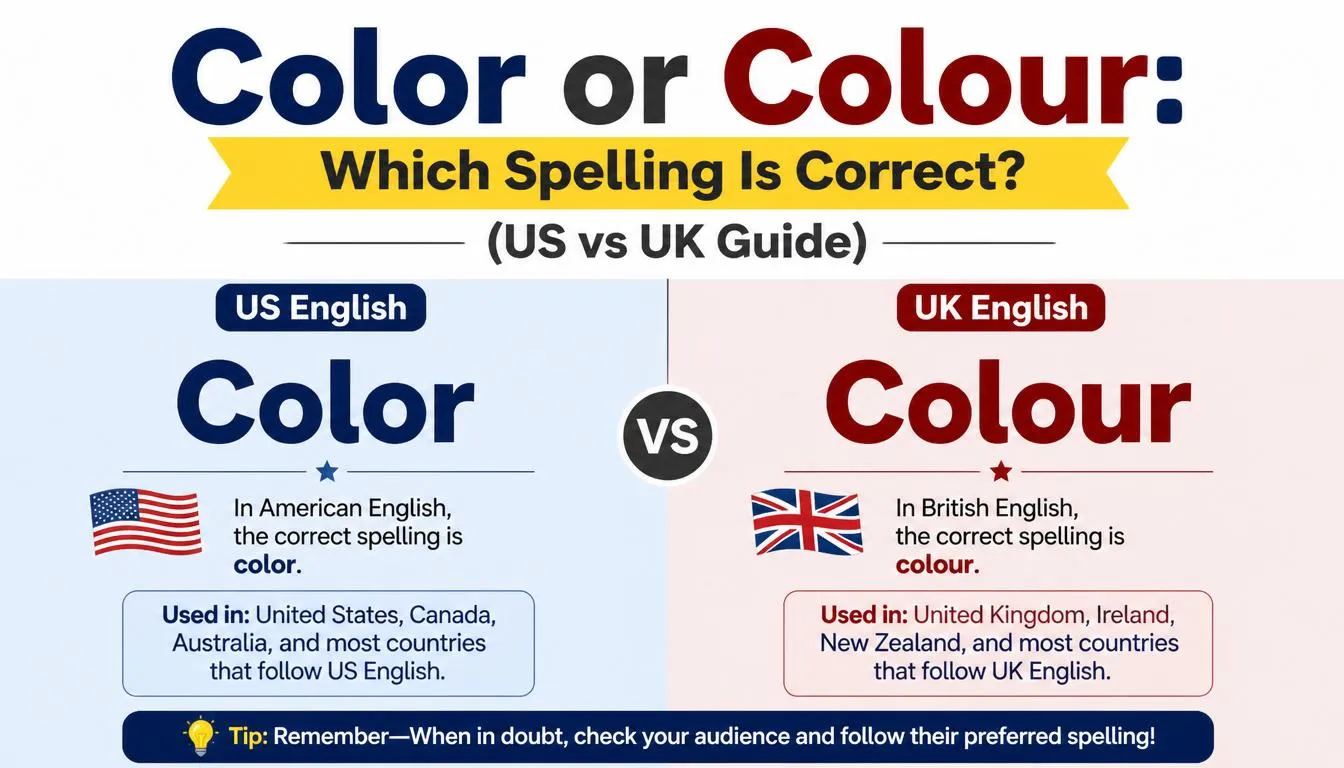
Here’s the quick fix: color is American English, and colour is British English.
Same word, same meaning, same pronunciation only the spelling changes based on your audience.
This is one of the most common American vs British spelling differences people search for.
Once you know which country uses which spelling, this stops being confusing for good.
Quick Answer
Color is the standard spelling in American English.
Colour is the standard spelling in British English, Australian English, and most Commonwealth countries.
Both describe the exact same thing: the property of light that gives objects their hue.
⚡ Quick Rule
Drop the u for America, keep the u for Britain that’s the entire rule.
Color vs Colour: The Core Difference
Color and colour mean exactly the same thing: the visual property created by light wavelengths, like red, blue, or green.
The only difference between them is regional spelling, not meaning or pronunciation.
If you’re writing for American readers, use color. If you’re writing for British or Commonwealth readers, use colour.
This single audience-based rule applies to nearly every situation you’ll encounter with this word.
Why Do Both Spellings Exist?
The spelling split traces back to differences between American and British English that grew over centuries.
British English kept spellings closer to their French and Latin origins, which is why colour retained the u.
American lexicographer Noah Webster pushed for simplified spellings in the early 1800s, dropping unnecessary letters from many words.
His reforms made color the standard in the United States, while colour remained standard in Britain and its former colonies.
Noah Webster Spelling Reform Explained
Noah Webster believed English spelling should match how words actually sound, not how they were borrowed from French or Latin.
His 1828 dictionary dropped the silent u from words like colour, favour, and honour, creating the American spellings we use today.
Britain never adopted these changes, which is why the u survives in colour, favourite, and honour across British English.
Grammar Rule
There is no grammar rule that changes color or colour; this is purely a spelling difference, not a grammatical one.
The word functions identically as a noun or verb in both spellings.
Examples: The color of the sky changed at sunset. The colour of the sky changed at sunset.
Both sentences are grammatically correct. Only the audience determines which spelling fits better.
Color vs Colour Comparison Table
| Feature | Color | Colour |
| Meaning | Hue or shade | Hue or shade |
| American English | ✅ Standard | Less common |
| British English | Rare | ✅ Standard |
| Australian English | Rare | ✅ Standard |
| Canadian English | Sometimes used | More common |
| Pronunciation | Same | Same |
| Grammar | Correct | Correct |
Memory Trick
Remember: America likes things short, so it drops the u color.
Britain keeps tradition, so it keeps the u col-u-r.
If you’re ever unsure, picture the American flag for color and the British flag for colour.
Real Example Sentences
American English (Color):
- The color of the walls needs updating.
- She chose a bright color for her dress.
- His favorite color is green.
- The paint color didn’t match the sample.
- We compared several color options for the kitchen.
British English (Colour):
- The colour of the walls needs updating.
- She chose a bright colour for her dress.
- His favourite colour is green.
- The paint colour didn’t match the sample.
- We compared several colour options for the kitchen.
Colored or Coloured? Coloring or Colouring?
Colored is the American past tense and adjective form, as in a colored pencil.
Coloured is the British equivalent, as in a coloured pencil.
The same pattern applies to the -ing form: coloring (American) versus colouring (British), as in coloring book versus colouring book.
Follow the same audience-based rule you use for the base word.
Colorful or Colourful?
Colorful is the standard American spelling, meaning full of color or vivid.
Colourful is the standard British spelling, meaning exactly the same thing.
Example: The festival was colorful (US) versus The festival was colourful (UK) identical meaning, different spelling.
Color or Colour in Proper Names and Brands
Brand names and official titles keep their original spelling, regardless of your regional English.
| Name | Spelling | Why |
| Color Splash (app/brand) | Color | Uses American spelling by design |
| Colour Pop Cosmetics | Colour | Uses stylized British-style spelling as branding |
| Pantone Color Institute | Color | Official American company name |
Never change the spelling of a brand or official title, even if it doesn’t match your regional English.
Around the World: Where Each Spelling Is Used
| Country | Preferred Spelling |
| United States | Color |
| United Kingdom | Colour |
| Canada | Usually Colour |
| Australia | Colour |
| New Zealand | Colour |
| Ireland | Colour |
Canada often mixes both spellings, though colour remains more common in official and government writing.
Common Mistakes
1. Mixing both spellings in one document Incorrect: The color of the room matched the colour of the curtains. Correct (US): The color of the room matched the color of the curtains.
2. Changing brand or product spellings Never rename an official brand to match your regional English.
3. Assuming one spelling is more correct Both spellings are equally correct only your audience determines which fits better.
4. Forgetting related words follow the same rule Colored/coloured, coloring/colouring, and colorful/colourful all follow the same pattern as color/colour.
When to Use Each Spelling
Use Color When:
- Writing for American readers
- Following AP Style or Chicago Manual of Style
- Writing for US schools or businesses
Examples: color scheme, color palette, favorite color
Use Colour When:
- Writing for British, Australian, or NZ readers
- Following Oxford or British publishing standards
- Writing for most Canadian readers
Examples: colour scheme, colour palette, favourite colour
Similar American and British Spelling Differences
Color and colour aren’t alone; many English words follow this same regional pattern.
| American | British |
| color | colour |
| favorite | favourite |
| honor | honour |
| theater | theatre |
| center | centre |
| canceled | cancelled |
Recognizing this pattern makes it easier to guess the correct spelling for similar word pairs.
FAQs
Is it color or colour? Both are correct. Color is American English, while colour is British English and most Commonwealth countries.
Is color the American spelling?
Yes. American dictionaries, schools, and style guides recommend color over colour.
Is colour used in the UK?
Yes. It’s the standard spelling in British English and also common in Australia, New Zealand, and Ireland.
Do color and colour mean different things?
No. Both describe the exact same visual property only the spelling differs by region.
Why are there two spellings?
American and British English developed differently over time, partly due to Noah Webster’s 19th-century spelling reforms.
Is one spelling more correct than the other?
No. Neither spelling is more correct, match your spelling to your audience instead.
How do I remember which spelling to use?
Think: America drops the u for a shorter word; Britain keeps the u for the traditional spelling.
Is it colored or coloured ?
Colored is American English. Coloured is British English, following the same regional pattern as color/colour.
Is it a coloring book or colouring book ?
The coloring book is American English. Colouring book is British English.
Should I change the spelling in a brand name like ColourPop?
No. Brand names and official titles always keep their original spelling, regardless of your regional English.
What is the color colour rule in one sentence?
Drop the u for American English (color), keep the u for British English (colour) that’s the whole rule.
What is the correct spelling of color for a US audience?
For American readers, color (without the u ) is the correct and expected spelling.
Conclusion
Color and colour are both correct spellings of the same word.
The only real difference is the audience you’re writing for.
Use color for American English, and colour for British English and Commonwealth countries and stay consistent throughout your writing.

Hi, I’m Daniel Carter. I’m passionate about helping learners improve their English with practical grammar tips and clear writing advice.