You’re wrapping up a presentation.
You want to smoothly move to the next topic.
You type ‘let me segway into the next point’ and hit send.
Then you wonder if that’s even a word.
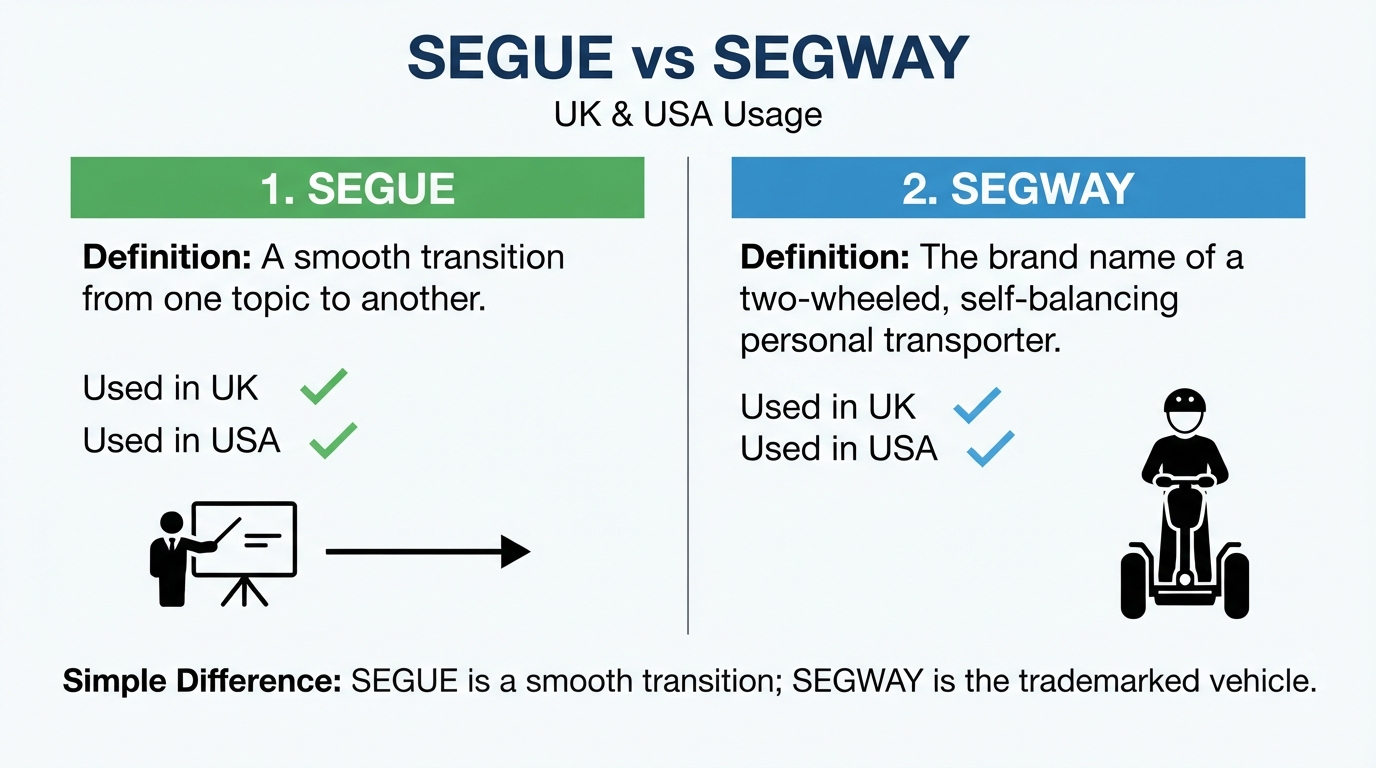
Here’s the quick answer: ‘segue’ is the correct spelling for a smooth transition between topics, scenes, or music.
‘Segway’ is a trademarked brand name for a two-wheeled scooter, not a general English word at all.
They sound exactly the same. That’s exactly why this mix-up is so common, even among careful writers.
Table of Contents
Did You Know?
Quick Answer Box
Quick Rule in One Line
How Do You Spell Segue?
The Real Difference Between Segue and Segway
Why This Word Breaks the Usual Pattern
Segue vs. Segway Comparison Table
The Easiest Memory Trick
16 Real Example Sentences
Common Mistakes
When to Use Each Form
Segue Meaning in English
Why Is Segue Pronounced “Segway”?
Another Word for Segue
Is “Segway” in the Dictionary?
Expert Tip
Fun Fact
FAQs
Conclusion
Key Takeaways
Did You Know? 🔍
Merriam-Webster confirms ‘segue’ is often misspelled as ‘segway,’ even in edited text.
Two things cause this. First, the familiar ‘-way’ ending in words like driveway and runway.
Second, the real existence of Segway, the scooter company founded in 2001.
That company named itself after a phonetic spelling of the Italian word ‘segue.’
Quick Answer Box
‘Segue’ is the correct word for a smooth transition.
It works as both a verb (‘he segued into the next story’) and a noun (‘a nice segue’).
‘Segway,’ always capitalized, refers only to the branded electric scooter.
It should never be used as a general English word.
⚡ Quick Rule in One Line
Segue is the transition, Segway is the scooter, and only one of them belongs in a sentence about topics.
How Do You Spell Segue?
The correct spelling is s-e-g-u-e, four letters, no ‘w’ anywhere.
It’s pronounced ‘SEG-way,’ which is exactly what causes the common spelling mistake.
‘Segway’ with a ‘w’ is only correct when you mean the actual scooter brand.
This is one of English’s trickiest homophone pairs, since both words sound completely identical.
The Real Difference Between Segue and Segway
Segue is an Italian-derived English word.
It means to move smoothly from one thing to another.
Segway is a capitalized brand name for a specific electric scooter.
Nothing more, nothing less.
They’re pronounced identically, which makes this pair unusual.
Most confused word pairs at least sound slightly different.
Segue and Segway are true homophones with completely unrelated meanings.
Segue works as a verb, meaning to transition without interruption.
It also works as a noun, meaning the transition itself.
Segway, on the other hand, only works as a proper noun.
It has no verb form and no general meaning in standard English.
Why This Word Breaks the Usual Pattern
Most confused English pairs are two real words with different meanings or spellings.
This pair is different, and it’s worth calling out directly.
‘Segway’ didn’t exist as any kind of English word until 2001.
That’s when the scooter company chose that name, specifically because it echoed ‘segue.’
So this isn’t really a spelling variant at all.
It’s a trademarked brand name that happens to sound exactly like an older, unrelated word.
That coincidence is the entire reason the confusion exists.
Segue itself has a much older history.
It comes from the Italian word segue, meaning ‘it follows’ or ‘there follows.’
Its was originally used strictly as a musical direction.
It told a performer to move into the next passage without pausing.
Later, it spread into everyday English to describe any smooth transition.
Segue vs. Segway Comparison Table
| Feature | Segue | Segway |
|---|---|---|
| Word type | Verb and noun | Proper noun (brand name) only |
| Meaning | A smooth transition | A branded electric scooter |
| Origin | Italian, meaning ‘it follows’ | Coined in 2001, echoing ‘segue’ |
| Capitalization | Lowercase | Always capitalized |
| Correct in general writing | Yes | Only when referring to the actual scooter |
| Pronunciation | SEG-way | SEG-way (identical) |
The Easiest Memory Trick
Picture the scooter itself.
Segway, with a capital S, only ever refers to that specific product.
Same as how Kleenex only refers to a specific tissue brand.
If your sentence has nothing to do with an actual scooter, you don’t want Segway.
For ‘segue,’ remember its Italian root.
Segue literally means ‘follows.’
A segue is what naturally follows one topic into the next.
16 Real Example Sentences
Segue (transition) examples:
The host used a joke to segue into the next segment.
Her introduction was a smooth segue into the main presentation.
The band segued from one song directly into the next.
He struggled to find a natural segue back to the main topic.
The article’s ending felt more like a segue than a real conclusion.
She segued from small talk into the actual pitch effortlessly.
This chapter serves as a segue between the two main sections.
The teacher segued from grammar into vocabulary without missing a beat.
That was a clever segue back to your original point.
The film segues between past and present without warning.
Segway (scooter brand) examples:
He rented a Segway to tour the city in an afternoon.
The security guard patrolled the mall on a Segway.
Segway scooters became a common sight on college campuses.
She fell off her Segway trying to turn too sharply.
The company that makes Segway scooters was founded in New Hampshire.
Tour groups often use Segways to cover more ground quickly.
Common Mistakes
❌ ‘Let me segway into the next topic.’
✅ ‘Let me segue into the next topic.’ (a transition, not the scooter)
❌ ‘The presentation needed a better segway between sections.’
✅ ‘The presentation needed a better segue between sections.’ (noun form, meaning transition)
❌ ‘He rode his segue through the park.’
✅ ‘He rode his Segway through the park.’ (referring to the actual scooter here)
❌ ‘She segued to work on her new scooter.’
✅ ‘She rode her Segway to work.’ (segue isn’t a mode of transportation)
This is a classic example of a common word mix-up.
Two words sound alike, so the wrong spelling sneaks into writing without anyone noticing.
When to Use Each Form
Use segue any time you’re describing a smooth transition.
That includes topics, scenes, songs, or ideas.
It works as a verb (‘he segues smoothly’) or a noun (‘a natural segue’).
Use Segway, always capitalized, only for the branded electric scooter.
If your sentence has nothing to do with a physical two-wheeled device, Segway is almost certainly the wrong word.
Segue Meaning in English
In English, segue means a smooth move from one thing to the next.
Dictionaries list it as both a verb and a noun.
What Is the Definition of Segue?
As a verb, it means to move from one topic, scene, or song to another without a break.
As a noun, it means the transition itself, or the link that joins two parts.
The plural noun is ‘segues.’
The verb takes the same form in the present tense: ‘she segues into the next point.’
What Does “Nice Segue” Mean?
It’s a compliment.
It means someone moved between two topics smoothly.
People also say it with a smile when the link is a bit of a stretch.
Example: ‘Speaking of pizza, I got a promotion.’ ‘Nice segue!’
What Does “Segue Into” Mean?
To ‘segue into’ something is to move into it smoothly.
Examples:
She segued into her closing remarks.
The song segues into a quiet piano ending.
You may also see ‘a segue into something.’ That means a lead-in to the next thing.
If you’ve seen ‘segway into’ written out, it’s the same phrase with the wrong spelling.
The right form is always ‘segue into.’
What Is a Segue in a Conversation?
In conversation, a segue is the bridge between two subjects.
It keeps the talk from feeling abrupt.
Common bridge phrases:
- ‘That reminds me…’
- ‘On a related note…’
- ‘Speaking of that…’
A good segue links the old topic to the new one in a single sentence.
Why Is Segue Pronounced “Segway”?
The spelling looks like it should sound different. Here’s why it doesn’t.
English borrowed the word from Italian, where it comes from the verb for ‘to follow.’
English kept the Italian spelling.
But English speakers changed the sound.
The Italian ending sounds closer to ‘gweh.’
In English, it settled into ‘way.’
So you say ‘SEG-way,’ with the stress on the first part.
‘SEG’ rhymes with ‘beg.’
That mismatch between spelling and sound is why so many people write ‘segway.’
Another Word for Segue
Looking for a different word? The right one depends on how you use it.
Synonyms for Segue as a Noun
- transition
- link
- bridge
- lead-in
- changeover
Synonyms for Segue as a Verb
- transition
- shift
- move on
- switch
- flow
Pick the one that fits your sentence. ‘Transition’ works almost everywhere.
Another Name for the Segway Scooter
‘Segway’ is a brand, so it has no synonyms.
The scooter itself is often called a ‘personal transporter.’
You may also see ‘self-balancing scooter’ used as a general term.
Is “Segway” in the Dictionary?
Not as a word for a transition.
Where Segway appears, it’s treated as a brand name for the scooter.
The transition meaning is listed under ‘segue.’
So if you’re looking up the meaning of a word for a smooth shift, search ‘segue.’
Expert Tip 💡
Try replacing the word with ‘transition’ when you’re unsure.
If ‘transition’ fits the sentence, you need ‘segue.’
If it doesn’t fit at all, and you’re actually talking about a scooter, you need ‘Segway.’
This quick substitution test catches the mistake almost every time.
Fun Fact 🎉
The Segway company didn’t pick its name randomly.
Segue was already a well-established word meaning a smooth transition.
The company wanted its scooter to represent a smooth transition between walking and riding.
That makes the brand name a clever bit of wordplay, not an accident.
FAQs
Is ‘segway’ ever a correct spelling?
Only when capitalized and referring specifically to the branded electric scooter.
As a general word for a smooth transition, the correct spelling is always ‘segue.’
How do you pronounce ‘segue’?
It’s pronounced ‘SEG-way,’ identical to how ‘Segway’ is pronounced.
That’s exactly why the two get confused so often in writing.
What language does ‘segue’ come from?
Italian. It comes from the Italian word segue, meaning ‘it follows’ or ‘there follows.’
It was originally used as a direction in music.
Can ‘segue’ be used as a verb?
Yes. Its verb forms are segue, segued, and segueing.
For example, ‘the host segued smoothly into the next topic.’
Is ‘Segway’ a real English word?
It’s a real proper noun, specifically a trademarked brand name.
It isn’t a general English word with its own dictionary definition beyond that brand.
Why do people confuse segue with Segway?
Mainly because they’re pronounced exactly the same.
The familiar ‘-way’ ending, as in driveway or runway, makes ‘segway’ look like a plausible spelling, even though it isn’t correct for the transition meaning.
Is ‘segue’ only used in music?
No. It started as a musical direction but is now common in everyday English.
You’ll see it in speech, writing, presentations, and film.
What’s the noun form of segue?
‘Segue’ itself works as the noun, as in ‘that was a great segue.’
It describes the transition itself, not the act of transitioning.
Should Segway always be capitalized?
Yes. Since it’s a proper noun and trademarked brand name, it should always be capitalized when referring to the scooter.
Is there a British versus American difference in this word?
No, this isn’t a regional spelling split.
‘Segue’ and ‘Segway’ mean different things everywhere English is spoken.
The correct spelling depends on meaning, not region.
What does ‘nice segue’ mean?
It praises a smooth link between two topics.
It’s also said playfully when the link is a stretch.
What does ‘segue into’ mean?
It means to move smoothly into a new topic, scene, or song.
Example: ‘The talk segued into a Q&A.’
Is ‘segway into’ correct?
No. The correct phrase is ‘segue into.’
‘Segway’ is only the scooter brand.
What is a segue in a conversation?
It’s a short bridge that moves the talk from one subject to another.
A phrase like ‘that reminds me’ often does the job.
Why is segue pronounced ‘segway’?
English kept the Italian spelling but adapted the sound.
The ending is said as ‘way,’ so the word is spoken ‘SEG-way.’
What is another word for segue?
‘Transition’ is the closest match.
Other options include ‘link,’ ‘bridge,’ and ‘shift.’
What is the plural of segue?
The plural is ‘segues.’
Example: ‘The film uses smooth segues between scenes.’
Conclusion
Segue and Segway sound identical.
But only one of them belongs in a sentence about smooth transitions.
Segue, rooted in Italian, describes moving from one topic, scene, or song to the next without a break.
Segway, always capitalized, refers only to the branded scooter.
It happens to share its name with segue by design, not by accident.
Once you remember that only one of these words describes an action anyone can take, the mix-up becomes easy to avoid for good.

Hi, I’m Daniel Carter. I’m passionate about helping learners improve their English with practical grammar tips and clear writing advice.