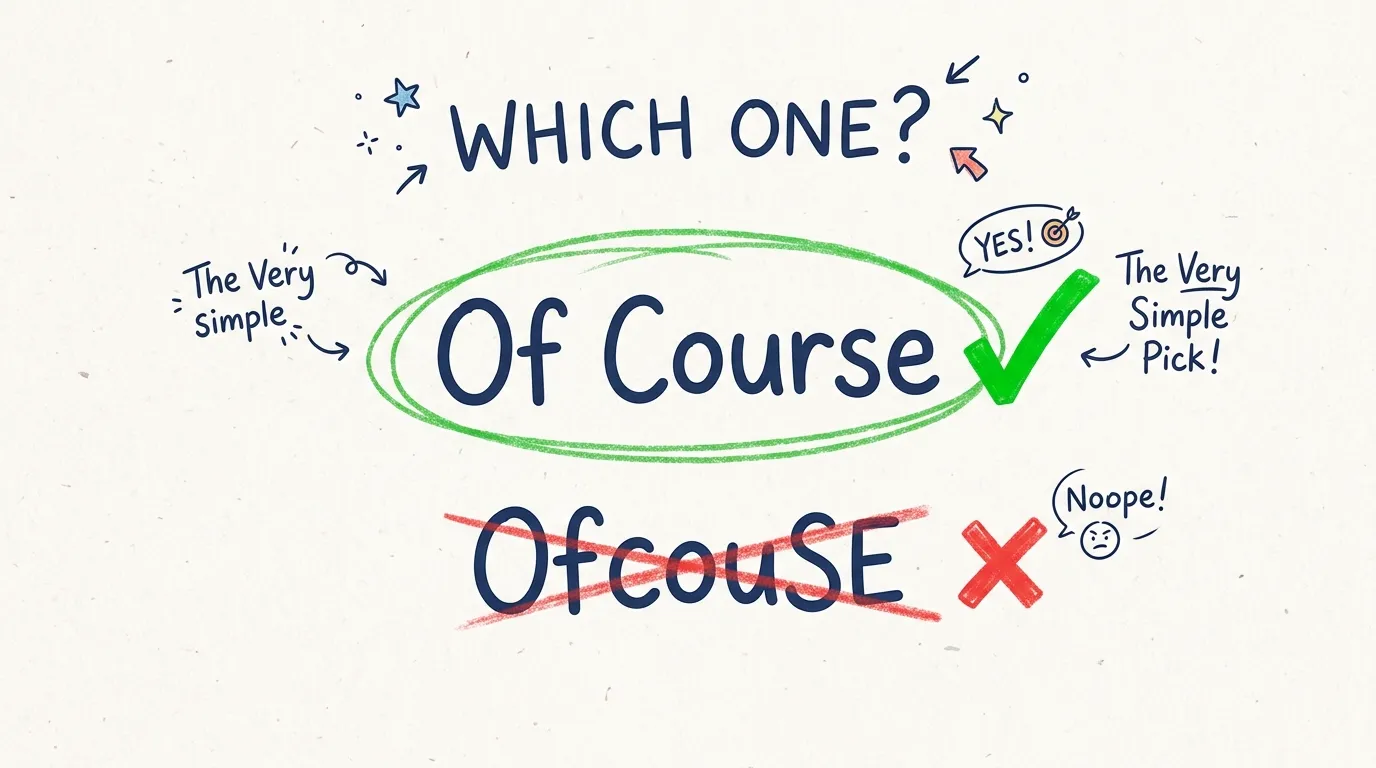
Have you ever wondered whether to write “of course” or “ofcourse”? The correct spelling is of course, written as two separate words.
“Ofcourse” is a common spelling mistake and is not accepted in standard English.
For example, you should write, “Of course, I can help you,” rather than “Ofcourse, I can help you.”
The phrase of course means “certainly,” “naturally,” or “yes,” depending on the context.
It is common in everyday conversations, text messages, emails, and professional writing. However, because people often say the phrase quickly, they may mistakenly join the two words when typing.
In this guide, you will learn the difference between of course and ofcourse, understand the phrase’s meaning, explore correct examples, and discover simple ways to avoid this spelling mistake.
Of Course or Ofcourse: Quick Answer
“Of course” is the correct spelling in standard English. It consists of two words separated by a space. “Ofcourse” is an incorrect spelling that you should avoid in school assignments, emails, articles, and professional documents.
| Spelling | Correct or Incorrect? | Example |
| Of course | Correct | Of course, you can join us. |
| Ofcourse | Incorrect | Ofcourse, you can join us. |
| Off course | Correct, with a different meaning | The plane drifted off course. |
| Offcourse | Incorrect | The plane went offcourse. |
Quick rule: Always write of course as two words when you mean “certainly,” “naturally,” or “yes.”
What Does Of Course Mean?
Of course is an English expression that usually means “certainly,” “yes,” or “naturally.” People use it to agree with someone, give permission, or refer to something they consider obvious or expected.
According to the Cambridge Dictionary, the expression has several uses, depending on the situation.
1. To Say Yes or Certainly
You can use of course to give a positive answer or show that you are happy to help.
Examples:
- “Can you help me with this assignment?” “Of course!”
- “May I borrow your pen?” “Of course.”
- “Can we meet tomorrow?” “Of course, that works for me.”
In these examples, the phrase expresses agreement or willingness.
2. To Show That Something Is Obvious
Sometimes, of course introduces information that the speaker believes is already known or easy to understand.
Examples:
- Of course, water is essential for life.
- She knew, of course, that the meeting was important.
- Of course, practice can help you improve your English.
Here, the expression emphasizes that something is expected, understood, or unsurprising.
3. To Describe an Expected Result
You can also use of course when an event or result seems natural under the circumstances.
Examples:
- We left home late, so of course we missed the bus.
- He forgot his umbrella and, of course, got wet in the rain.
- The store was closed on the holiday, so of course we had to return the next day.
Depending on your tone, this use can sound neutral, humorous, or slightly sarcastic.
4. To Respond Politely
In everyday conversation, of course can be a friendly response when someone asks for permission or assistance.
Examples:
- “Could I sit here?” “Of course.”
- “Would you mind checking this email?” “Of course, send it to me.”
- “Can I ask you a question?” “Of course!”
However, context matters. When someone asks for information you do not know they already have, starting with of course can sometimes sound impatient or dismissive. A simple “yes” may be more appropriate.
Why Is Of Course Written as Two Words?
The expression of course is written as two words because that is its established spelling in standard English. It is a fixed expression, and its words should not be joined merely because they sound connected when spoken.
The phrase contains two separate words:
- Of: A preposition that helps connect words and ideas.
- Course: A noun that can refer to a path, direction, series of lessons, or other meanings.
Together, they form the established expression of course, which is commonly used to mean “certainly” or “naturally.”
Compare it with other expressions that remain separate:
- In fact
- At least
- On purpose
- By chance
- Of course
Although each expression communicates a single idea, its words remain separate in writing.
For this reason, you should not write ofcourse as one word. Standard spelling depends on established usage, not simply on how quickly people pronounce a phrase.
Is Ofcourse a Real Word?
No. “Ofcourse” is not a standard English spelling. You may encounter it in social media posts, comments, text messages, or other online writing, but its frequent appearance does not make it correct.
The correct expression is of course.
Consider these examples:
Incorrect: Ofcourse, I will help you tomorrow.
Correct: Of course, I will help you tomorrow.
Incorrect: She ofcourse knows the answer.
Correct: She, of course, knows the answer.
Incorrect: You can ofcourse contact me later.
Correct: You can, of course, contact me later.
Notice that the correction requires a space between of and course. You do not need to change the meaning of the sentence.
Why Do People Write Ofcourse?
There are several possible reasons:
- Fast typing: People may accidentally skip the space between the words.
- Connected speech: When spoken quickly, the phrase can sound like one continuous unit.
- Typing habits: Repeated exposure to an incorrect spelling can make it look familiar.
- Missed proofreading: Writers may overlook a small spacing error while checking a sentence.
These reasons explain how the mistake can happen. They do not make the one-word spelling correct.
Of Course vs Ofcourse: Comparison Table
The difference between of course and ofcourse is straightforward: one is the standard spelling, while the other is an error.
| Feature | Of Course | Ofcourse |
| Standard spelling | Yes | No |
| Number of words | Two | Incorrectly joined into one |
| Meaning | Certainly, naturally, or yes | Intended meaning is usually the same |
| Suitable for formal writing | Yes, when appropriate | No |
| Suitable for text messages | Yes | Avoid it |
| Suitable for school assignments | Yes | No |
| Suitable for professional emails | Yes | No |
| Accepted standard form | Yes | No |
For example, if a colleague asks whether you can attend a meeting, you can reply, “Of course, I will be there.”
Writing “Ofcourse, I will be there” would introduce a spelling error even though your intended message remains understandable.
The same rule applies across everyday and professional writing. Use the two-word expression whenever you mean “certainly” or “naturally.”
How to Use Of Course in a Sentence
You can use of course at the beginning, middle, or end of a sentence. Its placement depends on the meaning you want to express and how the sentence is structured.
Of Course at the Beginning of a Sentence
At the beginning, the phrase can express agreement, confidence, or an expected fact.
Examples:
- Of course, you can borrow my book.
- Of course, we should check the instructions first.
- Of course, she wants to do well on the exam.
- Of course, I will let you know if anything changes.
- Of course, everyone needs time to learn a new skill.
When of course introduces the whole sentence, a comma often follows it.
Of Course in the Middle of a Sentence
In the middle of a sentence, the phrase can add emphasis or provide a side comment.
Examples:
- She will, of course, attend the wedding.
- We can, of course, discuss the details tomorrow.
- The answer is, of course, available in the textbook.
- He was, of course, pleased with the results.
- You should, of course, follow the safety instructions.
Commas can separate of course from the rest of the sentence when it acts as an interrupting comment. The exact punctuation depends on the sentence structure.
Of Course at the End of a Sentence
At the end of a sentence, of course can reinforce a statement or emphasize agreement.
Examples:
- I would be happy to help, of course.
- You can join us, of course.
- She knew the answer, of course.
- We can talk about it later, of course.
- I understand your concern, of course.
The phrase does not always need commas in every possible construction. Choose punctuation based on how the phrase functions in the sentence.
10 More Examples of Of Course
Here are additional examples to help you recognize the correct spelling in different situations.
- Of course, I remember your birthday.
- You can use my laptop, of course.
- “Do you need help?” “Of course!”
- Of course, learning a language takes time.
- We should, of course, consider every option.
- “May I come with you?” “Of course you may.”
- She was tired, so of course she went to bed early.
- Of course not! I would never do that.
- You are welcome to ask questions, of course.
- Of course, the final decision is yours.
In every example, the phrase remains two separate words.
Of Course in American and British English
The spelling of course is standard in both American and British English. There is no US-versus-UK spelling difference between these forms.
| English variety | Correct spelling | Incorrect spelling |
| American English | Of course | Ofcourse |
| British English | Of course | Ofcourse |
| Canadian English | Of course | Ofcourse |
| Australian English | Of course | Ofcourse |
For example, an American writer might say, “Of course, I can help you with your project.” A British writer could use exactly the same spelling and sentence.
The expression is widely understood in English. Therefore, you do not need to change its spelling based on your audience’s country.
If you are writing for an American audience, focus on American spelling differences in words such as color and colour. The phrase of course follows the same standard spelling in both varieties.
Of Course vs Off Course: What Is the Difference?
Of course and off course are both correctly spelled expressions, but they have different meanings. Do not confuse them simply because their letters look similar.
Of course means “certainly,” “naturally,” or “yes.”
Off course means away from an intended route, direction, or plan.
Examples of of course:
- Of course, I will attend the meeting.
- Of course, you can ask me for help.
- She was, of course, excited about the trip.
Examples of off course:
- The boat drifted off course during the storm.
- The plane was blown off course by strong winds.
- Our discussion went off course and moved to another topic.
How Can You Remember the Difference?
Ask yourself what you want to say.
If you mean certainly or naturally, write of course.
If you mean away from the correct route or direction, write off course.
Compare these two sentences:
- Of course, the driver knows the route.
- The driver went off course and missed the exit.
Both expressions are correct, but they cannot replace each other.
Common Spelling Mistakes to Avoid
Many English spelling mistakes happen because similar-looking words or phrases are confused. Here are some common errors related to of course.
Mistake 1: Writing Ofcourse
Incorrect: Ofcourse, I agree with you.
Correct: Of course, I agree with you.
Why? The standard expression requires two separate words.
Mistake 2: Writing Offcourse
Incorrect: Offcourse, she can help us.
Correct: Of course, she can help us.
Why? Offcourse is not the standard spelling of the expression meaning “certainly.”
Remember that off course is a separate, correct expression when you mean that something has moved away from its intended direction.
Mistake 3: Writing Of Coarse
Incorrect: Of coarse, I will come.
Correct: Of course, I will come.
Why? Course is the word used in the expression of course. Coarse is an adjective that can mean rough or not fine in texture.
For example: “The sand felt coarse under our feet.”
Mistake 4: Removing the Space in a Professional Email
Incorrect: Thank you for the invitation. Ofcourse, I would be delighted to attend.
Correct: Thank you for the invitation. Of course, I would be delighted to attend.
Why? A professional setting does not change the spelling rule. Always check spacing before sending an important message.
Mistake 5: Assuming Everyone Will Understand the Error
A reader might understand ofcourse without difficulty. However, that does not mean the spelling is correct.
Incorrect: Ofcourse I can send the report today.
Correct: Of course, I can send the report today.
Correct spelling makes your writing clearer and more polished, especially in academic and professional situations.
Easy Ways to Remember the Correct Spelling
If you often confuse of course and ofcourse, try these simple techniques.
1. Remember “Of” Plus “Course”
Think of the expression as two separate parts:
Of + course = Of course
There is a space between the words. This is the simplest way to remember the spelling.
2. Compare It With Other Two-Word Expressions
Think about phrases such as in fact, at least, and on purpose. They communicate complete ideas, but their words are still written separately.
Similarly, of course remains two words.
3. Read Your Writing Slowly
When proofreading, look for words that should be separated by a space. This can help you catch ofcourse before you submit an assignment or send an email.
4. Use a Simple Sentence
Remember this example:
“Of course, I can help.”
Once you know the correct spelling in a familiar sentence, you can apply the same rule to other situations.
5. Check Your Spelling Before Publishing
Spell-checking tools can help identify possible errors, but they may not catch every mistake. Read your text carefully before publishing an article or submitting a document.
A quick review can prevent a small spelling error from appearing throughout your writing.
FAQs
1. Is it of course or ofcourse?
Of course is correct. It is written as two separate words. Ofcourse is a misspelling in standard English and should be avoided in formal and informal writing.
Example: Of course, I can help you.
2. Is ofcourse one word or two words?
The correct expression consists of two words: of course. You should not combine them into ofcourse, even when writing a quick text message or social media comment.
3. What does of course mean?
Of course usually means “certainly,” “naturally,” or “yes.” People use it to express agreement, give permission, or emphasize something that is already known or expected.
Example: “Can I borrow your notebook?” “Of course!”
4. Is ofcourse ever correct in English?
Ofcourse is not the standard spelling of the expression. Although it appears in online messages and informal posts, you should write of course in standard English.
5. Is of course formal or informal?
Of course is used in both formal and informal situations. It can work in a professional email, everyday conversation, or friendly text message. However, its tone depends on the context.
6. Should I use a comma after of course?
Use a comma when of course introduces a sentence as an introductory comment or is set apart from the main sentence.
Example: “Of course, we can discuss this later.”
When it appears in the middle of a sentence, commas may be used around it.
Example: “We can, of course, discuss this later.”
Punctuation depends on the phrase’s role in the sentence.
7. Is of course correct in American and British English?
Yes. Of course is the standard spelling in both American and British English. Neither variety uses ofcourse as the standard spelling.
8. What is the difference between of course and off course?
Of course means “certainly” or “naturally.” Off course means away from an intended route, direction, or plan.
Example: “Of course, I agree.”
Example: “The boat drifted off course.”
9. Can I start a sentence with of course?
Yes. You can begin a sentence with of course to express agreement or emphasize an expected fact.
Example: “Of course, you are welcome to join us.”
A comma often follows the phrase when it introduces the whole sentence.
10. What are some alternatives to of course?
Depending on the context, you can use certainly, definitely, naturally, sure, or absolutely. However, these expressions do not fit every sentence in exactly the same way.
For example, “Certainly, I can help” is a possible alternative to “Of course, I can help.”
Conclusion
When choosing between of course or ofcourse, always use of course. It is the correct standard spelling, written as two separate words. The one-word form is a common spelling mistake, even though readers may understand what you mean.
The expression of course can mean “certainly,” “naturally,” or “yes.” You can use it at the beginning, middle, or end of a sentence, depending on your meaning and sentence structure.
Remember that of course has the same spelling in American and British English. Also, do not confuse it with off course, which refers to moving away from an intended route or direction.
A simple rule will help you avoid this mistake: If you mean “certainly,” write “of course” with a space.

Hi, I’m Sophia Bennett. My goal is to make grammar easy, clear, and useful through simple explanations and real-life examples.