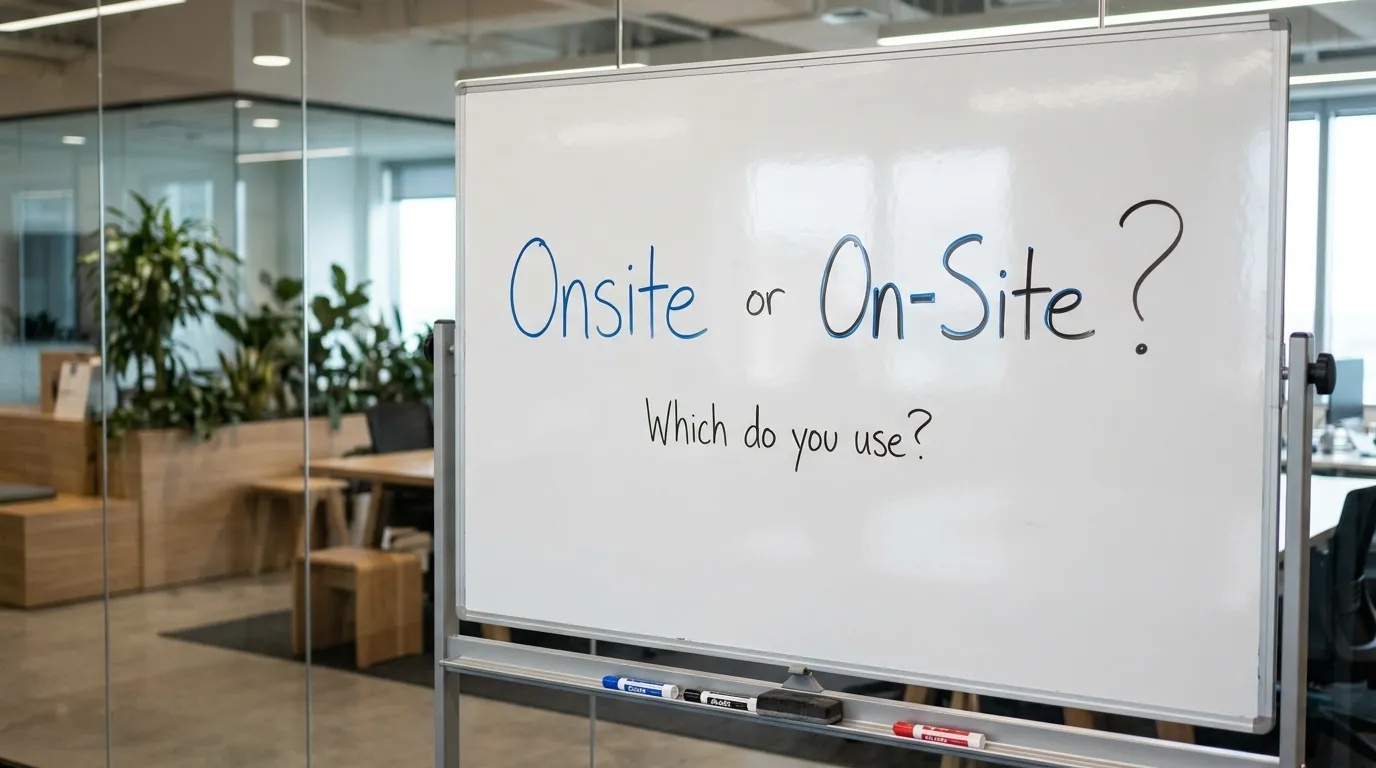
Should you write onsite or on-site? Both spellings are correct, and they have the same basic meaning.
The main difference is the spelling style preferred by a dictionary, publication, or organization.
On-site, with a hyphen, is a widely accepted form in American and British English. Onsite, written as one word, is also recognized and commonly used, particularly in business and workplace writing.
For example, you might write, “We offer on-site training” or “We offer onsite training.” Both versions communicate the same idea.
There is also a related expression: on site, written as two words. It is especially common when describing someone’s physical location, as in “The technician is on site.”
In this guide, you’ll learn how to use each form, compare examples, and choose the most consistent spelling for your writing.
Quick Answer: Onsite or On-Site?
Both onsite and on-site are correct. Use the spelling recommended by your preferred dictionary or style guide, and keep it consistent.
- On-site: A widely accepted hyphenated form, especially before a noun.
- Onsite: A recognized one-word alternative, common in business and workplace writing.
- On site: A common two-word phrase referring to a physical location.
| Form | Common use | Example |
|---|---|---|
| On-site | Adjective or adverb | We offer on-site training. |
| Onsite | Adjective or adverb | We offer onsite training. |
| On site | Location phrase | The technician is on site. |
Neither onsite nor on-site is automatically wrong. The sentence, context, and preferred style help determine which form to use.
What Does On-Site Mean?
On-site means happening at, located at, or provided at a particular place. The place might be a workplace, construction area, school, hospital, event venue, or customer location.
The hyphenated form is widely used as an adjective before a noun.
Examples of On-Site
- The company provides on-site technical support.
- We scheduled an on-site inspection for Friday.
- The hospital offers on-site medical services.
- Employees attended an on-site training session.
- The building has an on-site parking facility.
In each example, on-site describes a service, inspection, session, or facility connected with a particular location.
You may also see it used adverbially, as in “The team will work on-site tomorrow.”
What Does Onsite Mean?
Onsite has the same basic meaning as on-site. It describes something that takes place at or is available at a particular location.
The closed spelling is common in modern business, technology, healthcare, and workplace communication.
Examples of Onsite
- Our company provides onsite support.
- The office has an onsite gym.
- The school offers onsite tutoring.
- We arranged an onsite interview.
- The business provides onsite repair services.
These sentences mean the same as their hyphenated versions. The spelling preference may depend on the organization’s style guide or the publication’s conventions.
Onsite vs On-Site: Main Differences
The difference is mainly orthographic, meaning it concerns how the expression is written.
| Feature | Onsite | On-Site |
|---|---|---|
| Spelling | One word | Hyphenated |
| Meaning | At or provided at a particular location | At or provided at a particular location |
| Common contexts | Business, technology, workplace writing | Business, professional, and edited writing |
| Correctness | Accepted usage | Accepted usage |
| Best choice | When your style guide prefers the closed form | When your style guide prefers the hyphenated form |
For most everyday writing, readers will understand either version. If you are writing for a company, school, or publication, follow its preferred style.
When Should You Use On-Site?
Use on-site when it fits the spelling conventions of your document or style guide. It is especially familiar in professional writing and before nouns.
1. Before a Noun
Examples:
- We need an on-site technician.
- The company arranged an on-site visit.
- The hospital has an on-site pharmacy.
- The manager requested an on-site inspection.
Here, on-site describes the noun that follows it.
2. In Professional Writing
The hyphenated form is suitable for reports, formal emails, service descriptions, and business documents.
Examples:
- On-site support is available during office hours.
- The project requires on-site supervision.
- The organization provides on-site training for new employees.
3. When Your Style Guide Prefers Hyphens
Some publications and organizations use hyphens in compound expressions. If your style guide specifies on-site, use that spelling throughout your content.
Consistency is more important than switching between forms without a reason.
When Should You Use Onsite?
Use onsite when your preferred dictionary or style guide accepts the closed form and you want to follow that convention.
1. In Business and Workplace Writing
Examples:
- We provide onsite training for employees.
- The company offers onsite customer support.
- Our office includes an onsite fitness center.
- The role requires onsite attendance.
This spelling is common in modern workplace communication.
2. In Technology and Services
Examples:
- The provider offers onsite computer repair.
- An onsite specialist will help install the equipment.
- The customer requested onsite technical assistance.
The one-word form is easy to recognize in these contexts.
3. When Your Organization Uses the Closed Form
If your company consistently writes onsite support, onsite services, and onsite training, follow that style unless there is a clear reason to change it.
For a website, consistent spelling helps create a polished reading experience.
What About On Site as Two Words?
The phrase on site is also correct. It is especially natural when you mean that someone or something is physically present at a location.
Examples:
- The technician is on site.
- The inspector arrived on site early.
- Several workers are already on site.
- The manager will be on site tomorrow.
In these sentences, on works as a preposition and site refers to a place.
Compare these examples:
- The company offers on-site training. The hyphenated expression describes the training.
- The company offers onsite training. The closed expression describes the training.
- The trainer is on site. The phrase identifies the trainer’s location.
The first two examples use alternative spellings of a compound expression. The third uses a two-word location phrase.
Is There a US vs UK Spelling Difference?
There is no simple rule saying that American English must use onsite while British English must use on-site.
Both forms appear in English writing, and preferences can vary among dictionaries, publications, and organizations.
For example:
American English
- We provide on-site training.
- We provide onsite training.
British English
- The company offers on-site support.
- The company offers onsite support.
Both versions can be understood in either variety of English. If you are writing for a specific audience, follow a consistent style rather than assuming that one spelling belongs exclusively to one country.
Common Mistakes to Avoid
1. Assuming Onsite Is Always Wrong
Incorrect assumption: “Onsite” is never acceptable.
Correction: Onsite is a recognized spelling. Its suitability depends on the style you follow.
2. Assuming On-Site Is Always Wrong
Incorrect assumption: The hyphen is unnecessary in every situation.
Correction: On-site is an established spelling and remains a widely accepted choice.
3. Confusing Onsite With On Site
Example:
- The technician is on site.
- The company provides onsite support.
The first sentence describes a location. The second describes a type of support.
4. Mixing Styles Without a Reason
A document that switches between on-site training and onsite training may look inconsistent.
Choose a preferred spelling and apply it throughout the article, unless you are quoting a source that uses a different form.
Easy Trick to Remember the Difference
Use this simple memory tip:
- On-site: Use the hyphenated form if that is your preferred editorial style.
- Onsite: Use the closed form if that is the style your dictionary or organization follows.
- On site: Use the two-word phrase when describing physical presence at a location.
Remember that the first two forms can have the same meaning. You do not need to assign them different definitions just because their spelling differs.
Onsite or On-Site: Which Spelling Should You Use?
Many people search “onsite or on-site,” “on-site or onsite,” and “onsite or on site” to settle this fast. Both are correct, and the choice is a style choice.
Onsite or On Site?
If you ask “onsite or on site” or “on site or onsite,” the answer depends on the sentence. Use “on site” (two words) when you describe where someone is.
Use “onsite” or “on-site” before a noun, as in “onsite training.”
Onsite vs On-Site
The same question shows up in many forms. You may see “onsite vs on-site,” “onsite vs. on-site,” “onsite versus on site,” “onsite vs on site,” and “on site vs onsite.”
You may also see “on site vs on-site,” “on-site vs on site,” and “on site or on-site.” All of them ask the same thing.
Three-Way Searches
Some people search all three forms at once. Examples include “onsite or on-site or on site,” “on site or on-site or onsite,” “on site on-site or onsite,” “on site onsite or on site,” and “on site on site or onsite.”
The answer is the same. Use “on site” for location, and “on-site” or “onsite” before a noun.
On Site or On Site?
Typing “on site or on site,” “on site vs on site,” “on site or onsite or on site,” or “onsite or onsite” by accident is common while checking spelling. Whichever form you meant, the rule above decides.
On Site or Onsite Grammar
For “on site or onsite grammar,” think of the part of speech. “On site” is a preposition plus a noun, and “on-site” or “onsite” is an adjective or adverb.
Onsite or Onsite UK
For “onsite or on-site uk” and “on site or onsite uk,” British English accepts both. Follow your style guide.
Is It Onsite or On Site in the UK?
Both are used in the UK. There is no strict British rule.
On Site Atau Onsite
Indonesian readers search “on site atau onsite.” The English answer is the same. Use “on-site” or “onsite” before a noun, and “on site” for a location.
Onsite or On-Site Hyphen
For “onsite or on site hyphen,” use a hyphen if your style guide prefers “on-site.” Use no hyphen if you choose “onsite.”
How to Spell Onsite and On Site
Spelling is a common question. Here is how to get each form right.
Onsite Spelling
If you ask “onsite spelling,” “spell onsite,” or “how do you spell onsite,” write o-n-s-i-t-e as one word.
On Site Spelling
For “on site spelling” and “how to spell on site,” write “on site” as two words. For example, “The team is on site.”
Is Onsite One Word?
For “is onsite one word,” yes. Onsite is a recognized one-word spelling.
Is Onsite a Single Word?
For “is onsite a single word,” yes. Many dictionaries list it as a variant of “on-site.”
Off Site Spelling
For “off site spelling,” the same pattern applies. You may see “off-site,” “offsite,” and “off site.”
Use “off site” (two words) for location, and “off-site” or “offsite” before a noun.
Off Site vs On Site
For “off site vs on site,” “on site” means at the location. “Off site” means away from it.
For example, “The meeting is off site” and “The meeting is on site.”
On-Site Definition and Meaning
Many readers want a plain definition. Here is how it works.
On-Site Definition
For on-site definition, on-site means at or provided at a particular place. For example, “on-site parking” is parking at the venue.
What Does “Onsite” Mean?
“Onsite” means the same as “on-site.” It describes something at or provided at a location.
Onsite or On Site Meaning
For “onsite or on site meaning,” both describe presence at a location. The spelling is the difference.
On-Site Betekenis
Dutch readers search “on-site betekenis.” The Dutch phrase “ter plaatse” is close in meaning. In English, “on-site” means at the location.
Onsite or On Site Synonym
For “onsite or on site synonym,” common synonyms include “in-house,” “at the location,” “in person,” and “on the premises.”
On Site in Everyday Sentences
Here are the most common sentence uses.
We Are on Site
For “we are on site,” write “on site” as two words. For example, “We are on site and ready to start.”
Not On Site
For “not on site,” write “not on site” as two words. For example, “The manager is not on site today.”
On Site
A search for “on site” alone is about the two-word phrase. It means at the place.
On Site or In Site
For “on site or in site” and “which is correct, on site or in site,” the answer is “on site.” “In site” is not a standard phrase.
Do not confuse it with “insight,” which means understanding.
At Site or On Site
For “at site or on site,” standard English uses “on site.” “At site” appears in some regional or technical writing, but “on site” is the safer choice.
Onsite or On-Site in Work and Hiring
Searchers also look for use in jobs and projects.
Onsite or On-Site Visit
For “onsite visit or on-site visit,” both are correct. For example, “We scheduled an on-site visit.”
Onsite or On Site Work
For “onsite or on site work,” use “onsite work” or “on-site work” before the noun. Use “on site” when describing where someone works, as in “He works on site.”
Onsite or On-Site Interview
For “onsite or on-site interview,” both are used. It means an interview at the employer’s location, rather than a remote one.
Onsite or On-Site Construction
For “onsite or on-site construction,” it means work done at the building location. It is often contrasted with off-site construction, where parts are built elsewhere.
Onsite or On-Site AP Style
For “onsite or on-site AP style,” check the current AP Stylebook. Many style guides hyphenate compound modifiers like this one.
What Is the Opposite of Onsite?
The opposite can be “off-site,” “remote,” or “off-premises,” depending on context.
Practice Quiz: Onsite or On-Site?
Choose the form that best fits each sentence and the style being followed.
- Our company provides ______ training.
- The inspector is already ______.
- The hospital offers ______ medical services.
- The manager arranged an ______ visit.
- The technician will be ______ tomorrow.
Answers
- On-site or onsite — both are accepted; follow your chosen style.
- On site — a natural two-word phrase describing location.
- On-site or onsite — both spellings are used.
- On-site or onsite — either can modify “visit.”
- On site or onsite — both occur in usage when describing presence at a location, though style preferences vary.
The important lesson is to understand the sentence and follow your preferred spelling convention.
FAQs
1. Is onsite or on-site correct?
Both are correct. Onsite is the one-word form, while on-site is the hyphenated form. Choose according to your preferred dictionary or style guide.
2. Is onsite one word?
Yes. Onsite is a recognized one-word spelling meaning at or provided at a particular location.
3. Should I write on-site or onsite in a formal email?
Either can work. If your organization has a style guide, follow it. Otherwise, on-site is a widely accepted choice in professional writing.
4. Is on site two words?
Yes. On site is a common phrase used to describe physical presence at a location. For example, “The engineer is on site.”
5. Is onsite American or British English?
The one-word form is common in American business writing, but it is not exclusive to American English. Both onsite and on-site appear in British and American usage.
6. Does onsite mean the same as on-site?
Yes. Both forms generally have the same meaning. Their difference is spelling, not definition.
7. Should I use on-site training or onsite training?
Both are acceptable. Choose the form preferred by your style guide and use it consistently throughout your document.
8. Is on-site hyphenated?
Yes. On-site contains a hyphen between on and site. The closed alternative is onsite.
9. What is the opposite of onsite?
Depending on the context, possible opposites include off-site, remote, or off-premises. For workplace arrangements, remote is often used to describe work performed away from the workplace.
10. Which spelling should I use on a US-focused website?
Either onsite or on-site can work for a US audience. Select one based on your editorial style and keep it consistent across your pages.
11. Is it onsite or on site in the UK?
Both are used in the UK. Choose one style and keep it consistent.
12. Is onsite a single word?
Yes. Onsite is a recognized one-word spelling.
13. What does “onsite” mean?
“Onsite” means at or provided at a particular location. It means the same as “on-site.”
14. Which is correct, on site or in site?
“On site” is correct. “In site” is not a standard phrase.
15. What is the on-site definition?
On-site means at or provided at a particular place, such as a workplace or venue.
16. Is “on site” one word or two?
As a location phrase, it is two words: “on site.” Before a noun, you can use “on-site” or “onsite.”
17. Is it “we are on site” or “we are onsite”?
“We are on site” is the standard form. “Onsite” is also seen, but two words is the safer choice.
18. Is it “not on site” or “not onsite”?
Write “not on site” with two words.
19. Is it off-site, offsite, or off site?
All three appear. Use “off site” for location, and “off-site” or “offsite” before a noun.
20. What is the difference between off site and on site?
“On site” means at the location. “Off site” means away from it.
21. Is it “at site” or “on site”?
“On site” is standard. “At site” appears in some regional writing.
22. Is it onsite or on-site in AP style?
Check the current AP Stylebook. Many style guides use a hyphen in this compound.
23. Is it an onsite interview or an on-site interview?
Both are used. It means an interview at the employer’s location.
24. What is on-site construction?
It is construction done at the building location, rather than made elsewhere and moved in.
25. What is a synonym for on-site?
Synonyms include in-house, on the premises, and in person.
26. What does on-site betekenis mean?
“Betekenis” is Dutch for “meaning.” The phrase asks for the meaning of “on-site.”
27. Is it “on site atau onsite”?
“Atau” is Indonesian for “or.” The English rule is the same as above.
Conclusion
When choosing between onsite or on-site, remember that both are accepted spellings with the same basic meaning.
The hyphenated form is widely used in professional writing, while the closed form is common in modern business and workplace communication.
The two-word phrase on site is also useful when describing someone’s physical location. For example, you can write, “The technician is on site,” or “The company provides on-site support.”
For clear, professional writing, choose a spelling convention that suits your audience and apply it consistently throughout your content.

Hi, I’m Sophia Bennett. My goal is to make grammar easy, clear, and useful through simple explanations and real-life examples.