You typed “don’t loose hope,” and your teacher circled it in red, even though you were confident it looked right.
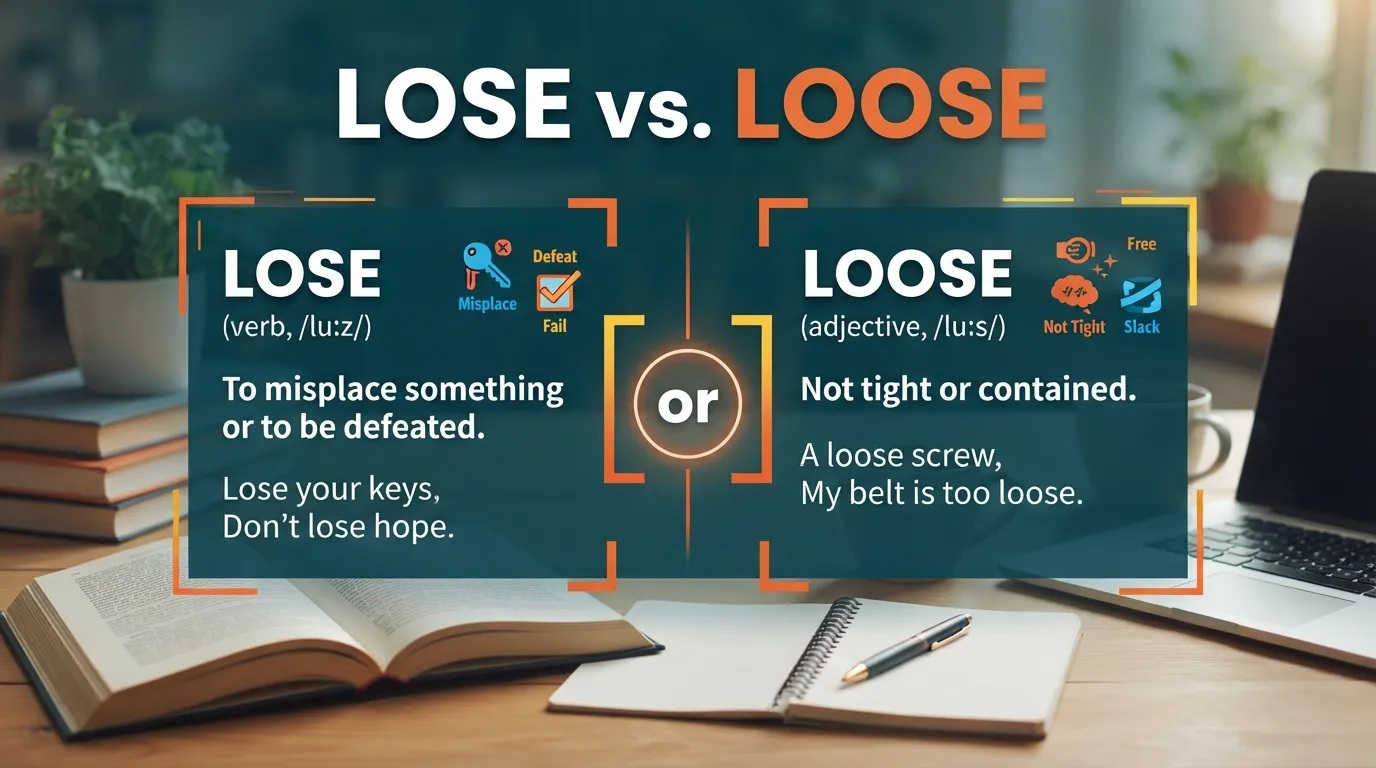
Here’s the quick fix: lose means to misplace something or fail to win, while loose means not tight or not fixed in place.
This is one of the most common spelling mistakes in English, mostly because of how similar the two words look.
Once you learn the one-letter difference and why it matters, this mistake becomes easy to avoid.
Quick Answer
Lose is a verb meaning to misplace something or fail to win (“I always lose my keys”).
Loose is an adjective meaning not tight, not fixed, or not restrained (“These pants are too loose”).
They differ by just one letter, but that single “o” changes the entire meaning and pronunciation.
⚡ Quick Rule
Lose means to misplace or fail to win; loose means not tight — one less “o,” one different meaning.
Lose vs Loose: The Core Difference
the “Lose” is a verb describing the act of misplacing something, failing to win, or no longer having something.
“Loose” is an adjective describing something that isn’t tight, secure, or firmly attached.
Say “I don’t want to lose the game” (fail to win), versus “This shirt feels loose on me” (not tight).
This verb-versus-adjective distinction is the key to keeping these two words straight.
Grammar Rule Explained
“Lose” rhymes with “choose” and functions only as a verb, describing an action.
“Loose” rhymes with “goose” and functions primarily as an adjective, describing a quality or state.
A simple test: if the word describes an action happening to something, use “lose.” If it describes how something feels or fits, use “loose.”
This action-versus-description test resolves nearly every situation where these words might be confused.
Pronunciation: Why This Mix-Up Happens So Often
“Lose” is pronounced with a “z” sound, like “looz,” even though it’s spelled with an “s.”
“Loose” is pronounced with an “s” sound, like “loos,” matching its spelling more closely.
This mismatch between spelling and pronunciation is part of why so many writers accidentally swap the two, especially since “loose” looks like it should have the “z” sound instead.
Remembering that “lose” sounds like “looz” can help reinforce the correct spelling when writing quickly.
Lose vs Loose Comparison Table
| Feature | Lose | Loose |
|---|---|---|
| Part of speech | Verb | Adjective |
| Meaning | To misplace or fail to win | Not tight, not fixed |
| Pronunciation | Rhymes with “choose” | Rhymes with “goose” |
| Example | Don’t lose your ticket. | The screw is loose. |
Memory Trick
Remember: “Lose” has one “o,” just like the single loss you experience when you lose something.
“Loose” has two “o”s, like two hands letting go of something loosely.
If you’re describing an action (losing something), use one “o.” If you’re describing looseness or fit, use two.
Real Example Sentences
Using Lose (verb):
- I always lose my umbrella on rainy days.
- She doesn’t want to lose the competition.
- Please don’t lose this important document.
- He hates to lose at board games.
- They might lose their flight if traffic doesn’t clear.
Using Loose (adjective):
- These jeans are too loose around the waist.
- The dog got loose from its leash.
- One of the chair legs feels loose.
- She wore her hair loose for the party.
- The rope was loose, so the boat drifted away.
Loose Ends or Lose Weight? Common Phrases Explained
“Loose ends” always uses “loose,” referring to unfinished details, as in “We need to tie up a few loose ends.”
“Lose weight” always uses “lose,” referring to reducing body weight, as in “He wants to lose weight before summer.”
A helpful check: “loose ends” describes something not tightly finished, while “lose weight” describes an action of losing something.
Common Mistakes
1. Using “loose” instead of “lose” for an action Incorrect: I don’t want to loose my keys again. Correct: I don’t want to lose my keys again.
2. Using “lose” instead of “loose” for description Incorrect: These shoes feel lose on my feet. Correct: These shoes feel loose on my feet.
3. Confusing the pronunciation with the spelling Remember: “lose” sounds like “looz,” even though it has fewer letters than “loose.”
4. Misspelling “loose ends” as “lose ends” Incorrect: We need to tie up a few lose ends. Correct: We need to tie up a few loose ends.
When to Use Each Word
Use Lose When:
- Describing an action of misplacing something
- Referring to failing to win
- Talking about losing weight, time, or opportunities
Examples: lose your keys, lose the game, lose weight
Use Loose When:
- Describing something not tight or secure
- Referring to something not fixed in place
- Describing hair, clothing, or objects that aren’t fastened
Examples: loose clothing, loose screw, loose hair
FAQs
What’s the difference between lose and loose?
“Lose” is a verb meaning to misplace something or fail to win. “Loose” is an adjective meaning not tight or not fixed in place.
How do I remember which spelling to use?
“Lose” has one “o,” matching the single act of losing something. “Loose” has two “o”s, like something loosely held.
Why do people confuse lose and loose so often?
Because they look almost identical in spelling, differing by just one letter, even though their pronunciation and meaning are completely different.
Is “loose” ever used as a verb?
Rarely, “loose” can function as a verb meaning “to release,” as in “loose the arrow,” though this usage is uncommon in everyday writing.
How do you pronounce “lose” correctly?
“Lose” is pronounced with a “z” sound, like “looz,” rhyming with “choose,” not “goose.”
Is “loose ends” spelled with one “o” or two?
“Loose ends” always uses two “o”s, since it describes something not tightly finished.
Can I use “lose” to describe clothing fit?
No, if you’re describing how clothing fits, “loose” is the correct word, not “lose.”
What’s a quick way to test which word I need?
Ask if the word describes an action (lose) or a description of tightness (loose) — that answer tells you which spelling to use.
Conclusion
Lose and loose differ by just one letter, but that single “o” completely changes their meaning and pronunciation.
Lose describes an action, like misplacing something or failing to win. Loose describes a quality, like something not tight or secure.
Remember the one-“o” versus two-“o” trick, and you’ll always spell this pair correctly.

Hi, I’m Daniel Carter. I’m passionate about helping learners improve their English with practical grammar tips and clear writing advice.