You’re finishing an email, typing “Yesterday, I choose the wrong file,” and something feels off. It should be past tense, but “choosed” doesn’t look right either.
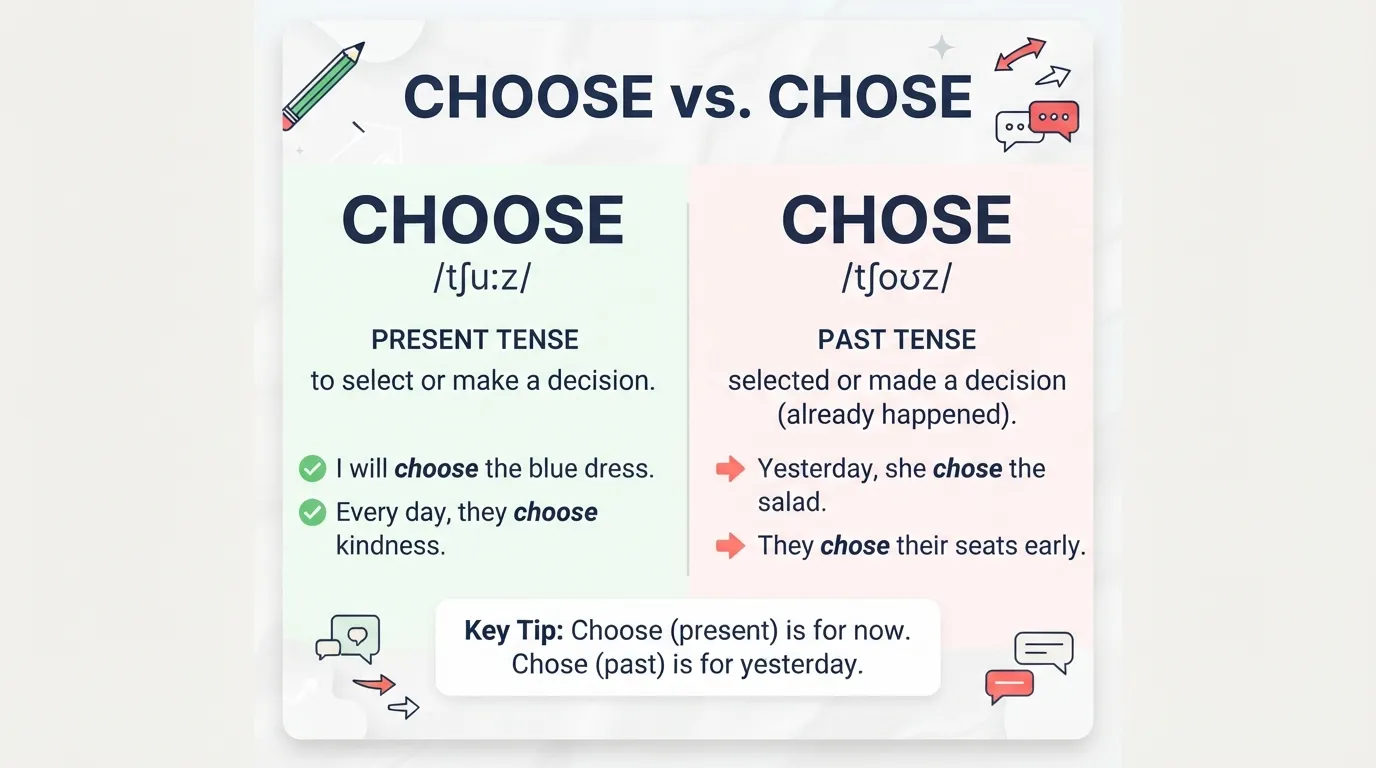
Quick answer: Use “choose” for the present or future tense, and “chose” for the simple past tense. “Choose” rhymes with “shoes”; “chose” rhymes with “froze.”
Table of Contents
- Quick Answer Box
- Quick Rule in One Line
- How Do You Spell Choose and Chose?
- How Do You Pronounce “Choose” and “Chose”?
- The Difference Explained
- Grammar Rule: Full Verb Conjugation
- Choose or Chose With Every Pronoun
- Choose: V1, V2, V3 (All Three Verb Forms)
- Chose or Chosen: What’s the Difference?
- Chosing or Choosing: Which Spelling Is Right?
- Comparison Table
- Memory Trick
- Example Sentences
- Common Mistakes
- Is “Choosed” a Word?
- Chooses or Choses: Which Is Correct?
- Synonyms for Choose and Chose
- When to Use Each Form
- Will Choose or Will Chose?
- “Choose” in Other Languages
- Expert Tip
- What Do Choose and Chose Mean?
- Should I Use Choose or Chose?
- Is Choose Past or Present Tense?
- Choose Verb Forms Chart
- Choose or Chose With Helping Verbs
- Chose and Choose in a Sentence
- Choose or Chooses: Subject-Verb Agreement
- Choosed, Chosed, and Choosen: More Answers
- How to Spell Choose, Chose, and Choosing
- Chose and Choose Pronunciation Tips
- Difference Between Choose and Chose (With Examples)
- Choose and Chose in Other Languages: Quick Answers
- Even More Quick Answers: You Chose, He Chose, and If You Choose
- Choose Conjugation: Full Tense Table
- Choose or Chose With Prepositions and Common Phrases
- Another Word for Chose
- Past Tense of Choosing and Other Forms
- More Misspellings of Choose and Chose
- More Languages: Third Form and Past Tense Quick Answers
- More Quiz Questions
- Quick Quiz
- FAQs
- Conclusion
Quick Answer Box
“Choose” is the present tense form of the verb meaning to select or decide between options. “Chose” is its simple past tense.
They describe the exact same action, picking something from a group, just at different points in time: choose happens now or later, chose already happened.
How Do You Spell Choose and Chose? ✍️
“Choose” is spelled c-h-o-o-s-e, with a double “o,” and is used for the present or future tense.
“Chose” is spelled c-h-o-s-e, with a single “o,” and is used only for the simple past tense.
The double “o” in “choose” is the easiest way to remember it’s the “current” spelling, happening now.
How Do You Pronounce “Choose” and “Chose”?
“Choose” is pronounced CHOOZ, rhyming with “shoes,” with a long “oo” sound and a soft “z” at the end.
“Chose” is pronounced CHOHZ, rhyming with “froze” and “nose,” with a long “o” sound.
The spelling difference (double “o” vs. single “o”) lines up directly with how each word sounds.
⚡ Quick Rule in 1 Line
“Choose is happening now, chose already happened, and choosed isn’t a word at all.”
The Difference Explained
“Choose” and “chose” are two forms of the same irregular verb, not two different words with different meanings.
“Choose” describes an action happening in the present or planned for the future: “I choose the blue one.” “Chose” describes that same kind of action already completed in the past: “I chose the blue one yesterday.”
The confusion usually comes from the fact that they look and sound almost identical, differing by just one vowel sound — and it’s also why some people mistakenly write “choosed” instead of “chose,” even though “choosed” isn’t a real word.
This holds true no matter which pronoun you’re using, whether it’s “I,” “we,” “they,” or “you.”
Grammar Rule: Full Verb Conjugation
Because “choose” is irregular, it doesn’t follow the standard “-ed” pattern that regular verbs use for the past tense. Instead, it changes internally, similar to “freeze” becoming “froze.”
The full set of forms is: choose (present), chooses (present, third-person singular, as in “she chooses”), chose (simple past), choosing (present participle), and chosen (past participle, often paired with “has,” “have,” or “had”).
Knowing all five forms, choose, chooses, chose, choosing, and chosen, makes it much easier to catch which one a sentence actually needs.
In simpler grammar terms, these correspond to V1 (choose), V2 (chose), and V3 (chosen). Watch the spelling of “choosing” closely too, since it’s often misspelled as “chosing” by mistake.
Choose vs Chose With Every Pronoun
The choice between “choose” and “chose” doesn’t change based on the pronoun — it only depends on the tense. Here’s how it looks with each subject:
| Pronoun | Present (Choose) | Past (Chose) |
|---|---|---|
| I | I choose | I chose |
| You | You choose | You chose |
| He/She/It | He chooses | He chose |
| We | We choose | We chose |
| They | They choose | They chose |
Notice that “he” and “she” are the only exception, taking “chooses” in the present tense instead of “choose.” Every other pronoun, along with “chose” in the past tense, stays the same regardless of subject.
Choose: V1, V2, V3 (All Three Verb Forms)
In grammar terms, “choose” has three main forms: V1 (base form), V2 (simple past), and V3 (past participle). Here’s the full breakdown:
V1 (base form): choose — used for present and future tense (“I choose,” “I will choose”)
V2 (simple past): chose — used for a completed past action (“I chose”)
V3 (past participle): chosen — used with “has,” “have,” or “had” (“I have chosen”)
These three forms cover every tense “choose” can appear in.
Getting V2 and V3 mixed up is common, since “chose” and “chosen” look similar but aren’t interchangeable — “chosen” always needs a helping verb like “has” or “have,” while “chose” stands on its own.
Chose or Chosen: What’s the Difference?
“The Chose” and “chosen” both point to the past, but they aren’t interchangeable.
“Chose” is the simple past tense and stands alone in a sentence: “She chose the venue.” “Chosen” is the past participle and always needs a helping verb like “has,” “have,” or “had”: “She has chosen the venue.”
Also note that “choosen” is a common misspelling; the correct spelling is always “chosen,” with the “o” and “s” switched from what people often expect.
❌ “She has chose the venue.” ✅ “She has chosen the venue.”
❌ “I have choosen the winner.” ✅ “I have chosen the winner.”
Chosing or Choosing: Which Spelling Is Right?
The correct spelling is “choosing,” not “chosing.”
Since “choose” ends in a silent “e” followed by a double “o,” the “e” gets dropped before adding “-ing,” but the double “o” stays in place.
“Chosing” leaves out one of the required “o”s, which makes it an incorrect spelling.
❌ “She is chosing between two job offers.” ✅ “She is choosing between two job offers.”
Comparison Table: Choose vs Chose
| Feature | Choose | Chose |
|---|---|---|
| Tense | Present or future | Simple past |
| Pronunciation | Rhymes with “shoes” | Rhymes with “froze” |
| Example | I choose the window seat. | I chose the window seat yesterday. |
| Third-person form | chooses | (no separate form; chose works for all subjects) |
| Related forms | choosing, chosen | chosen (past participle, used with has/have/had) |
Memory Trick
Match the vowel sound: “choose” has that long “oo” sound, just like “shoes,” something you put on right now, today.
“Chose” rhymes with “froze,” something that already happened and is finished, frozen in the past.
If the action is done and over, reach for “chose.”
Example Sentences
Using “choose” (present/future):
I choose to walk to work most mornings.
Please choose a topic for your essay by Friday.
She will choose a dress for the wedding next week.
You can choose between the aisle seat and the window seat.
We always choose the same restaurant on Fridays.
They need to choose a name for the new puppy.
If you choose honesty, trust will follow.
He tends to choose comfort over style.
Voters will choose their representative in November.
I choose to see this as an opportunity, not a setback.
Using “chose” (simple past):
She chose the red dress for the interview.
We chose to leave early to avoid traffic.
He chose silence instead of arguing.
They chose a small wedding over a big one.
I chose the aisle seat on my last flight.
The committee chose her for the leadership role.
He chose to study abroad after graduation.
We chose the blue paint over the gray.
She chose her words carefully during the meeting.
They chose to stay home instead of traveling last summer.
Common Mistakes
❌ Yesterday, I choose the wrong bus stop. ✅ Yesterday, I chose the wrong bus stop.
❌ Last week, we choosed a new logo for the company. ✅ Last week, we chose a new logo for the company.
Is “Choosed” a Word? 🚫
No, “choosed” is not a word, and neither is the variant “chosed.”
Since “choose” is an irregular verb, its past tense doesn’t follow the regular “-ed” pattern the way words like “walked” or “played” do. The only correct past tense spelling is “chose.”
This mistake shows up most often with personal pronouns:
❌ “I choosed the wrong path.” ✅ “I chose the wrong path.”
“He choosed to stay home.” ✅ “He chose to stay home.”
❌ “She choosed the blue dress.” ✅ “She chose the blue dress.”
If you catch yourself typing “choosed” or “chosed,” swap it for “chose” every time — there’s no context where either spelling is correct.
Chooses or Choses: Which Is Correct? ✅
The correct spelling is “chooses,” not “choses.”
“Chooses” is the present tense form used with third-person singular subjects like he, she, it, or a singular noun; for example, “She chooses the aisle seat every time.”
“Choses” isn’t a standard English word, so it should never replace “chooses” in a sentence.
❌ “He choses the same coffee every morning.” ✅ “He chooses the same coffee every morning.”
❌ “The teacher choses a student to answer first.” ✅ “The teacher chooses a student to answer first.”
Synonyms for Choose and Chose
If you want to avoid repeating “choose” or “chose” too often in your writing, several close synonyms work well depending on context.
For present tense: “select,” “pick,” “opt for,” and “decide on.”
For past tense: “selected,” “picked,” “opted for,” and “decided on.”
These swap in cleanly since they follow regular “-ed” conjugation, unlike the irregular “choose/chose” pair.
When to Use Each Form
Use “choose” whenever the action is happening right now, is a general habit, or will happen in the future, often paired with “will” (“I will choose”).
Use “chose” only for a completed action in the simple past, something that already happened and is finished.
A quick test: if you could add “yesterday,” “last year,” or “already” to the sentence and it still makes sense, you need “chose.”
Will Choose or Will Chose?
Always use “will choose,” never “will chose.”
Since “will” already signals a future action, it must pair with the base form of the verb, “choose,” not the past tense “chose.”
This holds true no matter which pronoun comes before it: “I will choose,” “you will choose,” “they will choose,” and “we will choose” are all correct; “will chose” is never correct in standard English.
Notice that “choose” itself doesn’t change spelling for the future tense; only the added “will” signals it.
“Choose” in Other Languages
If you’ve searched for this topic in another language, here’s a quick reference.
German: “to choose” is wählen.
Tagalog: “to choose” is pumili.
Portuguese: “to choose” is escolher.
If your search was phrased in Hungarian, Turkish, Swedish, Korean, Persian, Arabic, or another language asking about the “past tense of choose,” the answer stays the same regardless of the language you searched in: the English past tense is always “chose.”
Expert Tip 💡
Watch for time markers in your own sentence, words like “yesterday,” “last week,” “in 2020,” or “already.” These almost always signal that you need “chose,” not “choose.”
If you see “will,” “always,” “every day,” or “right now,” stick with “choose” — “will” is always followed by “choose,” never “chose,” regardless of the subject.
What Do Choose and Chose Mean?
“Choose” means to pick or select from two or more options. “Chose” means the same thing, but in the past.
What Does “Choose” Mean?
To choose means to decide between options and pick one.
The definition is simple: to select someone or something from a group. “You choose” just means you pick.
“Chooses” is the same verb, used with he, she, or it, as in “she chooses.”
What Does “Chose” Mean?
“Chose” is the past tense of “choose.” It means selected, picked, or decided on, in the past.
For example, “she chose the blue one” means she picked it earlier.
Is “Chose” a Real Word?
Yes. “Chose” is a real word and the correct past tense of “choose.”
It’s a verb in English, never a noun, and it’s correct when the action is finished.
Chose Meaning in French, Tagalog, and Telugu
In some languages, “chose” looks familiar but means something else.
- French: “chose” means “thing” (une chose). It’s unrelated to the English verb.
- Tagalog: “pumili” is “to choose,” and “pinili” is “chose.”
- Telugu: ఎంచుకున్నాడు (enchukunnadu) means “he chose.”
Should I Use Choose or Chose?
Use “choose” for now or later. Use “chose” for something that already happened.
If you can add “yesterday” to the sentence, you need “chose.”
Is It Correct to Say “I Chose”?
Yes. “I chose” is correct when the choice was made in the past.
“I choose” is correct for the present or for a general habit.
Can I Choose or I Chose?
“I choose” means you’re picking now. “I chose” means you picked earlier.
The only difference between them is time.
Is Choose Correct, or Is Chose Correct?
Both are correct, but not in the same sentence.
Which one is right depends on the tense: choose for present and future, chose for past.
Chose or Choose in UK English
There’s no difference. UK and US English use both words the same way.
Is Choose Past or Present Tense?
“Choose” is present tense. It’s never the past tense.
If your sentence is about the past, you need “chose.”
Present Tense of Choose
The present tense is “choose,” or “chooses” for he, she, and it.
In the present simple, you’d say “I choose” or “she chooses.”
Past Tense of Choose
The past tense of “choose” is “chose.”
So “choose in past tense” is “chose,” as in “he chose the red one.”
Future Tense of Choose
“Choose” has no special future form. Just add “will”: “will choose.”
Present Tense of Chose
The present tense of “chose” is “choose.”
In other words, “chose” is already past tense, and its present form is “choose.”
Past Tense of Chose
“Chose” is itself past tense, so there’s no further form.
To go further back in time, use “had chosen.”
Past Tense of Choice
“Choice” is a noun, so it has no past tense.
If you mean the verb behind it, that’s “choose,” and its past tense is “chose.”
Choose Verb Forms Chart
Here’s the full set of forms for “choose” in one place.
| Form | Word | Example |
|---|---|---|
| V1 (base form) | choose | I choose the red one. |
| V2 (simple past) | chose | I chose the red one. |
| V3 (past participle) | chosen | I have chosen the red one. |
| Third-person singular | chooses | She chooses the red one. |
| Present participle | choosing | I am choosing the red one. |
Choose 2nd Form and 3rd Form
The 2nd form of “choose” is “chose.”
The 3rd form of “choose” is “chosen.”
Past Participle of Choose
The past participle of “choose” is “chosen.”
So “the past participle of choose is ___” is answered with “chosen.” It’s also known as V3 or “choose pp.”
Choose Conjugation by Tense
| Tense | Example |
|---|---|
| Present simple | I choose / she chooses |
| Past simple | I chose |
| Future simple | I will choose |
| Present perfect | I have chosen |
| Past perfect | I had chosen |
| Present continuous | I am choosing |
| Past continuous | I was choosing |
| Passive future | It will be chosen |
Choose or Chose With Helping Verbs
Helping verbs decide which form follows them.
Did and Didn’t
After “did” or “didn’t,” use the base form: “choose.”
“Did you choose?” is correct. “Did you chose?” is not. In the same way, “I didn’t choose” is correct.
Will, Can, Could, Would, and Should
After these verbs, use “choose.”
- You can choose either one.
- They can choose their seats.
- I would choose the window.
- It will choose automatically.
“Will chose” is never correct.
Have and Had
After “have,” “has,” or “had,” use “chosen.”
“I have chosen,” “we had chosen,” and “she could have chosen” are all correct.
“Have chose,” “had chose,” and “should’ve chose” are wrong.
After “To”
Use the base form after “to.” “To choose” is correct, and “to chose” is not.
Compare these two: “I choose to stay” (now) and “I chose to stay” (earlier).
Passive: Will Be Chosen
For passive sentences, use “chosen” after “be.”
“The winner will be chosen tomorrow” is the correct form.
Chose and Choose in a Sentence
A few more examples show how the words work in different patterns.
- They chose it because it was cheaper.
- He chose it without thinking.
- They chose to leave early.
- They choose to stay home on Sundays.
- I just chose a new phone.
- What I chose was the blue one.
- If I chose that one, I’d regret it.
- You already chose your seat.
- Please choose from the list.
- Choose one or chose one? Choose one if it’s an instruction, chose one if it’s finished.
- I choose you.
- I chose you.
- She chose to choose carefully.
Choose or Chooses: Subject-Verb Agreement
Use “chooses” with he, she, it, and singular nouns. Use “choose” with I, you, we, and they.
So it’s “he chooses,” “she chooses,” and “they choose.”
Everyone Chooses
“Everyone” takes a singular verb, so it’s “everyone chooses,” not “everyone choose.”
Plural of Choose
“Choose” is a verb, so it has no plural form.
It changes only by tense and subject: choose, chooses, chose, chosen, choosing.
Is “Choose’s” Correct?
No. “Choose’s” isn’t a standard form.
A verb doesn’t take an apostrophe-s, so stick with “chooses.”
Choosed, Chosed, and Choosen: More Answers
A few more questions come up around the same mistakes.
Why Do People Say “Choosed”?
Most English verbs add “-ed” for the past tense, so it feels natural.
“Choose” is irregular, though, so the correct form is always “chose.”
Is “Chosed” a Word?
No. “Chosed” is not a word.
The same goes for sentences like “I chosed” or “they chosed.” The right form is “chose.”
What Does “Choosed” Mean?
“Choosed” has no meaning because it isn’t a real word.
It’s simply a mistake for “chose.”
Chosen or Choosen?
It’s “chosen.” “Choosen” is a misspelling.
For example, “she has chosen” is correct and “she has choosen” is not.
Chose or Chosen?
“Chose” is the simple past. “Chosen” is the past participle used with have, has, or had.
So “she chose” and “she has chosen” are both correct.
How to Spell Choose, Chose, and Choosing
Here’s how each form is spelled.
- Choose: c-h-o-o-s-e
- Chose: c-h-o-s-e
- Chooses: c-h-o-o-s-e-s
- Chosen: c-h-o-s-e-n
- Choosing: c-h-o-o-s-i-n-g
Choosing or Chosing?
It’s “choosing.” “Chosing” is wrong because it drops an “o.”
Common Misspellings
Some typos look close but are wrong.
- Choise, chouse, chosse, chosr, chosess
- Shose, shoose, coose, cose, chise, vhose
- Choos, chooose, choo se
- Choosed and chosed
If you searched “choose bs chose,” “chose cs choose,” or “chose vc choose,” you probably meant “choose vs chose.”
Duplicates like “choose vs choose” or “chose or chose” are usually the same typo.
Chose and Choose Pronunciation Tips
Say them out loud to hear the difference.
- Choose: CHOOZ, like “shoes.”
- Chose: CHOHZ, like “froze.”
- Chosen: CHOH-zun.
The vowel sound is the only difference between choose and chose.
Difference Between Choose and Chose (With Examples)
The difference between choose and chose is tense.
“Choose” is present or future. “Chose” is past.
| Form | Time | Example |
|---|---|---|
| Choose | Now or later | I choose the blue pen. |
| Chose | Already happened | I chose the blue pen. |
Choose vs Chosen
“Choose” is the base form. “Chosen” is the past participle.
You’d say “I choose” but “I have chosen.”
Choose vs Select
“Choose” and “select” mean nearly the same thing.
The “Choose” often suggests personal preference, while “select” can sound more careful or formal.
Choose, Choice, and Chose
“Choose” and “chose” are verbs. “Choice” is a noun meaning an option or decision.
For example, “I chose well” uses the verb, and “it was a good choice” uses the noun.
Choose and Chose in Other Languages: Quick Answers
Many readers search this in their own language. The answer stays the same: “choose” is present, “chose” is past.
- German: Die Vergangenheit von choose ist chose. Wählen heißt choose.
- Hungarian: A choose múlt ideje chose. A choose három alakja: choose, chose, chosen.
- Turkish: Choose’un geçmiş zaman hali chose’dur. İkinci hali de chose’dur.
- Korean: choose의 과거형은 chose입니다.
- Arabic: ماضي choose هو chose.
- Russian: Прошедшее время choose — chose.
- Dutch: De verleden tijd van choose is chose.
- Swedish: Böjning: choose, chooses, chose, chosen, choosing.
- Danish/Norwegian: Datid av choose er chose.
- Indonesian: Choose adalah bentuk sekarang, chose bentuk lampau. Chosen adalah verb ke-3 (V3).
- Malay: Beza choose dan chose: choose ialah kala kini, chose ialah kala lampau.
- Polish: Choose to czas teraźniejszy, a chose to czas przeszły.
- Portuguese: O passado de choose é chose.
- Spanish: “Elijo” es correcto, no “eligo.” En inglés, “I choose.”
- Lithuanian: Choose — esamasis laikas, chose — būtasis laikas.
- Uzbek: Choose — hozirgi zamon, chose — o’tgan zamon.
- Tagalog: Pumili ang “choose,” at pinili ang “chose.”
- Roman Urdu / Hindi: Choose abhi ya aane wale waqt ke liye hai, chose guzre hue waqt ke liye hai.
Even More Quick Answers: You Chose, He Chose, and If You Choose
Here are a few more phrases people search for.
Is “I Chose You” Correct?
Yes. “I chose you” is correct. It means you picked that person in the past.
“I choose you” is also correct, and it means you’re picking them now.
You Chose or You Choose?
“You chose” is past, and “you choose” is present.
For example, “you chose the red one yesterday” and “you choose the red one today.”
Is He Chose or He Chooses?
“He chose” is past.
“He chooses” is present.
“The choose” is wrong in both cases.
They Chose It, They Chose To, and They Chose That
These are all past tense: “they chose it,” “they chose to leave,” and “they chose that one.”
Chose Me or Choose Me?
“Chose me” means picked me earlier. “Choose me” is a request or present action.
For example, “they chose me for the team” and “please choose me.”
Choosing Me
“Choosing me” is the -ing form: “she is choosing me.”
what If You Choose or If You Chose?
“If you choose” talks about a real possibility: “if you choose red, you’ll like it.”
“If you chose” can refer to the past (“if you chose it last week”) or an imagined situation (“if you chose that, you’d regret it”).
What Do You Choose?
“What do you choose?” is a present-tense question.
For the past, ask “what did you choose?”
Why Did You Choose or Chose?
“Why did you choose?” is correct. After “did,” use the base form.
“Why did you chose?” is wrong.
Choose Singular?
“Choose” isn’t singular or plural by itself. It’s a verb form used with I, you, we, they, and plural nouns.
For he, she, it, or a singular noun, use “chooses.”
Chose Singular or Plural?
“Chose” is the same for singular and plural subjects: “he chose” and “they chose.”
Is “Chose” a Past Participle?
No. The past participle is “chosen.” “Has chose” is incorrect.
Choose en Past
If you searched “choose en past” (or its equivalent in another language), the past form is “chose.”
Choose Conjugation: Full Tense Table
Here’s a fuller table of “choose” in different tenses.
| Tense | Example |
|---|---|
| Present simple | I choose / she chooses |
| Present continuous | I am choosing |
| Present perfect | I have chosen / she has chosen |
| Present perfect continuous | I have been choosing |
| Past simple | I chose |
| Past continuous | I was choosing |
| Past perfect | I had chosen |
| Past perfect continuous | I had been choosing |
| Future simple | I will choose |
| Future continuous | I will be choosing |
| Future perfect | I will have chosen |
Passive Forms of Choose
| Tense | Example |
|---|---|
| Present passive | It is chosen. |
| Past passive | It was chosen. |
| Present perfect passive | It has been chosen. |
| Future passive | It will be chosen. |
All Forms of Choose at a Glance
Choose, chooses, chose, chosen, and choosing are all the forms.
Difference between Choose, Chose, Chosen, and Choice
| Word | Type | Example |
|---|---|---|
| choose | verb (base) | I choose the blue one. |
| chose | verb (past) | I chose the blue one. |
| chosen | verb (past participle) | I have chosen the blue one. |
| choice | noun | It was a good choice. |
Choose or Chose With Prepositions and Common Phrases
Prepositions and phrases don’t change the rule.
Choose From and Choose Between
- Please choose from the list.
- You can choose between tea and coffee.
- She chose from three options.
To Choose From, Not To Chose From
It’s “to choose from.” “To chose from” is wrong.
Choose For and Choose With
- Choose for yourself.
- He chose for her.
- Choose with care.
Choose Their and Choose That
- Voters choose their leaders.
- Choose that one.
- They chose that one.
Chose One and Choose One
- Please choose one.
- I chose one yesterday.
What I Chose
“What I chose was the blue one” is correct, because it describes a past choice.
Choose Example and Chose in a Sentence
- Choose a color you like.
- I chose the red scarf.
- She chose to stay home.
Another Word for Chose
You can replace “chose” with many other words.
- Selected
- Picked
- Opted for
- Decided on
- Went with
- Settled on
- Elected
Synonym for Chose
“Picked” and “selected” are the most common synonyms.
Word for Chose
If you need a word for “chose,” try “selected” or “picked,” depending on tone.
What Is the Past Tense of Pick?
The past tense of “pick” is “picked.”
That’s a regular verb, unlike “choose.” So “I picked” is correct, but “I choosed” is not.
Picked and Choosed
Don’t mix a regular verb with an irregular one. It’s “picked” and “chose,” never “choosed.”
Past Tense of Choosing and Other Forms
“Choosing” is the -ing form (present participle) of “choose.”
It isn’t a past tense by itself.
Past Tense of Choosing
For a past action, use “chose” or “was choosing.”
For example, “she chose a seat” and “she was choosing a seat.”
How Do You Spell I Chose?
It’s spelled “I chose,” with a capital “I.”
Choice 3 Form and Choice Past
“Choice” is a noun, so it has no forms like V1, V2, and V3.
If you mean the verb, the forms are choose, chose, and chosen.
More Misspellings of Choose and Chose
Here are more typos that look close but are wrong.
- Chooswe, chosw, chpose
- Choae, choosd, cjose
- Chooosed, chooose
- Chosse, chosr
If you searched “what is choos,” you probably meant “choose.”
More Languages: Third Form and Past Tense Quick Answers
Here are a few more quick answers.
- Persian: شکل سوم choose، chosen است.
- Turkish: Choose’un üçüncü hali chosen’dir.
- German: Das Simple Past von choose ist chose. Das Partizip II ist chosen.
- Portuguese: “Chose” é o passado de “choose.” Em francês, “chose” significa “coisa.”
- Spanish: El pasado de “choose” es “chose.”
- French: Le passé de “choose” est “chose” (à ne pas confondre avec le mot français “chose”).
- Roman Urdu: Choose ke spelling c-h-o-o-s-e hain, aur chose ke c-h-o-s-e.
More Quiz Questions
Try these extra questions.
- Last night, we ___ pizza for dinner. (choose / chose)
- If you ___ the red one, you’ll like it. (choose / chose)
- He has already ___ his seat. (choose / chose / chosen)
- Please ___ a color. (choose / chose)
- She ___ me for the team. (choose / chose)
Answers: 1. chose, 2. choose, 3. chosen, 4. choose, 5. chose.
Quick Quiz
Yesterday, she _____ the shorter route home. (choose / chose)
Every morning, I _____ between coffee and tea. (choose / chose)
They will _____ a winner tomorrow. (choose / chose)
Answers: 1. chose, 2. choose, 3. choose
FAQs
Is “choosed” or “chosed” ever correct?
No. Neither “choosed” nor “chosed” is a real word. “Choose” is an irregular verb, so its past tense doesn’t take the regular “-ed” ending; the correct past tense is simply “chose.”
What is the future tense of “choose”?
“Choose” doesn’t change form for the future tense. Instead, you simply add “will” before it: “will choose.” There’s no separate future-tense spelling, unlike the shift from “choose” to “chose” for the past.
What is the past participle of “choose”?
“Chosen,” used with helping verbs like has, have, or had, as in “She has chosen the venue.” Note that “choosen” is a common misspelling; the correct form is always “chosen.”
How do I know if I need “choose” or “chose”?
Ask whether the action is happening now or already finished. Present or future needs “choose”; a completed past action needs “chose.”
Is “choose” a verb?
Yes, “choose” is a verb meaning to select or decide between options. It’s an action word, not a noun, adjective, or any other part of speech.
Is “choose” present or past tense?
“Choose” is present tense (or future, when paired with “will”). It never functions as a past tense form; “chose” is the past tense instead.
Do “choose” and “chose” have different meanings?
No, they share the same core meaning, to select or decide; only the tense changes.
What is “chooses” used for?
“Chooses” is the present tense form used with third-person singular subjects, such as he, she, it, or a singular noun. Note that “choses” is not a correct alternative spelling; “chooses” is the only accepted form.
Is “choose” a regular or irregular verb?
Irregular. Its past tense form changes internally instead of simply adding “-ed.”
How do you pronounce “chose” correctly?
It rhymes with “froze” and “nose,” not with “chose” spelled like “choose.”
Can “chose” be used for future actions?
No, “chose” is strictly the simple past tense and cannot describe present or future actions.
What’s the difference between “chose” and “choice”?
“Chose” is a verb (the past tense of choose); “choice” is a noun meaning an option or decision.
Is “chose” a noun?
No, “chose” is always a verb — the past tense of “choose.” The noun form you’re likely thinking of is “choice.”
Is there a quick trick to remember the difference?
Yes: “choose” has that long “oo” sound like “shoes,” something current, while “chose” rhymes with “froze,” something already in the past.
Is there a synonym for “chose”?
Yes, depending on context: “selected,” “picked,” “opted for,” or “decided on” can all work as substitutes for “chose.”
Can you give an example sentence using “chose”?
Sure: “She chose the window seat before anyone else got on the bus.” For more examples with both “choose” and “chose,” see the Example Sentences section above.
Is it “did not choose” or “did not chose”?
“Did not choose” is correct. When “did” is used to form a negative or question, the main verb always returns to its base form, “choose,” never the past tense “chose.”
Is it “had chosen” or “had chose”?
“Had chosen” is correct. The helping verb “had” always pairs with the past participle “chosen,” not the simple past “chose.”
Is there a plural form of “choose”?
No. “Choose” is a verb, not a noun, so it doesn’t have a plural form. It only changes based on tense and subject, such as “choose” versus “chooses.”
Is there a UK/British English difference between “choose” and “chose”?
No. The spelling, meaning, and usage of “choose” and “chose” are identical in British and American English, with no regional variation.
People Also Ask
Should I use choose or chose?
Use “choose” for the present or future and “chose” for the past. If you can add “yesterday,” you need “chose.”
What does “chose” mean?
“Chose” is the past tense of “choose.” It means picked or selected in the past.
Is it correct to say “I chose”?
Yes. “I chose” is correct for a choice made in the past. Use “I choose” for the present.
What does “choose” mean?
“Choose” means to pick or select from two or more options.
More Questions About Choose and Chose
Is choose and chose the same?
They’re the same verb in different tenses. Choose is present, and chose is past.
What is the difference between choose and chose?
The difference is tense. “Choose” is present or future, and “chose” is past.
Is it choose or chose?
It depends on timing. Use “choose” for now or later and “chose” for something already done.
What is the past tense of choose?
The past tense of “choose” is “chose.”
What is the present tense of choose?
The present tense is “choose,” or “chooses” with he, she, or it.
What is the present tense of chose?
The present tense of “chose” is “choose.”
Is chose past tense?
Yes. “Chose” is the simple past tense of “choose.”
Is choose past or present tense?
“Choose” is present tense.
What is the 3rd form of choose?
The 3rd form (V3) of “choose” is “chosen.”
What is the 2nd form of choose?
The 2nd form (V2) of “choose” is “chose.”
What are the three forms of choose?
They are choose (V1), chose (V2), and chosen (V3).
Is “chose” a real word?
Yes. It’s the correct past tense of “choose.”
Is “chooses” a word?
Yes. “Chooses” is the present tense form for he, she, and it.
Is “choosed” correct?
No. The correct past tense is “chose.”
Is it chosen or choosen?
It’s “chosen.” “Choosen” is a misspelling.
Is it “chosing” or “choosing”?
It’s “choosing.”
How do you spell chose?
Chose is spelled c-h-o-s-e.
How do you spell choose?
Choose is spelled c-h-o-o-s-e.
How do you spell chooses?
Chooses is spelled c-h-o-o-s-e-s.
Is it “I will choose” or “I will chose”?
It’s “I will choose.” Use the base form after “will.”
Is it “to choose” or “to chose”?
It’s “to choose.” Use the base form after “to.”
Is it “I choose to stay” or “I chose to stay”?
Both are correct. “I choose to stay” is present, and “I chose to stay” is past.
Is it “have chosen” or “have chose”?
It’s “have chosen.”
Is it “could have chosen” or “could have chose”?
It’s “could have chosen.”
Is it “he chooses” or “he choose”?
It’s “he chooses” in the present, and “he chose” in the past.
Is it “everyone chooses” or “everyone choose”?
It’s “everyone chooses.”
What is the past tense of choice?
“Choice” is a noun, so it has no past tense. The verb is “choose,” and its past tense is “chose.”
What is the difference between choose and select?
They mean almost the same thing. “Select” often sounds more formal or careful.
How do you pronounce chose?
“Chose” is pronounced CHOHZ, like “froze.”
How do you pronounce choose?
“Choose” is pronounced CHOOZ, like “shoes.”
Is “chose” a noun?
In English, no. In French, “chose” means “thing,” but that’s a different word.
Choose aur chose mein kya farq hai?
Choose present ya future ke liye hota hai, aur chose past ke liye. Dono ka matlab ek hi hai: chunna ya select karna.
Chose ka matlab kya hai?
Chose ka matlab hai “chuna” ya “select kiya.” Ye choose ka past tense hai.
Choose ka past tense kya hai?
Choose ka past tense “chose” hai, aur past participle “chosen” hai.
Even More People Also Ask and Search Questions
Is “I chose you” correct?
Yes. “I chose you” means you picked that person in the past. “I choose you” means you pick them now.
Why does “choose” mean?
This is usually a typo for “what does choose mean.” “Choose” means to pick or select from two or more options.
The Choose vs chose pronunciation
“Choose” is CHOOZ, like “shoes.” “Chose” is CHOHZ, like “froze.”
Chose or choose quiz
Try the quiz sections above. The answers depend on time: “choose” for now or later, and “chose” for the past.
You chose or choose
“You chose” is past, and “you choose” is present.
Chose or choose meaning
Both mean to pick or select. “Chose” is the past tense, and “choose” is the present.
Chose or choose past tense
The past tense of “choose” is “chose.”
Chose or choose UK
The rule is the same in the UK as in the US.
Chose or choose in a sentence
“I choose the blue one” (present) and “I chose the blue one yesterday” (past).
Can If you choose or chose
“If you choose” is for a real possibility. “If you chose” is for the past or an imagined situation.
What is the past tense of pick?
“Picked.”
Is “to chose from” correct?
No. It’s “to choose from.”
What is chose?
It’s the past tense of the verb “choose,” meaning picked or selected in the past.
Is “has chose” correct?
No. It’s “has chosen.”
Choose ke spelling kya hain?
Choose ke spelling c-h-o-o-s-e hain. Chose ke spelling c-h-o-s-e hain.
Conclusion
“Choose” means to select or decide, and “chose” is simply its past tense; they’re two tenses of the same verb, not two words with different meanings.
If the action is happening now or will happen later, use “choose.” If it already happened, use “chose.”
Once you connect the sound of each word (“shoes” versus “froze”) to its timing, the choice becomes automatic.

Hi, I’m Daniel Carter. I’m passionate about helping learners improve their English with practical grammar tips and clear writing advice.