A friend once texted, “Whom is calling?” and it sounded off, though she couldn’t say why.
The word felt fancy, so she assumed it must be correct.
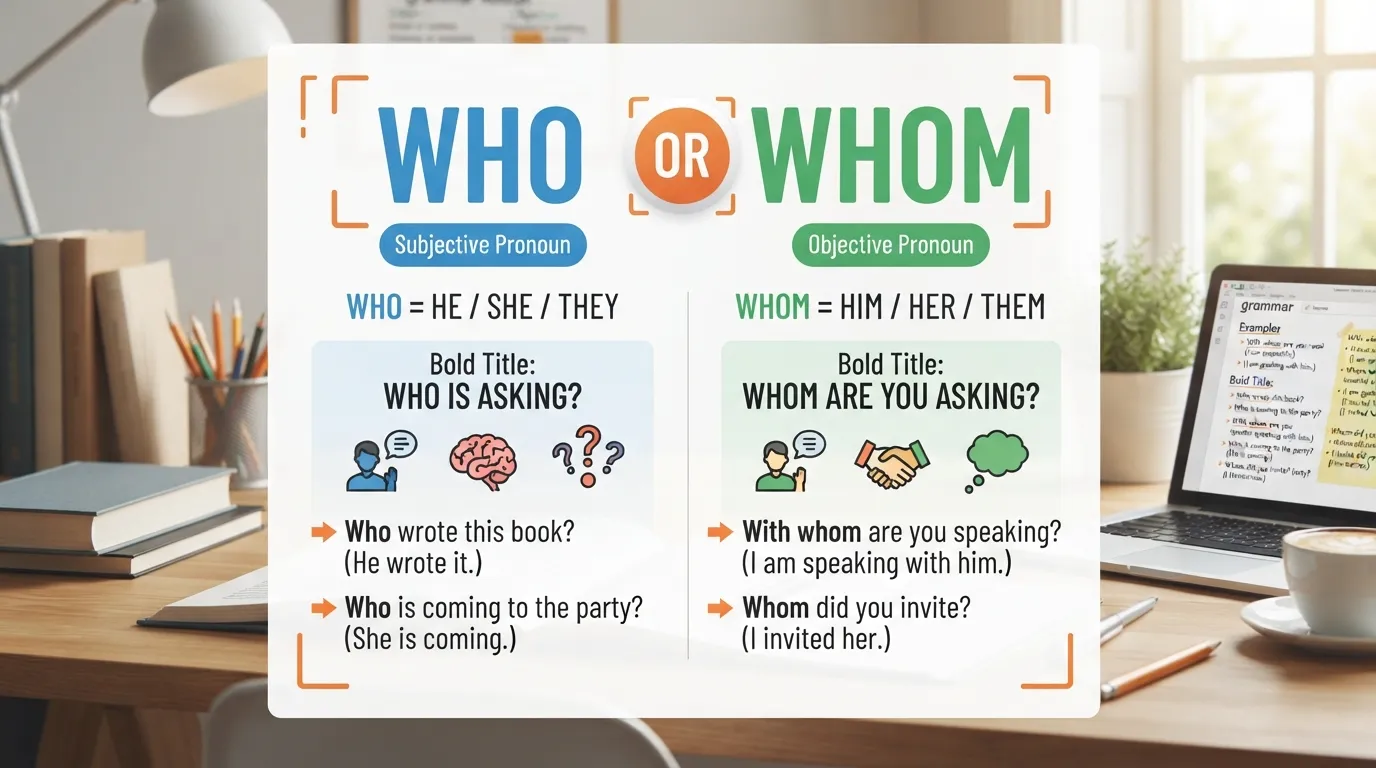
Who is a subject pronoun. Whom is an object pronoun. If you can replace the word with “he,” use who. If you can replace it with “him,” use whom.
That one trick solves almost every mix-up between these two words.
Once you learn it, you’ll never second-guess a sentence again.
Quick Answer Box 🎯
Use “who” when it’s doing the action, like the subject of a sentence. Use “whom” when it’s receiving the action, like the object. Test it by swapping in “he” (who) or “him” (whom) to see which one fits.
⚡ Quick Rule in 1 Line
Who is subject, whom is object — replace with he/him to test it.
Who vs Whom: The Real Difference
whom and whoboth refer to people, but they play different roles in a sentence.
“Who” acts as the subject, meaning it performs the action of the verb.
“Whom” acts as the object, meaning it receives the action of the verb.
This mirrors the difference between “he” and “him,” or “she” and “her.”
You wouldn’t say “Him called me.” You’d say “He called me.”
The same logic applies directly to who and whom.
This distinction goes back to Old English, which had a much richer case system for pronouns.
Modern English simplified most of that system, but who and whom survived as one of the last clear examples.
That’s part of why the rule feels tricky. Most other English pronouns don’t require this kind of testing.
The He/Him Test Explained
Here’s the simplest way to check which word fits: rewrite the sentence using “he” or “him.”
Take the sentence apart, and answer it using a pronoun instead of who or whom.
If “he” sounds right, use “who.” If “him” sounds right, use “whom.”
For example: “___ is coming to dinner?” becomes “He is coming to dinner,” so the answer is “who.”
Try another: “You gave the gift to ___?” becomes “You gave the gift to him,” so the answer is “whom.”
This test works almost every time, even in tricky or long sentences.
Reorder the sentence in your head if needed, focusing only on the pronoun’s role.
For longer sentences, isolate just the clause containing who or whom before applying the test.
This keeps the extra words from confusing which pronoun the test actually applies to.
Correct vs Incorrect Examples
| Incorrect | Correct | Why |
|---|---|---|
| Whom is calling? | Who is calling? | Subject of the sentence, replace with “he” |
| Who did you give it to? | Whom did you give it to? | Object of the preposition “to” |
| To who it may concern | To whom it may concern | Object of the preposition “to” |
| I don’t know whom is coming. | I don’t know who is coming. | Subject of “is coming” |
| Whom called you yesterday? | Who called you yesterday? | Subject of “called” |
Comparison Table
| Word | Role | Test Pronoun | Example |
|---|---|---|---|
| Who | Subject | He | Who wrote this letter? |
| Whom | Object | Him | To whom did you send it? |
| Who | Subject | He | Who is at the door? |
| Whom | Object | Him | Whom should I ask? |
Memory Trick to Never Mix Them Up
Think of it this way: “whom” and “him” both end in “M.”
If “him” fits the sentence, “whom” is the word you need.
If “he” fits the sentence, “who” is the word you need.
Picture the “M” in whom pointing straight to the “M” in him, like a matching pair.
This small visual cue makes the test easy to remember, even under pressure.
Example Sentences
Who is going to the party tonight?
Whom did you invite to the party?
Who left this note on my desk?
To whom should I address this letter?
Who is responsible for this project?
Whom did the manager choose for the role?
Who called during the meeting?
I wasn’t sure whom to trust with the secret.
Who won the game last night?
Whom did you meet at the conference?
Who is your favorite author?
Whom does this book belong to?
Who taught you how to cook?
Whom did they select as team leader?
Who answered the phone this morning?
Whom should I contact about the refund?
Who is presenting at the conference?
Common Mistakes to Avoid
Many writers default to “who” everywhere, since it sounds more natural in casual speech.
Others overuse “whom” to sound formal, even when “who” is grammatically correct.
This is sometimes called “hypercorrection,” where trying too hard to sound proper creates a new mistake.
A common error appears in questions like “Whom is this?” which should always be “Who is this?”
Prepositions often signal “whom,” as in “with whom,” “for whom,” or “to whom.”
Skipping the he/him test is the biggest reason writers guess wrong on this pair.
Relative clauses cause confusion too, like “the man who/whom I saw yesterday.”
Always pause and apply the test before finalizing a sentence with who or whom.
When to Use Each Word
Use “who” whenever the pronoun performs the action in the sentence.
Use “whom” whenever the pronoun receives the action or follows a preposition.
In casual conversation, “who” is often accepted even where “whom” is technically correct.
Many native speakers rarely use “whom” at all in everyday spoken English.
In formal writing, emails, or professional documents, follow the strict rule for polish and accuracy.
Job applications, academic papers, and business letters are places where the distinction still matters.
When unsure, running the he/him test takes only a few seconds and settles it clearly.
Who vs Whom in Relative Clauses
Relative clauses often trip people up, since the pronoun sits in the middle of a longer sentence.
Take “the woman who/whom called me” as an example.
Isolate the clause: “she called me” works, so “who” is correct here.
Now try “the woman who/whom I called.”
Isolate the clause: “I called her” works, so “whom” is correct in this version.
This same method applies no matter how long or complex the surrounding sentence becomes.
FAQs ❓
Is it who or whom in a question?
It depends on the pronoun’s role. If “he” answers the question, use “who.” If “him” answers it, use “whom.”
Is “whom” outdated in modern English?
No, whom is still correct, especially in formal writing, though “who” is increasingly accepted in casual speech.
What’s the fastest way to check who vs whom?
Replace the pronoun with “he” or “him” in your head. “He” means who; “him” means whom.
Is “to whom it may concern” still correct?
Yes, this formal greeting is still standard and grammatically correct in professional letters and emails.
Can I always use “who” in casual texting?
Yes, in casual texting, “who” is widely accepted even when “whom” would be technically correct.
Why does whom sound so formal?
Whom is used less often in spoken English, so it naturally carries a more formal, old-fashioned tone.
Does word order affect the who/whom rule?
No, the rule depends on the pronoun’s grammatical role, not its position in the sentence.
Is “whomever” the same rule as whom?
Yes, “whomever” follows the same object rule as “whom,” while “whoever” follows the same subject rule as “who.”
Conclusion
Who and whom follow one simple, reliable rule.
Use “who” for the subject, replaceable with “he.”
Use “whom” for the object, replaceable with “him.”
Run the quick test, and you’ll never second-guess this pair again.

Hi, I’m Daniel Carter. I’m passionate about helping learners improve their English with practical grammar tips and clear writing advice.