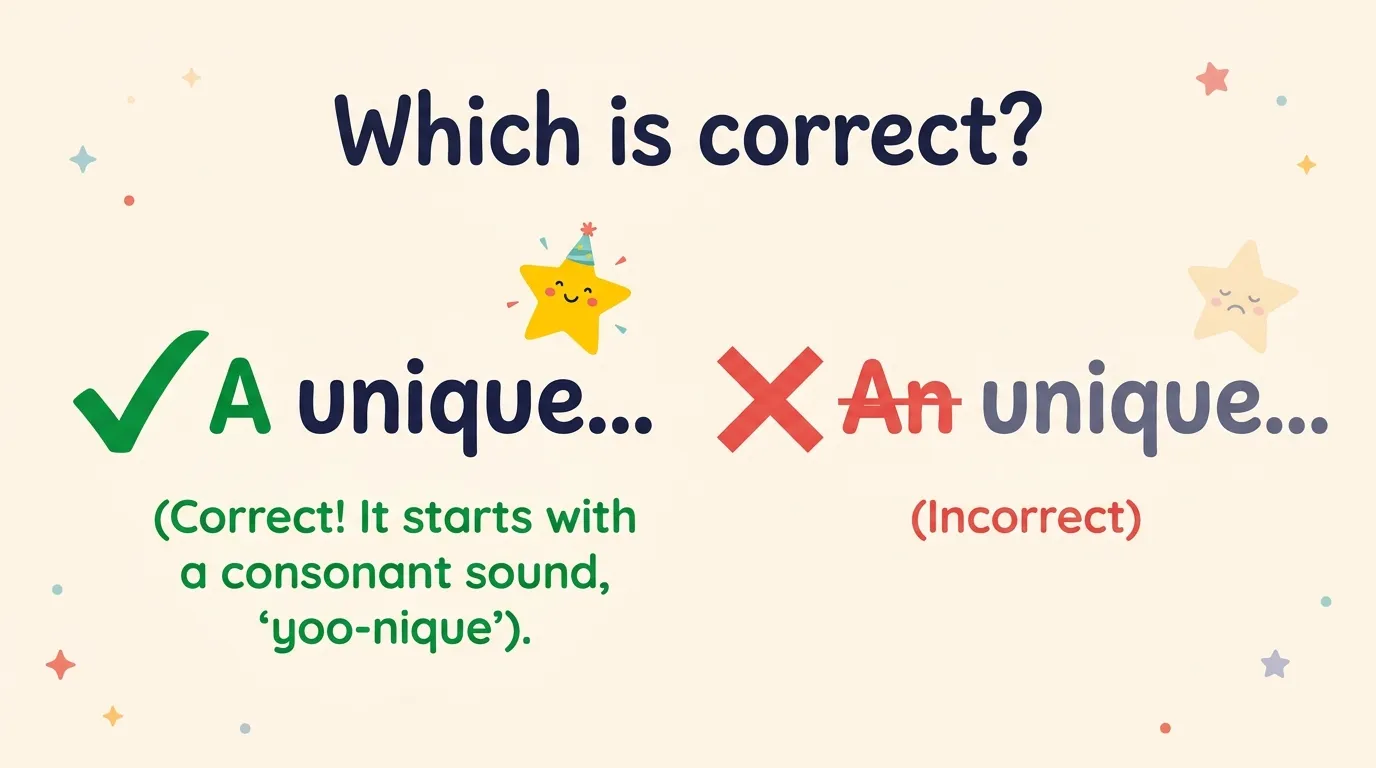
Should you write a unique or an unique? The correct phrase in standard modern English is a unique. Although unique begins with the vowel letter u, its first sound is like the “y” in you.
This is a consonant sound, so it takes a, not an.
For example, you should write “She has a unique talent,” not “She has an unique talent.”
The rule is simple: choose a or an according to the sound that comes next, not just the first letter. This is why we say “a university” but “an umbrella.”
In this guide, you will learn why a unique is correct, explore examples, compare similar words, and practice the rule with a short quiz.
Quick Answer: A Unique or An Unique?
“A unique” is correct. “An unique” is incorrect in standard English.
| Phrase | Correct? | Explanation |
| A unique idea | Yes | Unique begins with a consonant sound. |
| An unique idea | No | The word does not begin with a vowel sound. |
| A unique opportunity | Yes | The opening sound is like “you.” |
| A university | Yes | University begins with a “you” sound. |
| An umbrella | Yes | Umbrella begins with a vowel sound. |
| An unusual event | Yes | Unusual begins with a vowel sound. |
Easy rule: Use a before a consonant sound and an before a vowel sound.
The Cambridge Dictionary lists the pronunciation of unique with an initial /j/ sound, as in yes. That explains why the correct phrase is a unique. <Cite refs={[“turn895150search7″,”turn895150search5”]}/>
Why Is “A Unique” Correct?
The confusion happens because unique begins with the letter u, and u is a vowel. However, English articles depend on pronunciation rather than spelling alone.
The beginning of unique sounds like “you.” That initial sound is a consonant sound, so the correct expression is a unique.
Examples:
- She has a unique way of solving problems.
- This is a unique opportunity.
- The artist created a unique design.
- We found a unique solution to the problem.
- He has a unique sense of humor.
- The restaurant offers a unique dining experience.
- Every student brings a unique perspective.
In each sentence, a is the correct article because the next word begins with a consonant sound.
How Is “Unique” Pronounced?
Cambridge Dictionary gives the pronunciation as /juːˈniːk/ in both British and American English.
The first sound is /j/, like the initial sound in yes. The word then continues with the long /uː/ sound, as in blue.
You do not need to memorize phonetic symbols to use the correct article. Just remember that unique starts with a “you” sound.
Therefore:
- A unique idea — correct
- An unique idea — incorrect in standard English
The Difference Between “A” and “An”
The indefinite articles a and an are used before singular countable nouns when referring to something that is not specifically identified.
The choice depends on the first sound of the following word.
Use “A” Before a Consonant Sound
Use a when the next word begins with a consonant sound.
Examples:
- A book
- A car
- A house
- A student
- A unique idea
- A useful tool
- A university
- A European country
Some of these words begin with vowel letters, but their opening sounds are consonant sounds.
For example, university and useful begin with the same general “you” sound as unique. That is why we say “a university” and “a useful tool.”
Use “An” Before a Vowel Sound
Use an when the next word begins with a vowel sound.
Examples:
- An apple
- An egg
- An idea
- An orange
- An umbrella
- An unusual event
- An honest person
- An hour
Notice that honest and hour begin with the consonant letter h, but that letter is silent in their usual pronunciation. Their first spoken sound is a vowel sound, so they take an.
A vs An: Quick Comparison
| Rule | Correct Example |
| Consonant sound | A unique idea |
| Consonant sound | A university |
| Consonant sound | A useful suggestion |
| Vowel sound | An umbrella |
| Vowel sound | An unusual event |
| Vowel sound | An honest answer |
| Vowel sound | An hour |
The most reliable approach is to listen to the opening sound instead of choosing an article based on the first written letter. <Cite refs={[“turn895150search5″,”turn895150search7”]}/>
A Unique vs An Unusual: Why Are They Different?
This comparison makes the rule easier to understand.
Both unique and unusual begin with the letter u. However, their opening sounds are different.
- A unique idea — unique begins with a “you” sound.
- An unusual idea — unusual begins with a vowel sound.
Both phrases are correct.
Here are more examples:
| Correct Phrase | Why? |
| A unique experience | Begins with a consonant sound |
| An unusual experience | Begins with a vowel sound |
| A useful suggestion | Begins with a “you” sound |
| An unfair decision | Begins with a vowel sound |
| A uniform | Begins with a “you” sound |
| An uncle | Begins with a vowel sound |
Do not assume that every word beginning with u takes an. Pronunciation determines the correct article.
Common Mistakes With “A Unique” and “An Unique”
1. Choosing “An” Because “Unique” Starts With U
Incorrect: She has an unique talent.
Correct: She has a unique talent.
The article depends on the first sound, not simply the first letter.
2. Thinking Every Vowel Letter Needs “An”
Incorrect: He found an useful tool.
Correct: He found a useful tool.
The word useful begins with a “you” sound, so it takes a.
3. Using “A” Before Every Word Beginning With U
Incorrect: She carried a umbrella.
Correct: She carried an umbrella.
The word umbrella starts with a vowel sound, so an is correct.
4. Forgetting About Silent Letters
Incorrect: He waited for a hour.
Correct: He waited for an hour.
The h in hour is silent, so the word begins with a vowel sound.
5. Assuming the Rule Changes in British English
The standard phrase is a unique in both American and British English. The initial sound of unique is the same for this purpose.
More Examples of “A Unique” in Sentences
Here are examples you can use to understand the phrase in different contexts.
Everyday English
- That is a unique name.
- She has a unique style.
- We had a unique experience.
- This café has a unique atmosphere.
- He came up with a unique idea.
Academic and Professional Writing
- The research presents a unique perspective on the issue.
- The company developed a unique approach to customer service.
- Each project has a unique set of requirements.
- The study examines a unique combination of factors.
- The team proposed a unique solution to the problem.
Business and Technology
- The app offers a unique feature.
- The company created a unique product.
- This service provides a unique benefit to customers.
- The software uses a unique method to organize information.
Remember that unique means one of a kind or distinctly different. Avoid using it only to mean “good” or “excellent” unless the context supports that meaning.
Is “An Unique” Ever Correct?
In standard contemporary English, a unique is the expected form. You should use it in school assignments, business writing, website content, emails, and professional documents.
You may occasionally encounter an unique in older texts, unusual writing, or material written by people who are following spelling rather than pronunciation. That does not make it the recommended modern form.
For clear and natural English, write:
- A unique opportunity
- A unique experience
- A unique feature
- A unique perspective
Avoid:
- An unique opportunity
- An unique experience
- An unique feature
- An unique perspective
Easy Ways to Remember the Rule
Trick 1: Remember “You” and “Unique”
The beginning of unique sounds like the word you.
You → Unique → A unique
This is a quick memory trick for choosing the correct article.
Trick 2: Say the Phrase Out Loud
Say “a unique idea” aloud. You will hear the consonant-like opening sound before the rest of the word.
Compare it with “an umbrella.” The opening sound of umbrella is a vowel sound, which is why an works there.
Trick 3: Focus on Sound, Not Spelling
Keep this rule in mind:
- Consonant sound = a
- Vowel sound = an
This works for many other words, including university, useful, hour, and honest.
Quick Practice Quiz: A or An?
Choose the correct article for each sentence.
1. She has _____ unique idea.
- A. a
- B. an
2. He studies at _____ university.
- A. a
- B. an
3. We saw _____ umbrella near the door.
- A. a
- B. an
4. It was _____ unusual experience.
- A. a
- B. an
5. They waited for _____ hour.
- A. a
- B. an
6. The company developed _____ useful tool.
- A. a
- B. an
Answer Key
- A — a unique idea. Unique begins with a consonant sound.
- A — a university. University starts with a “you” sound.
- B — an umbrella. Umbrella begins with a vowel sound.
- B — an unusual experience. Unusual begins with a vowel sound.
- B — an hour. The h is silent.
- A — a useful tool. Useful begins with a “you” sound.
FAQs
1. Is it “a unique” or “an unique”?
The correct phrase is a unique. The word unique begins with a consonant sound, similar to the first sound in you.
2. Why do we say “a unique” if U is a vowel?
Because the choice between a and an depends on pronunciation, not just spelling. The opening sound of unique is a consonant sound, so it takes a.
3. Is “an unique” grammatically correct?
It is not the standard form in modern English. Use a unique in formal and informal writing.
4. Is “a unique idea” correct?
Yes. For example: “She shared a unique idea during the meeting.” The article a is correct because unique begins with a consonant sound.
5. Is it “a university” or “an university”?
The correct phrase is a university. The word begins with the “you” sound, which functions as a consonant sound.
6. Is it “a useful” or “an useful”?
Use a useful, as in “a useful tool.” The word useful begins with a “you” sound.
7. Why do we say “an umbrella” but “a unique”?
Although both words begin with U, they start with different sounds. Umbrella begins with a vowel sound, while unique begins with a consonant sound.
8. Is “a unique opportunity” correct?
Yes. “A unique opportunity” is standard English because unique begins with a consonant sound.
9. Does this rule apply to American and British English?
Yes. Both varieties use a unique because the initial sound of unique is a consonant sound.
10. What is the easiest way to remember a vs. an?
Use a before consonant sounds and an before vowel sounds. Remember that the sound matters more than the first written letter.
Conclusion
The correct phrase is a unique, not an unique. Although unique starts with the vowel letter U, it begins with a consonant sound like the start of you. English articles depend on the sound that follows them, not simply on spelling.
Use a unique idea, a unique experience, and a unique opportunity. In contrast, use an umbrella and an unusual event because those words begin with vowel sounds.
Remember the simple rule: use “a” before consonant sounds and “an” before vowel sounds. This rule will help you choose the correct article in many everyday and professional sentences.

Hi, I’m Ethan Brooks. I create easy-to-follow grammar guides, writing tips, and vocabulary resources to make English learning enjoyable for everyone.