You wrote aging in a report for a UK health journal, and the editor added an e before publishing it but you hadn’t actually made a mistake.
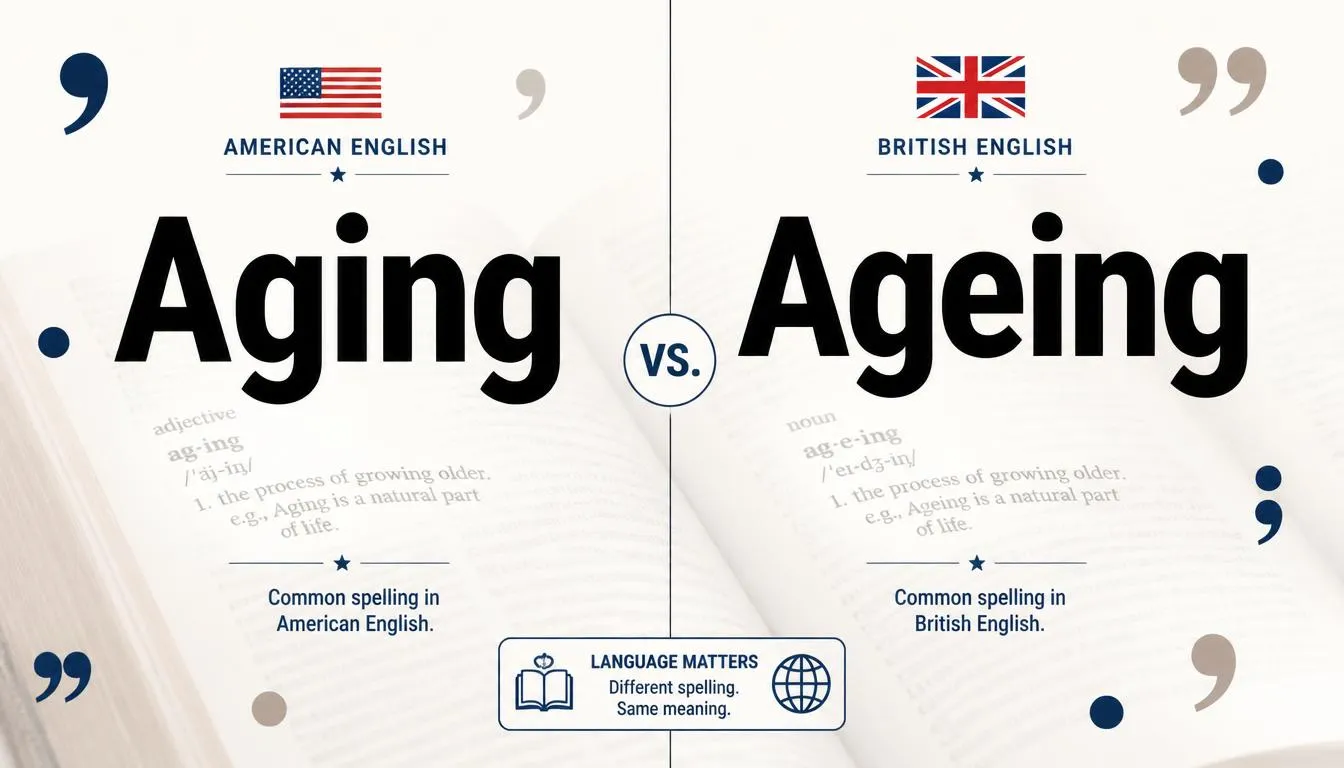
Here’s the quick fix: aging (no middle e) is standard American English, and ageing (with a middle e) is standard British English.
This follows a different pattern than most US/UK pairs: it’s about keeping or dropping a silent e, not doubling a consonant.
Once you understand this rule, you’ll recognize it in several other tricky word pairs too.
Quick Answer
Aging (no middle e ) is the standard spelling in American English.
Ageing (with a middle e ) is the standard spelling in British English, Australian English, and most Commonwealth countries.
Both describe the same process: growing older over time.
⚡ Quick Rule
America drops the silent e before adding -ing ; Britain keeps it that’s the whole rule for aging and ageing.
Aging vs Ageing: The Core Difference
Aging and ageing mean exactly the same thing: the process of growing older.
American English typically drops the silent e from age before adding -ing, creating aging.
British English typically keeps the silent e, creating ageing instead.
This single letter difference is the entire distinction between the two spellings.
Why Do Both Spellings Exist? The Silent-E Rule Explained
English generally drops a silent e before adding a suffix that starts with a vowel, like -ing this is why make becomes making, not making.
By that standard rule, age should become aging, which is exactly what American English does.
British English makes an exception for words like age, dye, and a few others, keeping the e to avoid confusion with unrelated words or awkward pronunciation.
Keeping the e in ageing also helps visually separate it from unrelated short words, which is part of why British style guides preserved this exception.
Aging vs Ageing Comparison Table
| Feature | Aging | Ageing |
| Meaning | The process of growing older | The process of growing older |
| American English | ✅ Standard | Rare |
| British English | Less common | ✅ Standard |
| Australian English | Rare | ✅ Standard |
| Canadian English | Sometimes used | More common |
| Pronunciation | Same | Same |
| Grammar | Correct | Correct |
Memory Trick
Remember: America follows the standard silent-e rule strictly, so it drops the aging.
Britain makes a special exception here, keeping the e age-ing, spelled out to see the extra letter clearly.
Picture the word age staying fully visible inside ageing; that’s the British version keeping its roots intact.
Real Example Sentences
American English (Aging):
- The aging population needs better healthcare access.
- She’s aging gracefully, according to her friends.
- Wine improves with aging.
- The aging process affects everyone differently.
- His parents are aging well despite the stress.
British English (Ageing):
- The ageing population needs better healthcare access.
- She’s ageing gracefully, according to her friends.
- Wine improves with ageing.
- The ageing process affects everyone differently.
- His parents are ageing well despite the stress.
Aging Population, Aging Gracefully, and Anti-Aging
Aging population (US) or ageing population (UK) refers to a country or society where the average age is steadily increasing.
Anti-aging (US) or anti-ageing (UK) refers to products or practices designed to slow the visible or physical effects of growing older.
All of these common phrases follow the same regional spelling rule as the base word itself.
Similar Silent-E Words: Judgement, Acknowledgement
Ageing isn’t the only British word that keeps a silent e before a suffix.
Judgment (US) vs Judgement (UK): British English keeps the e here too, following a similar pattern, outside legal writing.
Acknowledgment (US) vs Acknowledgement (UK): American English drops the e, while British English keeps it, just like ageing.
These words share a common thread: British English often preserves the e from the original root word, while American English simplifies it away.
Around the World: Where Each Spelling Is Used
| Country | Preferred Spelling |
| United States | Aging |
| United Kingdom | Ageing |
| Canada | Usually Ageing |
| Australia | Ageing |
| New Zealand | Ageing |
| Ireland | Ageing |
Canada leans toward the British spelling here, similar to its pattern with colour and judgement.
Common Mistakes
1. Mixing both spellings in one document Incorrect: The aging population and the ageing workforce both need support. Correct (US): The aging population and the aging workforce both need support.
2. Assuming the rule matches doubling words like traveling This is a different rule entirely: ageing is about keeping a silent e, not doubling a consonant like travelling.
3. Misspelling aging with a double g Incorrect: agging Correct: aging (US) or ageing (UK)
4. Forgetting related phrases follow the same pattern: Aging population, aging gracefully, and anti-aging all follow the same regional rule as the base word.
When to Use Each Spelling
Use Aging When:
- Writing for an American audience
- Following AP Style or Chicago Manual of Style
- Writing for US schools, health, or business content
Examples: aging population, anti-aging cream, aging gracefully
Use Ageing When:
- Writing for British, Australian, or NZ readers
- Following Oxford or British publishing standards
- Writing for most Canadian readers
Examples: ageing population, anti-ageing cream, ageing gracefully
FAQs
Is it aging or ageing?
Both are correct. Aging is standard American English, while ageing is standard British English.
Is aging the American spelling?
Yes. American dictionaries, schools, and style guides recommend aging, without the middle e.
Is ageing used in the UK?
Yes. It’s the standard spelling in British English and also common in Australia, New Zealand, and Canada.
Do aging and aging mean different things?
No. Both describe the same process of growing older; only the spelling differs by region.
Why does British English keep the e ?
British English makes a specific exception for words like age, keeping the silent e instead of following the usual drop-e rule.
Is one spelling more correct than the other?
No. Neither spelling is more correct match your spelling to your audience and stay consistent.
How do I remember which spelling to use?
Think: America drops the silent e following the standard rule; Britain keeps it as a special exception.
What does an aging population mean?
It refers to a society where the average age of its residents is steadily increasing over time.
Is it anti-aging or anti-ageing ?
Anti-aging is American English. Anti-ageing is British English, following the same regional spelling rule.
Do judgment/judgement and aging/ageing follow the same rule?
They follow a similar pattern of American English dropping a letter that British English keeps, though the underlying reasons differ slightly for each word.
Conclusion
Aging and ageing are both correct spellings of the same word.
American English drops the silent e following the standard rule, while British English keeps it as an exception.
Once you understand this pattern, similar words like judgement and acknowledgement become easier to spell with confidence.

Hi, I’m Olivia Harper. I love turning complex English grammar into simple, practical lessons that help readers write and speak with confidence.