Something feels slightly off, but you can’t quite place it.
That small hesitation is your ear catching what your eye missed: “hour” doesn’t sound the way it looks.
This guide clears up exactly why “an hour” is correct, and how to spot the pattern in similar words.
Quick Answer Box
“An hour” is the correct phrase, not “a hour.” The rule for “a” versus “an” depends on sound, not spelling. Since the “h” in “hour” is silent, the word actually begins with a vowel sound (“our”), which requires “an” rather than “a.”
⚡ Quick Rule in 1 Line
“Listen, don’t look — if the first sound is a vowel, the article is always ‘an.'”
Why “An Hour” Is Correct 📖
The choice between “a” and “an” comes down to one thing: the sound that follows, not the letter.
“A” goes before words that start with a consonant sound. “An” goes before words that start with a vowel sound.
“Hour” is spelled with an “h,” which looks like a consonant, so the instinct is to reach for “a.”
But say it out loud: “hour” is pronounced “our,” with a completely silent h.
Since the word actually begins with a vowel sound, “an” is the only correct choice.
Correct: I’ll call you back in an hour. Incorrect: I’ll call you back in a hour.
Correct: It took her an hour to finish the report. Incorrect: It took her a hour to finish the report.
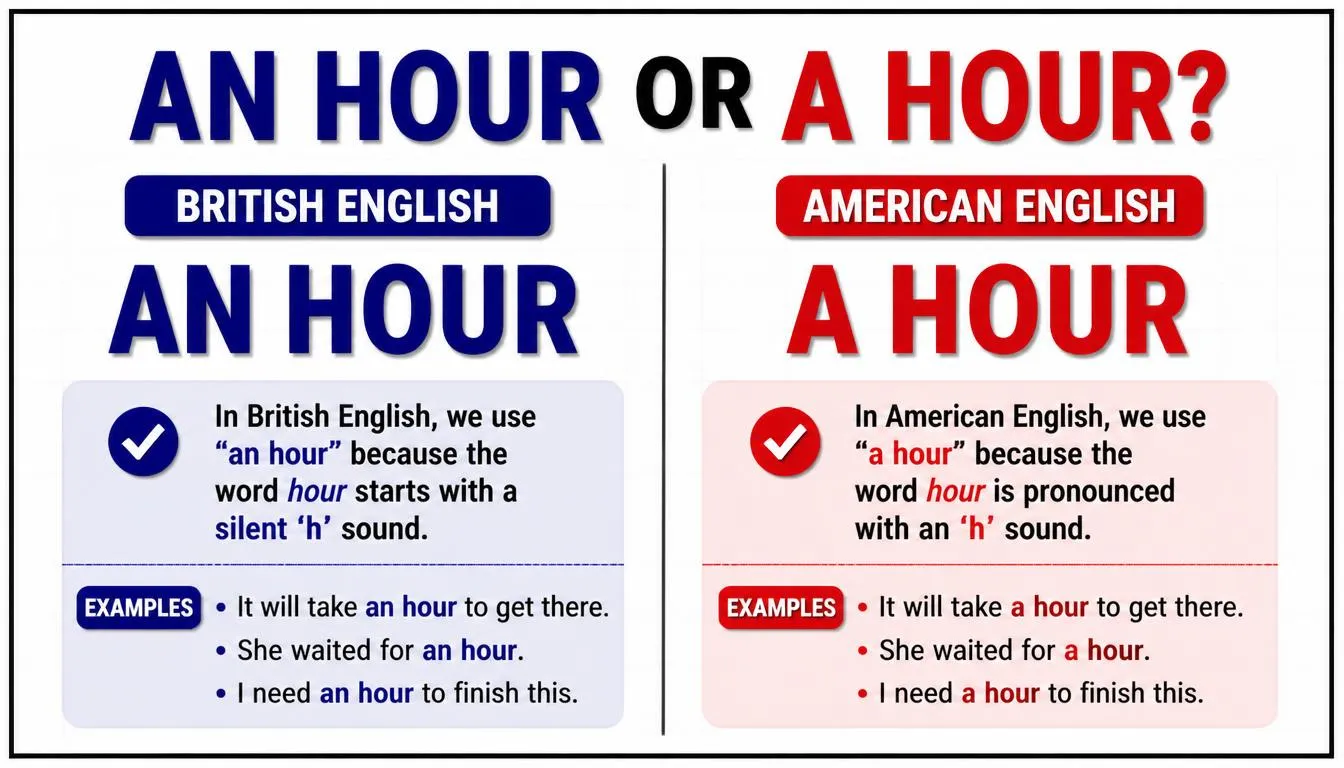
This rule holds true in both American and British English. There’s no regional variation here.
Other Silent-H Words 📖
“Hour” isn’t the only word where the “h” disappears in speech. A handful of common words follow the exact same pattern.
| Word | Article | Example |
|---|---|---|
| Hour | an | an hour ago |
| Honest | an | an honest mistake |
| Honor | an | an honor to meet you |
| Heir | an | an heir to the throne |
| Herb (US English) | an | an herb garden |
Notice the pattern: in every case, the “h” simply isn’t pronounced, so the word functions as if it started with a vowel.
Compare that to words where the “h” is fully voiced, like “house,” “hotel,” or “history.” Those words correctly take “a.”
Correct: She lives in a house near the river. Incorrect: She lives in an house near the river.
Common Mistakes ❌ / ✅
❌ I waited a hour for the bus. ✅ I waited an hour for the bus.
❌ It’s a honor to be here. ✅ It’s an honor to be here.
He’s an heir apparent — wait, that one’s actually correct. ✅ He’s an heir apparent to the family business.
❌ We need an hotel near the airport. (common in older British writing, now considered outdated) ✅ We need a hotel near the airport. (standard in modern English, since the “h” in “hotel” is pronounced)
When to Use “A” Instead
If you can hear the “h” when you say the word aloud, use “a.”
“A house,” “a history lesson,” “a hospital,” and “a hobby” all keep their “h” sound, so they follow the normal consonant rule.
The only exception worth remembering is “herb,” which drops its “h” in American English (an herb) but keeps it in British English (a herb).
Expert Tip 💡
When you’re unsure whether a word’s “h” is silent, say the sentence out loud before you finalize your writing. Your ear will almost always catch what your eye misses, since native speakers naturally default to the version that flows more smoothly.
Fun Fact 🎉
English used to pronounce the “h” in “hour” centuries ago. Over time, the sound quietly dropped out of everyday speech, but the spelling never caught up, leaving modern English with this small, sneaky exception.
FAQs ❓
Is it “a hour” or “an hour”?
It’s always “an hour.” The “h” in “hour” is silent, so the word begins with a vowel sound, which requires “an.”
Why does “hour” use “an” if it starts with a consonant letter?
Because the article rule depends on sound, not spelling. Since the “h” isn’t pronounced, “hour” sounds like it starts with a vowel.
Is this rule different in British English?
No. Both American and British English use “an hour” consistently, since the silent “h” applies in both dialects.
What other words work like “hour”?
“Honest,” “honor,” and “heir” all follow the same rule, since their “h” is also silent.
Is “an historic” correct?
This is debated. Some older or British writing uses “an historic” because the “h” was once softer, but “a historic” is now standard in most modern English, since the “h” is fully pronounced.
Does “herb” follow the same rule?
Only in American English, where the “h” is silent (an herb). In British English, the “h” is pronounced, so it’s “a herb.”
Is “a hour” ever acceptable in casual speech?
No. Even in casual speech, “an hour” remains correct; the confusion is really about writing quickly without checking pronunciation.
How can I remember this rule permanently?
Focus on sound, not spelling. If reading the word aloud produces a vowel sound first, use “an,” regardless of which letter it’s spelled with.
Does “hourly” follow the same rule as “hour”?
Yes. Since “hourly” also starts with a silent “h,” it takes “an” too — “an hourly rate,” not “a hourly rate.”
Is there a plural form that needs an article?
“Hours” doesn’t need an article at all when used generally (“it took hours,” not “an hours” or “a hours”). The a/an rule only applies to the singular “hour.”
What about “a one-hour meeting” — is that different?
Yes, this is a different case. “One” is pronounced “won,” which starts with a consonant sound, so it takes “a” — “a one-hour meeting,” not “an one-hour meeting.” The rule still follows sound, just applied to “one” instead of “hour.”
Conclusion
The rule behind “an hour” comes down to a single idea: articles follow sound, not spelling.
Since the “h” in “hour” is silent, the word behaves exactly like any other vowel-sound word, requiring “an” rather than “a.”
The same logic applies to “honest,” “honor,” and “heir,” so once this pattern clicks, you’ll never second-guess it again.

Hi, I’m Sophia Bennett. My goal is to make grammar easy, clear, and useful through simple explanations and real-life examples.