You wrote “the dog wagged it’s tail” in an email, and autocorrect didn’t catch the mistake before you hit send.
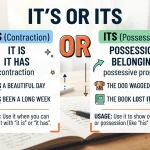
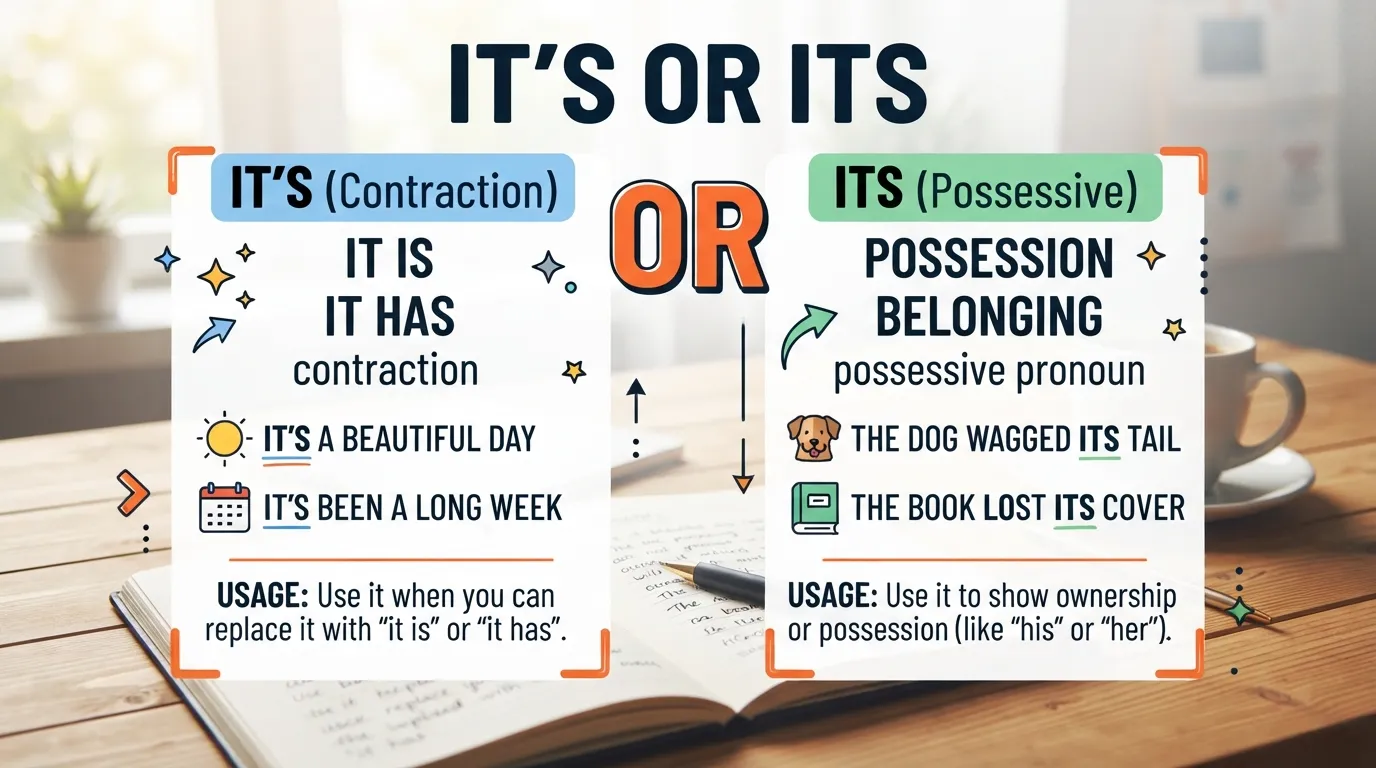
Here’s the quick fix: it’s is always a contraction of “it is” or “it has,” while its shows possession, meaning something belongs to it.
This is one of the most common mistakes in English, partly because apostrophes usually show possession everywhere else.
Once you learn the one test that always works, this mistake becomes easy to avoid for good.
Quick Answer
It’s is short for “it is” or “it has” (“It’s raining outside”).
Its shows possession, meaning something belongs to “it” (“The dog wagged its tail”).
Never use an apostrophe in “its” when showing possession — that’s the exact opposite of the usual rule.
⚡ Quick Rule
It’s always means “it is” or “it has”; its always shows possession — no apostrophe for ownership here.
It’s vs Its: The Core Difference
the “It’s” is a contraction, meaning it combines two words into one using an apostrophe, standing for “it is” or “it has.”
“Its” is a possessive adjective, meaning something belongs to “it,” similar to “his” or “her.”
Say “It’s cold today” (it is cold), versus “The car lost its wheel” (the wheel belongs to the car).
This contraction-versus-possession distinction is the entire key to using these words correctly.
Grammar Rule Explained
A simple, reliable test: try expanding “it’s” into “it is” or “it has.” If the sentence still makes sense, “it’s” is correct.
Example: “It’s been a long day” expands to “It has been a long day” — confirming the apostrophe is correct here.
If the sentence describes something belonging to “it,” use “its” without an apostrophe instead.
Example: “The company changed its logo” — the logo belongs to the company, so no apostrophe is needed.
Why This Word Breaks the Usual Apostrophe Rule
Normally, English adds an apostrophe plus “s” to show possession, like “the dog’s bone” or “Sarah’s car.”
“Its” is an exception to this rule, following the same pattern as other possessive pronouns like “his,” “hers,” and “theirs,” none of which use apostrophes either.
This exception exists specifically to avoid confusion with the contraction “it’s,” which already uses the apostrophe for a different purpose.
Understanding this exception explains why “its” looks unusual compared to most other possessive nouns in English.
It’s vs Its Comparison Table
| Feature | It’s | Its |
|---|---|---|
| Function | Contraction | Possessive adjective |
| Expands to | It is / It has | N/A (shows ownership) |
| Example | It’s a nice day. | The cat licked its paw. |
| Apostrophe | Always has one | Never has one |
Memory Trick
Remember: “It’s” always has an apostrophe because it’s secretly hiding a missing letter, just like “don’t” or “can’t.”
“Its” never has an apostrophe, just like “his” and “hers” — all possessive pronouns skip the apostrophe.
If in doubt, try saying “it is” or “it has” in place of the word. If that sounds right, add the apostrophe.
Real Example Sentences
Using It’s:
- It’s going to rain later today.
- It’s been a wonderful trip so far.
- I think it’s time to leave.
- It’s clear that everyone agrees.
- She said it’s her favorite movie.
Using Its:
- The company updated its website design.
- The bird built its nest in the tree.
- Every rule has its exception.
- The team celebrated its championship win.
- The book lost its cover in the move.
Its Own or It’s Own? Common Mistakes in Phrases
“Its own” is always correct when showing possession, as in “The project has its own timeline.”
“It’s own” is never correct — this phrase always describes something belonging to “it,” so it never takes an apostrophe.
If you’re ever unsure about this specific phrase, remember: “own” always follows a possessive word, and “its” is the possessive form here, not the contraction.
Common Mistakes
1. Adding an apostrophe to show possession Incorrect: The dog wagged it’s tail. Correct: The dog wagged its tail.
2. Forgetting the apostrophe in the contraction Incorrect: Its a beautiful day outside. Correct: It’s a beautiful day outside.
3. Assuming “its” follows the usual possessive rule Unlike most nouns, “its” never takes an apostrophe for possession, just like “his” and “hers.”
4. Not testing the sentence by expanding “it’s” Always try expanding to “it is” or “it has” first — if it doesn’t work, you need “its” instead.
When to Use Each Word
Use It’s When:
- You mean “it is” or “it has”
- The sentence still works when expanded
- Introducing a description, action, or state
Examples: it’s raining, it’s been years, it’s true
Use Its When:
- Showing something belongs to “it”
- Followed directly by a noun
- You could replace it with “his” or “her”
Examples: its color, its purpose, its own rules
FAQs
What’s the difference between it’s and its?
“It’s” is a contraction of “it is” or “it has.” “Its” shows possession, meaning something belongs to “it.”
How do I know when to use “it’s”?
Try expanding it to “it is” or “it has.” If the sentence still makes sense, “it’s” is correct.
Why doesn’t “its” have an apostrophe like other possessives?
“Its” follows the same rule as “his,” “hers,” and “theirs” — none of these possessive pronouns use an apostrophe.
Is “its” ever a contraction?
No, “its” is always possessive. Only “it’s” functions as a contraction, for “it is” or “it has.”
Can “it’s” ever show possession?
No, “it’s” only means “it is” or “it has” — it never shows ownership.
What’s an easy way to remember the difference?
“It’s” always has an apostrophe because a letter is missing. “Its” never has one, just like “his” and “hers.”
Is “its'” (with the apostrophe after the s) ever correct?
No, “its'” is never correct in standard English. The only options are “it’s” and “its.”
Why is this such a common mistake?
Because apostrophes usually show possession in English, making “its” feel like an exception people often forget.
Conclusion
It’s and its might look nearly identical, but they serve completely different purposes.
It’s always means “it is” or “it has.” Its always shows possession, without ever needing an apostrophe.
Test any confusing sentence by expanding “it’s” to “it is” or “it has” — if that doesn’t work, “its” is what you need instead.

Hi, I’m Ethan Brooks. I create easy-to-follow grammar guides, writing tips, and vocabulary resources to make English learning enjoyable for everyone.