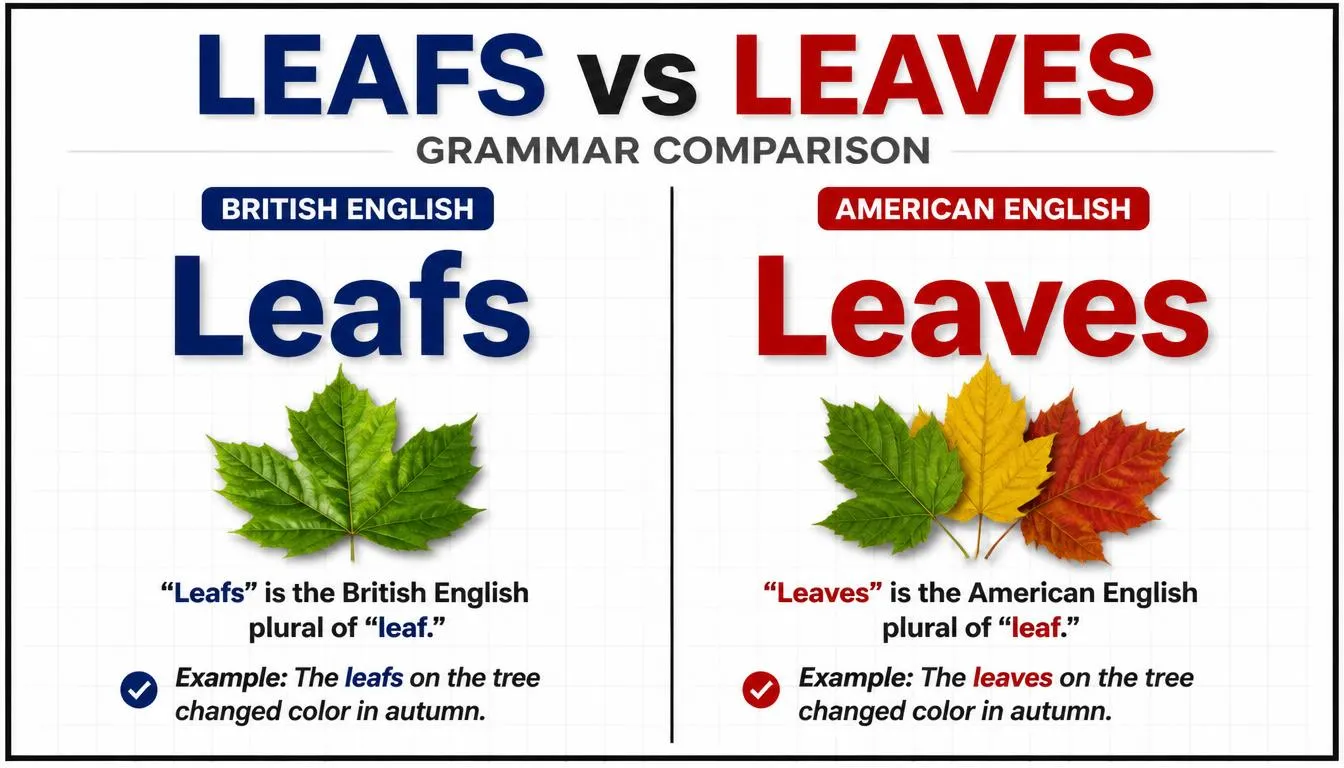
You’re describing the pile of red and gold foliage covering your driveway, and you pause: leaves, or leafs?
Then you remember a hockey game you watched last week, where the team name spelled it the other way entirely.
Both versions genuinely exist in English, just for completely different reasons.
This guide untangles exactly when each spelling belongs, so you’ll never second-guess it again.
Did You Know? 🔍
The Toronto Maple Leafs deliberately chose the “incorrect” plural “Leafs” when the team was founded.
It has stayed that way for nearly a century, making it one of the most famous intentional grammar exceptions in English.
Table of Contents
- Quick Answer
- Leaves vs Leafs: Quick Comparison
- Quick Rule in One Line
- Leaf or Leaves: Singular vs Plural
- The Standard Plural Rule
- When “Leafs” Is Actually Correct
- Is “Leafs” a Word?
- What Does “Leafs” Mean?
- Past Tense of “Leaf” (the Verb)
- Leave vs Leaf: Two Completely Different Words
- How to Pronounce Leaf, Leaves, and Leafs
- Common Mistakes
- Similar F-to-VES Words
- Cheque Leaf or Cheque Leaves?
- Door Leaf, Gate Leaf, and Table Leaf
- Is “Leaf” Countable or Uncountable?
- “Leaf” and “Leaves” in Other Languages
- Leaves or Leafs When Drawing or Labeling
- Leaf and Leaves Difference
- Is Leaf Singular or Plural?
- A Leaf or An Leaf?
- Tree Leaves or Tree Leafs?
- Leaf Meaning and Definition
- Leaves Meaning: Noun or Verb?
- Leave vs Leaves: What’s the Difference?
- Is Leaf a Noun, a Common Noun, or a Verb?
- Verb Forms of Leaf
- Are Leaves Countable or Uncountable?
- How to Spell Leaves, Leaf, and Leafs
- Leafs or Leaves in UK English
- Leaf Plural in Other Languages: Quick Answers
- Quick Practice Question
- FAQs
Quick Answer Box
“Leaves” is the standard plural of “leaf” when referring to plants, trees, or pages.
It follows the common English pattern where words ending in “f” shift to “ves.”
“Leafs” is correct only as a present-tense verb (“she leafs through the book”) or as part of the proper noun “Toronto Maple Leafs.”
Leaves vs Leafs: Quick Comparison
Here’s the distinction in one glance:
| Word | Meaning | Example |
|---|---|---|
| Leaves | Plural of leaf (plants, pages, table extensions) | The leaves are falling. |
| Leafs | Proper-name usage, mainly sports teams | The Leafs won the game. |
| Leafs | Verb, meaning to flip through pages | He leafs through the report. |
“Leafs” isn’t simply a mistake. It has real, legitimate jobs in English, just not as the plural of a leaf.
⚡ Quick Rule in One Line
Nature leaves, hockey leafs, that’s the whole exception in six words.
Leaf or Leaves: Singular vs Plural
Before getting into the spelling exceptions, it helps to separate the basics.
“Leaf” is singular, describing one single piece of foliage, one page in a book, or one flat section of a table.
“Leaves” is its plural, used the moment you’re talking about more than one.
So a single autumn leaf falling from a branch is a “leaf,” while a whole pile of them on the ground is “leaves,” not “leafs.”
The Standard Plural Rule 📖
English has an old pattern where many nouns ending in “f” or “fe” shift that sound to “v” when made plural.
“Leaf” becomes “leaves,” following the exact same shift as “knife” to “knives” and “wife” to “wives.”
This happens because the “f” sound softens into a “v” sound when the plural ending is added, a pattern inherited from Old English pronunciation.
This is also the direct answer to why the plural of “leaf” is “leaves” and not simply “leafs”: it’s this old sound shift, not a random exception.
Correct: The maple tree lost most of its leaves by mid-October.
Incorrect: The maple tree lost most of its leafs by mid-October.
Correct: She pressed dried leaves into her notebook.
Incorrect: She pressed dried leafs into her notebook.
| Singular | Plural |
|---|---|
| leaf | leaves |
| knife | knives |
| wife | wives |
| loaf | loaves |
| shelf | shelves |
Not every “f” word follows this pattern, though. “Roof” becomes “roofs,” and “chief” becomes “chiefs,” not “rooves” or “chieves.” English keeps a few genuine exceptions here too.
When “Leafs” Is Actually Correct 📖
“Leafs” isn’t simply wrong; it has two specific, legitimate uses in standard English.
As a verb, “leafs” is the third-person singular present tense of “to leaf,” meaning to flip quickly through pages.
Correct: She leafs through the magazine while waiting for her coffee.
Incorrect: She leaves through the magazine while waiting for her coffee. (this confuses it with the verb “to leave”)
As a proper noun, “Leafs” appears in the name of the Toronto Maple Leafs, the NHL hockey team, which intentionally breaks the standard plural rule.
Correct: The Toronto Maple Leafs won last night’s game.
Incorrect: The Toronto Maple Leaves won last night’s game.
Proper nouns and brand names are allowed to set their own spelling, since names aren’t governed by ordinary grammar rules the way common nouns are.
Is “Leafs” a Word?
Yes, “leafs” is a real word, but only in two specific roles.
It’s the present-tense verb form of “to leaf” (flipping through pages), and it’s part of the proper noun “Toronto Maple Leafs.”
As a plural noun for foliage, book pages, or table sections, “leafs” is not a word, and “leaves” is the only correct choice.
What Does “Leafs” Mean?
“Leafs” carries two completely different meanings, depending on context.
As a verb, it means to flip through the pages of a book, magazine, or document: “He leafs through the catalog.”
As part of a proper noun, it’s simply the name of a sports team, the Toronto Maple Leafs, and doesn’t carry any separate dictionary meaning of its own beyond identifying that team.
It never means “more than one leaf” in ordinary writing. That job always belongs to “leaves.”
Past Tense of “Leaf” (the Verb)
The past tense of “leaf,” when used as a verb meaning to flip through pages, is “leafed.”
Correct: She leafed through the magazine before putting it down.
It follows regular verb conjugation, unlike the unrelated plural noun “leaves.”
Leave vs Leaf: Two Completely Different Words
It’s worth separating “leaf” from “leave” entirely, since they’re unrelated words that simply share some letters.
“Leaf” refers to plant foliage, a page, or a flat table section.
“Leave” is a verb meaning to depart or go away, as in “I leave for the airport at noon,” or a noun meaning permission or time off work, as in “she took two weeks of leave.”
Neither word is a variant spelling of the other; they just happen to look similar on the page.
How to Pronounce Leaf, Leaves, and Leafs
All three words look similar but end differently when spoken.
“Leaf” is pronounced LEEF, with an F sound at the end.
“Leaves” is pronounced LEEVZ, with a V sound, matching the “f to v” shift in the spelling.
“Leafs” is pronounced LEEFS, keeping the F sound and simply adding an S, since it’s a verb or proper noun, not the plant-based plural.
That F-versus-V sound is a quick way to hear the difference, even before you see the word written down.
Common Mistakes ❌ / ✅
❌ The tree has beautiful green leafs in the summer.
✅ The tree has beautiful green leaves in the summer.
❌ He leaves through the report every morning before the meeting.
✅ He leafs through the report every morning before the meeting.
❌ The Toronto Maple Leaves are playing tonight.
✅ The Toronto Maple Leafs are playing tonight.
❌ Please collect all the fallen leafs from the yard.
✅ Please collect all the fallen leaves from the yard.
Similar F-to-VES Words
Once you recognize this pattern, it shows up throughout English in words you already use daily.
| Word | Correct Plural |
|---|---|
| calf | calves |
| self | selves |
| half | halves |
| life | lives |
| thief | thieves |
If a word sounds smoother with a “v” sound before the “es,” that’s usually your signal it follows this pattern.
Cheque Leaf or Cheque Leaves?
In banking terminology, a single page in a chequebook is called a “cheque leaf,” and the standard plural follows the same rule as everything else in this guide: “cheque leaves,” not “cheque leafs.”
This usage is more common in British and South Asian English, where “chequebook” itself is more widely used, but the plural rule stays exactly the same as with tree foliage or book pages.
Door Leaf, Gate Leaf, and Table Leaf
“Leaf” shows up in a few more specialized, compound terms beyond trees, pages, and cheques, and every one of them follows the exact same plural rule.
In construction and architecture, a “door leaf” is a single door panel, especially one half of a double door, and the plural is “door leaves,” never “door leafs.”
The same applies to a “gate leaf,” one hinged panel of a gate, which becomes “gate leaves” in the plural.
“Table leaf,” the flat, removable extension section of a dining table, works the same way: one “table leaf,” multiple “table leaves.”
Whether you’re talking about a tree, a cheque, a door, a gate, or a table, the underlying rule never changes: “leaf” becomes “leaves” in every one of these common nouns.
Is “Leaf” Countable or Uncountable?
“Leaf” is a countable noun, meaning it can be counted individually and takes a plural form: one leaf, two leaves, three leaves.
This is different from an uncountable noun like “foliage,” which describes leaves collectively without a plural form of its own.
There isn’t one single, official collective noun for a group of leaves the way “a flock” works for birds; in everyday English, people simply say “a pile of leaves” or “a heap of leaves.”
“Leaf” and “Leaves” in Other Languages
If you’re comparing this word across languages, here’s how a few common ones handle it.
French: feuille (singular), feuilles (plural).
Spanish: hoja (singular), hojas (plural).
Dutch: blad (singular), bladeren (plural, or “meervoud”).
Arabic: ورقة / waraqa (singular), أوراق / awraq (plural).
Russian: лист / list (singular), листья / list’ya (plural).
Thai and Chinese don’t inflect nouns for plural the same way English does; “leaf” and “leaves” are usually expressed with the same base word plus context or a counting word.
None of this changes the English rule covered in this guide: in English, it’s always “leaf” for one, “leaves” for more than one.
Leaves or Leafs When Drawing or Labeling
If you’re labeling a drawing, diagram, or illustration of foliage, the correct word is still “leaves” for more than one, following the same standard plural rule as everywhere else in this guide.
“Leafs” would only belong in that context if you were specifically labeling something related to the Toronto Maple Leafs or the verb “to leaf.”
Leaf and Leaves Difference
The difference between leaf and leaves is simple: one is singular, the other is plural.
Use “leaf” for one item and “leaves” for two or more.
Leaf vs Leaves in Example Sentences
Short examples make the leaf vs leaves difference easy to see.
- This is a leaf.
- These are leaves.
- Those are leaves.
- One leaf, two leaves.
- 1 leaf, 2 leaves, 3 leaves.
- The leaf of a tree is usually green.
- The leaves of a plant help it make food.
- It has leaves. Its leaves are turning red.
- You’ll see leaves on trees all through spring.
More than one leaf is always called “leaves.”
If you ever wonder how to go from leaf to leaves, just swap the “f” for “ves.”
Is Leaf Singular or Plural?
“Leaf” is singular. “Leaves” is plural.
Many learners search “leaf singular or plural” because the two words look so close.
Singular of Leaves
The singular of “leaves” is “leaf.”
When “leaves” means foliage, drop the “ves” and write “leaf” for just one.
Plural Form of Leaf: Spelling, Word, and Number
The plural form of “leaf” is “leaves.” It’s spelled L-E-A-V-E-S.
There is no second plural word for it. Whether you mean two leaves or two hundred, the plural noun stays the same.
Does Leaf Have a Plural?
Yes. “Leaf” has a regular, well-known plural: “leaves.”
Some people think “leaf” has no plural, but that idea is simply a myth.
A Leaf or An Leaf?
The correct phrase is “a leaf,” not “an leaf.”
“Leaf” starts with a consonant sound, so it takes “a.”
“An” is only for vowel sounds, as in “an apple” or “an oak leaf.”
Tree Leaves or Tree Leafs?
It’s always “tree leaves,” never “tree leafs.”
The same goes for “plant leaves,” “the leaves on a tree,” and “leaves on trees.”
If you’re writing about a tree or any plant, “leaves” is the only correct plural.
Fall Leaves or Fall Leafs?
The “Fall leaves” and “autumn leaves” are both correct.
“Fall leafs” and “autumn leafs” are not.
Tea Leaves or Tea Leaf?
One piece is a “tea leaf.” Many pieces are “tea leaves.”
This is the same standard plural, just in a kitchen setting.
Maple Leafs or Maple Leaves?
For the tree, write “maple leaves.”
For the hockey team, the name is “Toronto Maple Leafs.” That’s the one place “Leafs” is correct as a name.
Leaf Meaning and Definition
The word “leaf” has a few related meanings.
What Does Leaf Mean?
A leaf is the flat, usually green part of a plant that grows from a stem.
It can also mean a single sheet of paper in a book, or a thin layer of metal, like gold leaf.
What Are Leaves?
Leaves are the parts of a plant that catch sunlight and help it make food.
The word “leaves” can also be the verb form of “leave,” which is a different meaning entirely.
What Does Door Leaf Mean?
A door leaf is the movable panel of a door.
An internal door leaf is simply the door panel used inside a building, between rooms.
What Does “Per Leaf” Mean?
“Per leaf” means “for each leaf.”
You might see it in printing or bookbinding, where a price or measurement applies to each page.
Leaves Meaning: Noun or Verb?
“Leaves” has two separate jobs in English.
It can be the plural of “leaf,” or it can be a verb form of “leave.”
Leaves as a Plural Noun
As a noun, “leaves” means more than one leaf.
Example: The leaves are green.
Leaves as a Verb
As a verb, “leaves” means goes away or causes something to remain.
- She leaves for work at eight.
- He leaves to go to the market.
- This leaves us with one option.
- That leaves me wondering.
“Leaves” works like “leaving” here, since both come from the verb “leave.”
The past tense of “leave” is “left,” not “leaved.” So it’s “she left early.”
Also remember to say “to leave,” not “to leaves.”
Leave vs Leaves: What’s the Difference?
“Leave” is the base verb, as in “I leave at noon.”
“Leaves” is the form used with he, she, or it (“she leaves at noon”), and it’s also the plural of “leaf.”
So “leave vs leaves” depends on who is doing the action, or whether you mean foliage.
Plural of Leave
As a noun meaning time off, “leave” is usually uncountable, so it normally has no plural.
You will see “leaves of absence” as the plural of “leave of absence.”
In some workplaces, people say “sick leaves” or “casual leaves,” though “sick leave” is the more standard form.
Is Leave Singular or Plural?
“Leave” is singular as a noun and the base form as a verb.
“Leaves” is the plural noun for foliage and the third-person singular verb.
Is Leaf a Noun, a Common Noun, or a Verb?
“Leaf” is mainly a noun.
It’s a common noun, because it names a general thing rather than a specific person or place.
“Leaves” is also a common noun, and a plural one, when it means foliage.
As a verb, “leaf” means to flip through pages, as in “to leaf through a book.”
Verb Forms of Leaf
When “leaf” is a verb, it follows regular rules.
| Form | Word | Example |
|---|---|---|
| Base | leaf | I leaf through the catalog. |
| Third person | leafs | She leafs through the catalog. |
| Past | leafed | He leafed through the catalog. |
| -ing form | leafing | They are leafing through the catalog. |
Are Leaves Countable or Uncountable?
Leaves are countable.
You can say five leaves or ten leaves, so “leaves” is countable, just like “leaf.”
Plural of Foliage
“Foliage” is uncountable and normally has no plural.
Use “foliage” for leaves as a whole, and “leaves” when you’re counting them.
Collective Noun for Leaves
There’s no single official collective noun for leaves.
People simply say “a pile of leaves,” “a heap of leaves,” or “a carpet of leaves.”
How to Spell Leaves, Leaf, and Leafs
Spelling these words correctly comes down to remembering one pattern.
Correct Spelling
“Leaf” is spelled L-E-A-F.
“Leaves” is spelled L-E-A-V-E-S, and that’s how you spell leaves on a tree.
“Leafs” is spelled L-E-A-F-S, and it’s only for the verb or the hockey team.
Common Misspellings
Some spellings look right at a glance but aren’t correct.
- Leafes, leafves, and leavs should be “leaves.”
- Leef, leag, keaf, and ieaf should be “leaf.”
- “Leaf plur,” “leaf pural,” and “leaf prular” are typos for “leaf plural.”
“Leaves or leads” is a mix-up with a different word, since “leads” comes from “to lead.”
Don’t write “leave’s” for the plural. No apostrophe is needed.
If you searched “leaves vs leaves” or “leaves or leaves,” you most likely meant leaves vs leafs.
Leafs or Leaves in UK English
The plural of leaf is the same in UK and US English: “leaves.”
So “leafs or leaves UK” has the same answer as everywhere else.
The only place “Leafs” appears is the Canadian hockey team and the verb “to leaf.”
Leaf Plural in Other Languages: Quick Answers
Many people look up this word in their own language. Here’s the English answer, in a few of them.
- French: Le pluriel de leaf est leaves. How do you say leaves in French? “Feuilles.”
- Spanish: El plural de leaf es leaves. En español, “hoja” es leaf.
- Dutch: Het meervoud van leaf is leaves.
- German: Die Mehrzahl von leaf ist leaves.
- Russian: Множественное число от leaf — leaves. Перевод слова leaf: “лист.”
- Polish: Liczba mnoga od leaf to leaves, a nie leafs.
- Danish: Flertal af leaf er leaves.
- Lithuanian: Daugiskaita nuo leaf yra leaves.
- Turkish: Leaf kelimesinin çoğulu leaves olur.
- Arabic: جمع leaf هو leaves.
- Hebrew: הרבים של leaf הוא leaves.
- Thai: พหูพจน์ของ leaf คือ leaves
- Vietnamese: Leaf là số ít, leaves là số nhiều.
- Korean: leaf의 복수형은 leaves입니다.
- Japanese: leaf の複数形は leaves です。
- Chinese: leaf 的复数是 leaves。
- Roman Urdu / Hindi: Leaf ka plural form leaves hota hai.
Quick Practice Question
Try this one on your own.
“In the autumn, oak trees shed their ___.” Choose the standard plural form: leafen, leafs, leaven, or leaves.
The answer is leaves.
FAQs ❓
Is it “leafs” or “leaves” for a tree?
For trees and plants, the correct plural is always “leaves.” “Leafs” doesn’t apply in this context.
Why is the hockey team called the “Maple Leafs” and not “Maple Leaves”?
It’s a proper noun, and proper nouns can set their own spelling. The team intentionally kept “Leafs” since its founding, breaking the standard grammar rule on purpose.
Is it “Toronto Maple Leafs” or “Toronto Maple Leaves”?
It’s “Toronto Maple Leafs.” The team’s official name has always used this spelling, even though it breaks the usual leaf-to-leaves rule.
Is “leafs” ever correct as a plural noun?
Only within a proper noun, like “Toronto Maple Leafs.” As a common noun for plant foliage, “leafs” is incorrect.
What does “leafs” mean as a verb?
“Leafs” is the present-tense verb form meaning to flip through pages, as in “he leafs through the newspaper.”
Is “leaves” ever a verb too?
Yes. “Leaves” is also the third-person singular of “to leave,” as in “she leaves for work at 8 a.m.,” which is unrelated to the plant meaning.
What’s the plural of “leaf” when referring to book pages?
“Leaves” is correct here too, since a “leaf” in this context means a single sheet, and multiple sheets become “leaves.”
Are there other “f” words that don’t follow the leaf-to-leaves pattern?
Yes. “Roof” becomes “roofs,” and “chief” becomes “chiefs,” both keeping the regular “-s” ending instead of shifting to “-ves.”
Should I use “leafs” or “leaves” for table extensions?
“Leaves” is correct here as well; the flat, removable sections of a dining table are called “leaves,” following the same standard plural.
What’s the plural of “cheque leaf”?
“Cheque leaves,” following the same standard “f” to “ves” pattern used for tree leaves and book pages.
Is “leaf” the same word as “leave”?
No. “Leaf” refers to foliage or a page, while “leave” is a separate word meaning to depart or a noun meaning time off. They only look similar in spelling.
Is “door leaf” plural “door leafs” or “door leaves”?
“Door leaves,” following the same standard plural rule as every other sense of “leaf” covered in this guide.
Is “leaf” countable or uncountable?
Countable. It has a clear singular and plural form: one leaf, two leaves.
Is “leaf” a noun?
Yes, most commonly. It’s also a verb in the specific sense of flipping through pages, as in “she leafs through the catalog.”
Why are leaves called leaves?
The word traces back to Old English “leaf,” from an older Proto-Germanic root, and it’s unrelated to any other English word that happens to share letters with it, like “leave” or the metal “lead.”
What’s the past tense of “leaf” as a verb?
“Leafed,” as in “she leafed through the magazine.” It’s a regular verb, separate from the plural noun “leaves.”
How do you say “leaf” or “leaves” in other languages?
It varies by language — for example, feuille/feuilles in French, hoja/hojas in Spanish, and blad/bladeren in Dutch. See the dedicated section above for more.
Is it “leafs” or “leaves” when drawing or labeling foliage?
The “Leaves,” following the standard plural rule — the same as with real plants.
Leaves ka singular kya hai?
Leaves ka singular “leaf” hai. Ek patta “leaf” kehlata hai, aur jab ek se zyada hon to “leaves” likha jata hai.
People Also Ask
Can I say “leafs”?
Yes, but only in two cases: as a verb meaning to flip through pages, or in the name “Toronto Maple Leafs.” For plants, say “leaves.”
Which is correct, a leaf or an leaf?
“A leaf” is correct. “Leaf” begins with a consonant sound, so it takes “a,” not “an.”
Is it tree leafs or tree leaves?
It’s “tree leaves.” “Tree leafs” is incorrect, because “leaves” is the only plural for foliage.
What does “leafs” mean?
“Leafs” means flips through pages, as in “she leafs through a book.” It’s also part of the hockey team’s name.
More Questions About Leaf and Leaves
Is “leafs” correct?
It’s correct only as a verb or in the team name “Maple Leafs.” It’s not correct as the plural of a plant leaf.
Is “leaves” correct?
Yes. “Leaves” is the correct plural of “leaf,” and it’s also a valid verb form of “leave.”
Which is correct, leaves or leafs?
For plants, pages, and table extensions, “leaves” is correct. “Leafs” is only for the verb and the team name.
What is the difference between leaf and leaves?
“Leaf” is one, and “leaves” is more than one. That’s the whole difference.
What is the singular of leaves?
The singular of “leaves” is “leaf.”
Are leaves countable or uncountable?
Countable. You can count them: one leaf, two leaves, three leaves.
What is the collective noun for leaves?
There isn’t a single official one. People say “a pile,” “a heap,” or “a carpet” of leaves.
What is the plural of foliage?
“Foliage” is uncountable and doesn’t normally take a plural. Use “leaves” when you’re counting.
Is it “tea leaves” or “tea leaf”?
Both are correct. “Tea leaf” is one piece, and “tea leaves” means more than one.
Is it “maple leafs” or “maple leaves”?
For the tree, it’s “maple leaves.” For the hockey team, it’s “Toronto Maple Leafs.”
Is it “fall leaves” or “fall leafs”?
“Fall leaves.” The plural noun for foliage is never spelled “leafs.”
What does “leaves” mean?
“Leaves” means more than one leaf. It can also mean “goes away,” from the verb “leave.”
What is the difference between leave and leaves?
“Leave” is the base verb, and “leaves” is the he/she/it form or the plural of “leaf.”
What is the plural of “leave”?
As time off, “leave” has no regular plural. You may see “leaves of absence” for more than one “leave of absence.”
Is “leaf” a common noun?
Yes. “Leaf” is a common noun because it names a general thing, not a specific one.
What does “door leaf” mean?
A door leaf is the movable panel of a door. An internal door leaf is a door panel used between rooms.
Is it “leafs or leaves” in UK English?
It’s “leaves.” UK and US English use the same plural for the word “leaf.”
How do you spell leaves?
It’s spelled L-E-A-V-E-S. The singular is spelled L-E-A-F.
Does “leaf” have a plural?
Yes. The plural of “leaf” is “leaves.”
What are leaves?
Leaves are the flat parts of a plant that catch sunlight and help it make food.
How do you say “leaves” in French?
“Leaves” in French is “feuilles.” The singular, “leaf,” is “feuille.”
Choose the standard plural form of the underlined noun: “In the autumn, oak trees shed their leaf.” Is it leafen, leafs, leaven, or leaves?
The answer is “leaves.” It’s the standard plural form of “leaf.”
Leaf ka plural kya hai?
Leaf ka plural “leaves” hai. “Leafs” plural ke taur par sahi nahi hai.
Leaves ka singular kya hoga?
Leaves ka singular “leaf” hoga. Ek patta “leaf” aur kai patte “leaves” kehlate hain.
Leaves ka spelling kaise likhte hain?
Leaves ki spelling L-E-A-V-E-S hoti hai. Leaf ki spelling L-E-A-F hoti hai.
Conclusion
“Leaves” remains the correct, standard plural of “leaf” in almost every situation, from autumn foliage to book pages to dining tables to cheque leaves to door leaves.
“Leafs” survives only in two specific corners of English: as a verb meaning to flip through pages, and as the deliberately unconventional name of a hockey team.
Once you separate those two exceptions from the everyday plural, and keep “leaf” distinct from the unrelated word “leave,” this word stops being confusing at all.

Hi, I’m Ethan Brooks. I create easy-to-follow grammar guides, writing tips, and vocabulary resources to make English learning enjoyable for everyone.