A news editor once got two emails in one week, both correcting his spelling of “ax.”
One reader said it should be “axe.” The other insisted “ax” was wrong entirely.
Both readers were partly right. Ax and axe mean exactly the same thing, and both spellings are correct. The real story is messier than a simple US/UK split.
Once you know the actual pattern, and its one big exception, you’ll never second-guess this word again.
Quick Answer Box 🎯
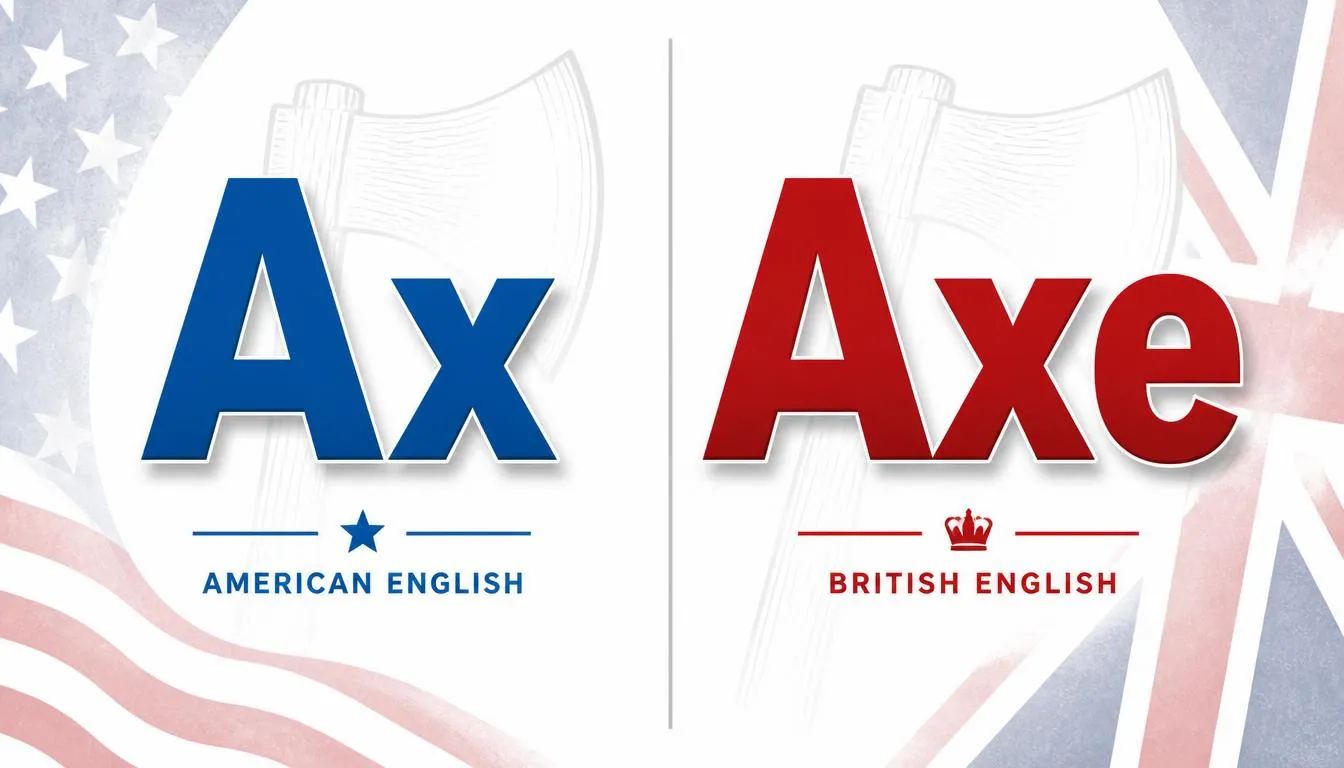
Both “ax” and “axe” are correct. “Axe” is the only standard spelling in British English. In American English, both are accepted, though “axe” is actually more common overall, even though style guides like AP and Chicago prefer “ax.”
⚡ Quick Rule in 1 Line
Axe works everywhere; ax is the shorter, style-guide-preferred option in American writing.
Ax vs Axe: The Real Difference
Ax and axe are two spellings of the same word, a chopping tool with a handle and a blade.
Both nouns and verbs work the same way regardless of spelling.
In British English, Australian, Canadian, and South African English, “axe” is the only accepted spelling.
In American English, both spellings are technically correct, which is where the confusion starts.
Unlike cleaner US/UK splits, such as “color” versus “colour,” this pair doesn’t divide neatly by country.
The Exception Nobody Tells You About
Here’s the twist most spelling guides skip: “axe” is actually more common in American writing too, not just British.
Garner’s Modern English Usage found “axe” outpaces “ax” by roughly two to one across English overall, including in the US.
Yet major American style guides tell a different story. The AP Stylebook, the Chicago Manual of Style, and even the Oxford English Dictionary list “ax” as the preferred American spelling.
This means journalists and writers following AP or Chicago style will see “ax” recommended, even though it’s the less common spelling in everyday American writing.
So the real rule isn’t really American versus British. It’s style guide versus general usage.
If you’re writing for a newspaper or publication with AP style rules, use “ax.” If you’re writing generally, “axe” is safe and arguably more standard, even in the US.
Comparison Table
| Context | Recommended Spelling | Why |
|---|---|---|
| British/Australian/Canadian English | Axe | Only accepted spelling |
| General American writing | Axe (more common) | Preferred 2:1 per Garner’s |
| AP Stylebook journalism | Ax | House style preference |
| Chicago Manual of Style | Ax | House style preference |
| Academic/formal US writing | Either, check your style guide | No single universal rule |
Memory Trick
Think of it this way: “Axe” has more letters, and it’s used in more places.
Britain, Australia, Canada, and most general American writing all lean toward the longer, more traditional “axe.”
Only specific American style guides — AP, Chicago — trim it down to “ax,” matching America’s general habit of dropping extra letters, as in “color” instead of “colour.”
If you’re not writing for a specific newsroom style guide, “axe” is the safer default.
Example Sentences
The woodcutter swung his axe against the old oak tree.
She kept an ax by the fireplace for splitting kindling.
The board decided to axe the failing project.
He was worried the company would ax his position next.
I sharpened the axe before heading into the woods.
The Stanford Axe is awarded to the winner of the Big Game.
They axed three characters from the show’s final season.
Her father taught her how to swing an ax safely.
The pickaxe leaned against the barn door.
He used the poleaxe as a decorative piece above the fireplace.
The manager had an axe to grind with the new policy.
Reporters, following AP style, wrote that the mayor planned to “ax the budget.”
Common Mistakes
Many writers assume “ax” is simply the American spelling and “axe” is British, missing the more nuanced reality.
Others mix both spellings within the same document, which looks inconsistent.
Some assume style guide preference reflects general usage, when Garner’s data shows the opposite is often true for “ax” versus “axe.”
Always check your specific style guide if you’re writing for a publication, and stay consistent throughout your piece either way.
When to Use Each Spelling
Use “axe” if you’re writing for a British, Australian, Canadian, or general international audience.
Use “axe” if you have no specific style guide requirement and want the historically dominant spelling.
Use “ax” only if you’re specifically following AP Stylebook, Chicago Manual of Style, or a publication that requires it.
When in doubt, “axe” remains the safer, more widely recognized choice.
Expert Tip 💡
If you’re a freelance writer, always check the specific publication’s style guide before defaulting to either spelling. Some outlets that generally follow AP style still make exceptions for “axe,” so a quick style-guide check saves you an editing round.
FAQs ❓
Is ax or axe correct?
Both are correct. Axe is the only standard British spelling, while American English accepts both, with axe actually being more common overall.
Is ax a misspelling?
No, ax is standard American English, particularly favored by AP Stylebook and Chicago Manual of Style, even though axe is used more often overall.
Which spelling is older?
Axe is the older, more traditional spelling, tracing back to Old English “æx.” Ax became more common in American print later.
Why does AP Stylebook prefer ax?
AP Stylebook favors shorter, simplified American spellings in several cases, similar to how it handles other trimmed word forms in journalism.
Is axe used in America at all?
Yes, axe is actually the more commonly used spelling in America overall, even though certain style guides recommend ax specifically.
Does the ax/axe difference affect the verb form?
No, both spellings work identically as verbs, as in “axed the plan” or “ax the plan,” with no difference in meaning.
What about words like pickax and poleax?
These compound words follow the same pattern: pickaxe/pickax and poleaxe/poleax both exist, with axe-based spellings generally more traditional.
Should I worry about mixing ax and axe in one document?
Yes, pick one spelling and stay consistent throughout your writing, regardless of which one you choose.
Conclusion
Ax and axe are the same word, and neither spelling is wrong.
Axe remains the standard choice in British English and is actually more common overall, even in America.
Ax survives mainly through specific American style guides like AP and Chicago.
Check your audience or style guide, stay consistent, and either spelling will serve you well.

Hi, I’m Daniel Carter. I’m passionate about helping learners improve their English with practical grammar tips and clear writing advice.