A student once wrote “here here” in a debate paper to show agreement with a speaker, and their teacher circled it immediately.
Since this phrase is almost always spoken aloud, most people have simply never seen it written correctly.
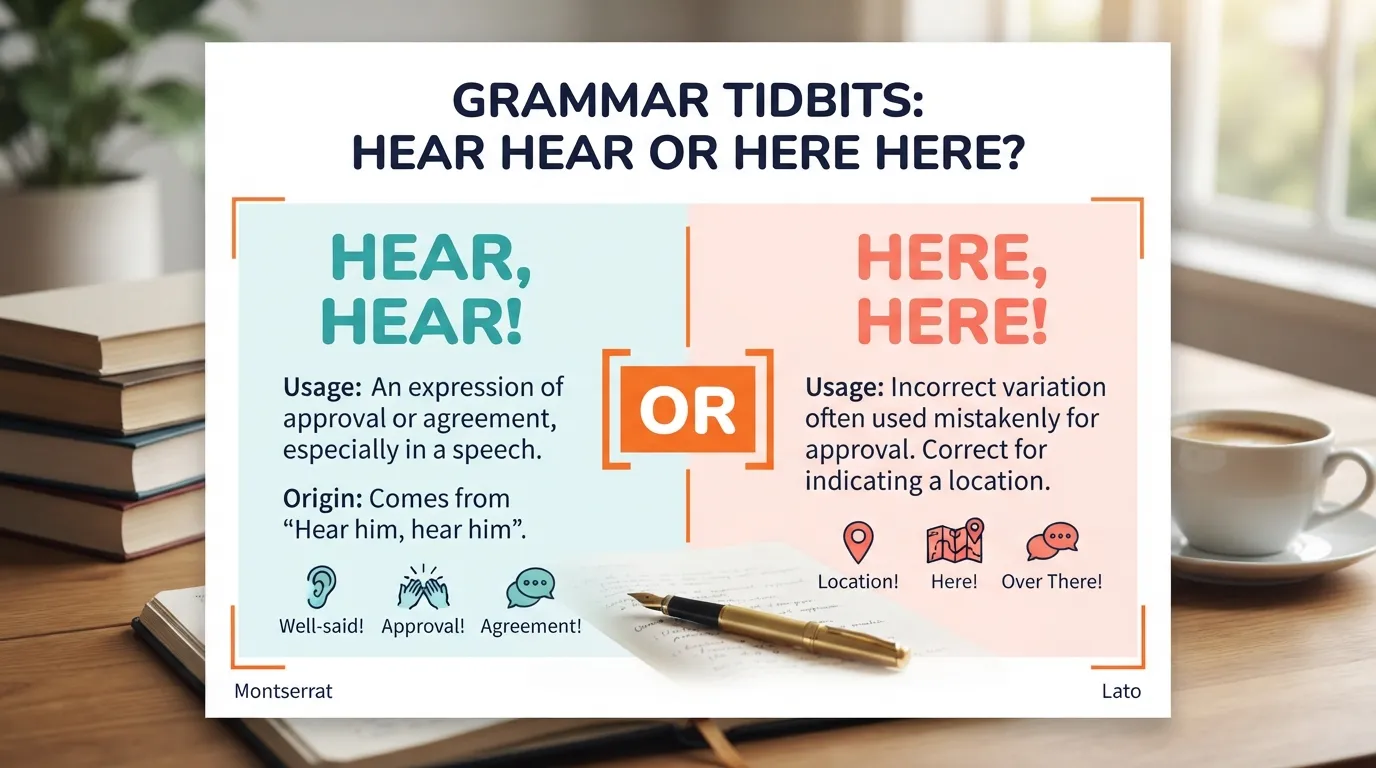
The correct expression is “hear, hear!” It’s used to show approval or agreement with something being said, especially in formal speeches or debates. “Here here” isn’t a recognized expression at all.
Once you know the phrase’s real origin, the correct spelling makes complete sense.
Quick Answer Box 🎯
The correct expression is “hear, hear!” not “here here.” It’s used to express agreement or approval, especially during speeches or debates, and originally meant “listen to this” in British parliamentary tradition. “Here here” is not a standard English expression.
Hear Hear vs Here Here: The Real Difference
“Hear, hear!” is the only correct spelling of this expression, used to show enthusiastic agreement or approval.
“Here here” is not a recognized phrase in standard English at all. It’s simply a common misspelling based on how the expression sounds when spoken.
Unlike other confused-word pairs on this site, this isn’t a true competition between two valid words. Only one version is actually correct.
The confusion happens because “hear” and “here” are homophones, and the expression is rarely seen in writing, so people guess based on sound alone.
The Parliamentary Origin
“Hear, hear!” traces back to the British Parliament in the 1600s and 1700s.
Members originally shouted “hear him, hear him!” to direct the chamber’s attention toward whoever was currently speaking.
Over time, this phrase shortened naturally to simply “hear, hear!” while keeping its core function: drawing attention to and supporting what a speaker was saying.
It evolved from a literal instruction — listen to this person — into a general expression of agreement or approval.
This history explains why “hear” is correct: the phrase is fundamentally about listening, not about location, which rules out “here” entirely.
Comparison Table
| Expression | Correct? | Meaning |
|---|---|---|
| Hear, hear! | ✅ Correct | Expresses agreement or approval, originally “listen to this” |
| Here here | ❌ Incorrect | Not a recognized English expression |
| Hear ye, hear ye | ✅ Correct, different phrase | Traditional announcement phrase, historically used by town criers |
Memory Trick
Think of it this way: You “hear” a speech with your ears, and “hear, hear!” tells others to listen too.
If you remember the phrase’s real meaning — “listen to this” — the word “hear” becomes the obvious choice, since “here” has nothing to do with listening.
Picture someone cupping a hand to their ear while saying it, reinforcing that this expression is entirely about hearing, not location.
Example Sentences
“Hear, hear!” shouted several members after the senator’s speech.
The crowd responded with a chorus of “hear, hear!”
When she proposed the toast, everyone replied, “Hear, hear!”
The debate team erupted into “hear, hear!” after his closing argument.
“Hear, hear!” the committee agreed, nodding along with the proposal.
His colleagues murmured “hear, hear!” in support of the new policy.
The audience called out “hear, hear!” after the compelling testimony.
At the town hall, residents shouted “hear, hear!” to support the speaker.
Common Mistakes
The most common mistake is writing “here here,” based purely on how the phrase sounds when spoken aloud.
Since this expression is rarely written down in casual contexts, many people have simply never seen the correct spelling before guessing.
Some assume it relates to pointing at something (“here”), missing the phrase’s actual meaning tied to listening and attention.
This mistake appears often in casual online writing, forum posts, and informal transcriptions of speeches or debates.
Knowing the phrase’s parliamentary origin makes the correct spelling much easier to remember going forward.
When to Use It
Use “hear, hear!” to express agreement or approval, especially after someone makes a compelling point in a speech, debate, or discussion.
It works well in both formal settings, like meetings or parliamentary proceedings, and informal settings, like toasts or casual agreement.
Always include the comma between the two words, matching its traditional, standard punctuation.
Avoid using “here here” entirely, since it’s not a recognized expression in any context.
Expert Tip 💡
Since “hear, hear!” is rarely used in everyday writing outside of formal or semi-formal contexts, it’s worth double-checking this one specifically if you’re writing dialogue, meeting minutes, or a debate transcript — contexts where this expression shows up most often and where the error is most visible to careful readers.
FAQs ❓
Is it “hear hear” or “here here”?
It’s “hear, hear!” The correct expression comes from British parliamentary tradition and means “listen to this,” expressing agreement or approval.
What does “hear, hear!” mean?
It means agreement or approval, especially in response to a speech or statement, originally shortened from “hear him, hear him!”
Is “here here” ever correct?
No, “here here” is not a recognized English expression in any context. It’s simply a common misspelling of “hear, hear!”
Where does “hear, hear!” come from?
It originated in the British Parliament in the 1600s and 1700s, shortened from “hear him, hear him!” directing attention to a speaker.
Does “hear, hear!” need a comma?
Traditionally, yes, it’s written as “hear, hear!” with a comma separating the repeated word, matching its standard punctuation.
Is “hear, hear!” still used today?
Yes, it remains common in formal speeches, debates, parliamentary proceedings, and even casual expressions of agreement.
How can I remember the correct spelling?
Remember the phrase’s meaning: “listen to this.” Since it’s about hearing, not location, “hear” is always the correct spelling.
Conclusion
The correct expression is “hear, hear!” not “here here.”
It traces back to British Parliament, originally meaning “listen to this,” and evolved into a general expression of agreement.
Since “here here” isn’t a real English phrase, remembering the expression’s true meaning makes the correct spelling obvious.
Next time you want to show enthusiastic agreement, you’ll know exactly how to write it correctly.

Hi, I’m Daniel Carter. I’m passionate about helping learners improve their English with practical grammar tips and clear writing advice.