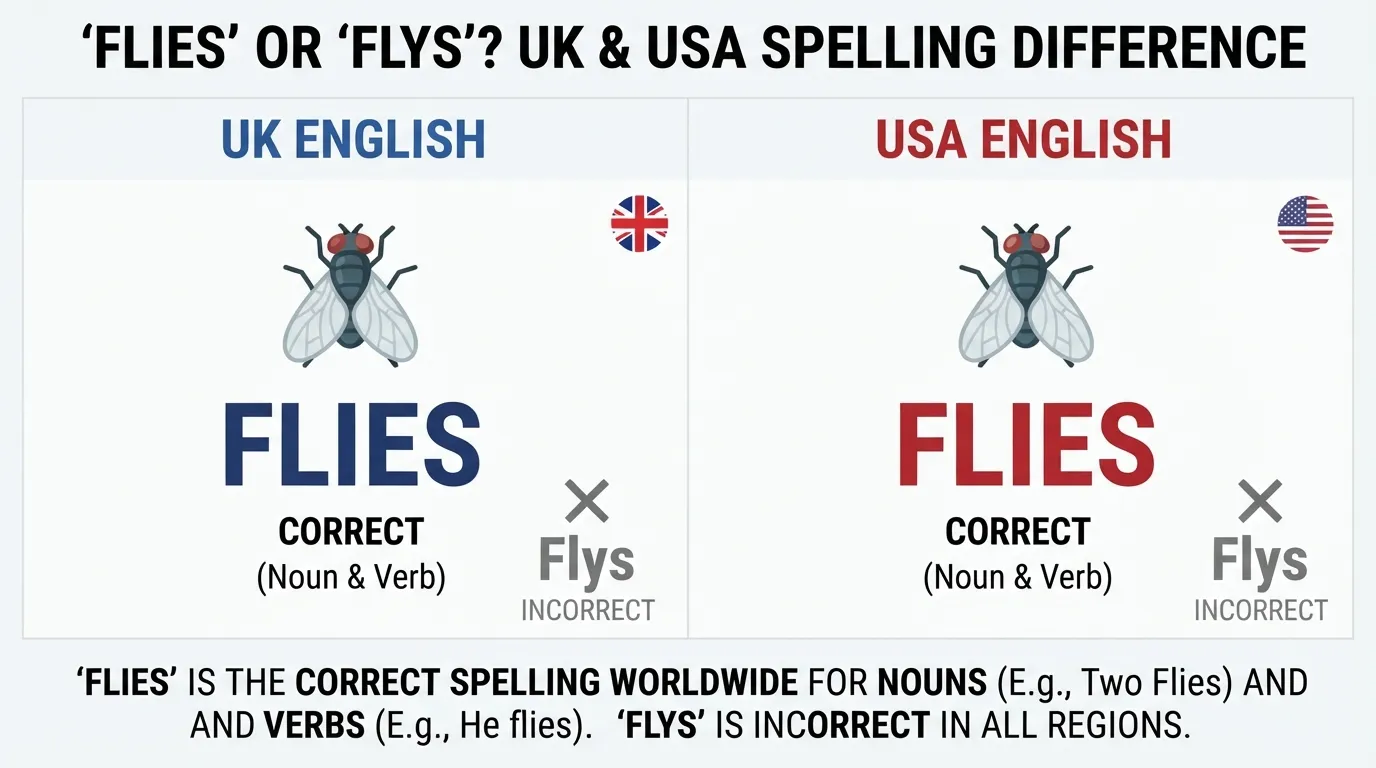
Have you ever wondered whether the correct spelling is flies or flys? You’re not alone.
This is a common English spelling question, especially when talking about more than one fly or using the verb fly in a sentence.
The correct spelling depends on how you use the word. Flies is the standard and correct form in English, while flys is generally considered incorrect.
In this guide, we’ll explain flies vs. flys, show you when to use each form, and give you clear examples so you can avoid this common spelling mistake.
Quick answer: The correct spelling is always “flies,” whether you mean the insect, the plural noun, or the verb form (as in “time flies”). “Flys” is a misspelling in every modern context.
Table of Contents
- Quick Answer Box
- Quick Rule in One Line
- The Difference Explained
- Grammar Rule: The Consonant + Y Pattern
- Comparison Table
- Memory Trick
- Example Sentences
- “Flies By,” “Flies Off,” “Flies Away” — Same Rule Applies
- Common Mistakes
- When to Use Each Form
- Expert Tip
- Flies or Flys: Quick Answers
- Time Flies or Time Flys?
- Plural of Fly
- Flies as a Verb: He Flies, She Flies, It Flies
- Fly vs Flies vs Fly’s
- Flies in Fly Fishing and Other Meanings
- Why Does Fly Become Flies?
- How to Spell Flies and Flys
- Flies or Flys in Other Languages: Quick Answers
- More Examples
- FAQs
- Conclusion
Quick Answer Box
“Flies” is correct for the plural of the insect (“three flies”), and for the verb “to fly” in its third-person present tense (“time flies”).
“Flys” is not standard English. The only exception is a rare historical use referring to old horse-drawn carriages, plus proper nouns like surnames.
⚡ Quick Rule in 1 Line
“Fly ends in a consonant plus Y, so the Y always changes to IES.”
The Difference Explained
“Fly” ends in a consonant (L) followed by Y. English has a reliable rule for words like this: drop the Y and add “-ies.”
That rule applies whether “fly” is working as a noun (an insect) or as a verb (to move through the air). Either way, the result is “flies.”
“Flys” simply skips that rule, adding an S directly onto “fly” the way you would for most other words. That shortcut doesn’t apply here.
Grammar Rule: The Consonant + Y Pattern
English nouns and verbs ending in a consonant plus Y almost always follow the same pattern.
Change the Y to I, then add “-es.” “Baby” becomes “babies.” “City” becomes “cities.” “Fly” becomes “flies.”
This is different from words ending in a vowel plus Y, like “day” or “toy,” which simply add S: “days,” “toys.” Fly doesn’t qualify for that shortcut, since it ends in consonant + Y, not vowel + Y.
Comparison Table
| Feature | Flies | Flys |
|---|---|---|
| Status | Correct in all modern uses | Misspelling (except rare historical/proper noun use) |
| As a noun | Plural of the insect | Not standard |
| As a verb | Third-person singular (“she flies”) | Not standard |
| Idiom | Time flies | Incorrect |
| Historical use | N/A | 19th-century word for a small carriage |
Memory Trick
Picture a fly buzzing straight into a jar labeled “IES.” Every time “fly” needs an ending, that Y gets swapped out and the jar’s letters go on instead.
Consonant plus Y almost always means IES, not just S.
Example Sentences
Using “flies” (insect, plural noun):
There are three flies buzzing around the kitchen.
Fruit flies gather near ripe bananas.
She swatted at the flies on the porch.
House flies can carry bacteria on their legs.
The barn was full of flies in the summer heat.
Using “flies” (verb):
Time flies when you’re having fun.
The plane flies out of gate twelve.
She flies to Chicago every other week.
A hummingbird flies in short, fast bursts.
He flies through his homework in under an hour.
“Flies By,” “Flies Off,” “Flies Away” — Same Rule Applies
Any phrase pairing “fly” with a preposition follows the exact same spelling rule.
“Flies by” (not “flys by”), “flies off” (not “flys off”), and “flies away” (not “flys away”) are all correct, since the base verb form is still “flies.”
Example: “The weekend flies by,” “The bird flies off at the first sign of danger,” “She flies away for vacation every July.”
Common Mistakes
❌ There were so many flys in the garage.
✅ There were so many flies in the garage.
❌ Time flys when you’re on vacation.
✅ Time flies when you’re on vacation.
❌ My uncle flys to Denver every summer.
✅ My uncle flies to Denver every summer.
When to Use Each Form
Always use “flies” for the insect, for the verb form, and for the common idiom “time flies.” There’s no everyday context where “flys” is correct.
The only exceptions are proper nouns, like a surname spelled “Flys,” or historical writing set in 19th-century Britain describing the old carriage.
Expert Tip 💡
If a spell checker flags “flys,” trust it. This is one of the rare cases where the rule has almost no modern exceptions, so there’s no need to second-guess the correction.
Flies or Flys: Quick Answers
Here are fast answers to the most common versions of the question.
Which Is Correct, Flys or Flies?
“Flies” is correct. “Flys” is a misspelling in modern English.
Is It Flies or Flys?
It’s “flies,” for both the insect and the verb.
Is Flys a Word?
Not in everyday English. “Flys” only appears as a surname or in a rare historical sense.
Flys Meaning and Define Flys
The “Flys” has no standard meaning today. Historically, it was a word for a small carriage.
Flies and Flys: Duplicate Searches
If you searched “flys flies,” “flies flys,” or “fly flies flys,” you probably meant “flies or flys.”
Fly + S
Adding just “s” to “fly” gives “flys,” which is wrong. Change the “y” to “ies” instead.
Time Flies or Time Flys?
It’s “time flies.”
“Flies” is the correct verb form, because “time” is a singular subject.
Is It Right to Say Time Flies?
Yes. “Time flies” is a common idiom meaning that time seems to pass quickly.
It’s usually completed as “time flies when you’re having fun.”
Flies By or Flys By?
It’s “flies by.” For example, “the weekend flies by.”
“Flies bye” is a different spelling error. The phrase uses “by.”
Flies Off or Flys Off?
It’s “flies off.” “The bird flies off at the first sign of danger.”
Flies Away or Flys Away?
It’s “flies away.” “She flies away for vacation every July.”
Flies Home or Flys Home?
It’s “flies home.” “He flies home on Friday.”
Before the Snow Flies or Flys?
It’s “before the snow flies.” This idiom means before it starts to snow.
Plural of Fly
The plural of the insect “fly” is “flies.”
Fly Plural and Plural Form of Fly
The plural is “flies.”
- one fly
- two flies
- a swarm of flies
More Than One Fly
For more than one fly, write “flies.”
Plural of Fly (Plane)
When “fly” is a noun for an aircraft trip, you still use “flies” as the plural, but you’ll more often say “flights.”
Plural of a Fly, Plural for Fly, Plural of Insect Fly
All of these have one answer: “flies.”
Singular Form of Flies
The singular of “flies” (the noun) is “fly.”
Plural of Flies
“Flies” is already plural, so there’s no further plural form.
Flying Plural
“Flying” is the -ing form of the verb. It has no plural.
Plural of To Fly
“To fly” is a verb, so it doesn’t have a plural. The third-person singular form is “flies.”
Flies as a Verb: He Flies, She Flies, It Flies
“Flies” is also the he/she/it form of the verb “to fly.”
| Subject | Present tense |
|---|---|
| I / you / we / they | fly |
| he / she / it | flies |
Verb Forms of Fly
| Form | Word | Example |
|---|---|---|
| Base | fly | I fly to Chicago. |
| Third person | flies | She flies to Chicago. |
| Past | flew | He flew to Chicago. |
| Past participle | flown | She has flown there. |
| -ing | flying | They are flying there. |
He Flies or He Flys?
It’s “he flies.” The same goes for “she flies” and “it flies.”
The Plane Flies or Flys?
It’s “the plane flies.”
The same rule applies to “the airplane flies” and “a plane flies.”
The Bird Flies or Flys?
It’s “the bird flies.”
Flies With S?
When you add “s” for the he/she/it form, “fly” becomes “flies.”
Flies Verb Form
“Flies” as a verb is the present tense for singular subjects.
Is Flies a Noun?
Yes, “flies” is also the plural noun for the insect.
It’s both a noun (insects) and a verb (he flies).
Fly vs Flies vs Fly’s
These three look alike but do different jobs.
| Form | Job | Example |
|---|---|---|
| fly | one insect, or base verb | A fly landed on the table. |
| flies | plural noun, or he/she/it verb | Flies are buzzing. / She flies often. |
| fly’s | possessive, or “fly is” | The fly’s wing is damaged. |
When to Use Fly or Flies?
Use “fly” for one insect or after I, you, we, and they. Use “flies” for more than one insect or after he, she, or it.
What Is the Difference Between Fly’s and Flies?
“Fly’s” has an apostrophe and shows possession: “the fly’s wings.”
“Flies” is the plural noun or the he/she/it verb. It doesn’t take an apostrophe.
Flies in Fly Fishing and Other Meanings
“Flies” has a few special meanings.
The Flies or Flys for Fishing
In fly fishing, artificial lures are called “flies.”
For example, “she ties her own flies.” It’s never “flys.”
Flies in Baseball
In baseball, a high-hit ball is a “fly,” and a sacrifice fly is plural “sacrifice flies.”
Flies in Clothing
In British English, “flies” can mean the zip on trousers.
Flies in Theater
In theater, “the flies” is the area above the stage where scenery is hung.
Why Does Fly Become Flies?
Words ending in a consonant plus “y” change the “y” to “i” and add “-es.”
| Word | Plural or he/she/it form |
|---|---|
| fly | flies |
| baby | babies |
| city | cities |
| puppy | puppies |
| try | tries |
| cry | cries |
The Words Ending in Vowel Plus Y
Words ending in a vowel plus “y” just add “s.” For example, day becomes days and toy becomes toys.
Surnames and Proper Nouns
Surnames ending in “y” usually keep the “y” and add “s,” like “the Kennedys.”
So “the Flys” can be correct for a family called Fly.
How to Spell Flies and Flys
Here’s how each is spelled.
- Flies: F-L-I-E-S
- Flys: F-L-Y-S (not standard)
Common Misspellings
- Flyes, flie, flis
- Flys, fly s
- Flies bye (confusing “by” with “bye”)
How Do You Spell Flies?
F-L-I-E-S. It has an “i” and an “e” before the “s.”
Flies or Flys in Other Languages: Quick Answers
Many readers search this in their own language.
- Thai: “Flys” หรือ “flies”? “Flies” ถูกต้อง ส่วน “flys” สะกดผิด
- Russian: “Flies” или “flys”? Правильно “flies.” “Flys” — ошибка.
- Vietnamese: “Flys” hay “flies”? “Flies” là đúng.
- Roman Urdu: “Flys” ghalat hai. Sahi “flies” hai.
More Examples
Here are a few more sentences with “flies.”
- The flies left when the window opened.
- He flies a small plane on weekends.
- The week flies by.
- Time flies when we’re together.
- She flies home on Friday.
- The fisherman tied new flies.
FAQs
Question: Is “flys” ever correct today?
Answer: Only as a proper noun, such as a surname, or in historical writing about 19th-century carriages. For everyday use, it’s always “flies.”
Question: What is the plural of “fly”?
Answer: “Flies,” following the consonant + Y rule that changes Y to “-ies.”
Question: Is “flies” the correct form for “time flies”?
Answer: Yes. “Flies” is the correct third-person singular verb form in this common idiom.
Question: Why do people misspell it as “flys”?
Answer: Because adding just an S is the default way to form plurals in English, so writers apply that shortcut without noticing “fly” needs the “-ies” pattern instead.
Question: Does this rule apply to other words ending in consonant + Y?
Answer: Yes. Words like “baby,” “city,” and “puppy” follow the same pattern: babies, cities, puppies.
Question: Is there a difference between American and British English here?
Answer: No. Both use “flies” as the standard spelling, with no regional variation.
Question: What does “flys” mean historically?
Answer: It once referred to a small, light carriage pulled by a horse in 19th-century England, unrelated to today’s meaning.
Question: Can “flys” be a name?
Answer: Yes, as a surname or brand name it can appear that way, but that’s a proper noun, not a spelling rule exception.
Question: Is “flies” a noun?
Answer: Yes, in one sense — “flies” is the plural noun for the insect. It’s also a verb, the third-person singular form of “to fly.”
Question: Does “flies” apply the same way to planes as to insects?
Answer: Yes. “The plane flies” uses the same verb form as “time flies” — both are the third-person singular of “to fly,” unrelated to the insect meaning.
Question: Does this spelling rule change in other languages?
Answer: No — “flies” is strictly an English spelling rule. If you searched this in another language, the answer is the same: “flies” is always correct in English, regardless of the language you searched from.
People Also Ask
Question: Which is correct, flys or flies?
Answer: “Flies” is correct. “Flys” is a misspelling in modern English.
Question: Is it time flies or flys?
Answer: It’s “time flies.”
Question: When to use fly or flies?
Answer: Use “fly” for one insect or after I, you, we, and they. Use “flies” for more than one insect or after he, she, or it.
Question: Is it right to say time flies?
Answer: Yes. It’s a common idiom meaning that time seems to pass quickly.
People Also Search For
Question: Time flies or flys
Answer: “Time flies.”
Question: Flies or flys for plane
Answer: “The plane flies.”
Question: Flies or flys meaning
Answer: “Flies” is the plural of the insect and the he/she/it verb form. “Flys” has no standard meaning.
Question: Flies or flys away
Answer: “Flies away.”
Question: The bird flies or flys
Answer: “The bird flies.”
Question: She flies or flys
Answer: “She flies.”
Question: Flies or flys fishing
Answer: “Flies” is the word for artificial lures in fly fishing.
Question: Is flys a word
Answer: Only as a surname or in a rare historical sense. In everyday English, use “flies.”
More Questions About Flies and Flys
Question: What is the plural of fly?
Answer: Flies.
Question: How do you spell flies?
Answer: F-L-I-E-S.
Question: Is it he flies or he flys?
Answer: He flies.
Question: Is it flies by or flys by?
Answer: Flies by.
Question: Is it before the snow flies or flys?
Answer: Before the snow flies.
Question: What is the difference between fly’s and flies?
Answer: “Fly’s” is possessive (“the fly’s wing”), and “flies” is plural or the he/she/it verb form.
Question: What is the difference between flies and flys?
Answer: “Flies” is the standard spelling. “Flys” is a misspelling in modern English.
Question: Is flies a verb?
Answer: Yes, it’s the he/she/it form of “to fly.”
Question: Is flies a noun?
Answer: Yes, it’s the plural noun for the insect.
Flies ya flys, kaunsa sahi hai?
Answer: “Flies” sahi hai. “Flys” ghalat spelling hai.
Fly ka plural kya hai?
Answer: Fly ka plural “flies” hai.
Conclusion
“Flies” is the correct spelling for the insect, the verb form, and the idiom “time flies.” “Flys” isn’t a standard word in modern English, aside from rare historical or proper-noun uses.
Once you remember the consonant + Y rule, this spelling becomes automatic.

Hi, I’m Sophia Bennett. My goal is to make grammar easy, clear, and useful through simple explanations and real-life examples.