You wrote “we need to discuss this farther,” and a colleague quietly changed it to “further” before sending the email out.
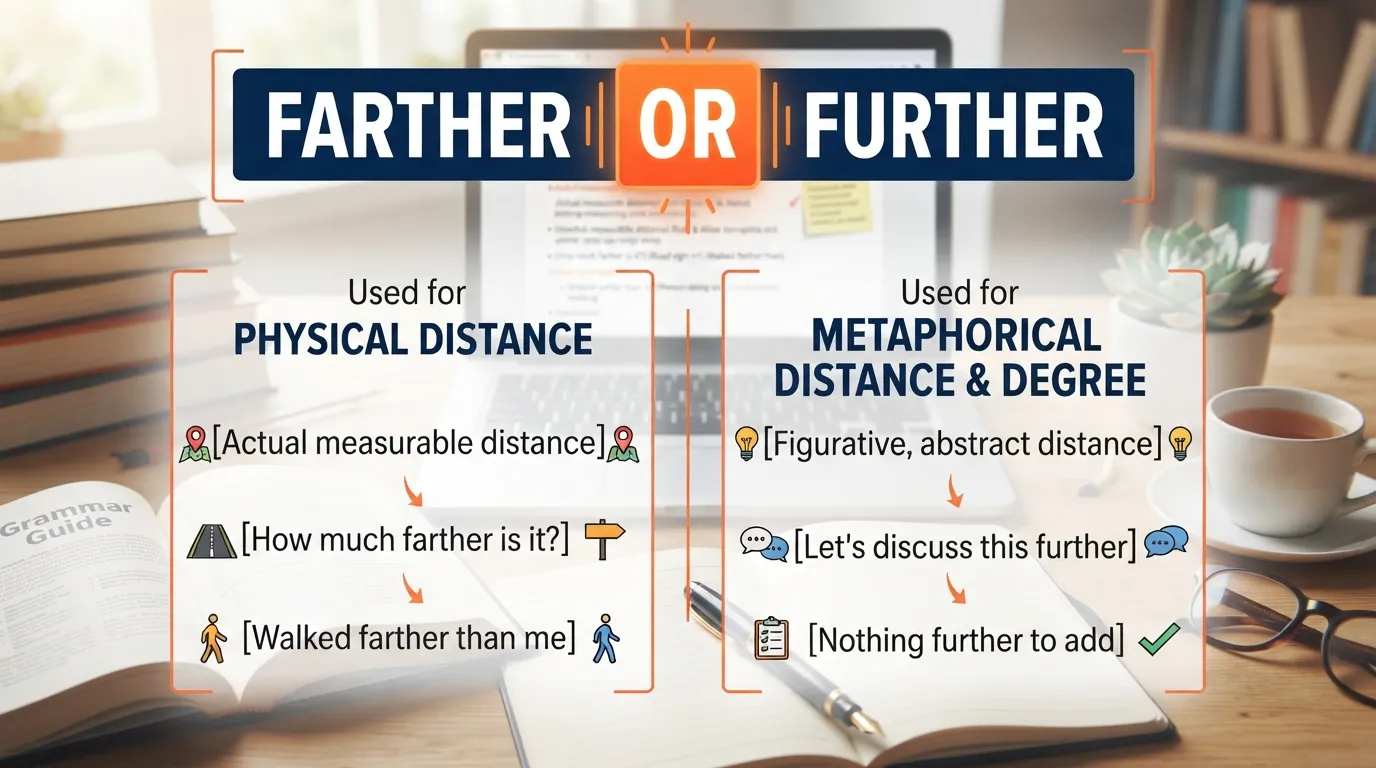
Here’s the quick fix: farther refers to physical distance, while further refers to figurative or additional degree.
Say “farther down the road” for physical distance, but “further discussion” for something abstract.
Once you separate physical distance from figurative progress, this word pair stops being confusing.
Quick Answer
Farther describes physical, measurable distance (“The store is farther than I thought”).
Further describes additional degree, extent, or figurative progress (“We need further discussion on this topic”).
Many style guides still maintain this distinction, though everyday speech often blurs the two.
⚡ Quick Rule
Farther means physical distance; further means figurative or additional — distance versus degree.
Farther vs Further: The Core Difference
“Further” is used for figurative distance, meaning “more,” “additional,” or “to a greater extent.”
Say “He walked farther than his friend” (measurable distance), versus “Let’s discuss this further” (additional depth, not physical distance).
This physical-versus-figurative distinction is the traditional rule taught in most style guides.
Grammar Rule Explained
There’s no regional spelling difference here — this is a meaning distinction based on physical versus figurative use.
Both words function as comparative adverbs or adjectives, describing “more” of something.
“Farther” comes from “far,” specifically tied to physical space and measurable distance.
“Further” comes from an older root meaning “additional” or “more,” which naturally extended to abstract, non-physical contexts.
Farther vs Further Comparison Table
| Feature | Farther | Further |
|---|---|---|
| Meaning | Additional physical distance | Additional degree or extent |
| Context | Measurable distance | Abstract or figurative progress |
| Example | The city is farther than expected | We need further clarification |
| Can be a verb? | No | Yes (“to further a cause”) |
Memory Trick
Remember: “Farther” contains the word “far,” which relates to physical distance.
“Further” doesn’t contain “far,” so use it for anything that isn’t physical distance — ideas, discussions, or plans.
If you can replace the word with “more miles” or “more steps,” use farther. If you mean “more” in any other sense, use further.
Real Example Sentences
Using Farther (physical distance):
- The hotel is farther from the airport than we thought.
- She ran farther today than yesterday.
- The nearest gas station is a mile farther down this road.
- He threw the ball farther than anyone else.
- Our new house is farther from downtown.
Using Further (figurative or additional):
- We need further information before deciding.
- Let’s discuss this further at our next meeting.
- The project requires further research.
- She has no further questions at this time.
- The company plans to expand further next year.
Further as a Verb: Furthering a Cause
Unlike “farther,” the word “further” can also function as a verb, meaning to promote or advance something.
Example: “She volunteers to further the cause of animal rights” — meaning she helps advance or support that cause.
“Farther” cannot be used as a verb in modern English, which is one clear way to tell the two words apart.
If you’re describing an action of promoting or advancing something, “further” is always the correct choice.
Does This Rule Still Matter Today?
Many major dictionaries, including Merriam-Webster, note that “further” is increasingly used for both physical and figurative distance in everyday speech.
However, most formal style guides, academic writing, and professional editors still maintain the traditional farther/further distinction.
For casual writing, using “further” for both meanings is unlikely to cause confusion.
For formal, academic, or professional writing, following the traditional rule remains the safer choice.
Common Mistakes
1. Using “further” for clearly physical distance in formal writing Incorrect (formal): The store is further than I thought. Correct (formal): The store is farther than I thought.
2. Using “farther” for abstract or figurative situations Incorrect: We need to discuss this farther. Correct: We need to discuss this further.
3. Using “farther” as a verb Incorrect: She wants to farther her education. Correct: She wants to further her education.
4. Assuming the rule no longer applies anywhere While casual speech blends the two, formal and professional writing still expects the traditional distinction.
When to Use Each Word
Use Farther When:
- Referring to measurable, physical distance
- Writing formally or academically
- Comparing how far something travels or extends physically
Examples: farther away, farther down the road, farther than expected
Use Further When:
- Referring to additional degree, extent, or abstract progress
- Using the word as a verb
- Discussing ideas, plans, or figurative distance
Examples: further discussion, further notice, further the cause
FAQs
Is it farther or further?
It depends on meaning: farther refers to physical distance, while further refers to figurative or additional degree.
Can I use “further” for physical distance too?
In casual speech, many people do, but formal writing typically reserves “farther” for physical distance specifically.
Can “farther” be used as a verb?
No. Only “further” can function as a verb, meaning to promote or advance something.
What does “further” mean as a verb?
As a verb, “further” means to help advance or promote a cause, goal, or plan.
Is “further” used more often than “farther” today?
Yes, especially in everyday speech, “further” is increasingly used for both meanings, though formal writing still separates them.
What’s an easy way to remember the difference?
Remember that “farther” contains the word “far,” linking it directly to physical distance.
Is this a British versus American spelling difference?
No, this isn’t a regional spelling variation — both words exist and are used similarly in American and British English.
Should I always follow the traditional farther/further rule?
For formal, academic, or professional writing, yes. For casual writing, the distinction matters less today.
Conclusion
Farther and further both mean “more,” but they apply to different kinds of distance.
Farther is reserved for physical, measurable distance, while further covers figurative progress, additional degree, and can even function as a verb.
Following this traditional rule keeps your formal and professional writing precise, even as casual usage continues to blend the two.

Hi, I’m Sophia Bennett. My goal is to make grammar easy, clear, and useful through simple explanations and real-life examples.