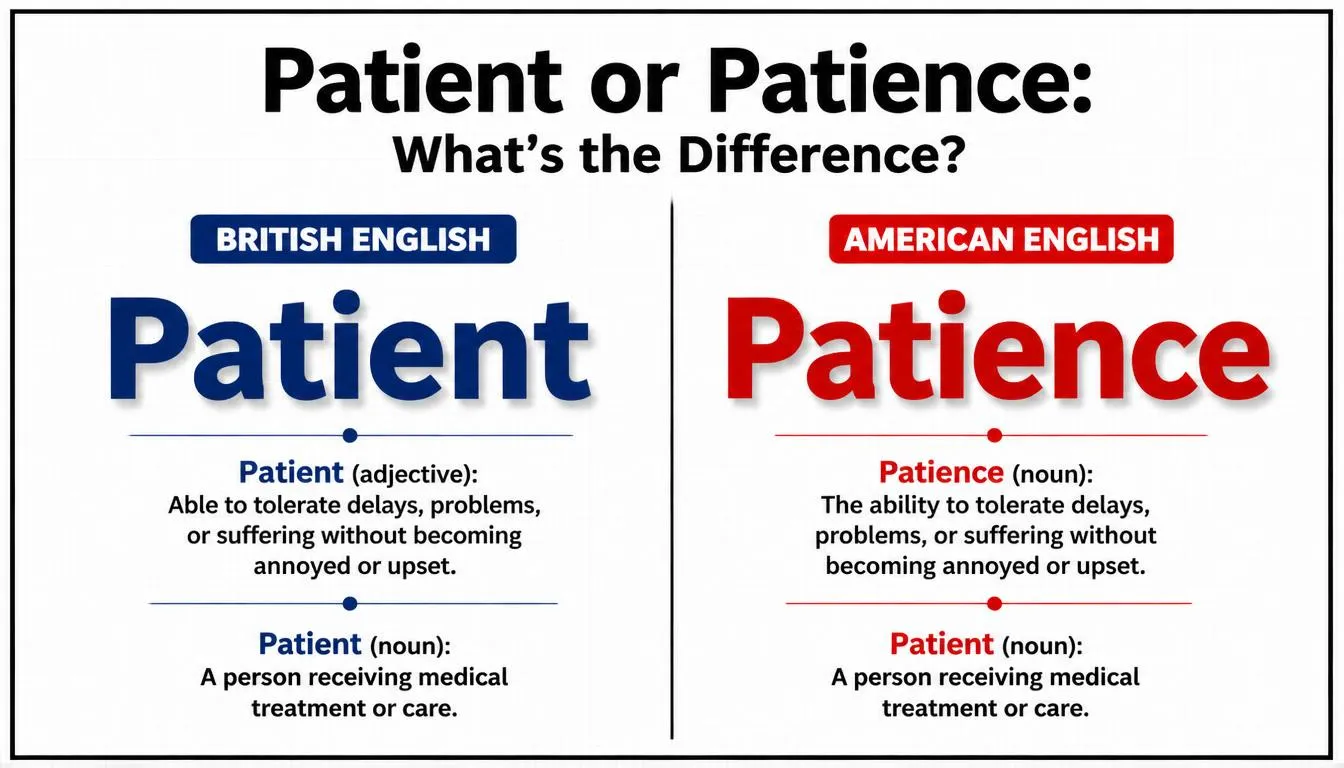
“Patient” works as an adjective (“a patient teacher”) or as a noun meaning a person receiving medical care (“the doctor’s patient”).
“Patience” is only a noun, an abstract quality meaning the ability to stay calm while waiting or dealing with problems.
You’re writing an email, “thank you for your patient while we resolve this,” and something looks off, even though the sentence still sort of makes sense.
Quick answer:
“Patient” is an adjective meaning calm and able to wait without getting annoyed, or a noun meaning someone receiving medical care.
“Patience” is the abstract noun for that calm quality itself.
If you can say “thank you for your calmness,” you need “patience.”
Table of Contents
- Quick Answer Box
- Quick Rule in One Line
- The Difference Explained
- Grammar Rule: Adjective vs Abstract Noun
- Is Patience an Abstract Noun?
- Patients or Patience? Don’t Mix Up the Plural and the Quality
- Patient’s or Patients’? Singular and Plural Possessive
- Comparison Table
- Does Patient Have a Superlative or Tense Form?
- Memory Trick
- How to Spell Patient and Patience
- Example Sentences
- Be Patient or Have Patience?
- Common Mistakes
- When to Use Each Form
- Expert Tip
- What Do Patient and Patience Mean?
- What Is Being Patient?
- Part of Speech: Is Patient a Noun or an Adjective?
- What Type of Noun Is Patience?
- Past Tense and Present Tense of Patient and Patience
- Comparative, Superlative, and Negative Forms of Patient
- Be Patient, Have Patience, and Thank You for Your Patience
- Patient or Patience in a Hospital
- Possessives: Doctor’s Patience and the Patient’s Chart
- Patient Is to Patience as Opulent Is to Opulence
- How to Spell Patient, Patience, and Patients
- Patient vs Patience Pronunciation and Homophones
- 10 Sentences With Patient and Patience
- Patient vs Patience in Other Languages: Quick Answers
- FAQs
- Conclusion
⚡ Quick Rule in 1 Line
“Patience is the quality; patient is the person or the description.”
The Difference Explained
“Patient” can do two different jobs in a sentence.
As an adjective, it describes someone who stays calm and doesn’t get easily frustrated: “She is a patient listener.”
As a noun, it refers to a person receiving medical treatment: “The nurse checked on her patient.”
“Patience” only works one way. It’s an abstract, uncountable noun describing the quality of staying calm, as in “He handled the delay with patience.”
The confusing part: the adjective “patient” is actually the root word, and “patience” is the noun form built from it, similar to how “silent” relates to “silence.”
Grammar Rule: Adjective vs Abstract Noun
“Patient” as an adjective describes a person’s behavior or character: patient, calm, tolerant.
“Patient” as a noun names a specific kind of person, someone under medical care, and it takes a regular plural: patients.
“Patience” belongs to a small family of abstract nouns ending in “-ence,” alongside words like “silence” and “prudence.”
These nouns name a quality or state, not a person, and they’re typically uncountable, meaning they don’t take a plural form (“patiences” isn’t standard).
A quick structural test: if the word needs “a” or “the” in front of it and refers to a person, you likely need “patient.” If it’s describing a quality someone has or needs, you likely need “patience.”
Is Patience an Abstract Noun?
Yes. “Patience” is the abstract noun form of “patient.”
It names a quality, not a physical thing or a person, so grammar guides classify it as abstract.
It’s also uncountable. You can say “some patience” or “a lot of patience,” but never “a patience” or “two patiences.”
One more thing worth knowing: “patience” is only ever a noun. It doesn’t have an adjective form of its own — that job belongs to “patient.”
Patients or Patience? Don’t Mix Up the Plural and the Quality
These two get confused constantly because they sound almost the same.
“Patients” is the plural of the noun “patient.” It means more than one person receiving medical care: “The clinic saw twelve patients today.”
“Patience” is the quality of staying calm. It has no plural form at all.
❌ “Thank you for your patients while we sort this out.”
✅ “Thank you for your patience while we sort this out.”
If you’re not talking about people in a hospital or clinic, you almost always want “patience.”
Patient’s or Patients’? Singular and Plural Possessive
This is a different mix-up, and it has nothing to do with “patience.”
“Patient’s” (apostrophe before the “s”) shows something belongs to one patient: “the patient’s chart.”
“Patients'” (apostrophe after the “s”) shows something belongs to more than one patient: “the patients’ waiting room.”
Neither of these forms is ever spelled “patience’s.”
Comparison Table
| Feature | Patient | Patience |
|---|---|---|
| Part of speech | Adjective, or noun (person) | Noun only (quality) |
| Meaning | Calm and tolerant; or a person receiving care | The quality of staying calm |
| Countable? | Yes, as a noun (“patients”) | No, uncountable |
| Example | She is a patient teacher. / The patient waited for the doctor. | She waited with great patience. |
| Related words | patiently, impatient | impatience |
Does Patient Have a Superlative or Tense Form?
“Patient” and “patience” aren’t verbs, so neither one has a present or past tense.
As an adjective, “patient” does have comparative and superlative forms: more patient, most patient.
The negative form of the adjective is “impatient,” not “unpatient.”
The negative form of the noun is “impatience,” not “unpatience” or “non-patience.”
Memory Trick
Notice the ending: “patience” ends in “-ence,” the same way “silence” and “prudence” do, all naming an abstract quality.
“Patient” ends in “-ent,” the same way “silent” and “prudent” do, both working as adjectives describing a person’s trait.
How to Spell Patient and Patience
“Patient” is spelled P-A-T-I-E-N-T, ending in “-ent.”
“Patience” is spelled P-A-T-I-E-N-C-E, ending in “-ence.”
“Pation” and “pacient” are common misspellings, borrowed from how the word sounds or looks in other languages. Neither is correct in English.
The spelling stays exactly the same whether you mean calm, waiting, or a person under medical care — “patient” only has one correct spelling for all three meanings.
Example Sentences
Using “patient” (adjective):
She is a patient and encouraging teacher.
He remained patient even during the long delay.
Being a patient listener helps build trust.
The coach stayed patient with the young players.
A patient response works better than an angry one.
Using “patient” (noun, medical):
The doctor examined her next patient.
The hospital admitted three new patients today.
Each patient received a follow-up call after surgery.
The nurse checked on her patient every hour.
The clinic serves patients from across the county.
in Using “patience” (noun, quality):
Thank you for your patience during the delay.
Raising toddlers requires an enormous amount of patience.
Her patience finally paid off after months of practice.
He handled the criticism with remarkable patience.
It takes patience to learn a new language well.
Be Patient or Have Patience?
“Be patient” is the correct phrase when telling someone to stay calm: “Please be patient.”
“Patience” can’t follow “be” directly in this instruction, because “patience” isn’t an adjective.
“Have patience” is the correct alternative, using “patience” as a noun: “Please have patience.”
Both phrases are common and correct. “Be patient” describes a state; “have patience” names the quality directly.
Common Mistakes
❌ Thank you for your patient while we fix this issue.
✅ Thank you for your patience while we fix this issue.
❌ He was a patience man during the crisis.
✅ He was a patient man during the crisis.
❌ The doctor has ten patience waiting in the lobby.
✅ The doctor has ten patients waiting in the lobby.
❌ Thank you for your patients (when you mean the quality, not the people).
✅ Thank you for your patience.
When to Use Each Form
Use “patient” whenever you’re describing a calm personality trait, or naming a person receiving medical care.
Use “patience” whenever you’re naming the quality of calmness itself, especially in phrases like “thank you for your patience” or “have patience.”
A quick test: try substituting “calm person” or “medical patient” for the word. If either works, use “patient.” If “calmness” fits instead, use “patience.”
Expert Tip 💡
Watch for this mistake specifically in customer service emails and away messages, where “thank you for your patient” is a surprisingly common typo for “thank you for your patience.”
A quick proofread before sending catches this every time.
What Do Patient and Patience Mean?
Both words come from the same Latin root, “patiens,” which means enduring or suffering.
That shared root is why the two words feel so closely linked.
What Are the Two Meanings of Patient?
“Patient” has two main meanings.
- Adjective: calm and able to wait or deal with problems without getting upset.
- Noun: a person receiving medical care.
Patient Meaning: Calm and Waiting
When “patient” means calm or waiting, it’s describing someone’s behavior.
“A patient customer” is someone who waits calmly. You can also say “patient as in calm” or “patient as in waiting.”
Patience Meaning
“Patience” is the ability to stay calm while waiting or facing difficulty.
In British English, “patience” is also a name for the card game solitaire.
So Patient, Very Patient, and More Patient
Words like “so,” “very,” and “more” simply strengthen the adjective.
“You are very patient” means you stay calm even in difficult situations. “More patient” means calmer than before, and “ever patient” means always patient.
I Was Patient: What Does It Mean?
“I was patient” means you stayed calm and waited without complaint.
It describes your behavior at that time.
Patient Enough and More Than Patient
“Patient enough” means calm enough for the situation, as in “she wasn’t patient enough to wait.”
“More than patient” suggests someone went beyond ordinary calm.
Idioms With Patience
- “The patience of a saint” means a great deal of patience.
- “As patient as Job” refers to the biblical figure known for enduring hardship.
- “Patience is a virtue” means staying calm is a good quality.
- “Lose your patience” means to become annoyed after waiting.
What Is Being Patient?
Being patient means staying calm while you wait or while something is difficult.
It means not getting angry, rushed, or upset when things take time.
Is It Correct to Say “Be Patient”?
Yes. “Be patient” is perfectly correct, because “patient” is an adjective.
You’ll hear it in phrases like “please be patient” and “you need to be patient.”
Part of Speech: Is Patient a Noun or an Adjective?
“Patient” can be both a noun and an adjective.
It depends on how it’s used in the sentence.
Patient as an Adjective
As an adjective, it describes a person: “a patient teacher.”
You can also say “you’re patient” or “you’re very patient.”
Patient as a Noun
As a noun, it means a person receiving medical care: “the patient waited.”
It’s countable, so the plural is “patients.”
Noun Form of Patient
The abstract noun form of “patient” is “patience.”
So if you want the quality itself, use “patience.”
Adjective Form of Patience
“Patience” has no adjective form of its own. The adjective is “patient.”
Words like “great,” “endless,” or “remarkable” simply describe the noun, as in “great patience.”
Patiently
“Patiently” is the adverb. It describes how someone does something: “she waited patiently.”
What Type of Noun Is Patience?
“Patience” is an abstract noun, because it names a quality you can’t touch.
It’s also uncountable and, like all abstract nouns, a common noun.
Is Patient an Abstract Noun?
No. “Patient” as a noun is a regular, countable noun naming a person.
As an adjective, “patient” isn’t a noun at all.
Is Patience Singular or Plural?
“Patience” is singular. It doesn’t have a plural form.
“Patient” is also singular, and its plural is “patients.”
Patience Countable or Uncountable?
Uncountable. You can say “a lot of patience” but not “two patiences.”
Past Tense and Present Tense of Patient and Patience
Neither word is a verb, so neither has a past tense or a present tense.
That answers searches like “past tense of patience” and “patient past tense.”
What to Use Instead
If you need a past tense, use a verb with the word.
- Present: She is patient. / She has patience.
- Past: She was patient. / She had patience.
Verb Form of Patience
There’s no verb form of “patience.”
Related verbs include “wait,” “endure,” and “tolerate,” and “patiently” is the adverb.
Patience Third Form
Because “patience” isn’t a verb, it has no third form (V3).
For “wait,” the forms are wait, waited, and waited.
Comparative, Superlative, and Negative Forms of Patient
Only the adjective “patient” can be compared.
Comparative and Superlative of Patient
The comparative is “more patient,” and the superlative is “most patient.”
“Patientest” and “patienter” aren’t correct.
More Patient or More Patience?
“More patient” compares two people: “she is more patient than I am.”
The “More patience” is about quantity: “I need more patience.”
The same applies to “most patient” and “most patience.”
Negative Form of Patient
The negative form of “patient” is “impatient.”
“Patientless” isn’t a standard word, so don’t use it for the opposite of patient.
If you want a softer version, say “less patient.”
Be Patient, Have Patience, and Thank You for Your Patience
This is where most real-life mistakes happen.
Please Be Patient or Please Be Patience?
It’s “please be patient.” “Patience” can’t follow “be” here.
You can also say “please have patience.”
Let’s Be Patient or Patience?
It’s “let’s be patient.”
The same rule applies to “being patient” (not “being patience”) and “to be patient” (not “to be patience”).
Thanks for Being Patient or Patience?
Both of these are correct: “thanks for being patient” and “thank you for your patience.”
“Thank you for being so patient” works too.
Thank You for Your Patient or Patience?
It’s “thank you for your patience.”
After “your,” you need a noun, and “patience” is the noun.
She Is Patient or She Is Patience?
It’s “she is patient.” Use the adjective after “is.”
“She was very patient” and “he is very patient” follow the same rule.
Keep Patience or Have Patience?
“Have patience” is the standard phrase.
“Keep your patience” can work when you mean not losing it.
A Patient Person
“A patient person” is correct. “A patience person” is not.
“Remained patient” is also correct.
Patient or Patience in a Hospital
In a hospital, the word is “patient,” meaning a person receiving care.
The plural is “patients”: “the hospital has fifty patients.”
Why Are Hospital Patients Called Patients?
The word traces back to the Latin “patiens,” meaning one who suffers or endures.
That’s why “patient” and “patience” are related.
Patient or Patience for a Doctor?
You’d say a doctor treats patients, and a good doctor shows patience.
You may also see “her patient” and “a doctor’s patience.”
She Was a Patient
“They was a patient” means she received medical care.
“She was patient” means she stayed calm.
Possessives: Doctor’s Patience and the Patient’s Chart
Possessives follow the usual rules.
- A doctor’s patience: the patience of one doctor.
- Doctors’ patience: the patience of several doctors.
- The patient’s chart: one patient’s chart.
- The patients’ waiting room: the room for multiple patients.
“Patience’s” is not a standard form.
Patient Is to Patience as Opulent Is to Opulence
Word analogies like “patient : patience :: opulent : opulence” test word forms.
The pattern is adjective to abstract noun.
- patient : patience
- opulent : opulence
- silent : silence
- prudent : prudence
How to Spell Patient, Patience, and Patients
Spelling is where small slips happen.
Patient and Patience, Letter by Letter
Patient: P-A-T-I-E-N-T. Patience: P-A-T-I-E-N-C-E.
The same spelling works whether you mean calm, waiting, or a person in a hospital.
How to Spell Patient as in Waiting
It’s spelled the same: P-A-T-I-E-N-T.
“Patient as in calm” and “patient as in waiting” both use that spelling.
How to Spell Patience as in Waiting
Use P-A-T-I-E-N-C-E, ending in “-ence.”
How to Spell Patients
“Patients” is patient plus “s”: P-A-T-I-E-N-T-S.
“Patients” never means calm. It’s the plural of the noun.
How Do You Spell Being Patient?
It’s “being patient” or “be patient,” spelled with the adjective.
Common Misspellings
- Pation, pationce
- Pacient, pacients
- Patiance, patiense
- Patientce, patientest
“Pacient” is a common slip. The correct spelling in English is “patient.”
Patient vs Patience Pronunciation and Homophones
Both words have two syllables.
- Patient: PAY-shunt
- Patience: PAY-shunss
- Patients: PAY-shunts
Are Patience and Patients Homophones?
“Patience” and “patients” sound almost identical, so many people treat them as homophones.
That’s why they’re so often swapped in writing.
A Quick Way to Hear the Difference
“Patient” ends in a “t” sound, and “patience” ends in an “s” sound.
In fast speech, though, the difference is easy to miss.
10 Sentences With Patient and Patience
Here are ten sentences to practice.
- She is a patient teacher.
- The patient waited calmly.
- The nurse comforted the patient.
- Thank you for your patience.
- He showed great patience.
- Please be patient with us.
- Please have patience while we update the system.
- The doctor saw ten patients today.
- She lost her patience.
- Learning takes patience.
Patient vs Patience in Other Languages: Quick Answers
Many readers search in their own language. Here are the short answers.
- Spanish: Comparativo de “patient”: “more patient.” Superlativo: “most patient.”
- French: Le pluriel de “patient” est “patients.”
- Indonesian: “Patient” adalah kata sifat, dan “patience” adalah kata benda. Katakan “be patient,” bukan “be patience.”
- Roman Urdu / Hindi: Patient ka matlab sabr karne wala ya mareez hai. Patience ka matlab sabr hai.
FAQs
Are “patient” and “patience” pronounced the same?
They’re very close, but not identical.
The extra syllable in “patience” (“pay-shuhns”) makes it sound slightly different from “patient” (“pay-shuhnt”), though they’re easy to mix up in fast speech.
Can “patience” ever be a plural noun?
No. “Patience” is uncountable, so it doesn’t take a plural form like “patiences.”
Is “patients” the plural of “patient” or a form of “patience”?
It’s the plural of the noun “patient,” referring to multiple people receiving medical care.
It’s a completely separate word from “patience,” despite sounding similar.
What’s the correct phrase: “thank you for your patient” or “thank you for your patience”?
“Thank you for your patience” is correct. “Patient” doesn’t fit grammatically in that phrase.
Is “patient” always about medical care?
No. As an adjective, “patient” simply means calm and tolerant, with no medical meaning at all.
The medical sense only applies to the noun form.
What word family does “patience” belong to?
It belongs to a group of abstract “-ence” nouns, including “silence,” “prudence,” and “confidence.”
How can I remember which word to use?
Check the ending: “-ent” (patient) describes a person or trait; “-ence” (patience) names the quality itself.
Is there a regional spelling difference between American and British English?
No. Both “patient” and “patience” are spelled the same way in American and British English. There’s no regional variation for either word.
Is patience an adjective?
No. “Patience” is only ever a noun. The adjective form is “patient.”
What is the abstract noun of patient?
“Patience” is the abstract noun form of “patient.” It names the quality of staying calm.
Is patience countable or uncountable?
Uncountable. You can say “a lot of patience,” but not “a patience” or “two patiences.”
What’s the plural of patient?
“Patients,” used only for the noun meaning people receiving medical care. “Patience” has no plural.
Is “pacient” a correct spelling?
No. “Pacient” is a misspelling, likely influenced by Spanish or Portuguese. The correct English spelling is “patient.”
Do “patient” and “patience” have a past or present tense?
No. Neither word is a verb, so neither has a tense. “Patient” does have comparative and superlative forms: more patient, most patient.
Is it “be patient” or “be patience”?
“Be patient” is correct, since “patient” is the adjective. “Have patience” is the correct way to use the noun in a similar instruction.
People Also Ask
Is it please be patient or patience?
It’s “please be patient.” You can also say “please have patience.”
What is being patient?
Being patient means staying calm while waiting or when something is difficult.
Is it correct to say “be patient”?
Yes. “Be patient” is correct because “patient” is an adjective.
What are the two meanings of patient?
It can be an adjective meaning calm and tolerant, or a noun meaning a person receiving medical care.
People Also Search For
She is very patient or patience
It’s “she is very patient.” Use the adjective after “is.”
Patient or patience meaning
“Patient” means calm, or a person under medical care. “Patience” means the quality of staying calm.
Patient or patience examples
“She is a patient teacher” uses the adjective, and “thank you for your patience” uses the noun. See the Example Sentences section for more.
Patience meaning
“Patience” means the ability to stay calm while waiting or dealing with difficulty.
Patient or patience in hospital
In a hospital, the word is “patient,” meaning a person receiving care.
Patient vs patience pronounce
“Patient” is PAY-shunt, and “patience” is PAY-shunss.
Thanks for being patient or patience
Both “thanks for being patient” and “thank you for your patience” are correct.
Patient or patient
This is usually a typo. You probably meant “patient or patience.”
More Questions About Patient and Patience
What is the past tense of patience?
Patience has no past tense, because it’s a noun. Use “had patience” for the past.
What is the past tense of patient?
Patient is an adjective, so it has no past tense. Use “was patient.”
What is the present tense of patience?
It has none. Use “has patience” in the present.
What is the verb form of patience?
There isn’t one. Related verbs include “wait” and “endure.”
Is patient an abstract noun?
No. The abstract noun is “patience.”
Is patience a common noun?
Yes. It’s an abstract common noun.
Is patient an adjective?
Yes, and it can also be a noun for a person receiving care.
What part of speech is patience?
A noun.
What part of speech is patient?
An adjective or a noun, depending on the sentence.
What is the superlative of patient?
“Most patient.”
What is the comparative of patient?
“More patient.”
What is the negative form of patient?
“Impatient.”
Is patient singular or plural?
“Patient” is singular. The plural is “patients.”
What is the plural of patience?
It has none.
Is it patient’s or patients’?
“Patient’s” is for one patient, and “patients'” is for several.
Is it more patient or more patience?
“More patient” compares people. “More patience” refers to a larger amount of the quality.
Is it keep patience or have patience?
“Have patience” is the standard phrase.
Is it patience or patiance?
It’s “patience.” “Patiance” is a misspelling.
Are patience and patients homophones?
They sound nearly the same, so they’re often treated as homophones.
How do you spell patient?
P-A-T-I-E-N-T.
How do you spell patience?
P-A-T-I-E-N-C-E.
How do you spell patients?
P-A-T-I-E-N-T-S.
Why are hospital patients called patients?
The word comes from a Latin root meaning one who endures or suffers.
What does “the patience of a saint” mean?
It means having a great deal of patience.
Patient aur patience mein kya farq hai?
Patient ek sifat hai (sabr karne wala) ya mareez ke liye noun. Patience ek noun hai jiska matlab sabr hai.
Please be patient ya please be patience?
Sahi “please be patient” hai. Aap “please have patience” bhi keh sakte hain.
Conclusion
“Patient” and “patience” share a root but serve very different jobs: “patient” describes a calm person or names someone receiving medical care, while “patience” names the abstract quality of staying calm.
Once you notice the “-ent” versus “-ence” ending, and remember that only “patience” fits after “thank you for,” this mix-up becomes easy to avoid.

Hi, I’m Sophia Bennett. My goal is to make grammar easy, clear, and useful through simple explanations and real-life examples.