Is it gray or grey? Both spellings are correct, and both describe the same color between black and white. The main difference is where the spelling is commonly used.
Gray is the standard spelling in American English, while grey is the usual spelling in British English. You may also see grey in Canadian English and other varieties of English.
For example, an American writer might describe a cloudy sky as gray, while a British writer might describe the same sky as grey. Neither sentence is wrong.
In this guide, you will learn when to use gray or grey, explore examples, understand related spellings, and discover an easy way to remember the difference.
Quick Answer: Gray or Grey?
Use gray in American English and grey in British English. Both words have the same meaning and pronunciation. The spelling depends mainly on the variety of English you are following.
| Spelling | Common Usage | Example |
| Gray | American English | She bought a gray coat. |
| Grey | British English | She bought a grey coat. |
Both spellings can be used as a noun, adjective, or verb.
- Adjective: He wore a gray shirt.
- Noun: Gray is my favorite color.
- Verb: Her hair began to gray.
In British English, these would generally be written with grey instead.
What Does “Gray” Mean?
Gray is a color between black and white. It can describe clothing, walls, clouds, hair, animals, and many other things.
It can also describe something dull, gloomy, or unclear. For example, a “gray area” is a situation that is not clearly defined.
Examples of “Gray” in Sentences
- The sky turned gray before the storm.
- She wore a gray sweater to work.
- My living room has light gray walls.
- His hair started turning gray as he got older.
- The cat has soft gray fur.
- There is a gray area in the current policy.
- The artist used several shades of gray in the painting.
- He prefers gray shoes because they match many outfits.
These examples use the American spelling. If you are writing in British English, you would normally replace gray with grey.
What Does “Grey” Mean?
Grey has the same meaning as gray. It describes the color between black and white and can also suggest dullness, gloom, or uncertainty.
The difference is spelling rather than meaning.
Examples of “Grey” in Sentences
- The sky looked grey all morning.
- She bought a grey jacket for winter.
- His beard is turning grey.
- The building has grey stone walls.
- The road disappeared into the grey fog.
- The report describes a grey area in the rules.
- The artist painted the house in different shades of grey.
- He wore a grey suit to the meeting.
These examples follow the usual British spelling convention.
Gray vs. Grey: Key Differences
| Feature | Gray | Grey |
| Main spelling variety | American English | British English |
| Meaning | Color between black and white | Same |
| Pronunciation | /ɡreɪ/ | /ɡreɪ/ |
| Noun | A shade of gray | A shade of grey |
| Adjective | Gray hair | Grey hair |
| Verb | The hair began to gray | The hair began to grey |
| Comparative | Grayer | Greyer |
| Common noun expression | Gray area | Grey area |
The most important rule is to match your spelling to your audience. If you write for American readers, choose gray. If you follow British English, choose grey.
When Should You Use “Gray”?
Use gray when writing in American English. This spelling is standard in US books, articles, school assignments, business documents, and websites.
Examples:
- The walls are painted light gray.
- She has gray eyes.
- The weather was cold and gray.
- He noticed a few gray hairs.
- The company operates in a gray area of the law.
If your website targets an American audience, gray is generally the best choice for your main text.
When Should You Use “Grey”?
Use grey when writing in British English. It is also common in Canadian English and other English varieties.
Examples:
- The sky became grey before the rain.
- She bought a grey handbag.
- His hair is turning grey.
- The old house had grey stone walls.
- The situation falls into a grey area.
British English generally uses grey and its related forms, such as greyer and greyish.
Gray or Grey Color: Is There a Difference?
No. In ordinary English usage, gray and grey refer to the same color. Neither spelling automatically represents a lighter, darker, warmer, or cooler shade.
You might hear people suggest that gray is cooler and grey is warmer, but this is not a standard spelling rule. In everyday writing, the two forms are regional variants.
For example:
- The room has a gray sofa.
- The room has a grey sofa.
Both sentences describe the same thing. The spelling simply reflects the writer’s preferred variety of English.
When choosing a paint shade, a manufacturer may give a particular color its own name or code. In that case, follow the manufacturer’s exact label rather than assuming the spelling determines the shade.
Gray or Grey Hair: Which Is Correct?
Both are correct. The choice depends on the English variety you are using.
American English:
- My hair is turning gray.
- He has a few gray hairs.
British English:
- My hair is turning grey.
- He has a few grey hairs.
The same rule applies to related forms:
| American English | British English |
| Gray hair | Grey hair |
| Grayer hair | Greyer hair |
| Grayish color | Greyish colour |
If you are writing for a particular audience, keep the related spellings consistent.
Gray Area or Grey Area?
Both expressions are correct. A gray area or grey area is a situation that is unclear, uncertain, or not covered by a clear rule.
Examples:
- American English: The policy leaves a gray area.
- British English: The policy leaves a grey area.
The expression can refer to laws, workplace rules, ethics, decisions, or other situations where the answer is not straightforward.
The meaning remains the same regardless of the spelling.
Common Mistakes to Avoid
1. Thinking One Spelling Is Always Wrong
Incorrect assumption: Grey is a misspelling because American English uses gray.
Correction: Both are correct. They follow different regional spelling conventions.
2. Mixing American and British Spellings
Less consistent: “The walls are gray, and her grey coat matches them.”
More consistent in American English: “The walls are gray, and her gray coat matches them.”
More consistent in British English: “The walls are grey, and her grey coat matches them.”
Mixing spellings is not always grammatically wrong, but consistency makes writing look more polished.
3. Assuming the Words Have Different Meanings
Incorrect assumption: Gray describes one shade, while grey describes another.
Correction: The spellings normally have the same meaning. The difference is regional, not a standard difference in color.
4. Forgetting Related Spellings
If you choose American English, use forms such as gray, grayer, and grayish. In British English, use grey, greyer, and greyish.
Some proper names and fixed spellings do not follow this pattern, so preserve their established spelling.
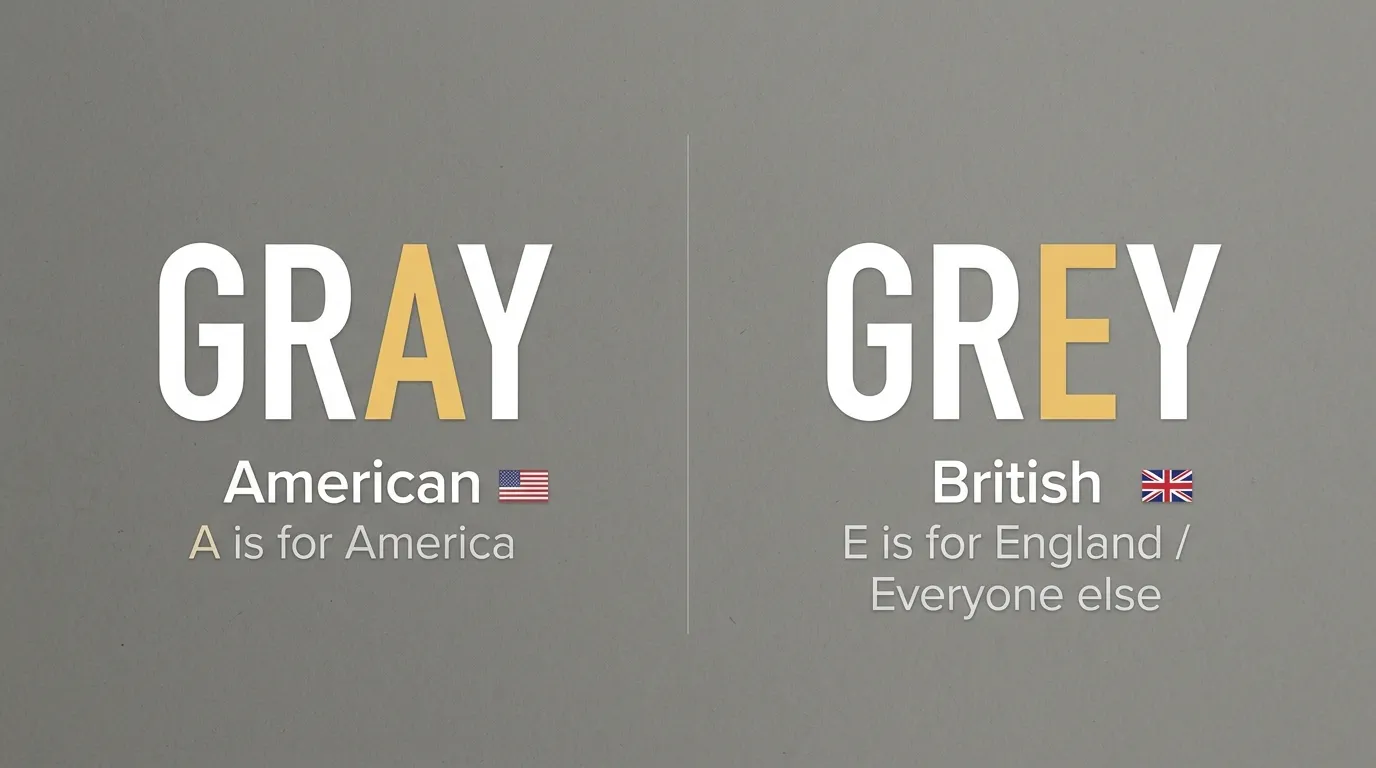
Easy Memory Trick: Gray or Grey
Here is a simple way to remember the difference:
A for America: grAy.
E for England: grEy.
This trick is useful for remembering the usual spelling conventions. It is not a rule that every English-speaking country must follow, but it works well for American and British English.
If you are writing for an American website, use gray. If you are writing for a British audience, use grey.
Practice Quiz: Gray or Grey?
Choose the spelling that best matches the English variety specified in each sentence.
- American English: She wore a ______ coat.
- British English: The sky turned ______ before the storm.
- American English: His hair is turning ______.
- British English: The house has ______ stone walls.
- American English: The issue is a ______ area.
- British English: He bought a ______ sweater.
- American English: The artist used several shades of ______.
- British English: Her hair became ______ with age.
Answers
- Gray — Standard American spelling.
- Grey — Standard British spelling.
- Gray — Standard American spelling.
- Grey — Standard British spelling.
- Gray — American English uses “gray area.”
- Grey — Standard British spelling.
- Gray — American English uses “shades of gray.”
- Grey — Standard British spelling.
Remember that the opposite spelling is not necessarily wrong in every context. The quiz tests the usual regional preference.
FAQs
1. Is it gray or grey?
Both spellings are correct. Gray is standard in American English, while grey is standard in British English.
2. Is gray or grey the American spelling?
Gray is the standard American spelling.
Example: The sky is gray today.
3. Is grey or gray the British spelling?
Grey is the usual British spelling.
Example: The sky is grey today.
4. Does gray mean the same thing as grey?
Yes. Both spellings describe the same color and have the same pronunciation. The main difference is regional spelling preference.
5. Which spelling should I use on an American website?
Use gray if your website targets American readers. Keep related forms such as grayer and grayish consistent with American English.
6. Is “gray color” correct?
Yes. “Gray color” is understandable and grammatically acceptable. In American English, gray is the usual spelling. In British English, write grey colour.
7. Is it gray hair or grey hair?
Both are correct. Use gray hair in American English and grey hair in British English.
8. Is it “gray area” or “grey area”?
Both are correct. American English generally uses gray area, while British English generally uses grey area. Both describe an unclear situation.
9. Is grey used in Canada?
Yes. Grey is common in Canadian English, although spelling preferences can vary by word, publisher, and style guide.
10. How can I remember gray versus grey?
Remember “A for America” and “E for England.” It is a simple reminder that gray is standard in American English and grey is usual in British English.
Conclusion
When choosing between gray or grey, remember that both spellings are correct and describe the same color.
The main difference is regional preference: American English usually uses gray, while British English usually uses grey.
The same distinction applies to common expressions such as gray area and grey area, as well as references to hair, clothing, walls, and weather.
For Grammarlify.com, keep gray as the preferred spelling when explaining American English, and show grey as the British alternative. This gives readers a clear answer while helping them understand both forms.

Hi, I’m Sophia Bennett. My goal is to make grammar easy, clear, and useful through simple explanations and real-life examples.