You’ve lost half your kitchen supplies during a move.
You tell a friend, ‘we’ll just have to make do with what we have.’
Then you second-guess yourself. Is it ‘make do’ or ‘make due’?
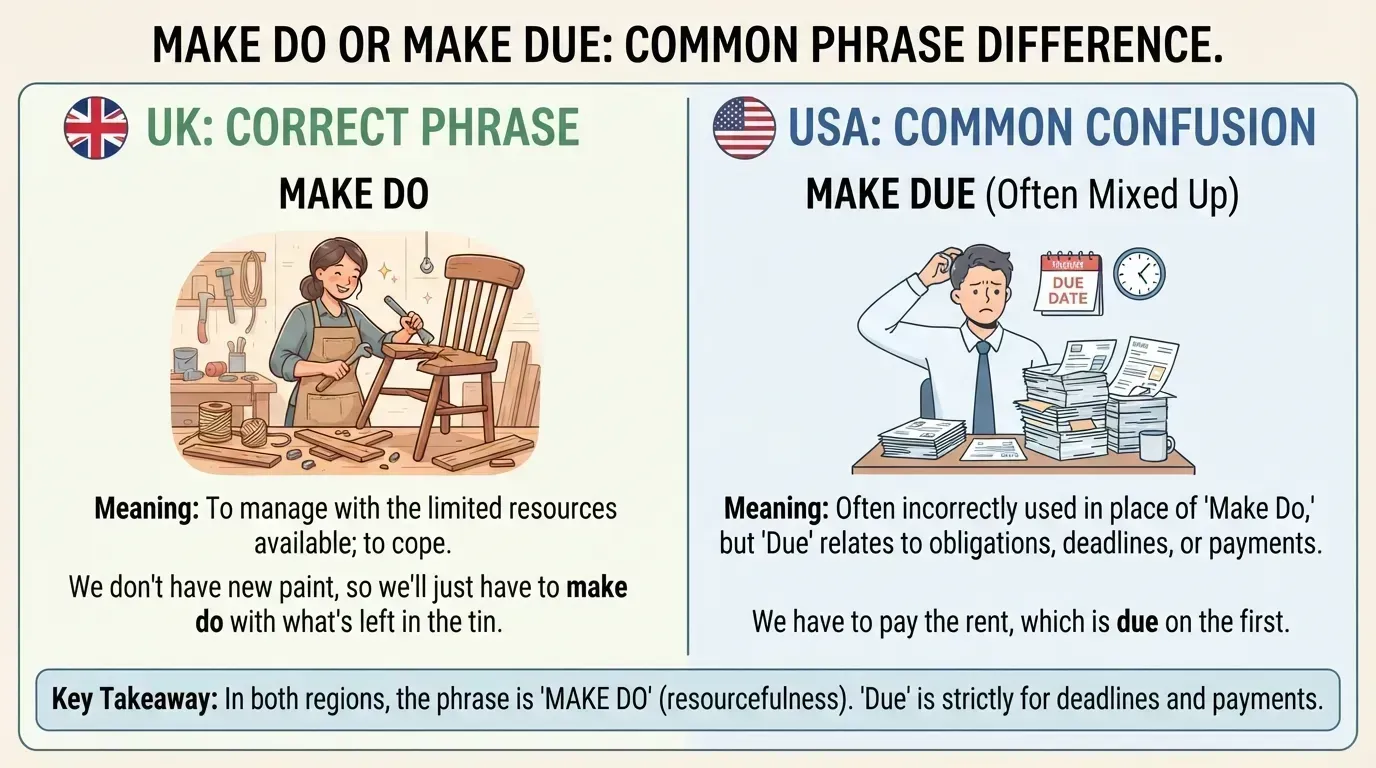
Here’s the quick answer: ‘make do’ is the correct phrase.
It means to manage with what’s available, even if it isn’t ideal.
‘Make due’ is a common mistake, though it was accepted spelling before the 1940s.
Table of Contents
- Did You Know?
- Quick Answer Box
- Quick Rule in One Line
- Where ‘Make Do’ Comes From
- Why ‘Make Due’ Exists at All
- Comparison Table
- Memory Trick
- Example Sentences
- Common Mistakes
- When to Use Each Form
- Expert Tip
- Make Do or Make Due: Quick Answers
- Make Do Meaning and Definition
- Make Due Meaning
- Make Do Verb Forms and Tenses
- We’ll or Well? Contractions With Make Do
- Do vs Due: What’s the Difference?
- Make Do Examples and Sentences
- How to Spell Do and Due
- Make Do in Other Languages: Quick Answers
- FAQs
- Conclusion
- Key Takeaways
Did You Know? 🔍
‘Make due’ wasn’t always wrong.
Until around the 1940s, it was a commonly accepted spelling of the phrase.
Language change, not a spelling error, is why ‘make do’ eventually became the standard.
Older novels and letters from that era may still show ‘make due’ correctly for their time.
Quick Answer Box
‘Make do’ is the correct, modern phrase, meaning to manage or get by with what’s available.
‘Make due’ is considered a misspelling today, even though it was standard before the 1940s.
If you’re writing in the 21st century, ‘make do’ is the version to use.
⚡ Quick Rule in One Line
Make do is correct today; make due was correct before the 1940s and is now considered a mistake.
Where ‘Make Do’ Comes From
‘Make do’ is short for the older phrase ‘make it do,’ meaning to make something serve a purpose well enough.
Charlotte Brontë used this exact phrase in Jane Eyre back in 1847.
The ‘do’ here means ‘to serve a purpose,’ similar to saying ‘tea will do’ when you don’t have coffee.
Over time, ‘make it do’ shortened into the ‘make do’ we use today.
Why ‘Make Due’ Exists at All
‘Due’ as an adjective can mean ‘sufficient’ or ‘appropriate,’ as in ‘due diligence’ or ‘due process.’
That meaning is close enough to ‘make do’ that the confusion made some logical sense.
‘Make due’ was genuinely the more common spelling until the 1940s.
Since then, ‘make do’ has won out, and ‘make due’ is now treated as an error in modern writing.
Comparison Table
| Feature | Make Do | Make Due |
|---|---|---|
| Correct today | Yes | No, considered a mistake |
| Correct historically (pre-1940s) | Yes | Yes |
| Origin | Short for ‘make it do’ | Confusion with ‘due’ meaning sufficient |
| Modern usage | Standard | Rare, often flagged as an error |
Memory Trick
Remember the phrase ‘make it do’ from Jane Eyre.
‘Do’ is the action word here, meaning to serve well enough.
If you can imagine adding ‘it’ before the word, ‘make it do’ only works with ‘do,’ never ‘due.’
Example Sentences
We’ve lost a lot of supplies, but we’ll make do with what we have.
The team will have to make do without its star player.
They made do with a smaller apartment during the move.
Can you make do with a cheaper phone plan for now?
We don’t have much money, so we’ll make do with what’s left.
Common Mistakes
❌ ‘We’ll have to make due until payday.’
✅ ‘We’ll have to make do until payday.’ (modern correct spelling)
❌ ‘She’s making due with an old laptop for now.’
✅ ‘She’s making do with an old laptop for now.’
When to Use Each Form
Use ‘make do’ in all modern writing, whether formal, casual, business, or academic.
Only use ‘make due’ if you’re deliberately writing dialogue or text meant to reflect language from before the 1940s.
Expert Tip 💡
If you’re editing older historical fiction or quoting a document from before 1940, ‘make due’ may be historically accurate and shouldn’t be ‘corrected.’
For anything written today, ‘make do’ is always the safer, standard choice.
Make Do or Make Due: Quick Answers
Here are fast answers to the most common versions of the question.
Is It Make Do or Make Due?
It’s “make do.” That’s the standard phrase in modern English.
We Will Make Do or Due?
It’s “we will make do.” The same applies to “we can make do,” “we make do,” and “I will make do.”
We’ll Make Do or We’ll Make Due?
It’s “we’ll make do.” Use “make do” with every pronoun.
Have to Make Do or Have to Make Due?
It’s “have to make do.” For example, “we have to make do with what we have.”
Make Do With What You Have or Make Due With What You Have?
It’s “make do with what you have.”
Correct Forms With Each Pronoun
| Phrase | Correct form |
|---|---|
| I will / I’ll | I’ll make do |
| We will / We’ll | We’ll make do |
| We can | We can make do |
| We have to | We have to make do |
| They will | They will make do |
| I had to | I had to make do |
Duplicate Searches
If you searched “make do or make do,” “make due or do,” or “made due or do,” you probably meant “make do or make due.”
Make Do Meaning and Definition
“Make do” means to manage or get by with what’s available, even if it isn’t ideal.
It suggests accepting a less-than-perfect solution.
Make Do Phrase
“Make do” is an idiom, so its meaning isn’t obvious from the words alone.
It’s often followed by “with” and the thing you have: “make do with an old laptop.”
Make Do With What You Have Meaning
“Make do with what you have” means use whatever is available instead of waiting for something better.
Will Make Do Meaning
“Will make do” means someone will manage with what they have.
For example, “I’ll make do” means “I’ll manage.”
Just Make Do Meaning
“Just make do” means to cope without complaining.
For example, “we’ll just make do.”
Have to Make Do
“Have to make do” means you have no better option and must get by.
Make Do Saying and Synonyms
Close synonyms include get by, manage, cope, improvise, and muddle through.
Make-Do as an Adjective
With a hyphen, “make-do” can describe something temporary or improvised, as in “a make-do repair.”
Make Due Meaning
“Make due” isn’t a standard phrase in modern English.
If you see it, the writer almost certainly meant “make do.”
Define Make Due
There’s no separate definition for “make due.” It’s an older or mistaken spelling of “make do.”
Making Due and Made Due
“Making due” and “made due” are also mistakes. The correct forms are “making do” and “made do.”
Make Due With
“Make due with” should be “make do with.”
Make Do Verb Forms and Tenses
“Make do” follows the verb “make,” so the forms change on “make,” not on “do.”
| Form | Example |
|---|---|
| make do | We make do. |
| makes do | She makes do. |
| made do | They made do. |
| making do | I’m making do. |
| will make do | We will make do. |
Make Do Past Tense
The past tense is “made do.”
For example, “we made do with what we had.”
Made Do or Made Due?
It’s “made do.”
If you searched “we made do or make due,” the answer is “we made do” for the past and “we make do” for the present.
Making Do
“Making do” is the -ing form: “she’s making do with a small budget.”
Makes Do
“Makes do” is the form for he, she, or it: “he makes do.”
How to Make Do
“How to make do” means how to manage with limited resources.
To Make Do
“To make do” is the infinitive: “we had to make do.”
Had to Make Do
“Had to make do” is the past form of “have to make do.”
We’ll or Well? Contractions With Make Do
“We’ll” is short for “we will,” so “we’ll make do” is correct.
“Well make do” without an apostrophe is a typo for “we’ll make do.”
Well Make Due and Well Make Do
“Well make due” has two mistakes: a missing apostrophe and the wrong word. The correct form is “we’ll make do.”
We ll Make Do or Due
If the apostrophe is missing, as in “we ll,” write “we’ll make do.”
Do vs Due: What’s the Difference?
“Do” and “due” are different words that sound similar.
| Word | Part of speech | Meaning | Example |
|---|---|---|---|
| do | verb | to perform, or to serve a purpose | That will do. |
| due | adjective or noun | owed, expected, or deserved | The rent is due. |
Do or Due Meaning
“Do” is an action word. “Due” describes something owed or expected, like “due date.”
Will Do or Will Due?
It’s “will do.” For example, “any pen will do” means any pen is enough.
“Will due” is a mistake.
Why They Get Confused
They sound alike, and “due” can also mean “sufficient” in older English, which links it to “make do.”
Common “Due” Phrases
- Due date
- Due diligence
- Due to
- Due process
Make Do Examples and Sentences
Here are a few more sentences with “make do.”
- We’ll make do with what we have.
- She made do with a borrowed coat.
- They had to make do without heating.
- I can make do with a smaller room.
- You’ll have to make do for now.
- The team made do with limited funding.
- Just make do until the new one arrives.
How to Spell Do and Due
Here’s how to spell each word.
- Do: D-O
- Due: D-U-E
Common Misspellings
- Make fo, make doo
- Make dew, make duh
- Make a due (not an idiom)
Do the Due
“Do the due” isn’t a phrase. If you mean “do the work that’s due,” say “do what’s due.”
Make Do in Other Languages: Quick Answers
Many readers search this in their own language.
- Chinese: “Make do” 的意思是将就、凑合。关于由来,它来自更早的说法 “make it do”。
- Roman Urdu: “Make do” ka matlab hai jo cheez mojood ho usi se guzara karna.
- Hindi: “Make do” का मतलब है जो उपलब्ध है उसी से काम चलाना।
- Spanish: “Make do” significa arreglárselas con lo que se tiene.
- French: “Make do” veut dire se débrouiller avec ce que l’on a.
- Indonesian: “Make do” artinya bertahan atau mencukupkan diri dengan apa yang ada.
FAQs
Is ‘make due’ ever correct today?
Not in modern standard English. It was accepted before the 1940s but is now considered a mistake.
What does ‘make do’ mean?
It means to manage or get by using what’s available, even if it isn’t ideal.
Where does ‘make do’ come from?
It’s shortened from the older phrase ‘make it do,’ where ‘do’ means to serve a purpose well enough.
Is ‘make-do’ with a hyphen also correct?
Yes, ‘make-do’ with a hyphen works as an adjective or noun, as in ‘a make-do repair’ or ‘the make-dos are working.’
Why do people still write ‘make due’?
Because ‘due’ can mean ‘sufficient,’ which sounds logical, and because the phrase was standard spelling before the 1940s, some older habits persist.
People Also Search For
Make do or make due meaning
“Make do” means to manage with what you have. “Make due” is a mistaken spelling of the same phrase.
Make do or make due sentences
“We’ll make do with what we have.” Never “make due.”
Make do meaning
To manage or get by using what’s available.
I’ll make do meaning
“I’ll manage with what I have.”
Have to make do
It means you have no better choice and must get by.
Make do with what you have meaning
Use what’s available instead of waiting for something better.
Make do past tense
“Made do.”
Make do examples
“She made do with an old laptop.” See the examples above.
More Questions About Make Do and Make Due
What does make due mean?
It isn’t a standard phrase. It’s a mistaken spelling of “make do.”
What does making due mean?
It’s a mistaken spelling of “making do.”
What does made due mean?
It’s a mistaken spelling of “made do.”
Is it “will make do” or “will make due”?
“Will make do.”
Is it “we will make do or due”?
“We will make do.”
Is it “we can make do or due”?
“We can make do.”
Is it “I’ll make do or due”?
“I’ll make do.”
Is it “will do” or “will due”?
“Will do.”
Is it “do” or “due”?
“Do” is a verb, and “due” is an adjective or noun meaning owed or expected.
What is the past tense of make do?
“Made do.”
What is the origin of make do?
It’s short for “make it do,” used by writers such as Charlotte Brontë.
Is “make do” an idiom?
Yes.
How do you spell due?
D-U-E.
Make do ka matlab kya hai?
Make do ka matlab hai jo cheez mojood ho usi se kaam chalana ya guzara karna.
Make do ya make due, kaunsa sahi hai?
“Make do” sahi hai. “Make due” aaj ke daur mein ghalat spelling samjhi jati hai.
Conclusion
‘Make do’ is the correct phrase in modern English, meaning to manage with what you have.
‘Make due’ isn’t a random typo; it was genuinely correct before the 1940s, but language moved on.
For anything you write today, ‘make do’ is the spelling to use.

Hi, I’m Sophia Bennett. My goal is to make grammar easy, clear, and useful through simple explanations and real-life examples.