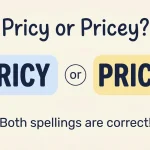
You’re texting a friend about concert tickets. You type “so pricy,” then pause. Wait, is it “pricey”? Both look fine.
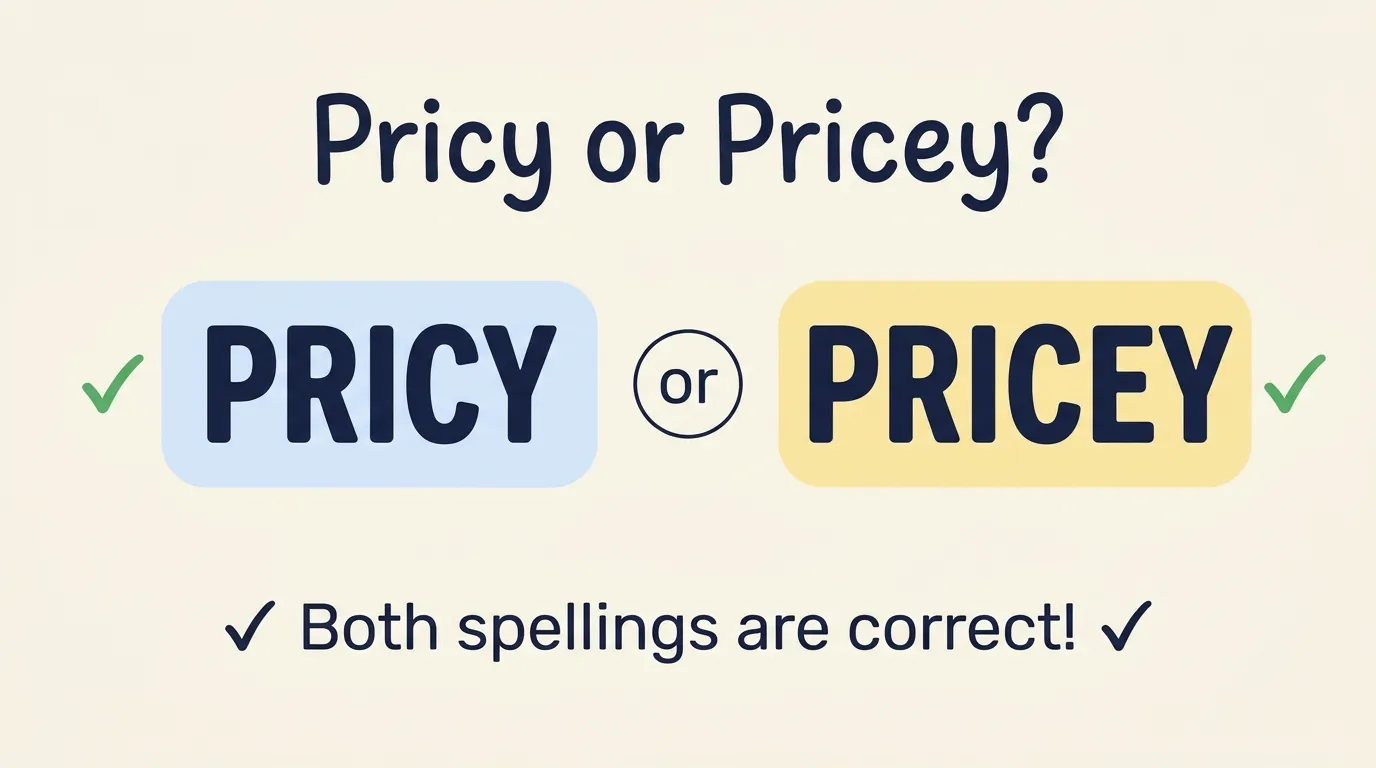
Both spellings mean “expensive,” but pricey is the standard spelling. Pricy is accepted as a less common variant. Merriam-Webster lists pricey first and calls pricy the less common form.
So you’re not wrong if you wrote pricy. But if you want the safest choice, go with pricey. It’s the more common spelling on both sides of the Atlantic.
This guide explains why two spellings exist, how they work, and which one to pick in your own writing.
Table of Contents
- Did You Know?
- Quick Answer
- Quick Rule in 1 Line
- Pricy vs. Pricey: What’s the Difference?
- Why Are There Two Spellings?
- Pricier and Priciest: The Comparison Forms
- Is It a US vs. UK Difference?
- Comparison Table
- Memory Trick
- 20 Example Sentences
- Common Mistakes
- When to Use Pricey (and When to Use Another Word)
- Expert Tip
- Common Misconception
- FAQs
- Conclusion
- Key Takeaways
Did You Know? 🔍
According to Etymonline, pricey dates to 1932 and was formed from price plus the ending -y. The site also notes an earlier funny use of “high-pricey” in a 1923 humorous poem, written to rhyme with “spicy.” So this word started as a joke, in a way.
Quick Answer
Pricey and pricy both mean expensive. Pricey is the standard spelling. Pricy is a less common variant listed in dictionaries like Merriam-Webster. Both are informal words. In formal writing, use “expensive” or “costly.”
⚡ Quick Rule in 1 Line
Pricey is the safe pick; pricy is accepted but rarer — and both are informal.
Pricy vs. Pricey: What’s the Difference?
There’s no difference in meaning. Both words are adjectives that mean costly. The only difference is spelling: pricey is more common, and pricy is a variant.
Merriam-Webster’s entry for pricey reads “variants or less commonly pricy.” Wiktionary also lists pricy as an informal alternative spelling of pricey. So dictionaries treat pricy as the variant and pricey as the main form.
That means:
- Pricey = standard, most common.
- Pricy = accepted variant, less common.
You’ll see both in print. Some language sites do say pricy “may be considered incorrect in formal writing,” but that’s not how the major dictionaries treat it. They list it as an acceptable variant. For a clean, no-risk choice, stick with pricey.
Why Are There Two Spellings?
Two spellings exist because English adds the ending -y to words in two different ways. Some words drop the silent e before -y, and others keep it.
Look at how other words handle this:
- Drop the e: ice → icy, spice → spicy, juice → juicy.
- Keep the e: horse → horsey, mouse → mousey, cage → cagey.
Price ends in a silent e. So it can follow either pattern. Following “spice → spicy” gives you pricy. Following “cage → cagey” gives you pricey.
Over time, writers favored the version with the e. It looks more like the base word price, so readers spot it right away.
This also explains the humor in that 1923 poem. “High-pricey” rhymes with “spicy,” so the poet used the longer spelling to make a joke. Etymonline records this origin.
Pricier and Priciest: The Comparison Forms
Whichever spelling you pick, the comparison forms are the same: pricier and priciest. The e drops out, and the y changes to i.
Merriam-Webster lists “pricier” and “priciest” under both spellings. So you never write “priceyer” or “priceyest.”
| Base form | Comparative | Superlative |
|---|---|---|
| pricey / pricy | pricier | priciest |
Here’s how they look in real sentences:
- This hotel is pricier than the one downtown.
- That’s the priciest item on the menu.
The related noun is priciness, which Wiktionary lists as a derived term.
Is It a US vs. UK Difference?
No. This pair isn’t a regional split. Research from language discussions and dictionaries shows pricey is more popular in both American and British English.
Many spelling pairs in this niche split cleanly by country. For example, “color” is American and “colour” is British. Pricy vs. pricey doesn’t work like that.
A language-learning forum discussion of corpus searches found that pricey is more popular in both places. That discussion is informal, so treat it as a helpful hint, not a hard rule. But it matches what dictionaries show: pricey is the lead spelling, and pricy is the variant.
So whether you write for US readers or UK readers, pricey is a safe choice.
Comparison Table
| Feature | Pricey | Pricy |
|---|---|---|
| Meaning | Expensive | Expensive |
| Part of speech | Adjective | Adjective |
| Status | Standard, main spelling | Accepted variant |
| How common | More common | Less common |
| Comparative | pricier | pricier |
| Superlative | priciest | priciest |
| Formality | Informal | Informal |
| US vs. UK | Used in both | Used in both |
| Safe for formal writing? | Better to use “expensive” | Better to use “expensive” |
Memory Trick
Think of “price” with a friendly “ey” tacked on. Keep the whole word price and add ey.
Three quick hooks:
- Keep the e. Pricey keeps the e from price. That makes it easy to see the root word.
- Say it out loud. The word sounds like “PRY-see.” The “ey” ending is simply how most writers spell that “ee” sound.
- When in doubt, add the e. It’s the choice dictionaries put first.
20 Example Sentences
Pricey (standard spelling):
- The restaurant was pricey, but the food was great.
- That jacket is too pricey for my budget.
- Laser treatment can be pricey.
- A pricey vase sat on the shelf.
- I found a less pricey option online.
Pricey in everyday talk:
- Concert tickets are getting pricey these days.
- It’s a pricey neighborhood, but it’s safe.
- She bought a pricey coffee on the way to work.
- Is that watch as pricey as it looks?
- Eating out every night gets pricey fast.
Pricy (accepted variant):
- The hotel was a bit pricy for a short stay.
- These shoes are pricy, but they last for years.
- A pricy tasting menu isn’t for everyone.
- We skipped the pricy seats and sat in the back.
- The game wasn’t pricy, so I bought two copies.
Pricier and priciest:
- This phone is pricier than last year’s model.
- The priciest bottle on the list costs two hundred dollars.
- Fresh fruit is pricier in winter.
Mixed:
- Is it too pricey, or is it worth the cost?
- Prices are rising, so everything feels a little pricier.
Common Mistakes
Mistake 1: Adding “er” to the wrong form.
- ❌ This one is priceyer than the other.
- ✅ This one is pricier than the other.
2: Using “priciest” with an extra e.
- ❌ It’s the priceyest item in the store.
- ✅ It’s the priciest item in the store.
Mistake 3: Mixing up “pricey” and “prices.”
- ❌ The store has pricey on everything today.
- ✅ The store has high prices on everything today.
4: Using pricey in very formal writing.
- ❌ The annual report calls the equipment pricey.
- ✅ The annual report calls the equipment costly.
Mistake 5: Thinking pricy is a typo.
- ❌ “Pricy” is always an error.
- ✅ Pricy is an accepted variant, though pricey is more common.
When to Use Pricey (and When to Use Another Word)
Use pricey in casual writing and conversation. Choose “expensive” or “costly” in formal reports, academic work, and business documents.
Both spellings are informal. Merriam-Webster’s examples show the word in everyday contexts, like a “pricey” boutique or a “pricey” car.
Good times to use pricey:
- Blog posts, emails to friends, and texts.
- Reviews of products or restaurants.
- Casual speech and dialogue in stories.
Better to use a different word:
- Formal reports, contracts, and research papers.
- Business writing aimed at executives.
- Any place where your style guide asks for a neutral tone.
Here are handy swaps:
| Casual | More formal |
|---|---|
| pricey | expensive |
| pricey | costly |
| pricey | high-priced |
| a bit pricey | somewhat expensive |
Expert Tip 💡
If you edit for more than one writer or client, choose one spelling and stick with it across the whole document. Mixing pricey and pricy looks sloppy, even though both are accepted. A quick find-and-replace before you publish keeps your work consistent. Pricey is the safest default.
Common Misconception
Myth: “One of these spellings must be wrong.”
Reality: Both are accepted. Dictionaries list pricy as a variant of pricey. The real difference is how common each one is, not whether it’s correct.
FAQs
1. Is it pricy or pricey?
Both are accepted, but pricey is the standard and more common spelling. Pricy is listed as a less common variant.
2. Is pricy a real word?
Yes. Merriam-Webster lists it as a variant of pricey. Wiktionary also lists it as an informal alternative spelling.
3. Which spelling is used in American English?
Pricey is the more common choice in American English. It’s also the more common choice in British English.
4. Is pricey formal or informal?
It’s informal. In formal writing, use “expensive” or “costly” instead.
5. What does pricey mean?
It means costly or expensive. For example, “The car is a little pricey,” as in Merriam-Webster’s examples.
6. How do you spell the comparative form?
It’s pricier, with no e. The superlative is priciest. These forms work for both pricey and pricy.
7. Where does the word pricey come from?
Etymonline says it was formed in 1932 from price plus the ending -y. A humorous 1923 use of “high-pricey” appears earlier.
8. Is “priceyer” a word?
No. The correct comparative is pricier.
9. What are good synonyms for pricey?
Try expensive, costly, high-priced, or dear. Which one fits depends on how formal you want to sound.
10. Why does English have both pricey and pricy?
English adds -y to silent-e words two ways. Some drop the e, like spicy. Others keep it, like cagey. Price can follow either pattern.
Conclusion
Here’s the short answer. Pricey is the standard spelling, and pricy is an accepted but less common variant. Both mean expensive, and neither is tied to a country.
If you want to play it safe, write pricey, and remember that the comparison forms are pricier and priciest. In formal writing, choose “expensive” or “costly” instead.
So go ahead and type that text about the concert tickets. Just don’t be surprised if the price still makes you wince.

Hi, I’m Olivia Harper. I love turning complex English grammar into simple, practical lessons that help readers write and speak with confidence.