You’ve just written a work email. “I purposely left the details out.” Then you stop. Should it be “purposefully”? Both words look right.
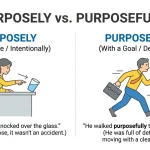
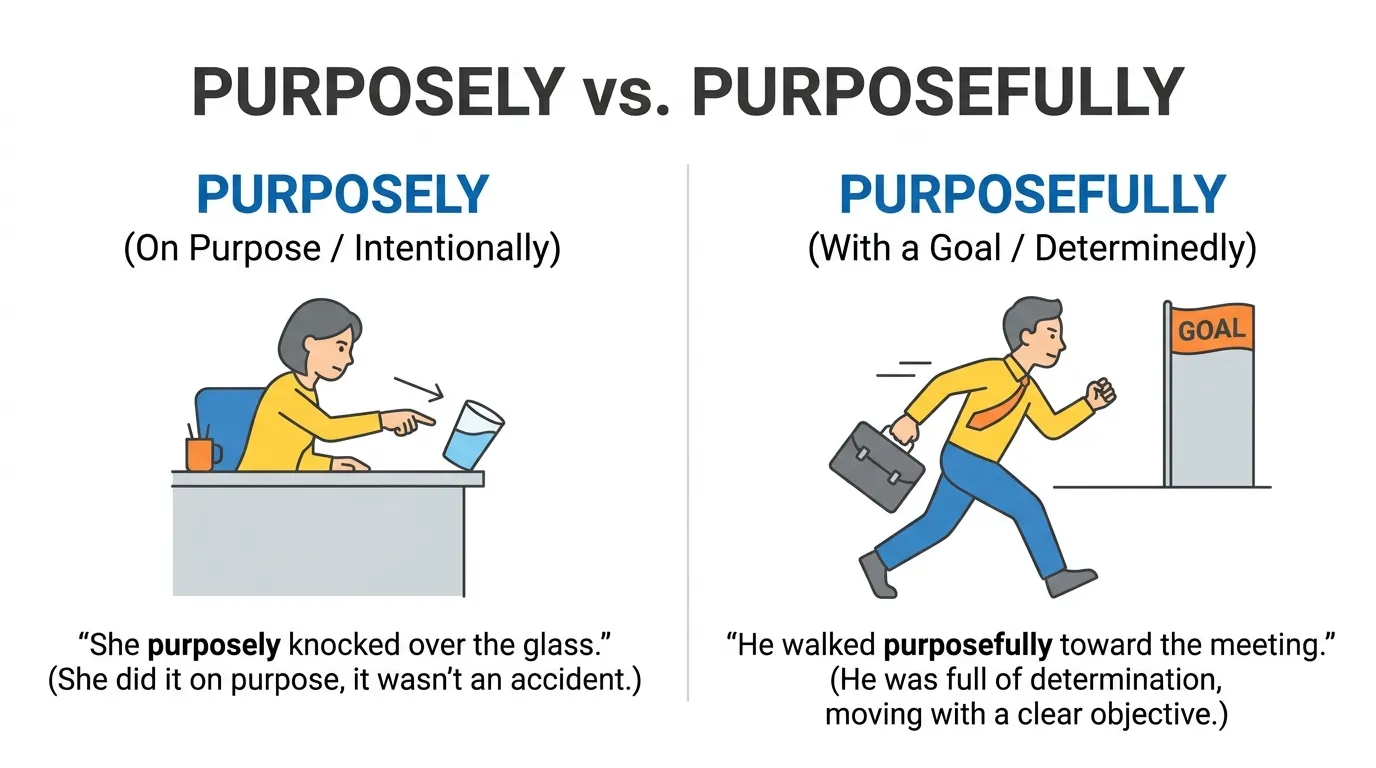
Purposely means “on purpose” and tells us an action was done deliberately. Purposefully means “with determination” and tells us how someone acts, with a clear aim. Often the two are close, so the choice comes down to emphasis.
That’s why people mix them up. They share a root, they both end in “-ly,” and they sometimes swap places without trouble.
This guide shows when each one fits best. You’ll get simple definitions, a memory trick, 20 example sentences, and a quick quiz to test yourself.
Table of Contents
- Did You Know?
- Quick Answer
- Quick Rule in 1 Line
- Purposely vs. Purposefully: The Core Difference
- What Does Purposely Mean?
- What Does Purposefully Mean?
- Can You Use Them Interchangeably?
- Comparison Table
- Memory Trick
- 20 Example Sentences
- Common Mistakes
- When to Use Each Word
- Expert Tip
- Common Misconception
- Quick Quiz
- FAQs
- Conclusion
- Key Takeaways
Did You Know? 🔍
Dictionary.com notes that the two words overlap. Both can mean “intentionally.” So in many sentences, either one works. The real difference shows up when you want to stress intent or stress determination.
Quick Answer
Purposely means on purpose. It tells us the action wasn’t an accident. Purposefully means acting with a clear goal and determination. It tells us how the person acted. In some sentences, both work.
⚡ Quick Rule in 1 Line
Purposely means “on purpose”; purposefully means “full of purpose,” acting with clear aim and determination.
Purposely vs. Purposefully: The Core Difference
The core difference is emphasis. Purposely stresses that something was done deliberately, not by accident. Purposefully stresses the determination or goal behind the action.
Think of it like this. Purposely answers the question, “Was it on purpose?” The answer is yes. Purposefully answers a different question: “How did the person do it?” The answer is with focus and resolve.
Here’s a quick way to see it:
- Purposely: The opposite is accidentally.
- Purposefully: The opposite is closer to carelessly or without aim.
Grammarly describes it this way. Purposely points to intent. Purposefully points to determination.
A small note on how sources describe it. Writing Explained says purposefully means the action has a specific goal or reason, while purposely doesn’t care about the reason. Grammarly leans on the “determination” idea instead. These views fit together. Both say purposefully carries extra weight about why or how. Purposely just says “not by accident.”
What Does Purposely Mean?
Purposely is an adverb that means on purpose or deliberately. It says the action wasn’t an accident, and it doesn’t say anything about the person’s mood or effort.
Use it when the main point is that someone meant to do it.
- She purposely hid the gift in the closet.
- He purposely left his phone at home.
- The writer purposely kept the ending vague.
Where purposely really shines. Grammarly points out a case where purposely is the better pick. Say someone does something sneaky, and it’s meant to look like an accident. Purposely fits, because purposefully would suggest open, determined action. Hiding a deliberate act is the opposite of that.
With design and planning. Writers often say something was “purposely designed.” That puts the focus on the choice itself.
- The menu was purposely kept simple.
What Does Purposefully Mean?
Purposefully is an adverb that means with a clear goal, determination, or focus. Think of someone who acts with a strong sense of aim.
The word purposeful sits inside it, and so does the word full. That’s a handy clue.
- He walked purposefully toward the stage.
- The team worked purposefully to meet the deadline.
- She purposefully chose a quiet seat so she could study.
Focus and effort. Dictionary.com notes that purposefully can describe thoughtful, focused action with a serious desire to get something done.
Body language. You’ll often see it with movement. Someone who “strides purposefully” looks like they know exactly where they’re going.
- The nurse moved purposefully down the hall.
It can also mean “deliberately.” Dictionary.com shows that purposefully can match purposely in the sense of doing something on purpose. That overlap is why mixing them up feels so natural.
Can You Use Them Interchangeably?
Sometimes yes. When you only mean “on purpose,” either word usually works. When you want to show determination, choose purposefully.
you want to show it wasn’t an accident, choose purposely.
Here are the three situations:
1. Either word works.
- The company purposely/purposefully hired local artists.
The meaning is nearly the same. Pick the one that sounds best.
2. Purposely works better.
- He purposely knocked over the vase, then blamed the cat.
The point is that it was deliberate, and the action was hidden.
3. Purposefully works better.
- She marched purposefully to the front of the room.
The point is the determined way she moved.
Grammarly gives another example. In a sentence about software, “purposely designed” focuses on the design choice. Switching to “purposefully designed” shifts the focus to the designers’ care and effort. Both are fine. The shade of meaning changes.
If you’re stuck, ask yourself: Am I describing the choice or the effort? Choice means purposely. Effort means purposefully.
Comparison Table
| Feature | Purposely | Purposefully |
|---|---|---|
| Part of speech | Adverb | Adverb |
| Simple meaning | On purpose | With determination or clear aim |
| Focus | The choice (not an accident) | The effort or goal behind it |
| Opposite | Accidentally | Carelessly, aimlessly |
| Memory hook | “On purpose” | “Full of purpose” |
| Often paired with | Hid, left, ignored, misled | Walked, worked, moved, chose |
| Can match the other word? | Yes, for “deliberately” | Yes, for “deliberately” |
Memory Trick
Purposefully has the word “full” in it. Think “full of purpose.” Purposely just means “on purpose.”
Here are three ways to lock it in:
- Spot the “full.” Purposefully = purpose + full + ly. It’s full of purpose.
- Swap in “on purpose.” If “on purpose” fits the sentence, purposely is a safe pick.
- Swap in “with determination.” If that fits, use purposefully.
20 Example Sentences
Purposely (on purpose):
- I purposely took the long road to enjoy the view.
- She purposely ignored the spam email.
- The author purposely left the question unanswered.
- He purposely arrived early to get a good seat.
- They purposely avoided the topic at dinner.
Purposely (a choice that wasn’t an accident):
- The teacher purposely mispronounced the word to see who’d notice.
- The shop purposely keeps the lights dim.
- I purposely didn’t tell her about the surprise.
- The brand purposely uses simple language in its ads.
- He purposely missed the call so he wouldn’t have to talk.
Purposefully (with determination):
- She walked purposefully into the interview.
- The coach spoke purposefully to the team.
- He purposefully pressed the button and waited.
- The children worked purposefully on their art project.
- The firefighter moved purposefully through the smoke.
Purposefully (with a clear aim):
- The gardener purposefully planted the roses near the fence.
- She purposefully set aside an hour to study each night.
- The team purposefully rebuilt the plan from scratch.
Either word can work:
- The editor purposely/purposefully cut the first paragraph.
- The store purposely/purposefully placed the sale items near the door.
Common Mistakes
Mistake 1: Using purposefully for a hidden, sneaky action.
- ❌ He purposefully acted like he didn’t see her.
- ✅ He purposely acted like he didn’t see her.
Mistake 2: Using purposely for determined movement.
- ❌ She purposely strode across the stage with her head high.
- ✅ She purposefully strode across the stage with her head high.
3: Misspelling the words.
- ❌ She purposly hid the keys. / He purposfully shut the door.
- ✅ She purposely hid the keys. / He purposefully shut the door.
Mistake 4: Overusing both words.
- ❌ She purposely and purposefully, on purpose, spilled the juice.
- ✅ She spilled the juice on purpose.
5: Confusing the adverb with the adjective.
- ❌ He gave a purposely look.
- ✅ He gave a purposeful look.
When to Use Each Word
Use purposely when the main point is that something wasn’t an accident. The Use purposefully when the main point is the determination, focus, or clear goal behind the action.
Use purposely when you want to:
- Say an action was deliberate.
- Contrast it with something accidental.
- Describe a sneaky or hidden choice.
- Talk about a design decision.
The Use purposefully when you want to:
- Show determination or focus.
- Describe confident movement.
- Stress a clear goal behind an action.
- Show careful, thoughtful effort.
When you’re not sure: try “on purpose” for purposely, and “with determination” for purposefully. Pick the one that fits. If both fit, either word is fine.
Expert Tip 💡
When you edit, look for a simpler option. “On purpose” and “deliberately” often read cleaner than either word. In business writing, “intentionally” is another solid choice. Save purposefully for moments when you really want the feeling of determination. It carries more weight, so it works best when used sparingly.
Common Misconception
Myth: “One of these words is always wrong.”
Reality: Neither is wrong. They’re two real adverbs. Dictionaries show they overlap in the “deliberately” sense. The skill is choosing the one that matches the shade of meaning you want.
Quick Quiz
Pick the best word for each sentence.
- She ____ walked to the front of the room, head high. (purposely / purposefully)
- He ____ left the door unlocked so the cat could get in. (purposely / purposefully)
- The sign was ____ placed so everyone would see it. (purposely / purposefully — either could work)
Answers: 1. purposefully (determined movement). 2. purposely (on purpose). 3. Either one works; the meaning is nearly the same.
FAQs
1. Is it purposely or purposefully?
Both are real words. Purposely means on purpose. Purposefully means with determination or a clear aim. Pick based on what you want to emphasize.
2. What is the difference between purposely and purposefully?
Purposely stresses that something wasn’t an accident. Purposefully stresses the determination or goal behind the action.
3. Are purposely and purposefully interchangeable?
Sometimes. Dictionary.com shows they overlap when both mean “deliberately.” But the shade of meaning can shift, so choose carefully.
4. What does purposely mean?
It means on purpose or deliberately. The action was meant, not accidental.
5. What does purposefully mean?
It means with a clear goal, determination, or focus. It’s often used for confident or serious action.
6. What is the opposite of purposely?
The opposite is accidentally. Something done purposely wasn’t done by accident.
7. What is the opposite of purposefully?
Grammarly suggests the opposite is closer to carelessly or without care. It describes a lack of aim.
8. Is purposely a formal word?
It’s fine in most writing. If you want something simpler, “on purpose” or “deliberately” also work well.
9. Which word should I use for a sneaky action?
Use purposely. Grammarly notes it fits actions meant to look accidental, because purposefully suggests open determination.
10. How can I remember which is which?
Look for “full” in purposefully. It means “full of purpose.” Purposely simply means “on purpose.”
Conclusion
Here’s the bottom line. Purposely means on purpose. Purposefully means acting with determination and a clear aim. When you only want to say “deliberately,” either one often works.
If you’re unsure, try the swap test. Does “on purpose” fit? Use purposely. Does “with determination” fit? Use purposefully. And if a plain phrase sounds better, use it.
So go back to that email. Whether you leave the details out purposely or add them purposefully, you now know exactly why you chose the word.

Hi, I’m Sophia Bennett. My goal is to make grammar easy, clear, and useful through simple explanations and real-life examples.