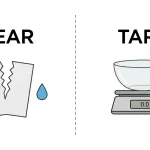
You’re making bread, and the recipe says, “Tear the scale first.” Wait. Does it want you to rip something? Or is that a typo?
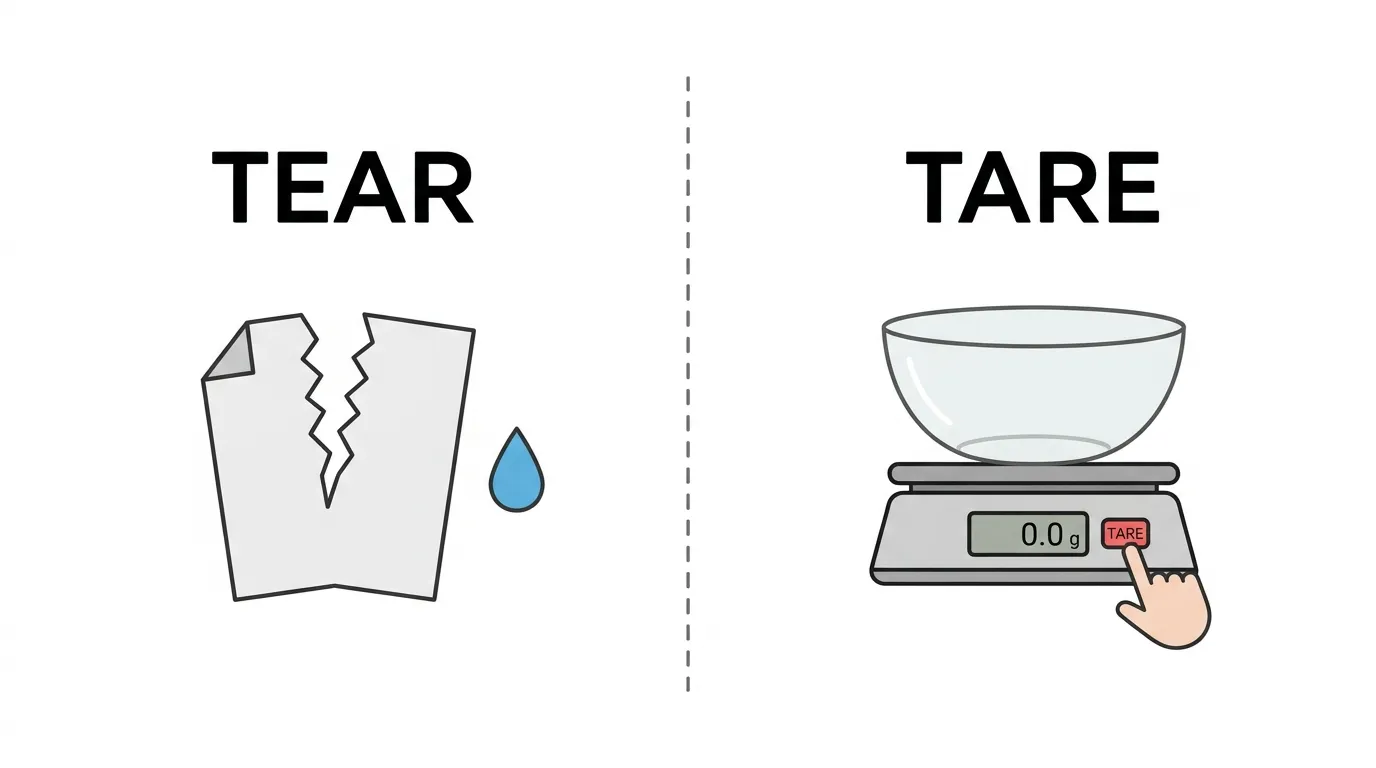
Tear means to rip something, or a drop of liquid from your eye. Tare is the weight of an empty container, which you subtract to find the true weight of what’s inside. The recipe meant “tare.”
These two words are homophones when “tear” means rip. They sound the same but have different spellings and meanings.
This guide explains each word, shows how they sound, and gives you an easy way to pick the right one.
Table of Contents
- Did You Know?
- Quick Answer
- Quick Rule in 1 Line
- Tear vs. Tare: The Core Difference
- What Does Tear Mean?
- What Does Tare Mean?
- How to Pronounce Tear and Tare
- Gross, Net, and Tare Weight
- Comparison Table
- Memory Trick
- 20 Example Sentences
- Common Mistakes
- When to Use Each Word
- Expert Tip
- Quick Quiz
- FAQs
- Conclusion
- Key Takeaways
Did You Know? 🔍
Merriam-Webster says tare came into English through Middle French from the Old Italian word tara. That word came from the Arabic ṭarḥa, which means “that which is removed.” It fits perfectly, because you remove the tare from the total.
Quick Answer
Tear means to rip something apart, or it names a drop from the eye. Tare means the weight of a container or packaging. When you weigh food or goods, you subtract the tare to get the net weight.
⚡ Quick Rule in 1 Line
Ripping or crying? Spell it tear. Weighing a container? Spell it tare.
Tear vs. Tare: The Core Difference
The core difference is meaning. Tear is about ripping or crying. Tare is about weight. They share a sound only when tear means “rip.”
Here’s where it gets tricky. The word tear has two meanings that are said in two different ways:
- Tear (rip): sounds like “tare” and rhymes with bear.
- Tear (eye drop): sounds like “tier” and rhymes with ear.
Words that are spelled the same but said differently are called heteronyms. So tear is a heteronym, and it’s also a homophone of tare. That’s a lot for one little word!
The good news is that the meaning in the sentence tells you which one you need. If it’s about weight, tare is the only answer. No other spelling works.
What Does Tear Mean?
Tear is a word with two sets of meanings. As a verb, it means to rip or pull apart. As a noun, it names a rip in something, or a drop of liquid from the eye.
1. To rip (verb). You tear paper, cloth, or a package. The past tense is tore, and the past participle is torn. Grammarist notes that tear comes from the Old English word teran, meaning to tear.
- Please don’t tear the page.
- She tore the envelope open.
2. A rip (noun). This names the hole or split left behind.
- There’s a tear in my jacket.
3. A drop from the eye (noun). This one rhymes with “ear.”
- A single tear ran down his cheek.
4. To move fast (informal verb). English speakers also say someone is “tearing down the road” when they move very quickly.
- The kids tore across the yard.
Related forms: tears, tearing, tore, torn.
What Does Tare Mean?
Tare is a noun for the weight of the packaging or container that holds something. You subtract it from the total weight to find the net weight of the goods inside.
You’ll see this word in shipping, cooking, science, and trade.
- Shipping: Truck drivers and freight companies use tare weight for an empty vehicle or container.
- Cooking: A kitchen scale has a “tare” button. You place a bowl on the scale, press tare, and the display goes back to zero. Then you add food and see only the food’s weight.
- Science: In a lab, a tare can offset the weight of a container on a balance.
Tare as a verb. You can also use it as a verb. Merriam-Webster lists a verb sense that dates to the early 1800s.
- Remember to tare the scale before you add flour.
An older meaning. Tare has a second, less common meaning tied to farming. It refers to a kind of weed that grows among grain. You’ll see “tares” in older books and Bible passages. Most modern readers will never need it.
A rare old form. Dictionary.com notes that tare is also an archaic past tense of tear. You won’t see it in everyday writing today.
How to Pronounce Tear and Tare
Tare is said like “tair,” rhyming with bear and fair. Tear sounds the same when it means rip, but it sounds like “teer” when it means a drop from the eye.
| Word and meaning | How it sounds | Rhymes with |
|---|---|---|
| Tare (weight) | tair | bear, fair |
| Tear (to rip) | tair | bear, fair |
| Tear (eye drop) | teer | ear, peer |
So there are really three meanings but only two sounds. Only the “rip” meaning matches tare.
A helpful way to think about it: when you hear “tair,” you can’t tell the spelling. You have to use the meaning. That’s true for every homophone.
Gross, Net, and Tare Weight
Gross weight is the total weight, container included. Tare weight is the container alone. Net weight is what’s left after you subtract tare from gross.
The three terms work together, and tare makes sense once you see the full picture.
| Term | What it measures | Example |
|---|---|---|
| Gross weight | Contents + container | 12 oz (jar of honey on the scale) |
| Tare weight | Container only | 4 oz (the empty jar) |
| Net weight | Contents only | 8 oz (the honey) |
The formula is simple: Gross − Tare = Net.
Merriam-Webster also notes that for vehicles, tare weight means the vehicle’s weight without any load. A delivery truck has a tare weight when it’s empty. It has a gross weight when it’s full.
Tare vs. zero vs. calibrate. On a kitchen scale, these three are different jobs.
- Tare: subtracts the container’s weight.
- Zero: resets the scale to read zero with nothing on it.
- Calibrate: checks that the scale is accurate.
Comparison Table
| Feature | Tear | Tare |
|---|---|---|
| Main meanings | Rip; a drop from the eye | Weight of a container |
| Part of speech | Verb and noun | Noun (also a verb) |
| Pronunciation | tair or teer | tair |
| Related forms | tears, tore, torn, tearing | tares, taring |
| Where you see it | Everyday life, emotion, damage | Shipping, cooking, science, trade |
| Origin | Old English teran | Arabic ṭarḥa via Old Italian tara |
| Common in daily writing? | Very | Less |
Memory Trick
Tie tare to the scale, and tie tear to things you feel or break.
- Tare and scale. Both tare and scale share the letter “a.” Think “tare, a scale word.”
- Tear has “ear” in it. The word tear contains ear, just like the eye-drop sound. It’s about things you feel or break.
- Ask a question. “Is this about weight?” If yes, use tare. If no, use tear.
20 Example Sentences
Tear (to rip):
- Be careful not to tear the paper.
- The dog will tear that toy apart.
- She tore the tag off the shirt.
- Please tear along the dotted line.
- He tore his jeans on the fence.
Tear (a rip or hole):
- There’s a small tear in the curtain.
- The tear in the tent let the rain in.
- A tear in the book’s spine needs tape.
(eye drop):Tear
- A tear fell down her cheek.
- He wiped away a tear at the wedding.
- The sad movie brought tears to my eyes.
Tare (weight):
- The tare weight of this box is two pounds.
- Subtract the tare to find the net weight.
- The truck’s tare weight is listed on the door.
- The scale shows the tare of the empty jar.
Tare (action or button):
- Press tare before you add the flour.
- Don’t forget to tare the scale.
- The tare button resets the display to zero.
Mixed:
- After I tare the bowl, I’ll tear the basil leaves into it.
- The package arrived torn, and the tare label was gone.
Common Mistakes
Mistake 1: Using tear for weight.
- ❌ Subtract the tear weight of the box.
- ✅ Subtract the tare weight of the box.
2: Using tare for ripping.
- ❌ Don’t tare the page when you turn it.
- ✅ Don’t tear the page when you turn it.
Mistake 3: Using tare for crying.
- ❌ A tare rolled down her face.
- ✅ A tear rolled down her face.
Mistake 4: Mixing up the tare button and the zero button.
- ❌ I used tare to check if the scale was accurate.
- ✅ I used calibration to check if the scale was accurate.
5: Saying “tore” for the present tense.
- ❌ Please tore the paper in half.
- ✅ Please tear the paper in half.
When to Use Each Word
Use tear when the sentence is about ripping, damage, crying, or moving fast. The Use tare when the sentence is about the weight of a container, packaging, or an empty vehicle.
Use tear when you mean:
- Pulling something apart.
- A hole or split in a material.
- A drop from the eye.
- Running or rushing at high speed (informal).
The Use tare when you mean:
- The weight of packaging, a box, or a bowl.
- The weight of an empty truck or container.
- The button or action that resets a scale.
- The weed meaning, in old or farming texts.
Expert Tip 💡
Writers in shipping, food, and science fields often see “tare” in forms, labels, and recipes. If you proofread those documents, search for the word “tear” and check each one. Spellcheck won’t flag it, because both words are real. Reading the sentence aloud and asking “Is this about weight?” catches the error fast.
Quick Quiz
Pick the right word for each sentence.
- Press the ____ button before adding sugar. (tear / tare)
- A ____ ran down his face. (tear / tare)
- Please don’t ____ the contract. (tear / tare)
- The ____ weight of the crate is 20 pounds. (tear / tare)
Answers: 1. tare. 2. tear. 3. tear. 4. tare.
FAQs
1. Is it tear or tare?
It depends on the meaning. Use tear for ripping or crying. Use tare for the weight of a container or packaging.
2. Are tear and tare homophones?
Yes, when tear means “to rip.” Both sound like “tair.” When tear means a drop from the eye, it sounds like “teer,” so it doesn’t match tare.
3. What does tare mean on a scale?
It means the scale subtracts the weight of the container you put on it. Press tare and the display goes back to zero.
4. What is tare weight?
It’s the weight of an empty container, package, or vehicle. You subtract it from the gross weight to find the net weight.
5. How do you calculate net weight from tare?
Subtract the tare weight from the gross weight. Gross minus tare equals net.
6. How do you pronounce tare?
It sounds like “tair,” and it rhymes with bear and fair.
7. Where does the word tare come from?
Merriam-Webster traces it to Arabic ṭarḥa (“that which is removed”), through Old Italian tara and Anglo-French into Middle English.
8. Is tare a verb?
Yes. Merriam-Webster lists a verb use. For example, “Tare the scale before you weigh the fruit.”
9. What’s the difference between tare and zero on a scale?
Zero resets the scale when nothing is on it. Tare resets it after you place a container, so the container’s weight isn’t counted.
10. What does tare mean in farming?
It’s an older word for a weed that grows among grain. It appears mostly in older texts.
Conclusion
The answer comes down to what you mean. Tear is for ripping and crying. Tare is for the weight of the container, and it’s the word on your kitchen scale.
Remember that tear plays two roles with two sounds, while tare keeps one. If a sentence talks about weight, boxes, bowls, or shipping, choose tare. If it talks about damage or emotion, choose tear.
Next time a recipe tells you to tare the scale, you’ll know exactly what to do. Press the button and keep the paper intact.

Hi, I’m Sophia Bennett. My goal is to make grammar easy, clear, and useful through simple explanations and real-life examples.