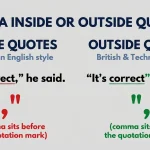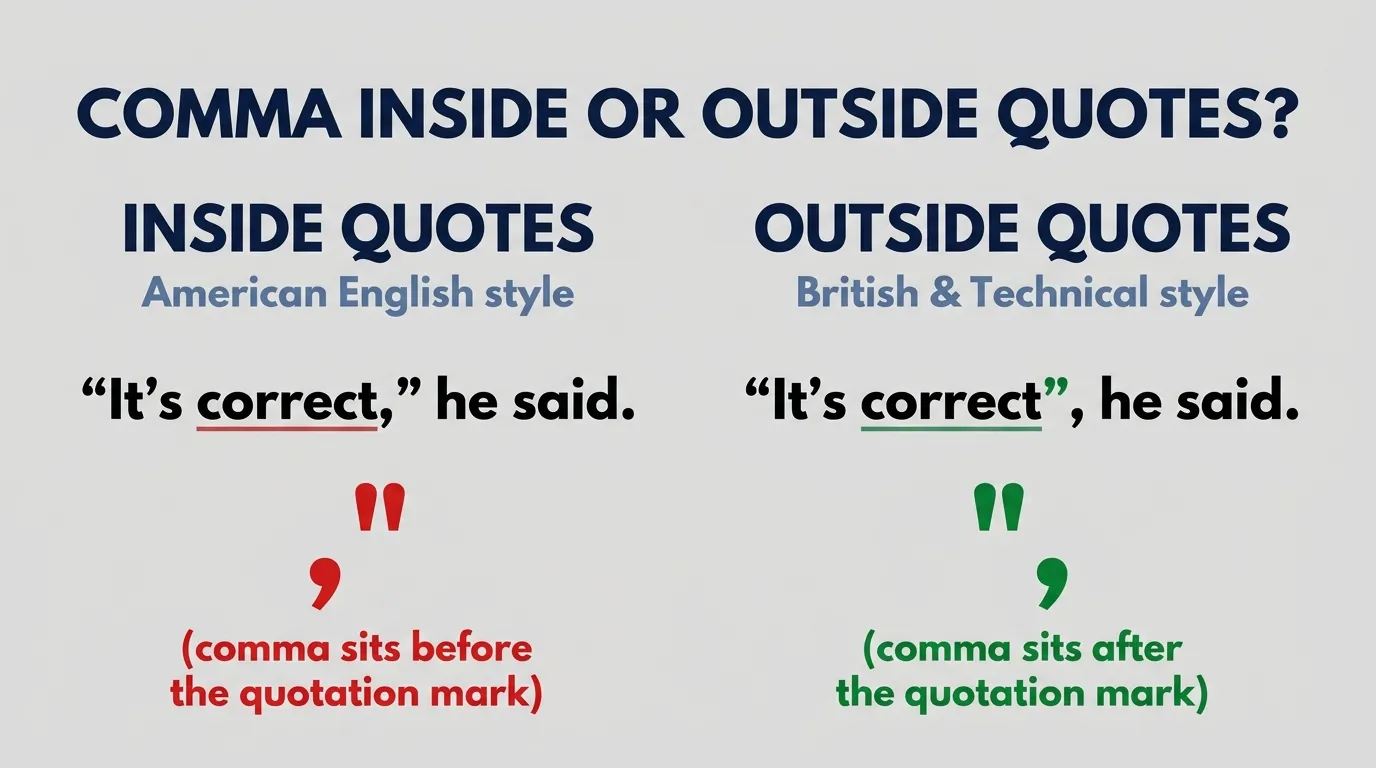
In American English, commas always go inside the closing quotation mark. That’s true even when the comma isn’t part of the quote.
You’re polishing an email. You write that a client called the plan “ambitious” and stop. Does the comma go before the closing mark or after it? Your cursor blinks while you guess.
Here’s the good news: the US rule is simple, and you can learn it in a minute. The confusion comes from British English, which handles the same question differently.
This guide gives you the American rule, the British version, and the few exceptions that really matter. You’ll also get plenty of examples to copy.
Table of Contents
- Comma Inside or Outside Quotes? The Short Answer
- Why Do Americans Put Commas Inside?
- American vs British Style
- What About Other Punctuation Marks?
- Exceptions and Tricky Cases
- Memory Trick
- Real Example Sentences
- Common Mistakes
- When to Use Each Form
- Expert Tip
- Common Misconception
- FAQs
- Conclusion and Key Takeaways
Did You Know? 🔍
The two systems have formal names. The American habit is sometimes called “typographer’s quotation,” while the British habit is often called “logical quotation” or “logical punctuation.” The names show the difference in thinking: one follows a fixed pattern, and the other follows meaning.
I didn’t find one confirmed origin story for the American habit in the sources I checked, so I won’t guess at one here.
Quick Answer Box
In American English, commas and periods go inside the closing quotation mark, every time. This holds even when the comma belongs to the larger sentence. In British English, the comma goes inside only if it belongs to the quoted words. Semicolons and colons go outside in both styles.
⚡ Quick Rule in 1 Line
In American English, commas and periods always go inside the closing quotation mark, whatever the meaning.
Comma Inside or Outside Quotes? The Short Answer
In the United States, put the comma inside the closing quotation mark. It goes before the mark, never after it. This applies to dialogue, titles, single words, and short phrases. You don’t need to check whether the comma is part of the quote.
Here’s the rule in action:
- “We still have a chance,” said Rita.
- They called the plan “ambitious,” but nobody believed it.
- She used the word “queen,” which seemed fitting.
Notice the second example. The comma belongs to the whole sentence, not to the word “ambitious.” American style still puts it inside.
The major US style guides agree. The Editor’s Manual notes that Chicago, AP, APA, and MLA all recommend placing commas inside quotation marks.
Why Do Americans Put Commas Inside?
Americans put commas inside because it’s the convention in US printing and style guides, not because of logic. The rule is about a consistent look on the page. Once you accept it as a fixed pattern, it’s easy to apply.
That’s why the rule feels odd to careful thinkers. In “They called it ‘intelligent,’ but can it think?” the comma has nothing to do with the quoted word. The US system puts it inside anyway.
The advantage is that you never have to analyze the sentence. Commas and periods go inside. Done.
British style asks you to think about meaning each time. That can be more precise, but it takes more effort. Wikipedia notes that British usage also varies widely, which adds to the confusion.
American vs British Style
American style puts commas and periods inside the closing quotation mark every time. British style puts them inside only when they belong to the quoted text. Otherwise, they go outside. British writers also usually start with single quotation marks.
| Feature | American English | British English |
|---|---|---|
| Main quote marks | Double (“like this”) | Single (‘like this’) |
| Comma at the end of a quote | Inside | Inside only if part of the quote |
| Period at the end of a quote | Inside | Inside only if the quoted sentence ends there |
| Quote within a quote | Single inside double | Double inside single |
| Example | They called it “progress,” but it wasn’t. | They called it ‘progress’, but it wasn’t. |
Many British style guides, including the New Oxford Style Manual and the Australian Government style manual, follow the logical approach, according to the Editor’s Manual.
Canada is mixed. The same source says American style is often used there, but publications may follow British style or house rules. Check the publication you’re writing for.
What About Other Punctuation Marks?
Commas and periods follow a fixed rule in American style, but other marks follow meaning. Colons and semicolons go outside the closing quotation mark. Question marks and exclamation points go inside only when they belong to the quoted words.
Here’s a quick guide:
| Mark | Where it goes (US) | Example |
|---|---|---|
| Comma | Always inside | “Help,” she said. |
| Period | Always inside | He said, “I can help.” |
| Semicolon | Outside | She said “maybe”; I said “no.” |
| Colon | Outside | He listed his “favorites”: pizza and tacos. |
| Question mark | Inside if part of the quote | Maya asked, “Does it matter?” |
| Question mark | Outside if the whole sentence asks | Would you call that “progress”? |
| Exclamation point | Inside if part of the quote | Farley cried, “Help!” |
| Exclamation point | Outside if the whole sentence exclaims | They say it’s “intelligent”! |
The Editor’s Manual says question marks and exclamation points follow meaning in both American and British usage. So the big difference between the two systems is really just commas and periods.
To check any question mark, ask: “Who is asking?” If the quoted speaker asks, it goes inside. If you’re asking, it goes outside.
Exceptions and Tricky Cases
A few situations break the simple US pattern or need extra care. These include citations after a quote, quotes inside quotes, modern British dialogue, and some technical writing. None of them cancel the basic rule in everyday American writing.
1. A citation follows the quote. In academic writing, the comma or period often moves after the citation. A university writing center puts it this way: place periods and commas inside quotation marks, except when citations follow.
- Aida said, “Aaron has a black shirt” (Lopez 12).
2. A quote inside a quote. US style uses single quotation marks inside double ones. The comma goes inside both.
- “They say this program is ‘intelligent,'” she said.
3. Modern British dialogue. Traditional British style puts the speech comma outside. Modern British fiction and journalism often put it inside, like American style.
- Traditional: ‘I think’, she said, ‘we still have a chance.’
- Modern: ‘I think,’ she said, ‘we still have a chance.’
4. Technical writing. Some software documentation puts punctuation outside quotes so it can’t be mistaken for part of a code string. That’s a house-style choice, not the general American rule. If your employer or publisher has one, follow it.
5. Words used as words. US style still puts the comma inside. For example: You wrote “teh,” but you meant “the.”
Memory Trick
Picture the closing quotation mark as a small house. In America, the comma and period move inside the house. In Britain, they wait on the porch unless they’re part of the family, meaning the quoted words.
If rhymes help, try this short line: “In the US, the comma moves inside.”
The comma is a very small guest, and it always gets a room.
Real Example Sentences
Here are examples grouped by use. Notice where each comma and period lands.
American style, dialogue
- “I’ll be there by noon,” Jake promised.
- “My cat,” she said, “has superpowers.”
- “Don’t forget your keys,” Mom called.
- “Well,” he said, “that went badly.”
American style, titles and phrases
- Her favorite poem is “Fire and Ice,” and she knows it by heart.
- He called the meeting “a waste of time,” which hurt a few feelings.
- The teacher described the essay as “thoughtful,” but she wanted more evidence.
- We read “The Gift of the Magi,” then discussed the ending.
The American style, other punctuation
- Did she really say, “I quit”?
- She asked, “Are we late?”
- They shouted, “Surprise!”
- He promised to be “on time”; he was twenty minutes late.
British style (for comparison)
- They called it ‘progress’, but nobody agreed.
- He offered ‘help’, which never came.
- I love the word ‘iridescent’, though I can never spell it.
- ‘We still have a chance,’ she said.
Citations and nested quotes
- The report found “steady growth” (Smith 14).
- “They say this program is ‘intelligent,'” she said.
- According to Smith, the results were “mixed,” but the team stayed hopeful.
Common Mistakes
The most common mistake is putting a comma outside the closing quotation mark in American writing. Another is applying British logic to a US audience. Here’s what to watch for.
❌ They called it “intelligent”, but can it think? ✅ They called it “intelligent,” but can it think?
❌ “I’m leaving”, she said. ✅ “I’m leaving,” she said.
She used the word “queen”, which seemed right. ✅ She used the word “queen,” which seemed right.
❌ He said “I can help”. ✅ He said, “I can help.”
❌ She said “maybe,” I said “no.” ✅ She said “maybe”; I said “no.”
Switching styles halfway through a document. ✅ Pick American or British style and use it from start to finish.
When to Use Each Form
Use the American rule if your audience is in the United States, or if your style guide is Chicago, AP, APA, or MLA. Use the British rule for UK, Australian, or other publications that follow the logical style. Always stay consistent.
| Situation | Best choice |
|---|---|
| US blog, article, or business writing | Comma inside |
| US school essay (MLA, APA, Chicago) | Comma inside; follow citation rules |
| UK or Australian publication | Follow that publication’s guide |
| Writing for a global audience | Comma inside is the safest default |
| Technical documentation with code | Follow your company’s house style |
If you’re unsure who will read your work, go with the American rule. It’s easy to apply and hard to get wrong.
Expert Tip 💡
Search your document for a closing quotation mark followed by a comma or period. In American style, every hit is a mistake. This ten-second check catches most errors before an editor sees them.
Common Misconception
“The comma goes outside because it’s not part of the quote.” That’s true in British style, but not in American style. In US writing, a comma or period goes inside even when it only belongs to the larger sentence. The rule is about convention, not logic.
FAQs
1. Does the comma go inside or outside quotation marks?
In American English, it goes inside. In British English, it goes inside only when it belongs to the quoted words. Pick the style that matches your audience.
2. Does a period go inside or outside quotation marks?
In American English, always inside. In British English, inside only if the quoted sentence ends there. Otherwise, the period goes outside.
3. Why do commas go inside quotation marks in the US?
It’s a printing and style convention in American English. The sources I checked describe it as a fixed rule rather than a logical one. Style guides such as Chicago, AP, APA, and MLA all follow it.
4. Do question marks go inside or outside quotes?
It depends on meaning. Inside if the quoted words are the question, and outside if the whole sentence is the question.
5. Do semicolons and colons go inside quotation marks?
No. In American style, they go outside the closing quotation mark.
6. What if I’m quoting a single word?
In American style, the comma still goes inside. For example: They called it “magic,” but it was just practice.
7. What if a citation comes after the quote?
In academic writing, the period or comma often moves after the citation. Follow your style guide, such as MLA or APA.
8. How do I punctuate a quote inside a quote?
In American English, use single quotation marks inside double ones. The comma goes inside both marks: “They say it’s ‘fine,'” she said.
9. Is the British rule wrong?
No. It’s the standard in many UK and Australian style guides. It simply follows a different logic than the American rule.
10. What should I do if I write for both audiences?
Choose one style for each piece and apply it consistently. For a US audience, use the American rule.
Conclusion
So, is the comma inside or outside quotes? In American English, it goes inside, every time. You don’t have to ask whether it belongs to the quote. British English asks that question and moves the comma outside when it doesn’t belong.
Remember the small exceptions. Citations can move punctuation, question marks follow meaning, and colons and semicolons stay outside. Beyond that, the rule is steady.
Here’s your takeaway: know your audience, pick a style, and stick with it. If you write for readers in the US, tuck the comma inside the closing quotation mark and move on. You’ve got this.

Hi, I’m Daniel Carter. I’m passionate about helping learners improve their English with practical grammar tips and clear writing advice.