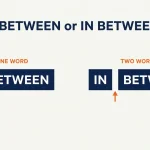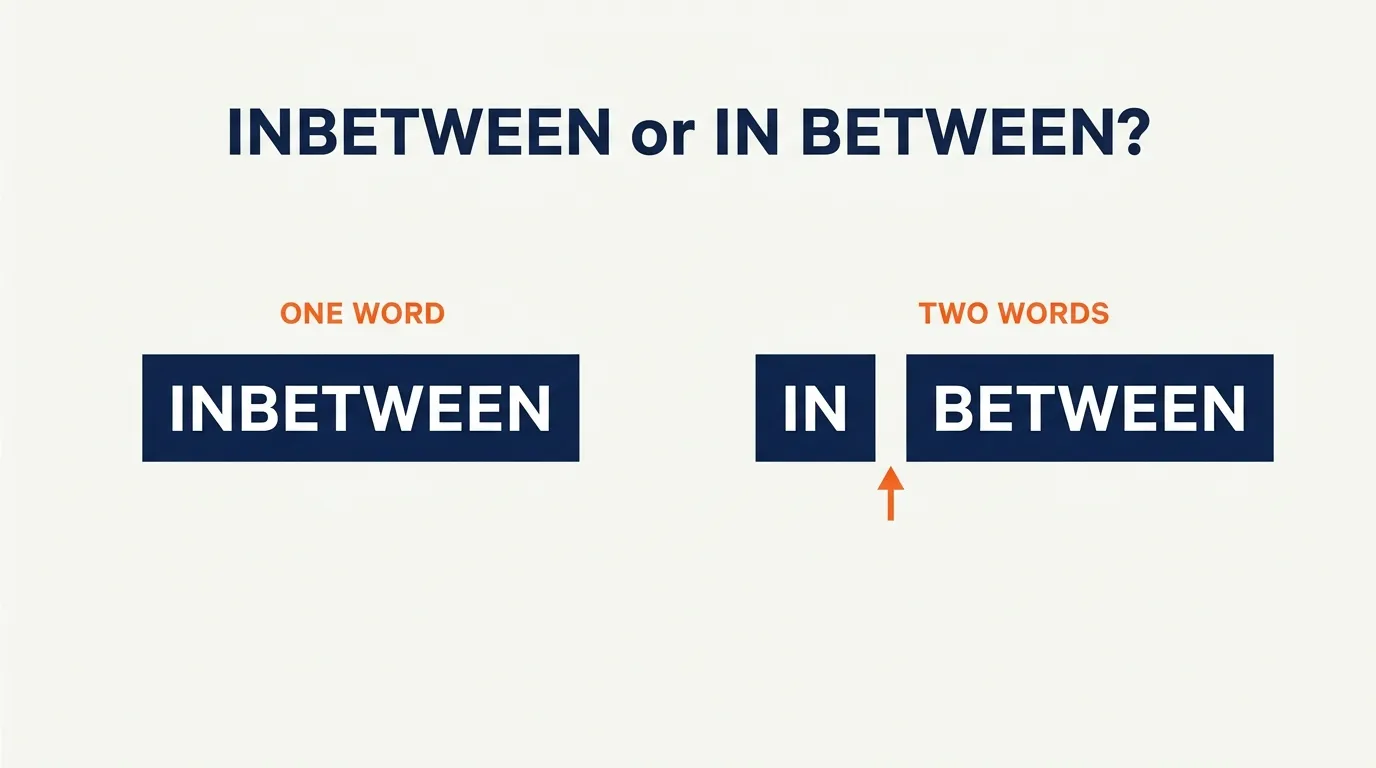
You’re typing a quick email: “I’ll call you inbetween meetings.” Your spellchecker draws a red line. Which part is wrong? The correct form is in between, written as two words.
Inbetween as one word isn’t standard English. Use in between for the phrase, and in-between with a hyphen when it works as an adjective or noun.
Once you see where each form fits, you won’t second-guess it again. Let’s go through it step by step.
Table of Contents
- Inbetween or In Between: The Quick Answer
- The Rule Behind Each Form
- Comparison Table
- A Memory Trick That Works
- 18 Real Example Sentences
- Common Mistakes
- In Between vs Between
- When You Need the Hyphen
- Quick Quiz
- FAQs
- Conclusion
- Key Takeaways
🔍 Did You Know?
English often starts with two separate words, then joins them over time. Think of every day and everyday, which are now two different words with two different jobs. But in between hasn’t made that jump in standard dictionaries. It stays two words (or hyphenated as a modifier). Check the Merriam-Webster entry to see how it lists each form.
Quick Answer Box
Write in between as two words when it works as an adverb or preposition, as in “in between meetings.” Use the hyphenated in-between when it describes a noun, as in “an in-between size.” The one-word spelling inbetween isn’t standard English, so avoid it in emails, essays, and articles.
⚡ Quick Rule in 1 Line
Two words for the phrase, a hyphen for the describer, and never one word: in between, in-between.
Inbetween or In Between: The Quick Answer
In between is the standard way to write the phrase. It means “in the space or time separating two things.” You’ll see it in American and British English.
Here are the forms side by side:
- ✅ I read in between classes.
- ❌ I read inbetween classes.
- ✅ She wears an in-between size.
- ❌ She wears an inbetween size.
So why does inbetween look so natural? Because we say it as one smooth sound. Speech has no spaces. Writing needs them.
Many learners also see words like inside and into written as one word. It feels logical that in + between would do the same. But English doesn’t follow that pattern here.
If you remember one thing, remember this: don’t glue it together.
The Rule Behind Each Form
In between is made of two words: the preposition in and the word between. Together, they work as an adverb or a preposition. The hyphenated in-between works as an adjective or a noun. The one-word inbetween isn’t part of the standard rule.
Use this simple check:
- Is it describing a noun? (an in-between size, an in-between stage) Use in-between.
- Is it acting as a noun? (the in-between) Use in-between.
- Is it showing where or when? (in between meetings, in between jobs) Use in between.
In between as an adverb answers “where?” or “when?”:
- She stood in between. (Where?)
- We rested in between. (When?)
In between as a preposition is followed by a noun:
- in between meals
- in between the two houses
In-between as an adjective comes before a noun:
- an in-between size
- the in-between years
In-between as a noun names the middle ground:
- She lives in the in-between.
Hyphens join words that work together as one describer. That’s why the hyphen appears only when the phrase sits before a noun, or acts as a noun itself.
Comparison Table
This table shows all three forms. Use it for quick checking.
| Form | Part of speech | Meaning | Example |
|---|---|---|---|
| in between | Adverb | in the middle, in the gap | We rested in between. |
| in between | Preposition | separating two things | I snack in between meals. |
| in-between | Adjective | middle, not one or the other | It’s an in-between size. |
| in-between | Noun | the middle ground | He lives in the in-between. |
| Not standard | n/a | Avoid in formal writing. |
Here’s a second table that shows the position of the phrase in a sentence:
| Where it appears | Form to use | Example |
|---|---|---|
| After a verb | in between | The cat sat in between. |
| Before a noun (as a describer) | in-between | The in-between time felt slow. |
| Before a noun (as a preposition) | in between | in between the doors |
A Memory Trick That Works
The trick is to think “two parts, two words.” In and between each have their own meaning. Keep them apart, and you can’t go wrong.
Try this picture: a sandwich. Two slices of bread sit on the outside. The filling sits in between. The words stand apart, like the slices.
Here’s a short rhyme:
“Keep the space in between, and your writing stays clean.”
You can also use the hyphen test. Ask: “Is it describing a noun right after it?” If yes, add the hyphen. If no, leave the space.
18 Real Example Sentences
Reading examples helps the pattern stick. Here are 18 sentences grouped by form.
In between (adverb or preposition):
- I check my email in between meetings.
- She sat in between her two brothers.
- We snack in between meals.
- The cafe sits in between the bank and the post office.
- He studies in between his work shifts.
- The kids played in between the rain showers.
In-between (adjective):
- She wears an in-between size.
- It’s that in-between season, not warm and not cold.
- He’s at an in-between stage in his career.
- I’m looking for an in-between option.
- The in-between years were tough.
- We chose an in-between price.
In-between (noun):
- Life happens in the in-between.
- Many people live in the in-between of two cultures.
- The in-between can feel strange.
Common phrases:
- She’s in between jobs right now.
- He read in between the lines.
- We talked a little in between songs.
Sentence 13 shows the noun use. The hyphenated form comes after the.
Common Mistakes
Most errors come from joining the words or adding a hyphen in the wrong place. Each one has a quick fix.
❌ I’ll call you inbetween meetings. ✅ I’ll call you in between meetings.
❌ It’s an inbetween size. ✅ It’s an in-between size.
We rested in-between. ✅ We rested in between. (No hyphen when it works as an adverb after the verb.)
❌ She’s inbetween jobs. ✅ She’s in between jobs.
❌ The in between years were hard. ✅ The in-between years were hard. (Add the hyphen when it describes the noun years.)
He sat in between of the two chairs. ✅ He sat in between the two chairs. (Don’t add of.)
The pattern is clear. Ask where the phrase sits in the sentence. That tells you if you need the hyphen.
In Between vs Between
Between alone and in between often mean almost the same thing. The difference is small. Between links two things directly. In between adds a sense of “in the gap” or “during the pause.”
Look at these pairs:
- I sat between Mia and Leo. (Direct position.)
- I sat in between Mia and Leo. (Same meaning, a little more casual.)
- I read between meetings. (Correct.)
- I read in between meetings. (Also correct, and common in speech.)
When you want clean, short writing, between is often enough. Use in between when you want to stress the gap or pause. It’s also useful as a stand-alone adverb: “We rested in between.” You can’t swap between in that sentence.
One note on style: with ranges, use between … and. Say “between 5 and 6 p.m.” Don’t write “in between 5 and 6 p.m.” The longer version is common in speech, but the shorter one is cleaner.
When You Need the Hyphen
You need the hyphen when in-between sits before a noun as a describer, or when it acts as a noun. Compound modifiers often take hyphens in English, as in well-known author or full-time job.
Here’s how it works:
| Situation | Form |
|---|---|
| Before a noun | an in-between size |
| After a verb | We rested in between. |
| As a noun | the in-between |
| After the noun (as a predicate) | The size is in between. |
Some style guides handle hyphens in slightly different ways. If you write for a publisher, check their guide. For most everyday writing, the rule above works.
If you’re unsure, look the word up in a dictionary such as Merriam-Webster. It lists how in-between is used and spelled.
One more point: inbetween may show up in brand names, band names, or titles. That’s a creative choice, not a grammar rule. In normal sentences, stay with the standard forms.
💡 Expert Tip
When you proofread, search your draft for “inbetween.” Then check each “in-between” and “in between” by asking one question: “Does it come right before a noun?” If yes, use the hyphen. If no, use the space. This quick check takes under a minute, and it works for similar pairs like every day and everyday.
Quick Quiz
Choose the correct form. Answers are below.
- I’ll finish the report (inbetween / in between) calls.
- She wears an (in between / in-between) size.
- We stopped (in between / in-between) for coffee.
Answers: 1. in between. 2. in-between. 3. in between.
FAQs
1. Is it inbetween or in between? It’s in between, written as two words. The one-word form inbetween isn’t standard.
2. Is “inbetween” a word? Not in standard dictionaries. You may see it in names and casual writing, but avoid it in formal text.
3. When do I use in-between with a hyphen? Use it when the phrase describes a noun, like an in-between size, or when it acts as a noun, like the in-between.
4. Is “in between” one word or two? It’s two words as an adverb or preposition.
5. What does “in between” mean? It means in the space or time that separates two things, such as “in between meetings.”
6. Is there a difference between “between” and “in between”? The meaning is close. In between often adds a sense of the gap or pause, and it works alone as an adverb.
7. Can I say “in between 5 and 6”? It’s common in speech, but “between 5 and 6” is cleaner in writing.
8. Is “in between” spelled differently in British English? No. The forms are the same in American and British English.
9. What does “in between jobs” mean? It means a person is not working right now but is looking for a new job.
10. How can I remember the correct form? Think of a sandwich. The words stay apart, like two slices of bread with the filling in between.
Conclusion
The answer is simple: write in between as two words. Use the hyphenated in-between when it describes a noun or acts as one. The one-word inbetween isn’t standard English.
Remember the quick test. If the phrase comes right before a noun, add the hyphen. If not, keep the space. That single habit fixes most mistakes.
Next time you write “in between meetings” or buy an “in-between size,” you’ll know exactly what to do. Clean spacing makes your writing look careful and professional.

Hi, I’m Olivia Harper. I love turning complex English grammar into simple, practical lessons that help readers write and speak with confidence.