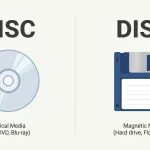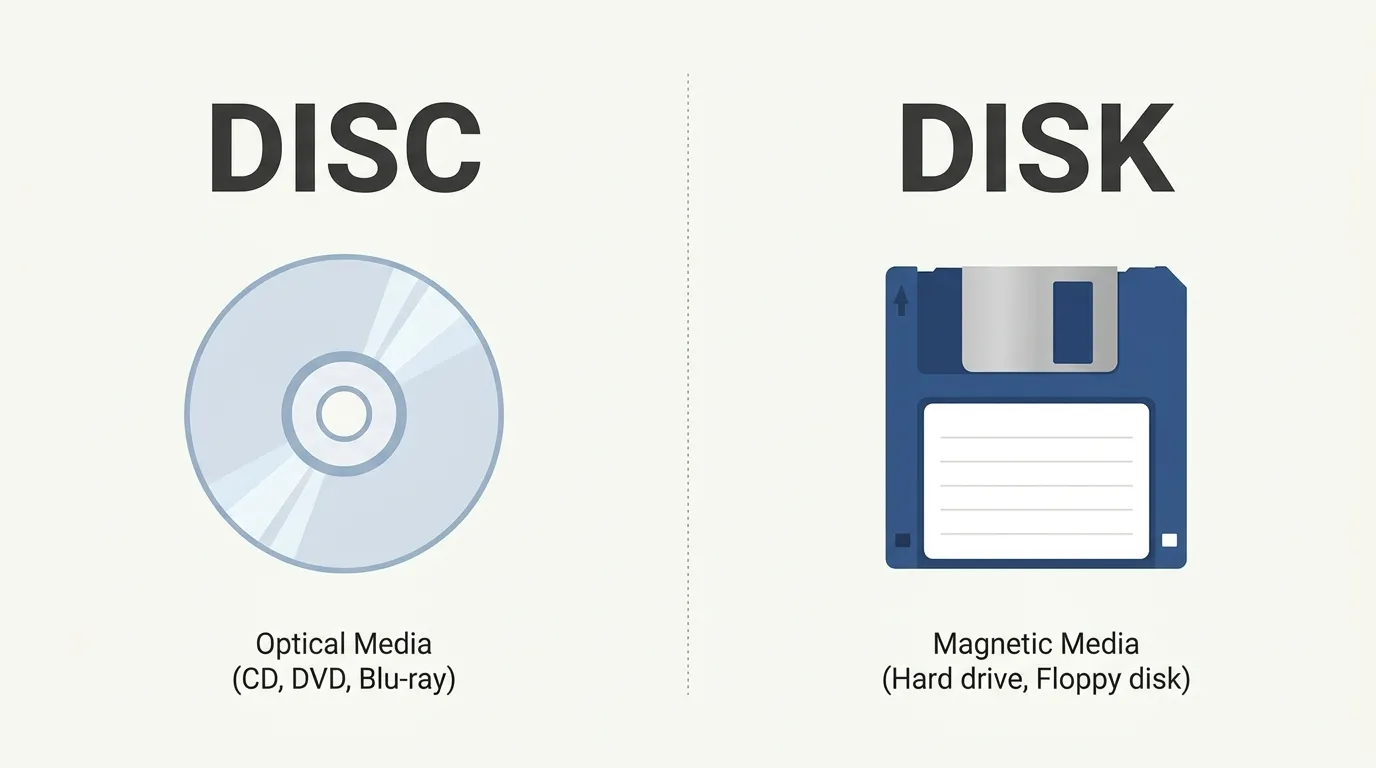
Disc and disk are two spellings of the same word. The right one depends on what you’re describing. Use disk for computer storage and disc for CDs, records, and disc jockeys.
Maybe you’re labeling a box of old CDs, and your spell-checker stays quiet either way. Or you’re writing about a hard drive, and a coworker says it’s spelled wrong. Both of you may be partly right.
That’s because region matters too. Americans lean toward disk, while British writers lean toward disc. Neither side is wrong.
This guide sorts the rules into simple groups, flags the exceptions, and gives you clear examples to copy right away.
You’ll also get memory tricks, common mistakes, and answers to the questions people ask most.
Table of Contents
- Disc or Disk? The Difference Explained
- When Should You Use Disk?
- When Should You Use Disc?
- Spine and Medical Terms
- Sports and Other Round Objects
- Memory Trick
- Real Example Sentences
- Common Mistakes
- When to Use Each Form
- Expert Tip
- Common Misconception
- FAQs
- Conclusion and Key Takeaways
Did You Know? 🔍
Both words come from the Latin “discus” and the Greek “diskos.” Mental Floss says the earliest English examples, from the mid-1600s, used “disk.” Words like “whisk” probably influenced that spelling. Writers later started favoring “disc” because of the Latin source.
Quick Answer Box
Disc and disk are two spellings of the same word. Use disk for computer storage, such as hard disks, in both US and UK English. Use disc for CDs, records, and disc jockeys. For general round objects, Americans lean toward disk and Britons toward disc. Medical and sports terms vary, so follow your style guide.
⚡ Quick Rule in 1 Line
Use disk for computer storage and disc for CDs, records, and DJs; the US leans disk.
Disc or Disk? The Difference Explained
Disc and disk both mean a thin, flat, circular object. Merriam-Webster labels disc a variant spelling of disk. The choice depends on context first and region second. Computers take disk almost everywhere, while CDs, records, and disc jockeys take disc.
Think of it as two layers. First, ask what the object is. Then ask who your readers are.
| Context | American English | British English |
|---|---|---|
| Computer storage (hard disk, floppy disk) | disk | disk |
| CDs, DVDs, optical media | disc | disc |
| Phonograph records | disc | disc |
| Disc jockey (DJ) | disc | disc |
| General flat, round objects | disk (usually) | disc (usually) |
| Spinal disc or disk | disk (often) | disc |
This table follows Writing Explained, with extra detail from Grammarly. Real usage is messier than any chart, so treat it as a strong guide, not a law.
When Should You Use Disk?
Use disk for computer storage in both American and British English. That includes hard disks, floppy disks, disk drives, and disk space. Disk is also the usual American spelling for general flat, round objects.
Here are the common computer terms:
- Hard disk: My hard disk is almost full.
- Floppy disk: Old floppy disks held very little data.
- Disk drive: The disk drive made a clicking sound.
- Disk space: You’ll need more disk space for that update.
Why did computing choose the K? Mental Floss notes that engineers named magnetic storage “floppy disks,” and the K stuck, along with “disk drive.”
When Should You Use Disc?
Use disc for optical media, phonograph records, and disc jockeys. These terms use disc in both regions, according to Writing Explained. Disc is also the usual British spelling for general round objects.
Common examples include:
- Compact disc: She burned a playlist onto a compact disc.
- Blu-ray disc: The movie came on a Blu-ray disc.
- Record: Collectors still hunt for rare discs from the 1960s.
- Disc jockey: The disc jockey played dance music all night.
- Disc brake: The bike has strong disc brakes.
Merriam-Webster marks several of these senses as “usually disc,” including optical discs, records, and disc brakes.
Notice the pattern. Most disc terms began as sound or machine words from the early recording age. Mental Floss traces the record use to disc-shaped records in the late 1800s.
Spine and Medical Terms
Spinal disk or disc depends on region and publication. Americans often write “herniated disk” while British writers write “slipped disc.” But sources disagree. Pick the form your style guide or publisher uses, and use it every time.
Here’s what the sources say:
| Source | Preference |
|---|---|
| Writing Explained | Disk in American usage, disc in British usage |
| Grammarly | The AMA uses disk for body parts; eye terms use disc |
| Mental Floss | Mayo Clinic uses “herniated disk”; AANS uses “herniated disc” |
| Merriam-Webster | Lists “intervertebral disc” as an example, with disc as a variant spelling |
One clear exception is the eye. Grammarly says ophthalmology uses disc, as in “optic disc.”
In short, medical writing has no single rule. Check the journal or clinic you’re writing for. If there’s no guide, choose one spelling and keep it consistent.
Sports and Other Round Objects
Sports terms like flying disc and disc golf usually take disc, though sources disagree. Dictionary.com and Mental Floss both recommend disc for the flying toy. Writing Explained lists a flying disk under American usage. Check your style guide.
Other round objects show the same mixed picture:
- Flying disc: Most sources lean toward disc.
- Disc golf: Dictionary.com lists it with disc.
- Plow or harrow discs: Usually disc.
- Astronomy (“disk of the moon”): Dictionary.com lists disk.
- Botany (the center of a flower): Dictionary.com lists disk.
So which should you pick? When two good sources disagree, choose the one your publication follows. Then apply it to every similar term in the same document.
Here’s an honest note for you. Writing Explained says disk is gaining ground in both regions, largely because of computing. That means the split may keep shrinking over time.
Memory Trick
A simple trick matches the letter to the object. The K in disk matches the K in keyboard, so link it to computers. The C in disc matches the C in CD and compact, so link it to optical media.
Mental Floss shares another idea. Round things, like the letter C, take disc. Angular things, like the letter K, take disk. It’s a loose rule, but it helps some learners.
Dictionary.com offers a third clue. The D in CD and DJ usually stands for “disc.”
Pick whichever trick sticks. Then use this quick order:
- Is it computer storage? Write disk.
- Is it a CD, a record, or a DJ? Write disc.
- Is it something else? Follow your region or style guide.
Real Example Sentences
These sentences are grouped by use, so you can see each pattern clearly.
Computers (disk)
- My hard disk ran out of space this morning.
- The old computer still had a floppy disk drive.
- You can free up disk space by deleting large files.
- The technician replaced the failed disk.
Optical media and sound (disc)
- I burned the photos onto a blank disc.
- The compact disc skipped in the middle of the song.
- He mailed the DVD disc in a paper sleeve.
- The record store sells rare vinyl discs.
Disc jockey
- The disc jockey took requests all evening.
- She dreams of becoming a famous disc jockey.
General round objects
- American style: A thin metal disk covered the hole.
- British style: A thin metal disc covered the hole.
- The sun appeared as a bright disk above the hills.
Spine and medical (varies)
- American style: He slipped a disk lifting the box.
- British style: He slipped a disc lifting the box.
- The doctor checked for a herniated disk.
Sports and machines
- They played disc golf at the park on Sunday.
- The bike’s front disc brake needs new pads.
- The farmer used a disc harrow to prepare the field.
Common Mistakes
The most common mistake is mixing the two spellings for the same object in one document. Another is using disc for computer storage. Here’s what to watch for.
❌ My hard disc is full. ✅ My hard disk is full.
❌ The floppy disc held only a few files. ✅ The floppy disk held only a few files.
She wants to be a disk jockey. ✅ She wants to be a disc jockey.
❌ Writing “disk” in one paragraph and “disc” in the next for the same CD. ✅ Pick one spelling for each object and keep it throughout.
❌ The bike has a disk brake on the front wheel. ✅ The bike has a disc brake on the front wheel.
Assuming one spelling is simply wrong. ✅ Treat both as valid, and choose by context and region.
When to Use Each Form
Use disk for computer storage and most American general uses. Use disc for CDs, records, DJs, and most British general uses. For medical, sports, and science terms, follow your style guide. Consistency inside a document matters most.
| Situation | Best choice |
|---|---|
| Hard drive, floppy, disk space | disk |
| CD, DVD, Blu-ray | disc |
| Vinyl record | disc |
| DJ | disc |
| US general flat object | disk |
| UK general flat object | disc |
| Spine (US publication) | Follow your guide (disk is common) |
| Spine (UK publication) | disc |
| Sports (flying disc, disc golf) | disc (most sources) |
If you write for a global audience, use the computing and optical rules above. They hold in both regions.
Expert Tip 💡
Before you publish, make a short list of the disc and disk terms in your document. Then check each one against your style guide. Writing Explained says AP and Chicago use disc for CDs, brakes, and disc jockeys. They use disk for most other things.
Common Misconception
“One of these spellings is simply wrong.” That’s not true. Merriam-Webster treats disc as a variant of disk, and both have long histories. What’s wrong is mixing them in the same document for the same object. The earliest English uses were even spelled “disk,” according to Mental Floss.
FAQs
1. Is it disc or disk? Both are real spellings of the same word. Use disk for computer storage and disc for CDs, records, and disc jockeys. For other objects, Americans lean toward disk and Britons toward disc.
2. Is it disk or disc for a CD? Use disc. Optical media like CDs and DVDs take disc in American and British English.
3. Is it hard disk or hard disc? It’s hard disk in both regions. Computer storage terms take disk.
4. Is it floppy disk or floppy disc? It’s floppy disk. Mental Floss notes that engineers named them with a K, and it stuck.
5. Is it disc jockey or disk jockey? It’s disc jockey. Writing Explained lists it as a disc term in both regions.
6. What’s the difference between disc and disk in American and British English? Americans generally prefer disk for flat, round objects. Britons generally prefer disc. Computer storage takes disk in both places.
7. Is it a herniated disc or herniated disk? Usage varies. Mayo Clinic uses disk, while the AANS uses disc, per Mental Floss. Follow your publisher’s guide.
8. Is it a flying disc or flying disk? Dictionary.com and Mental Floss both recommend flying disc. Writing Explained lists disk in American usage. Check your style guide.
9. Which spelling is more common today? Writing Explained says disk is gaining ground in both regions, partly because of computing. Dictionary.com says disk may be slightly more common overall.
10. Is disc a variant of disk? Yes. Merriam-Webster labels disc a variant spelling of disk.
Conclusion
So, is it disc or disk? Use disk for computer storage, and disc for CDs, records, and disc jockeys. For general round objects, Americans lean toward disk and Britons toward disc.
Remember that medical and sports terms vary. Sources disagree on spinal discs and flying discs, so a style guide is your best tiebreaker.
Here’s your plan. Decide what the object is. Match the rule above. Check your style guide for medical or sports terms. Then stay consistent for the whole document.
If you do that, no reader will question your spelling. You can stop worrying about this pair for good, and spend your energy on the rest of your writing.

Hi, I’m Ethan Brooks. I create easy-to-follow grammar guides, writing tips, and vocabulary resources to make English learning enjoyable for everyone.