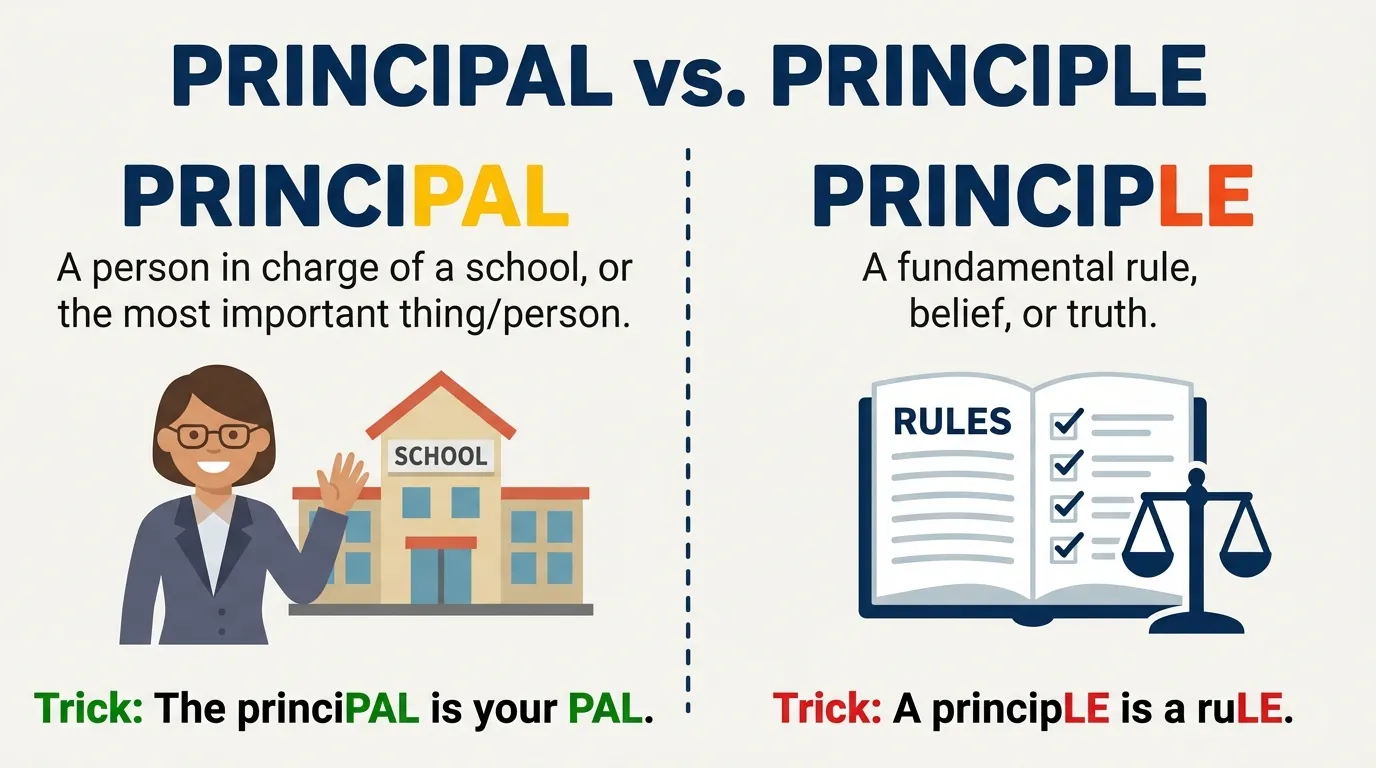
Principal means main, or a person in charge. Principle means a rule or belief. Those two lines settle most cases.
Picture this. You’re writing a thank-you note to your child’s school head, and you freeze.
Is it “Dear Principal” or “Dear Principle”? Your spell-checker stays silent, because both are real words.
That’s why the pair is so slippery. They sound identical, yet they live in different parts of speech. Principal can be a noun or an adjective, while principle is only a noun.
This guide gives you simple tricks to choose fast. You’ll also see the money meaning and the phrase “in principle.”
Real examples from school, banking, and everyday writing follow, plus a short check you can use anywhere.
Table of Contents
- Principal or Principle? The Difference Explained
- What Does Principal Mean?
- What Does Principle Mean?
- Memory Tricks
- Principal and Principle in Real Life
- Tricky Phrases to Watch
- Real Example Sentences
- Common Mistakes
- When to Use Each Form
- Expert Tip
- Common Misconception
- FAQs
- Conclusion and Key Takeaways
Did You Know? 🔍
The two words come from different Latin roots. According to Grammarly, principle comes from “principium,” meaning source, while principal comes from “principalis,” meaning first. That’s why one means a source of rules and the other means the first or most important thing.
Quick Answer Box
Principal means main, or a person in charge, such as a school head. It also means the original sum of a loan. Principle means a rule, belief, or basic truth. Principal can be a noun or an adjective. Principle is always a noun. If “rule” fits the sentence, use principle.
⚡ Quick Rule in 1 Line
Use principal for a person, money, or anything main, and principle for a rule or belief.
Principal or Principle? The Difference Explained
Principal and principle are homophones: they sound the same but have different meanings. Principal means main, first, or a person in charge. Principle means a rule or belief. Principle is always a noun, while principal can also be an adjective.
Here’s the difference at a glance, based on Merriam-Webster’s definitions.
| Word | Part of speech | Meaning | Example |
|---|---|---|---|
| principal | Noun | Person in charge | The principal called an assembly. |
| principal | Noun | Original sum of money | Each payment lowers the loan’s principal. |
| principal | Adjective | Main, most important | Cost was the principal reason. |
| principle | Noun | Rule, law, or basic truth | Honesty is a core principle. |
| principle | Noun | Personal belief about right and wrong | He refused on principle. |
Notice something helpful. Principle has no adjective use. The adjective form of principle is “principled.”
What Does Principal Mean?
Principal means “main” as an adjective, and “a person in charge” or “an original sum of money” as a noun. It appears in school settings, business, finance, and research. If the word names a person, a sum, or something most important, use principal.
You’ll meet it in four common ways:
- A school head: The principal greeted every student at the door.
- A leading person: The principal in the lawsuit was the company owner.
- Money: You pay interest on the principal.
- Main: Her principal worry was time.
The word also shows up in job titles. A principal investigator, for example, is the lead researcher on a funded study. It’s always “principal” because the title names a person.
What Does Principle Mean?
Principle is always a noun. It means a basic truth, a rule, or a personal standard of right and wrong. It never describes a person, and it never means “main.” If you can swap in “rule” or “belief,” principle is the right word.
Here are the main uses:
- A scientific rule: The principle of gravity applies everywhere.
- A moral standard: She won’t lie on principle.
- A guiding idea: Fairness is our first principle.
- A way of working: The engine runs on a simple principle.
If you need an adjective, use “principled.” For example: “He’s a principled leader who keeps his promises.”
Memory Tricks
The easiest trick links each ending to its meaning. Principal ends in “pal,” and a principal can be a person, like a school head. Principle ends in “-le,” just like the word “rule,” and a principle is a rule.
Here are four tricks from trusted style sources. Pick whichever sticks for you:
- The pal trick: Principal ends in “pal.” Your school principal is, ideally, your pal.
- The rule trick: Principle and rule both end in “-le.”
- The adjective trick: Principal ends in “-al,” and adjective starts with “a.” Principal can be an adjective.
- The swap test: If “main” or “most important” fits, use principal. If “rule” or “law” fits, use principle.
The swap test is the most reliable. Use it whenever the first three tricks leave you unsure.
Principal and Principle in Real Life
The right word often depends on the setting you’re writing about. School and job titles call for principal. Money talk usually calls for principal, too. Beliefs, laws, and rules call for principle. A quick look at each setting makes the choice feel natural.
School and work. A school head is a principal. So is a lead person in a legal or business deal. Use the word whenever it names a person in a top role.
Money. A bank statement shows the principal, which is the original amount borrowed or invested. Interest is extra. If you see “principle” on a loan, it’s a typo.
Beliefs and rules. A person’s values are principles. So are scientific laws and guiding ideas. If you could say “rule,” choose principle.
Writing essays or reports. You’ll often need both words in one paragraph. Take the sentences one at a time, and apply the swap test to each. Don’t try to fix the whole page at once.
Tricky Phrases to Watch
Some phrases cause more errors than others. The key rule is that “in principle” always ends in -le. Other phrases follow the meaning of the word. Check each phrase by asking if you mean a rule or something main.
| Phrase | Correct form | Why |
|---|---|---|
| in principle | in principle | It means “in theory,” a rule-like idea. |
| principal reason | principal reason | Principal means main here. |
| loan principal | loan principal | It’s the original sum, not a rule. |
| moral principles | moral principles | Principles are beliefs. |
| principal investigator | principal investigator | It names a person. |
| basic principles | basic principles | Principles are basic truths. |
Editor World states that “in principal” is always incorrect. Use “in principle” instead.
Another common slip is the plural. School heads are “principals,” while rules are “principles.” The extra letter changes the entire meaning.
Real Example Sentences
These sentences are grouped by meaning, so you can see each pattern clearly.
Principal as a person
- The principal announced a new schedule on Monday.
- Our principal knows every student by name.
- The two principals in the deal signed the contract.
- Principal Hernandez opened the science fair.
The Principal as money
- Each payment reduces the loan’s principal.
- She paid back the principal within two years.
- The interest is calculated on the principal.
- He didn’t touch the principal in his savings account.
Principal as “main”
- Her principal concern was cost.
- The principal ingredient in the soup is lentils.
- Traffic was the principal reason for the delay.
Principle as a rule or belief
- He lives by the principle of honesty.
- The engine works on a simple principle.
- She refused the gift on principle.
- We teach students the basic principles of fairness.
- The team agreed in principle to the plan.
Mixed (both words together)
- The principal explained the principle behind the new rule.
- Her principal goal is to follow her principles.
- A good principal sets a clear principle for respect.
Common Mistakes
The most common mistakes swap the two words in fixed phrases. People write “principle reason” or “in principal.” Here’s what to watch for.
❌ The principle reason for the delay was weather. ✅ The principal reason for the delay was weather.
❌ I agree in principal. ✅ I agree in principle.
He’s a man of principals. ✅ He’s a man of principles.
❌ She paid down the loan principle. ✅ She paid down the loan principal.
❌ The school principle called a meeting. ✅ The school principal called a meeting.
A scientific law is a principal. ✅ A scientific law is a principle.
When to Use Each Form
Use principal for a person in charge, a sum of money, or something most important. Use principle for a rule, law, belief, or moral standard. the word describes something, it’s probably principal. If it names an idea, it’s probably principle.
| Situation | Best choice |
|---|---|
| Head of a school | principal |
| Original loan amount | principal |
| Most important reason | principal |
| Lead researcher on a project | principal investigator |
| A rule or scientific law | principle |
| A personal belief about right and wrong | principle |
| “In theory” | in principle |
If you’re writing fast, apply the swap test. “Main” means principal. “Rule” means principle.
Expert Tip 💡
Search your draft for the words “principal” and “principle” before you publish. For each result, try replacing it with “main” and then with “rule.” Only one will fit. This quick check catches almost every error in this pair.
Common Misconception
“Principal only means a school head.” That’s one common use, but it’s not the only one. Principal also means the original sum of money in a loan. It works as an adjective meaning “main,” too. So a sentence like “Cost was the principal reason” is perfectly correct, even though no school is involved.
FAQs
1. Is it principal or principle? Use principal for a person in charge, a sum of money, or something main. Use principle for a rule or belief. The swap test helps: “main” means principal, and “rule” means principle.
2. What does principal mean? It means main or most important, or a person in a leading role, such as a school head. It also means the original amount of a loan or investment.
3. What does principle mean? It’s a rule, basic truth, or personal standard of right and wrong. It’s always a noun.
4. Is it “in principle” or “in principal”? It’s always “in principle.” The phrase means “in theory,” and it uses the rule word.
5. Is principal an adjective? Yes. As an adjective, principal means main or most important, as in “the principal reason.”
6. Is principle ever an adjective? No. Principle is only a noun. The adjective form is “principled.”
7. How do I remember the difference? Principal ends in “pal,” like a school head. Principle ends in “-le,” like “rule.” The swap test also works well.
8. What’s the principal on a loan? It’s the original amount you borrowed, before interest. Interest is charged on the principal.
9. What’s a principal investigator? It’s the lead researcher on a funded study or trial. The word is always “principal” because it names a person.
10. What’s the plural of each word? The plural of principal is principals, such as school heads. The plural of principle is principles, such as moral rules.
Conclusion
So, is it principal or principle? Principal means main, or a person in charge, or the original sum of a loan. Principle means a rule or belief.
Remember that principal can be a noun or an adjective, while principle is only a noun. Also remember that “in principle” always ends in -le.
Here’s your plan. Ask whether you mean “main” or “rule.” If “main” fits, write principal. If “rule” fits, write principle. That one question handles nearly every sentence.
It keeps your writing clear, correct, and confident from the first line to the last. Keep the swap test handy, and you’ll rarely need to look this up again.

Hi, I’m Daniel Carter. I’m passionate about helping learners improve their English with practical grammar tips and clear writing advice.