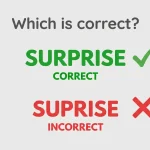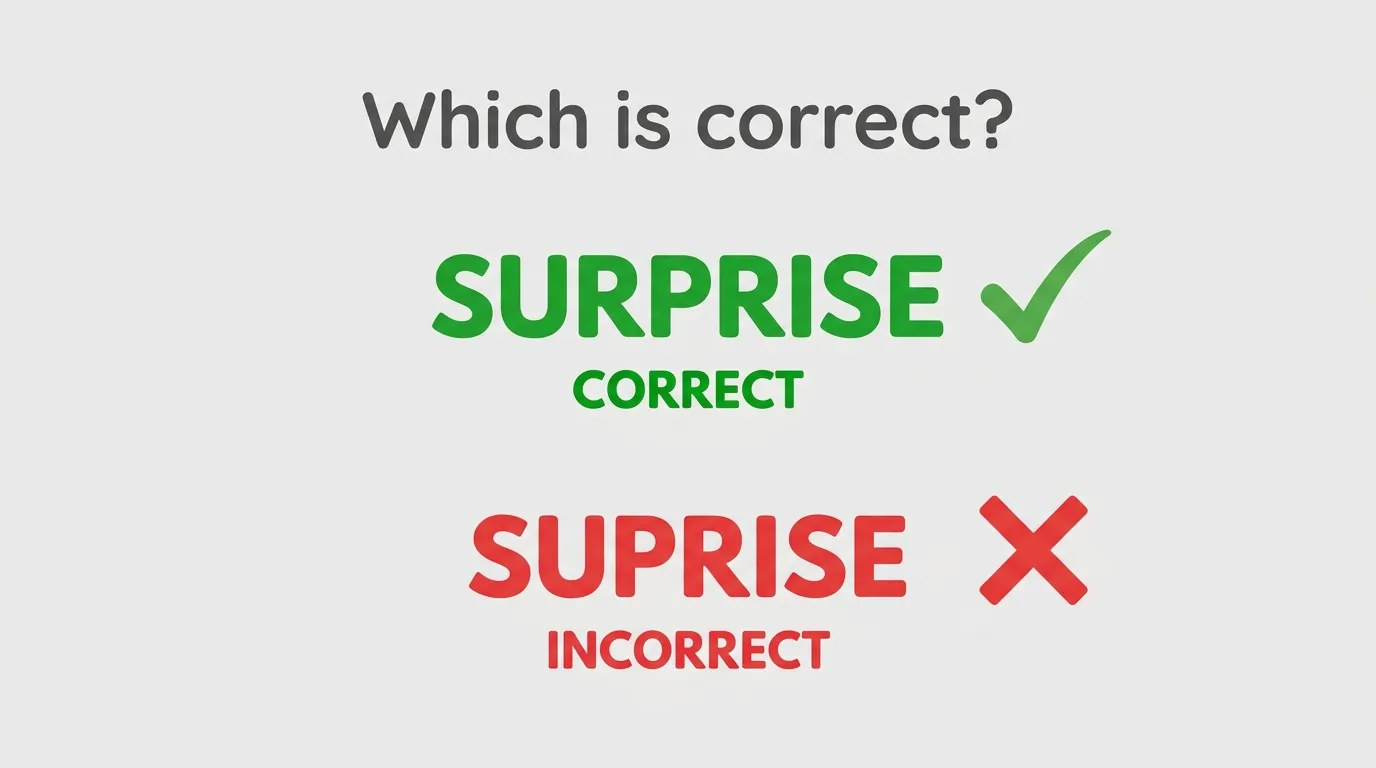
You plan a birthday party for your best friend. You write on the invite, “It’s a suprise!” Then you spot the red line. The correct spelling is surprise, with two Rs.
Suprise is a very common misspelling. Most people say the word as “suh-PRIZE,” so the first R gets lost. But in writing, it stays: sur + prise.
Once you know where the two Rs live, you’ll spell this word right every time. Let’s break it down.
Table of Contents
- Suprise or Surprise: The Quick Answer
- Why People Skip the First R
- Comparison Table
- A Memory Trick That Works
- 18 Real Example Sentences
- Common Mistakes
- Surprised vs Surprising
- Why It Ends in -ISE, Not -IZE
- Quick Quiz
- FAQs
- Conclusion
- Key Takeaways
🔍 Did You Know?
The word surprise comes from Old French. It joins sur-, which means “over” or “upon,” with a form of the verb prendre, which means “to take.” So the idea was being “taken over” suddenly. Check the Merriam-Webster or Oxford entry to confirm the history before you quote it.
Quick Answer Box
Surprise is the correct spelling. It has two Rs: one after the first u and one after the p. The common mistake suprise drops the first R, because the word sounds like “suh-PRIZE” when we say it. It’s spelled the same in American and British English.
⚡ Quick Rule in 1 Line
Say sur-prise in two clear parts, and both Rs appear: SUR-PRISE, never suprise.
Suprise or Surprise: The Quick Answer
Surprise is the only standard spelling. It works as a noun (“a nice surprise”) and a verb (“Don’t surprise me”). You’ll find it in every major dictionary.
Here are the two forms side by side:
- ✅ Her visit was a lovely surprise.
- ❌ Her visit was a lovely suprise.
Why do so many people write suprise? It comes down to pronunciation. In everyday speech, the first syllable is weak. We say “suh” instead of “sur.” Our ears hear no R, so our fingers skip it.
The spelling still carries the full prefix sur-. You’ll see that same start in words like surface, surround, and survive.
If you remember one thing, remember this: two Rs, one in each half.
Why People Skip the First R
People skip the first R because the first syllable sounds short and soft. In casual speech, “surprise” becomes “suhprise.” The brain spells what it hears, so the R disappears. The fix is to learn the word in two parts.
Here’s how it breaks down:
- Sur- is the prefix. It means “over” or “above.”
- Prise is the base part. It comes from an old word meaning “taken.”
Say each part slowly: sur (pause) prise. Now write what you said.
This habit has a name. It’s called a weak vowel or reduced syllable. English often shrinks unstressed syllables, which makes spelling harder. Other words with the same trap include:
- February (many people skip the first R)
- library (many say “libary”)
- government (many skip the N)
- probably (many say “probly”)
So you’re not alone. This is one of the most common spelling traps in English.
Comparison Table
This table shows the right spelling next to the wrong ones. Use it for quick checking.
| Spelling | Correct? | Why |
|---|---|---|
| surprise | ✅ Yes | Two Rs, ends in -ise |
| suprise | ❌ No | Missing the first R |
| surprize | ❌ No | Wrong ending (-ize) |
| supprise | ❌ No | Extra P, missing R |
| surprice | ❌ No | Wrong ending (-ice) |
| suprize | ❌ No | Missing R and wrong ending |
Here’s a second table that shows the word forms:
| Form | Part of speech | Example |
|---|---|---|
| surprise | Noun | It was a big surprise. |
| surprise | Verb | The news will surprise you. |
| surprised | Adjective or verb | I was surprised. |
| surprising | Adjective | That’s a surprising result. |
| surprisingly | Adverb | Surprisingly, it worked. |
| unsurprising | Adjective | An unsurprising outcome. |
A Memory Trick That Works
The trick is to match each R to a letter you can see in the word. Think SUR + PRISE. The R in sur is the one people skip. Say it loudly in your head.
Here’s a short rhyme:
“Two Rs in surprise, so open your eyes.”
You can also try the split-and-clap method. Clap once for sur. Clap again for prise. Then write each beat. You’ll see the R in the first clap.
A visual helper works too. Imagine a gift box with two ribbons, one on each side. Each ribbon is an R. A box with one ribbon looks unfinished, just like suprise.
18 Real Example Sentences
Seeing the word in action locks in the spelling. Here are 18 sentences grouped by use.
Noun (a surprise):
- The party was a total surprise.
- She hid the gift as a surprise.
- It came as no surprise to me.
- What a nice surprise to see you here!
- He planned a surprise for their anniversary.
- The test results held a big surprise.
Verb (to surprise):
- You always surprise me with your cooking.
- The weather didn’t surprise anyone.
- We want to surprise Dad on Sunday.
- Her answer might surprise you.
Surprised and surprising:
- I was surprised by the news.
- She looked surprised when he walked in.
- That’s a surprising answer.
- It’s not surprising that he’s tired.
- They were pleasantly surprised by the price.
Phrases and compounds:
- We threw a surprise party.
- The team made a surprise visit.
- Surprisingly, the old phone still works.
Sentences 11 and 13 show two forms that look alike but work differently. We’ll cover them next.
Common Mistakes
Most errors fall into three groups: a missing R, a wrong ending, or a mix-up between surprised and surprising. Each one has a simple fix.
❌ It’s a suprise! ✅ It’s a surprise!
❌ I was suprised by the gift. ✅ I was surprised by the gift.
That’s a suprising result. ✅ That’s a surprising result.
❌ The news was a nice surprize. ✅ The news was a nice surprise. (The ending is always -ise.)
❌ He was supprised to see me. ✅ He was surprised to see me.
The movie was surprised. ✅ The movie was surprising. (People feel surprised. Things are surprising.)
The pattern is clear. Keep both Rs and end with -ise.
Surprised vs Surprising
Surprised describes how a person feels. Surprising describes the thing that causes the feeling. This is a different mix-up from the spelling mistake, but it often appears in the same writing, so it’s worth a quick look.
| Word | Describes | Example |
|---|---|---|
| surprised | the person who feels it | I was surprised. |
| surprising | the thing that causes it | The news was surprising. |
Here’s a simple test. Ask: “Who feels it?” or “What causes it?”
- The person feels surprised: She was surprised.
- The news is surprising: The news was surprising.
This pattern works for other pairs too, like bored and boring, and excited and exciting. Learn one pair, and you’ve learned many.
Why It Ends in -ISE, Not -IZE
Surprise always ends in -ise, in both American and British English. That surprises some people, because many verbs like organize take -ize in the US. But a small group of verbs must end in -ise everywhere.
Here are some that always take -ise:
- advertise
- advise
- compromise
- devise
- disguise
- exercise
- revise
- supervise
- surprise
The -ise in these words isn’t a suffix that can switch to -ize. It’s part of the word’s root. So surprize is wrong, even in American English.
If you want a quick way to remember, think of surprise as part of the “rise” family. Both end the same way.
A note on sources: check an Oxford or Merriam-Webster entry to confirm which verbs are always spelled with -ise. Lists may vary a little by source.
💡 Expert Tip
When you proofread, look for tricky words that have weak syllables. Read them aloud slowly, in parts. For surprise, say “sur-prise.” For February, say “Feb-roo-air-ee.” Spellcheck catches suprise, but it may miss surprise in a wrong form. Always read your final draft once more, out loud if you can.
Quick Quiz
Choose the correct spelling. Answers are below.
- The party was a big (suprise / surprise).
- She was (suprised / surprised) by the gift.
- It’s a (surprising / suprising) result.
Answers: 1. surprise. 2. surprised. 3. surprising.
FAQs
1. Is it suprise or surprise? It’s surprise, with two Rs. Suprise is a common misspelling.
2. Why does surprise have two Rs? The word starts with the prefix sur-, then adds prise. Each part keeps its own R.
3. Is surprize correct? No. Surprise always ends in -ise, in both American and British English.
4. How do you spell surprise? S-U-R-P-R-I-S-E. Say it in two parts: sur-prise.
5. What does surprise mean? As a noun, it’s something unexpected. As a verb, it means to cause that feeling in someone.
6. What’s the difference between surprised and surprising? Surprised describes a person’s feeling. Surprising describes what causes it.
7. Is surprise spelled differently in British English? No. The spelling is the same in the US, UK, Canada, and Australia.
8. Is suprised ever correct? No. The correct form is surprised.
9. What are some synonyms for surprise? Common ones are shock, astonish, amaze, startle, and stun. Each has a slightly different strength.
10. How can I remember the spelling? Use the rhyme: “Two Rs in surprise, so open your eyes.” Or split it as sur-prise.
Conclusion
The answer is clear: surprise is correct, and suprise is a misspelling. The word has two Rs: one in sur- and one in prise. It always ends in -ise, never -ize.
People drop the first R because we say the word quickly and softly. The cure is simple. Say it in two parts, and write each part.
Remember the related forms too: surprised for how you feel, and surprising for what causes it. Keep both Rs, and your next invite, text, or email will look sharp and correct.

Hi, I’m Sophia Bennett. My goal is to make grammar easy, clear, and useful through simple explanations and real-life examples.