Picture this. You’re proofreading a work email and a coworker wrote “verbage.” It looks right. It sounds right. But something feels off.
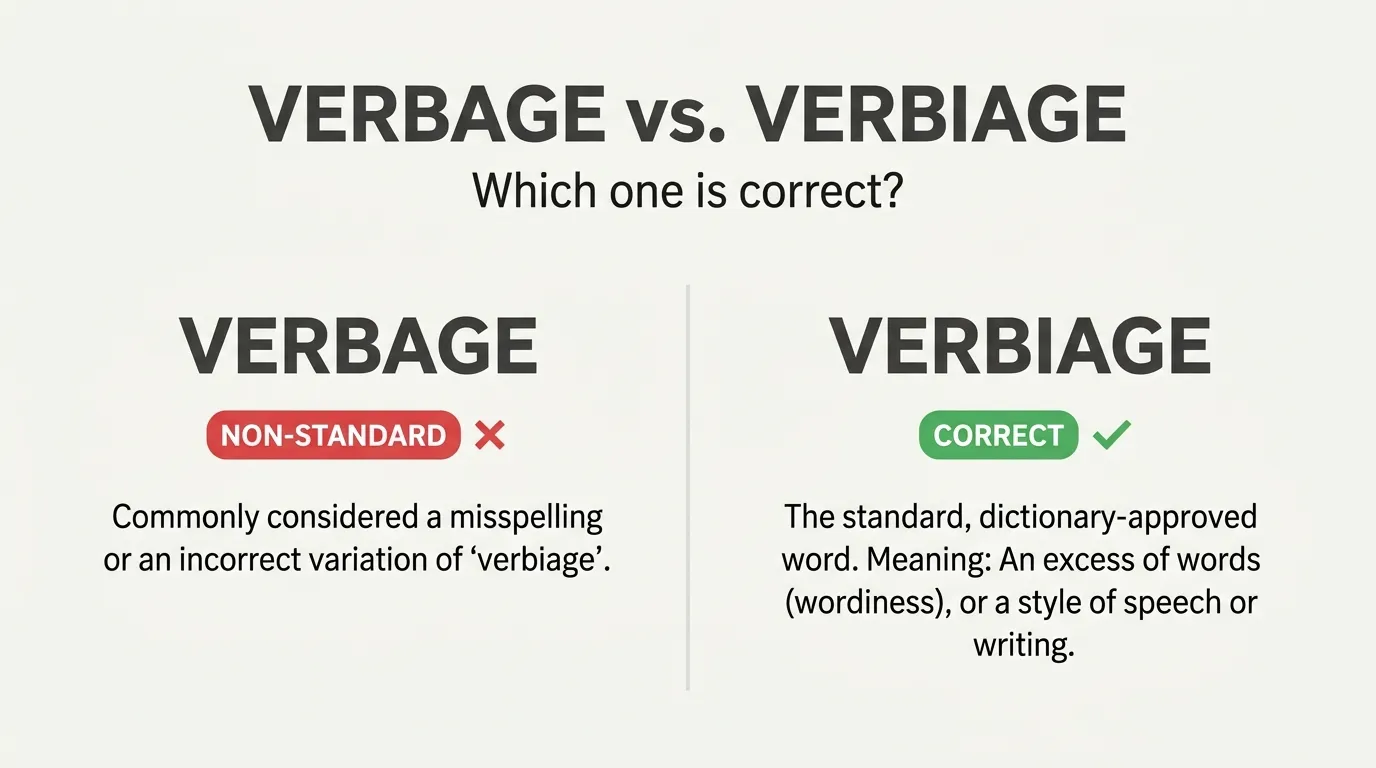
The correct spelling is verbiage, with an “i” before the “a.” “Verbage” is a common misspelling, and dictionaries list only verbiage.
So why does the wrong spelling look so natural? Many people say the word quickly, like “VER-bij.” That short sound hides the “i.” Once you know that, the mistake makes sense. This guide shows you the meaning, the two ways to say it, and a trick to spell it right every time.
Table of Contents
- Did You Know?
- Quick Answer
- Quick Rule in 1 Line
- Verbage vs. Verbiage: What’s the Difference?
- What Does Verbiage Mean?
- Why Do People Write “Verbage”?
- How to Pronounce Verbiage
- Memory Trick
- Comparison Table
- 20 Example Sentences
- Common Mistakes
- When to Use Verbiage (and When Not To)
- Expert Tip
- Common Misconception
- FAQs
- Conclusion
- Key Takeaways
Did You Know? 🔍
Merriam-Webster traces verbiage to the French word verbier, which means “to trill” or “to warble.” The first known use in English was around 1721. So the word is old, and it started out sounding a bit like birdsong.
Quick Answer
The right spelling is verbiage. It has three syllables: ver-bee-ij. The version without the “i,” verbage, is a misspelling. If you want a safe backup, use the simple word “wording” instead.
⚡ Quick Rule in 1 Line
If you can hear “bee” in the middle, spell it verbiage — never verbage.
Verbage vs. Verbiage: What’s the Difference?
There’s no difference in meaning, because only one of them is a real word. Verbiage is correct. Verbage is a spelling mistake that people make when they say the word too fast.
Most word pairs in this niche split by region. Think of color and colour. This pair doesn’t work that way. It’s not an American vs. British issue at all. Dictionaries such as Merriam-Webster list the entry as verbiage, and that’s the form you’ll see in published writing.
Business-writing guides say the same thing. They call verbage a misspelling and advise writers to avoid it in every context. You won’t find a style guide that welcomes it.
Here’s the simple split:
- Verbiage = correct, standard spelling.
- Verbage = incorrect spelling. Don’t use it.
What Does Verbiage Mean?
Verbiage is a noun with two meanings. The first is a flood of words with little real content. The second is simply the way something is worded.
Merriam-Webster lists both senses.
Sense 1: Too many words. This is the older, more negative meaning. Think of a report padded with big, empty phrases.
- The editor cut the excess verbiage from the article.
- Teachers often see verbiage when students try to fill a page.
Sense 2: Wording or diction. This meaning is neutral. It just describes how someone puts ideas into words.
- The verbiage in the contract was very formal.
- Please check the verbiage on the sign before we print it.
Some writers say the second sense is wrong. They believe verbiage must always mean “too many words.” But Merriam-Webster treats “wording” as a well-established meaning. So you can use it, though you should know that some readers may frown.
A quick note on the plural. Verbiages exists, but it’s rare. Most writers treat verbiage as a word that stays in one form, like “information.”
Why Do People Write “Verbage”?
People write “verbage” because they say the word with only two syllables. The “ee” sound in the middle gets squeezed out, and the spelling follows the sound.
Say it slowly: ver-bee-ij. Now say it fast: ver-bij. In the fast version, the “i” almost disappears. Your brain then spells what it hears.
This is a very common source of spelling errors in English. When a vowel goes quiet, writers drop it. The same thing happens with words like “interesting” and “family.”
Here’s what’s interesting. Both ways of saying the word are accepted. The Grammarphobia language blog notes that both Merriam-Webster’s Collegiate Dictionary and the American Heritage Dictionary list the three-syllable and two-syllable pronunciations as standard. An older Webster’s dictionary from the 1950s listed only the three-syllable version.
So the short pronunciation isn’t wrong. Only the spelling “verbage” is wrong. That’s the big takeaway. Say it either way, but spell it with the “i.”
How to Pronounce Verbiage
The standard way to say verbiage is VER-bee-ij, with stress on the first syllable. A shorter version, VER-bij, is also listed as acceptable.
Here’s a quick guide:
| Pronunciation | Syllables | Status |
|---|---|---|
| VER-bee-ij | 3 | Standard, most common in careful speech |
| VER-bij | 2 | Also listed as standard |
If you want to spell it correctly, always picture the three-syllable version in your head. That mental image keeps the “i” in place.
Memory Trick
Think of “verb” plus “i” plus “age.” The word verb is right there at the start, and the “i” hides in the middle.
Here are three easy ways to lock it in:
- “I” before “age.” Say to yourself, “There’s an I in verbiage.” Then add the “age” at the end.
- Hear the “bee.” If you can hear the buzzing “bee” sound, you need the “i.”
- Word-length check. Verbiage has eight letters. Verbage has seven. When in doubt, go with the longer one.
Comparison Table
| Feature | Verbiage | Verbage |
|---|---|---|
| Correct spelling? | ✅ Yes | ❌ No |
| Found in major dictionaries? | Yes | No (treated as a misspelling) |
| Part of speech | Noun | None |
| Syllables when spoken | 3 (or 2 in fast speech) | n/a |
| Safe in formal writing? | Yes | Never |
| Easy replacement | Wording, diction, language | Use verbiage |
20 Example Sentences
Verbiage meaning “too many words”:
- The lawyer trimmed the verbiage so the letter fit on one page.
- Her essay had too much verbiage and not enough ideas.
- We cut the verbiage from the speech and kept the main points.
- The old manual was full of confusing verbiage.
- He hid his lack of facts behind a wall of verbiage.
Verbiage meaning “wording”:
- Please review the verbiage on the poster before we print it.
- The verbiage in the lease was clear and simple.
- The legal team approved the new verbiage this morning.
- Her marketing verbiage felt warm and friendly.
- The error message uses technical verbiage that most users won’t understand.
Everyday and workplace use:
- Can you change the verbiage on the sign-up button?
- The contract’s verbiage said the fee was non-refundable.
- I like the verbiage in this ad. It sounds natural.
- The school updated the verbiage in its dress code.
- The app’s help page needs simpler verbiage.
Mixed contexts:
- Too much verbiage can make your writing hard to follow.
- The company tested two versions of the verbiage to see which one worked better.
- News writers often avoid heavy verbiage so readers stay interested.
- The official verbiage on the form hasn’t changed in years.
- Strip out the extra verbiage, and your message gets stronger.
Common Mistakes
Mistake 1: Dropping the “i.”
- ❌ The verbage in this email is confusing.
- ✅ The verbiage in this email is confusing.
2: Adding an extra letter.
- ❌ The verbiege on the sign is too long.
- ✅ The verbiage on the sign is too long.
Mistake 3: Using it when a plain word works better.
- ❌ Please update the verbiage regarding the aforementioned policy.
- ✅ Please update the wording of the policy.
4: Using “verbiage” to mean “vocabulary” or “words” in general.
- ❌ The child’s verbiage grew quickly this year.
- ✅ The child’s vocabulary grew quickly this year.
Mistake 5: Trusting spellcheck blindly.
- ❌ Spellcheck didn’t flag it, so it must be right.
- ✅ Always double-check the word yourself. Spellcheck tools can miss errors.
When to Use Verbiage (and When Not To)
Use verbiage when you’re talking about the exact wording of a document, sign, or message, or when you mean too many words. Choose a simpler word if you’re writing for a wide audience.
Good times to use it:
- Business and legal settings, where “verbiage” is common shorthand for wording.
- Editing notes, such as “tighten the verbiage.”
- Writing about style or wordiness.
When to pick another word:
- If your reader might take “verbiage” as a criticism, say “wording.”
- In very formal writing, some editors prefer “language” or “phrasing.”
- When talking about vocabulary or word choice, use those words instead.
Here are good swaps:
| Instead of… | Try… |
|---|---|
| The verbiage on the form | The wording on the form |
| Too much verbiage | Too many words, wordiness |
| Technical verbiage | Technical language, jargon |
| Legal verbiage | Legal language, legalese |
Expert Tip 💡
Here’s a tip from real-world editing. When you’re not sure how a reader will take the word, swap it for “wording.” It means the same thing in nearly every workplace use and carries no hint of criticism. Save “verbiage” for moments when you really do mean “too many words.”
Common Misconception
Myth: “Verbage and verbiage are just American and British spellings of the same word.”
Reality: They’re not. No major dictionary treats verbage as a regional variant. It’s simply an error, and it appears in both American and British writing.
FAQs
1. Is it verbage or verbiage?
It’s verbiage. The version without the “i” is a misspelling. Dictionaries such as Merriam-Webster list verbiage as the standard word.
2. Is verbage a real word?
No. Verbage is a common spelling mistake. It comes from saying the word quickly and dropping the “ee” sound in your head.
3. What does verbiage mean?
It has two meanings. One is a large amount of unnecessary words. The other is simply the wording or style of expression used in something.
4. How do you pronounce verbiage?
The standard way is VER-bee-ij, with three syllables. A shorter two-syllable version, VER-bij, is also listed as acceptable.
5. Is verbiage a negative word?
It can be. In its older sense, it means too many words. In its newer sense, it just means wording. Context tells you which one is meant.
6. Can I use verbiage instead of wording?
Yes. Merriam-Webster recognizes “wording” as a standard meaning. If you want to avoid any negative feeling, “wording” is the safer pick.
7. What is a good synonym for verbiage?
For “too many words,” try wordiness or long-windedness. For “the way something is worded,” try wording, phrasing, diction, or language.
8. Is “excess verbiage” redundant?
Not necessarily. Because verbiage can mean plain wording, adding “excess” makes the meaning clear. Merriam-Webster has made this point in a word-of-the-day entry.
9. Does verbiage have a plural?
Verbiages is listed as a plural form, but you’ll rarely see it. Most writers use verbiage as a word that doesn’t change.
10. Why does spellcheck sometimes miss verbage?
Tools differ in how well they catch errors. Don’t rely on them alone. A quick check of the spelling before you hit send is a good habit.
Conclusion
The answer is simple: verbiage is correct, and verbage is a mistake. The error happens because many people say the word fast and skip the “ee” sound. But spelling needs every letter.
Remember the quick trick. If you hear “bee,” add the “i.” And if you want to dodge the whole issue, write “wording” instead.
Now you can proofread that email with confidence. Fix the spelling, trim any extra words, and send it.

Hi, I’m Daniel Carter. I’m passionate about helping learners improve their English with practical grammar tips and clear writing advice.