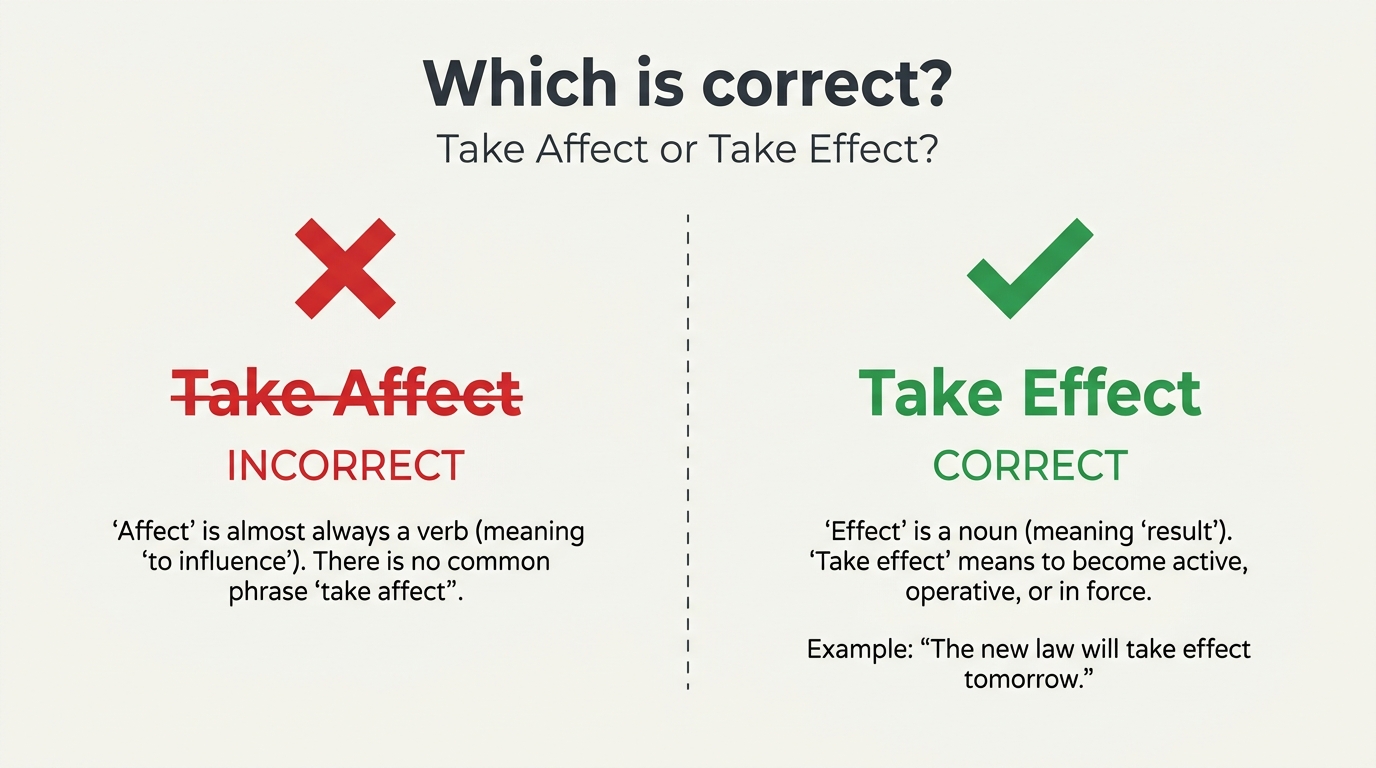
Take Affect or Take Effect? The Correct Phrase Explained
Your boss emails, “The new policy will take affect Monday.” You pause. Something looks off. You’re right: the correct phrase is take effect.
Take effect means to start working or become official. Take affect is a common mistake, because affect and effect look and sound alike.
The good news is that take effect is a fixed phrase. You don’t need to guess each time. Let’s break it down.
Table of Contents
- Take Affect or Take Effect: The Quick Answer
- Why “Effect” Is the Right Word
- Affect vs Effect in One Minute
- Comparison Table
- A Memory Trick That Works
- 18 Real Example Sentences
- Common Mistakes
- Phrases Like “Take Effect”
- When “Affect” Can Be a Noun
- Quick Quiz
- FAQs
- Conclusion
- Key Takeaways
🔍 Did You Know?
Effect can be a verb too. When it means “to bring about,” as in “effect change,” it’s a real and formal use. That’s one reason these two words cause so much confusion. Most of the time, though, effect is a noun and affect is a verb.
Quick Answer Box
Take effect is the correct phrase. It means to begin working, become active, or become official. Here, effect is a noun that means “result.” You’ll use it with laws, rules, medicines, and changes. Take affect is a common error, because affect is usually a verb and doesn’t fit this phrase.
⚡ Quick Rule in 1 Line
Rules, laws, and medicines take effect, never affect. Effect is the result that begins.
Take Affect or Take Effect: The Quick Answer
Take effect is the standard phrase in American and British English. It describes something that starts to work or becomes official. A law, a rule, a price change, or a pill can all take effect.
Here are the two forms side by side:
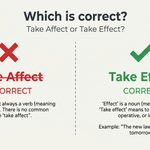
- ✅ The new law will take effect on January 1.
- ❌ The new law will take affect on January 1.
The word after take here is a noun. A noun answers the question “take what?” You take effect. The word effect is the noun, which means “result” or “impact.”
Affect is usually a verb. It means “to influence.” You can’t “take” a verb in this way, so the phrase breaks.
When you feel stuck, think of take effect as one chunk, like take place or take part. Learn it as a unit.
Why “Effect” Is the Right Word
In the phrase take effect, effect is a noun that means “result.” When a rule “takes effect,” its results begin. The phrase is an idiom, so it works as a fixed expression in English.
Break it into three parts:
- Take is the verb.
- Effect is the noun (the result).
- Together, they mean “begin to produce results.”
You can test it with a swap. Replace take effect with start working or become official. If it fits, you have the right phrase.
- “The medicine will start working soon.” ✅ → The medicine will take effect soon.
- “The rule will become official Monday.” ✅ → The rule will take effect Monday.
Now try the wrong version. “The medicine will take affect soon.” You can’t swap start working in a way that uses the verb affect. So effect is the one you need.
Affect vs Effect in One Minute
The basic difference is simple: affect is usually a verb, and effect is usually a noun. Affect means “to influence.” Effect means “a result.” This short guide helps you see where take effect fits.
Affect (usually a verb):
- Rain will affect the game.
- Stress can affect your sleep.
Effect (usually a noun):
- The rain had a big effect on the game.
- Stress has a bad effect on sleep.
Now see both in one sentence:
The new rule will affect every student and take effect on Monday.
Here, affect is the action (it influences students). Effect is the noun in the phrase take effect.
For a deeper guide, read our full article on Affect vs Effect.
Comparison Table
This table shows how the two words behave. Use it for quick checking.
| Word | Usual part of speech | Meaning | Example |
|---|---|---|---|
| affect | Verb | to influence | The weather will affect our trip. |
| effect | Noun | a result | The weather had an effect on our trip. |
| effect | Verb (formal) | to bring about | The team hopes to effect change. |
| affect | Noun (psychology) | visible emotion | The patient showed a flat affect. |
Here’s a second table with the phrases that use effect:
| Phrase | Meaning | Example |
|---|---|---|
| take effect | begin to work | The rule takes effect today. |
| go into effect | become official | The ban goes into effect in May. |
| come into effect | become active | The law came into effect last year. |
| in effect | in practice | We’re in effect a team of two. |
| put into effect | make active | They put the plan into effect. |
Notice that every phrase uses effect. None of them use affect.
A Memory Trick That Works
The easiest trick is RAVEN: Remember, Affect is a Verb, Effect is a Noun. In take effect, you need a noun, so choose effect.
Here are two more helpers:
- A for Action, E for End result. Affect is the action. Effect is the end result. A rule that “takes effect” is reaching its end result.
- The article test. You can put an or the before effect: “the effect.” You can’t do that with the verb affect. If “the” fits, use effect.
And here’s a short rhyme:
“Laws take effect; they don’t take affect.”
18 Real Example Sentences
Examples make the phrase feel natural. Here are 18 sentences grouped by use.
Laws and rules:
- The new tax law takes effect next month.
- The dress code will take effect on Monday.
- The ban took effect at midnight.
- When does the policy take effect?
- The changes take effect immediately.
- The contract takes effect once both sides sign.
Medicine and health:
- The pain pill should take effect in 30 minutes.
- It may take a few days for the cream to take effect.
- The medicine didn’t take effect right away.
- The doctor said the shot would take effect overnight.
Work and daily life:
- The price increase takes effect on June 1.
- My new schedule takes effect next week.
- The update will take effect after you restart your phone.
- The discount takes effect at checkout.
Both words together:
- The new rule will affect all workers and take effect on Friday.
- Bad weather can affect travel, and the delays may take effect fast.
- How will the change affect us when it takes effect?
- The medicine can affect your sleep once it takes effect.
Sentences 15 to 18 show affect and effect working together without conflict.
Common Mistakes
Most errors come from mixing up the two words. Each one has a quick fix.
❌ The law will take affect tomorrow. ✅ The law will take effect tomorrow.
❌ The medicine took affect quickly. ✅ The medicine took effect quickly.
The rule is taking affect now. ✅ The rule is taking effect now.
❌ The change goes into affect on Friday. ✅ The change goes into effect on Friday.
❌ How will this effect me? ✅ How will this affect me? (Here you need the verb, so use affect.)
The drug had a bad affect on him. ✅ The drug had a bad effect on him. (Here you need the noun, so use effect.)
The pattern is clear. Ask whether you need an action or a result. Action gets affect. Result gets effect.
Phrases Like “Take Effect”
Many English phrases use effect as a noun. If you learn them as a group, you’ll avoid the mistake in all of them. Each phrase shows a rule, plan, or change becoming active.
- Go into effect: “The new rules go into effect in March.”
- Come into effect: “The law came into effect in 2020.”
- Put into effect: “The school put the plan into effect.”
- In effect: “The store is in effect closed today.” (It means “in practice.”)
- To that effect: “She said no, or words to that effect.”
- Side effect: “The medicine has a mild side effect.”
- Special effect: “The movie has great special effects.”
Some of these, like come into effect, are more common in British English. Go into effect is common in American English. Both are correct.
For take effect, there’s no regional split. The phrase works everywhere.
When “Affect” Can Be a Noun
Affect is mostly a verb, but it does have a noun use. In psychology, affect (pronounced AF-ekt) means a person’s visible emotion. You may see it in medical or academic writing.
Example: “The patient showed a flat affect.”
Here’s the key point for this article. Even in psychology, no one says “take affect.” The noun affect describes a person’s emotional display. It doesn’t mean “to begin working.” So the phrase take effect stays the only correct choice for laws, medicines, and changes.
If you write for general readers, you’ll rarely need the noun affect. Stick to effect for results and affect for influence.
💡 Expert Tip
Before you publish, search your draft for the words “affect” and “effect.” Check each one by asking: “Is this an action or a result?” Then check every “take” phrase. Business writers often see take effect in policy emails, contracts, and press releases. Getting it right makes your writing look careful and professional.
Quick Quiz
Choose the correct word. Answers are below.
- The new rule will (take affect / take effect) tomorrow.
- The loud noise can (affect / effect) your hearing.
- The cream should (take affect / take effect) in an hour.
Answers: 1. take effect. 2. affect. 3. take effect.
FAQs
1. Is it take affect or take effect? It’s take effect.
The noun effect means “result,” and the phrase means “to begin working.”
2. What does “take effect” mean?
It means to start working or become official. A law, a rule, or a medicine can take effect.
3. Is “take affect” ever correct?
No, not as a standard phrase. Affect is usually a verb, so it doesn’t fit after take.
4. What is the past tense of take effect?
It’s took effect. For example: “The law took effect in 2020.”
5. What does “go into effect” mean?
It means the same as take effect. It’s common in American English.
6. Is “come into effect” correct?
Yes. It’s more common in British English, but American readers understand it.
7. What’s the difference between affect and effect?
Affect is usually a verb that means “to influence.” Effect is usually a noun that means “a result.”
8. Can effect be a verb?
Yes. It means “to bring about,” as in “effect change.” It’s formal and less common.
9. What does “in effect” mean?
It means “in practice” or “for all purposes.” For example: “We are in effect a team of two.”
10. How can I remember the difference?
Use RAVEN: Remember, Affect is a Verb, Effect is a Noun. In take effect, you need the noun.
Conclusion
The answer is simple: take effect is correct, and take affect is a mistake. In this phrase, effect is a noun that means “result.” It’s a fixed idiom for something that starts to work or becomes official.
Remember the basic rule. Affect is usually the action, and effect is usually the result. Laws, rules, and medicines take effect. They may affect people, but they never take affect.
Use RAVEN or the rhyme, and you’ll get it right every time. Your emails, reports, and posts will read clean and clear.

Hi, I’m Olivia Harper. I love turning complex English grammar into simple, practical lessons that help readers write and speak with confidence.