Have you ever wondered whether to write upmost or utmost? These two words look and sound similar, so it is easy to confuse them.
However, they have different meanings, and choosing the right one depends on what you want to express.
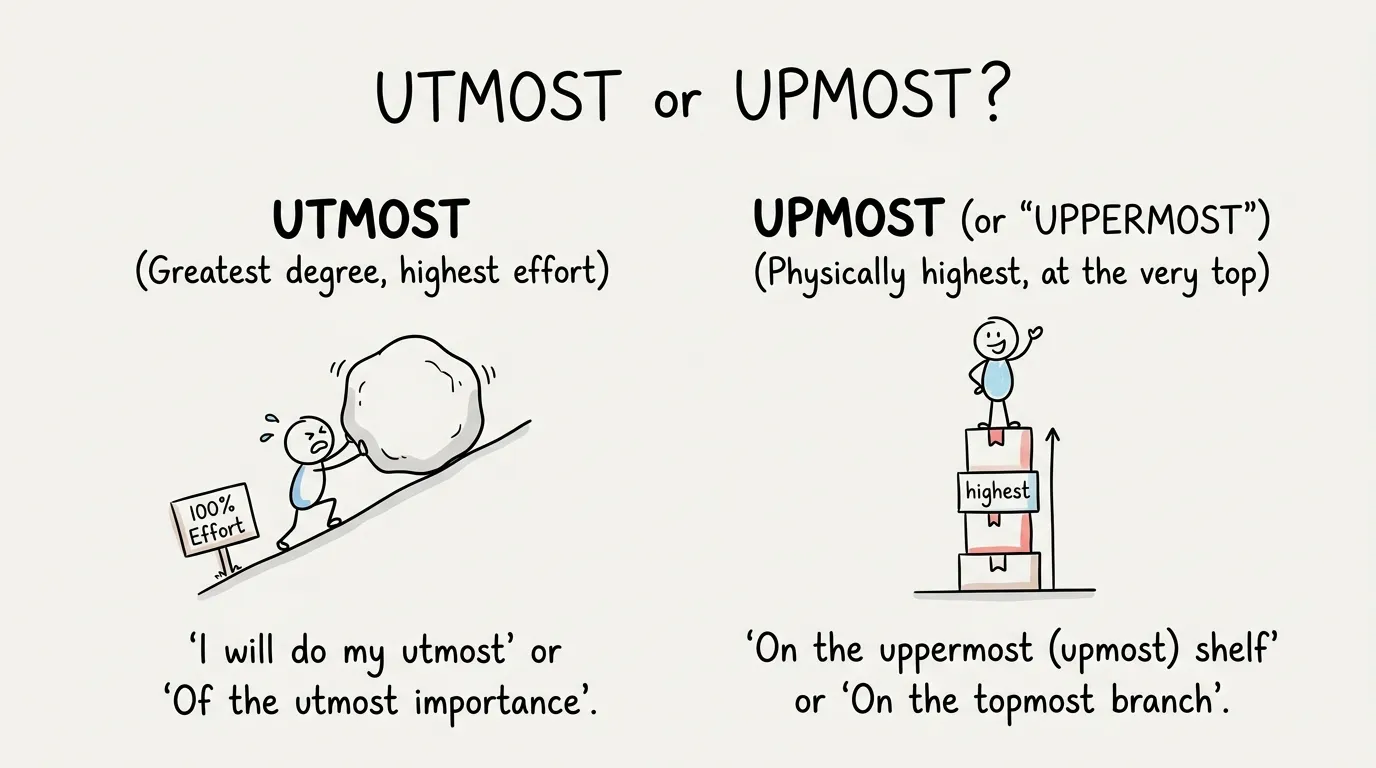
Utmost means the greatest possible degree, amount, or level. It is the correct word in common expressions such as utmost importance, utmost respect, utmost care, and do your utmost.
Upmost is also a real English word, but it is uncommon and old-fashioned. It means being in the highest position, similar to uppermost.
English meaning – Cambridge Dictionary
+1
For example, write, “This matter is of the utmost importance,” not “This matter is of the upmost importance.”
The easiest way to remember the difference is to connect utmost with the greatest degree and upmost with physical position.
In this guide, you will learn what both words mean, how to use them in sentences, which expressions are correct, and how to avoid common word-choice mistakes.
Quick Answer: Upmost or Utmost?
Utmost is the correct choice when you mean the greatest possible degree, amount, effort, or importance. Upmost means the highest position, although uppermost is generally a more natural choice in modern English.
Compare these examples:
- Correct: Your safety is of the utmost importance.
- Incorrect for the intended meaning: Your safety is of the upmost importance.
- Possible but uncommon: The upmost branches were difficult to reach.
- More natural: The uppermost branches were difficult to reach.
The two words are not interchangeable in ordinary writing.
| Word | Meaning | Example |
| Utmost | Greatest possible degree or amount | We handled the matter with the utmost care. |
| Upmost | Highest physical position; uncommon or old-fashioned | The upmost part of the structure was difficult to reach. |
| Uppermost | Highest in position; sometimes most prominent in thought | The uppermost shelf was empty. |
Quick Rule in One Line
Use utmost for the greatest degree and uppermost for the highest position.
What Does Utmost Mean?
Utmost is an adjective meaning greatest, highest in degree, or most extreme. It is commonly used before nouns to emphasize how important, serious, or extensive something is.
The Cambridge Dictionary explains that utmost emphasizes how important or serious something is. It can also function as a noun meaning the greatest amount or degree possible.
English meaning – Cambridge Dictionary
For example:
- Your safety is of the utmost importance.
- Please handle this equipment with the utmost care.
- She showed the utmost respect for her teacher.
- We made the utmost effort to finish on time.
- He did his utmost to help his family.
In each example, utmost expresses the greatest possible level of something.
Utmost as an Adjective
As an adjective, utmost usually appears before a noun. It strengthens the meaning of that noun by suggesting the highest possible degree.
Examples:
- Utmost importance: The meeting is of the utmost importance.
- Utmost care: Handle the glass with the utmost care.
- Utmost respect: I have the utmost respect for my parents.
- Utmost caution: Drivers should exercise the utmost caution in heavy fog.
- Utmost confidence: The manager expressed the utmost confidence in her team.
These expressions are common in professional communication, formal writing, academic work, and everyday English.
Utmost as a Noun
Utmost can also be used as a noun to mean the greatest amount of effort or the highest possible degree.
The most familiar expression is do your utmost, which means to try as hard as possible.
Examples:
- I will do my utmost to complete the project.
- She did her utmost to support her friend.
- We tried our utmost to resolve the problem.
- He is doing his utmost to improve his skills.
- They did their utmost to make the event successful.
Notice that the phrase is do your utmost, not do your upmost. This is an important distinction because the two words are frequently confused in this expression.
What Does Upmost Mean?
Upmost is a real English adjective, but it is uncommon and generally considered old-fashioned. It means being in the highest position and is similar in meaning to uppermost.
The Cambridge Dictionary entry for upmost labels the word old-fashioned and defines it as being in the highest position.
English meaning – Cambridge Dictionary
For example:
- The upmost branches of the tree were covered in snow.
- The climber reached the upmost section of the structure.
- Birds rested on the upmost part of the old building.
These examples refer to physical location rather than the greatest degree of importance, effort, or care.
However, because upmost is uncommon, modern writers generally prefer uppermost or highest.
Compare:
- Less common: The upmost shelf was covered in dust.
- More natural: The uppermost shelf was covered in dust.
- Also natural: The highest shelf was covered in dust.
All three sentences communicate a similar physical position, but uppermost and highest are more familiar choices in contemporary writing.
Is Upmost Incorrect?
Not always. Upmost is a recognized English word, so it is not simply a misspelling of utmost. The problem occurs when writers use it where they mean utmost.
For example:
- Incorrect word choice: We treated the issue with the upmost care.
- Correct: We treated the issue with the utmost care.
The first sentence uses a real word in the wrong context. The second uses the standard expression.
If you mean the highest physical position, consider using uppermost. If you mean the greatest possible level of importance or effort, use utmost.
Upmost vs Utmost: Key Differences
The main difference is degree versus position. Utmost describes the greatest possible extent or level, while upmost describes a high physical position.
| Feature | Utmost | Upmost |
| Main meaning | Greatest degree or amount | Highest position |
| Common in modern English? | Yes | No; uncommon |
| Typical use | Importance, care, respect, effort | Physical location |
| Common expression | Utmost importance | Upmost branches |
| Formal writing | Common and appropriate | Usually avoid when uppermost works |
| Can mean greatest effort? | Yes | No |
| Can mean highest physical position? | Not its usual meaning | Yes, though uppermost is more common |
Here is the simplest way to tell them apart:
- Utmost = greatest possible degree.
- Upmost = highest position.
- Uppermost = the usual modern word for the highest position.
For example, “I have the utmost respect for her” means you respect her greatly. “The uppermost floor is closed” means the highest floor is closed.
Is It Utmost Importance or Upmost Importance?
The correct standard expression is utmost importance.
Use it when you want to emphasize that something is extremely important or deserves the highest level of attention.
Examples:
- Your health is of the utmost importance.
- Accuracy is of the utmost importance in this report.
- Protecting personal information is of the utmost importance.
- The deadline is of the utmost importance to our team.
- Clear communication is of the utmost importance in this role.
Avoid upmost importance in standard writing when you mean greatest importance.
Why? Because importance refers to significance or value, not a physical position. Utmost is the established word for emphasizing the highest degree of importance.
The same rule applies to related expressions such as utmost concern, utmost caution, and utmost attention.
Is It Do Your Utmost or Do Your Upmost?
The correct expression is do your utmost.
This phrase means to make the greatest possible effort or to try as hard as you can. It is a well-established expression in English.
Examples:
- I will do my utmost to help you.
- She did her utmost to pass the exam.
- We will do our utmost to meet the deadline.
- He is doing his utmost to support his family.
- They did their utmost to protect the visitors.
You can also say try your utmost, although do your utmost is the more familiar expression.
Incorrect: I will do my upmost to finish the work.
Correct: I will do my utmost to finish the work.
Remember that this expression is about effort, not physical height. That is why utmost is the right choice.
20 Examples of Utmost and Upmost in Sentences
The following examples show how the two words work in context. Most everyday writing will use utmost or uppermost, rather than upmost.
Examples Using Utmost
- Your safety is of the utmost importance.
- Please handle the documents with the utmost care.
- I have the utmost respect for my teachers.
- She did her utmost to complete the assignment.
- We must exercise the utmost caution during the storm.
- The manager expressed the utmost confidence in the new employee.
- Accuracy is of the utmost importance in scientific research.
- He made the utmost effort to repair the damaged equipment.
- The team treated every customer with the utmost respect.
- I will do my utmost to support your decision.
- The company takes data privacy with the utmost seriousness.
- She showed the utmost patience while teaching the children.
- We appreciate your utmost attention to detail.
- He tried his utmost to resolve the disagreement.
- The doctor explained the situation with the utmost care.
Examples Using Upmost or Uppermost
- The upmost branches were difficult to see from the ground.
- The uppermost shelf holds the old photographs.
- Snow covered the uppermost part of the mountain.
- The uppermost floor of the building was closed.
- Safety remained uppermost in her mind.
Is Examples 16–20 illustrate position or prominence. In most modern writing, uppermost is the more natural word for physical height, while utmost is the standard choice for degree or effort.
Common Mistakes to Avoid
Because the two words look similar, writers sometimes choose the wrong one in familiar expressions. Here are the most common mistakes and how to correct them.
Mistake 1: Writing “Upmost Importance”
Incorrect: Accuracy is of the upmost importance.
Correct: Accuracy is of the utmost importance.
Importance describes significance, not physical height. Use utmost to communicate the greatest degree of importance.
Mistake 2: Writing “Do Your Upmost”
Incorrect: I will do my upmost to help.
Correct: I will do my utmost to help.
The established expression is do your utmost, meaning to make the greatest possible effort.
Mistake 3: Assuming Upmost Is Always a Misspelling
Incorrect assumption: Upmost is never a real word.
Better understanding: Upmost is a real but uncommon word meaning highest in position. However, uppermost is generally the more natural modern choice.
Mistake 4: Using Utmost for Every Physical Height
Awkward: The utmost shelf contains the books.
More natural: The uppermost shelf contains the books.
Use uppermost or highest when describing a shelf, floor, branch, or other physical location.
Mistake 5: Confusing Degree With Position
Incorrect: The uppermost importance of the matter was clear.
Correct: The utmost importance of the matter was clear.
Uppermost can describe something that is prominent or at the top, including in figurative contexts such as thoughts. However, the established expression for the greatest degree of importance is utmost importance.
Mistake 6: Changing the Word Without Checking the Sentence
Sometimes writers choose a word because it looks familiar rather than checking its meaning.
Before using either word, ask yourself:
- Am I describing the greatest possible degree? Use utmost.
- Am I describing something at the highest physical position? Use uppermost or highest.
- Am I writing the expression “do your ___”? Use utmost.
This quick check will prevent most errors.
Utmost, Upmost, and Uppermost: What Is the Difference?
These three words are related in appearance, but they do not serve exactly the same purpose.
| Word | Meaning | Best use | Example |
| Utmost | Greatest degree or amount | Importance, care, effort, respect | We used the utmost care. |
| Upmost | Highest position; uncommon or old-fashioned | Rare references to physical position | The upmost branches were hard to reach. |
| Uppermost | Highest in position; also most prominent in thought | Physical height or something prominent | The uppermost shelf was empty. |
The word uppermost can also be used figuratively.
For example, “Safety was uppermost in her mind” means safety was the most prominent concern in her thoughts.
That does not make uppermost interchangeable with utmost in every expression. You would still normally write “utmost importance” and “do your utmost.”
An Easy Memory Trick
Use this simple memory trick to choose the correct word.
Utmost = ultimate degree.
Think of utmost as the greatest possible level of something. It works with importance, care, respect, attention, and effort.
Upmost = up high.
Think of a physical object located at the top. Although upmost can express this idea, uppermost is usually more natural in modern English.
Remember these examples:
- Utmost respect
- Utmost care
- Utmost importance
- Do your utmost
- Uppermost shelf
- Uppermost floor
You can also ask yourself whether the sentence describes a degree or a position. If it describes a degree, utmost is usually the answer. If it describes a position, uppermost is often the clearest option.
Quick Practice Quiz: Upmost or Utmost?
Test your understanding with these five questions.
1. Your safety is of the ______ importance.
A. upmost
B. utmost
2. I will do my ______ to finish the task.
A. upmost
B. utmost
3. The ______ shelf was too high for the child to reach.
A. uppermost
B. utmost
4. She treated the guests with the ______ respect.
A. upmost
B. utmost
5. Which word is an uncommon term meaning highest in position?
A. Upmost
B. Utmost
Answers and Explanations
- B — utmost. The expression utmost importance means the greatest level of importance.
- B — utmost. Do your utmost means to make the greatest possible effort.
- A — uppermost. This describes a physical position.
- B — utmost. Utmost respect is the standard expression.
- A — upmost. It is a real but uncommon word meaning highest in position.
If you answered all five correctly, you understand the main difference between the words.
FAQs
1. Is it upmost or utmost?
Both are real English words, but they have different meanings. Utmost means greatest in degree or amount. Upmost means highest in position and is uncommon or old-fashioned. In modern writing, uppermost is generally preferred for physical height.
2. Is upmost a real word?
Yes. Upmost is a recognized English word meaning highest in position. However, it is uncommon and old-fashioned. Use uppermost when you want a more natural modern alternative.
3. Is it utmost importance or upmost importance?
The correct standard expression is utmost importance. It means something is extremely important or has the highest possible level of significance.
4. Is it do your utmost or do your upmost?
The correct expression is do your utmost. It means to try as hard as possible or make the greatest possible effort.
5. What does utmost mean in simple English?
Utmost means the greatest possible amount or degree. For example, “I will do my utmost” means “I will try as hard as I can.”
6. What does upmost mean in simple English?
Upmost means located at the highest position. It is uncommon in modern English, and uppermost or highest is usually a better choice.
7. What is the difference between utmost and uppermost?
Utmost usually refers to the greatest degree, amount, or effort. Uppermost refers to the highest physical position and can also describe something most prominent in someone’s thoughts.
For example, “utmost care” means the greatest care, while “uppermost shelf” means the highest shelf.
8. Can I use upmost in formal writing?
You can use it when you genuinely mean the highest position, but it may sound old-fashioned. In most formal writing, uppermost or highest is clearer. Do not use upmost in place of utmost in expressions such as utmost respect.
9. Is utmost an adjective or a noun?
Utmost can be both an adjective and a noun. As an adjective, it describes the greatest possible degree, as in “utmost care.” As a noun, it appears in expressions such as “do your utmost,” meaning to make the greatest possible effort.
10. How can I remember upmost and utmost?
Remember utmost = ultimate degree and uppermost = highest position. If you are talking about effort, respect, care, or importance, use utmost. If you are talking about a physical location, use uppermost or highest.
Conclusion
When choosing between upmost and utmost, focus on the meaning you want to express.
Utmost is the standard word for the greatest possible degree, amount, importance, or effort. It appears in common expressions such as utmost respect, utmost care, utmost importance, and do your utmost.
Upmost is a real but uncommon word meaning highest in position. In modern English, uppermost or highest is generally a more natural choice for physical height.
The easiest rule is to remember that utmost describes degree, while uppermost describes position.
Keep this distinction in mind, and you will be able to choose the right word confidently in emails, school assignments, professional writing, and everyday communication.

Hi, I’m Daniel Carter. I’m passionate about helping learners improve their English with practical grammar tips and clear writing advice.