You texted “who’s phone is this,” and your friend replied with a screenshot circling the mistake in red.
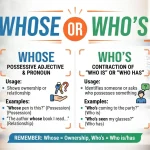
Here’s the quick fix: whose shows possession, meaning something belongs to someone, while who’s is short for “who is” or “who has.”
These words sound completely identical when spoken, which is exactly why they trip up even confident writers.
Once you learn the one expansion test, you’ll never mix these two up again.
Quick Answer
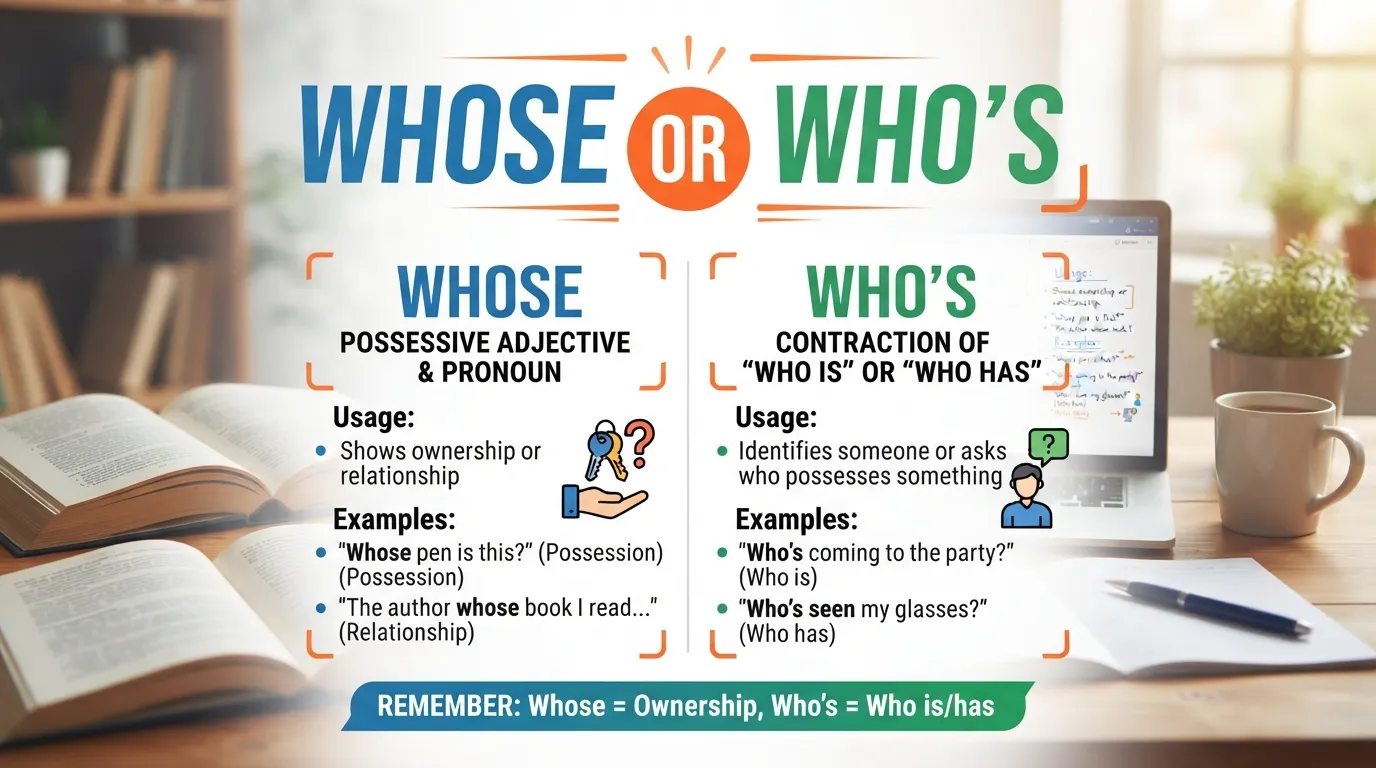
Whose shows possession, asking or describing who something belongs to (“Whose jacket is this?”).
Who’s is a contraction of “who is” or “who has” (“Who’s coming to the party?”).
Like its/it’s, this pair follows the same contraction-versus-possession pattern.
⚡ Quick Rule
Whose shows ownership; who’s means “who is” or “who has” — never confuse the two.
Whose vs Who’s: The Core Difference
“Who’s” is a contraction, combining “who” and “is” (or “has”) into one word using an apostrophe.
“Whose” is a possessive pronoun, used to ask or describe who owns or is connected to something.
Say “Whose car is that?” (asking about ownership), versus “Who’s driving?” (who is driving).
This ownership-versus-contraction distinction works exactly like the its/it’s pair discussed elsewhere on this site.
Grammar Rule Explained
A reliable test: try expanding “who’s” into “who is” or “who has.” If the sentence still makes sense, “who’s” is correct.
Example: “Who’s been eating my lunch?” expands to “Who has been eating my lunch?” — confirming the contraction is correct.
If the sentence asks about or shows possession instead, use “whose” without an apostrophe.
Example: “Whose keys are these?” — asking who owns the keys, so no apostrophe is needed.
Why This Pair Confuses Even Native Speakers
Like “its” and “it’s,” this pair breaks the usual rule that apostrophes show possession in English.
“Whose” follows the same pattern as “his,” “her,” and “its” — possessive words that never use an apostrophe.
“Who’s” only follows the contraction rule, standing in for two separate words joined together.
Since both words sound exactly alike out loud, only the sentence’s meaning and structure can reveal which one is correct in writing.
Whose vs Who’s Comparison Table
| Feature | Whose | Who’s |
|---|---|---|
| Function | Possessive pronoun | Contraction |
| Expands to | N/A (shows ownership) | Who is / Who has |
| Example | Whose bag is this? | Who’s coming tonight? |
| Apostrophe | Never has one | Always has one |
Memory Trick
Remember: “Who’s” always has an apostrophe because it’s hiding a missing letter, just like “it’s” and “don’t.”
“Whose” never has an apostrophe, following the same pattern as “his,” “hers,” and “its.”
If you can replace the word with “who is” or “who has” and it still makes sense, use “who’s.”
Real Example Sentences
Using Whose:
- Whose phone keeps ringing?
- I don’t know whose idea this was.
- Whose turn is it to cook dinner?
- The teacher asked whose homework was missing.
- Whose car is parked outside?
Using Who’s:
- Who’s coming to the meeting today?
- Who’s been using my charger?
- I wonder who’s going to win the game.
- Who’s ready to leave?
- She asked who’s responsible for the mistake.
Whose Fault or Who’s Fault? Common Phrases Explained
“Whose fault” is always correct when asking about responsibility or blame, as in “Whose fault was the accident?”
“Who’s fault” is never correct — this phrase asks about ownership of blame, which is a possessive meaning, not a contraction.
A simple check: expand “who’s” to “who is.” “Who is fault” makes no sense, confirming “whose” is the only correct option here.
Common Mistakes
1. Using “who’s” instead of “whose” for possession Incorrect: Who’s bag is this? Correct: Whose bag is this?
2. Using “whose” instead of “who’s” for a contraction Incorrect: Whose coming to dinner tonight? Correct: Who’s coming to dinner tonight?
3. Assuming “whose” follows the usual possessive apostrophe rule Like “its,” “whose” never takes an apostrophe, even though it shows possession.
4. Skipping the expansion test Always try expanding to “who is” or “who has” first — if that doesn’t work, “whose” is the correct choice.
When to Use Each Word
Use Whose When:
- Asking or describing who owns something
- Followed directly by a noun
- You could replace it with “his,” “her,” or “their”
Examples: whose car, whose decision, whose responsibility
Use Who’s When:
- You mean “who is” or “who has”
- The sentence still works when expanded
- Asking about an action, state, or identity
Examples: who’s calling, who’s been here, who’s ready
FAQs
What’s the difference between whose and who’s?
“Whose” shows possession, asking who owns something. “Who’s” is a contraction of “who is” or “who has.”
How do I know when to use “who’s”?
Try expanding it to “who is” or “who has.” If the sentence still makes sense, “who’s” is correct.
Why doesn’t “whose” have an apostrophe like other possessives?
“Whose” follows the same rule as “his,” “hers,” and “its” — none of these possessive words use an apostrophe.
Is “whose” only used for people?
No, “whose” can also apply to objects or animals when discussing ownership or connection, as in “the company whose logo changed.”
Can “who’s” ever show possession?
No, “who’s” only means “who is” or “who has” — it never shows ownership.
What’s an easy way to remember the difference?
“Who’s” always has an apostrophe because a letter is missing. “Whose” never has one, just like “its” and “his.”
Is “whose” the same as “who’s” in casual speech?
They sound identical when spoken, but they’re spelled differently and serve different grammatical functions in writing.
Why is this such a common mistake?
Because both words are homophones, sounding exactly alike, and apostrophes usually signal possession elsewhere in English.
Conclusion
Whose and who’s sound identical, but they play completely different roles in a sentence.
Whose always shows possession. Who’s always means “who is” or “who has.”
Test any confusing sentence by expanding “who’s” — if that doesn’t work, “whose” is what you need instead.

Hi, I’m Sophia Bennett. My goal is to make grammar easy, clear, and useful through simple explanations and real-life examples.