Is it farther or further? Both words are correct, and they often have similar meanings. However, knowing when to use each one can make your writing clearer.
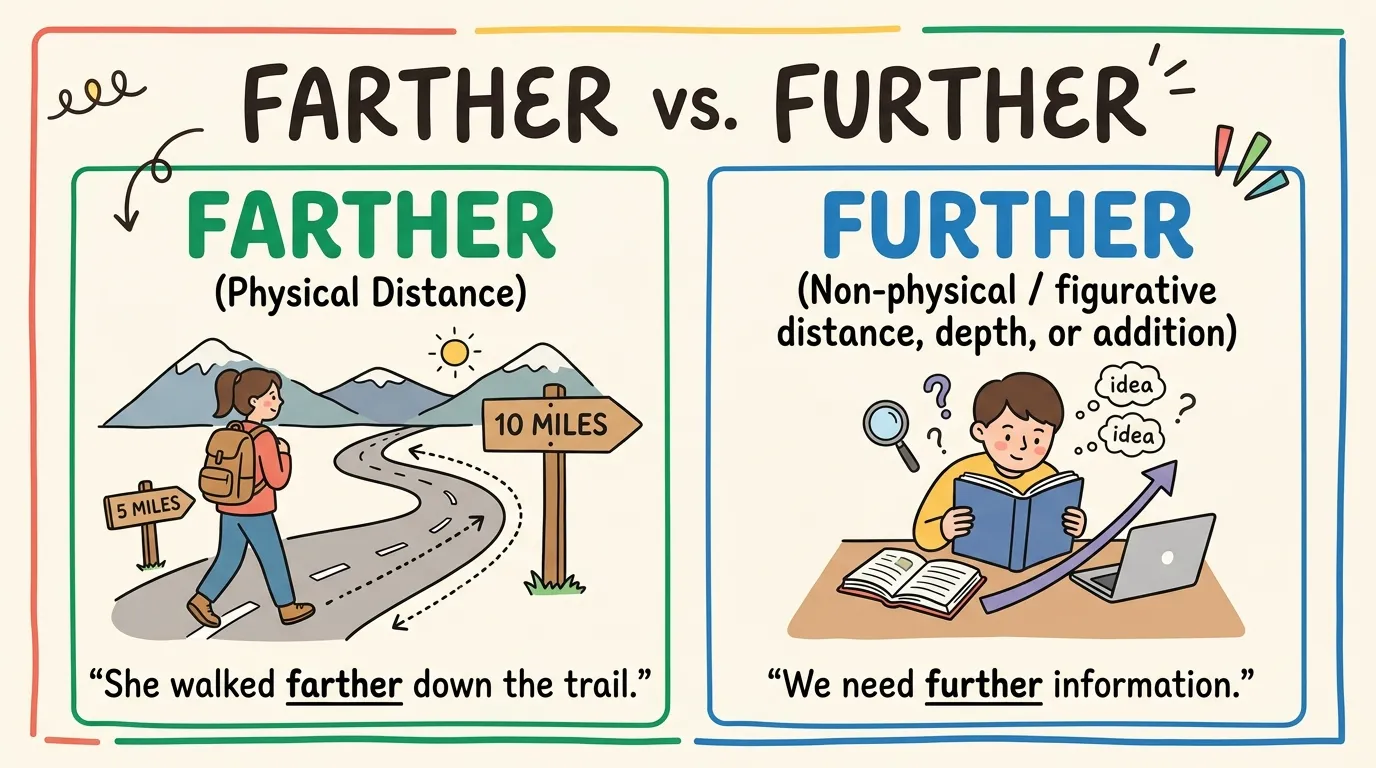
The traditional rule is simple: use farther for physical distance and further for additional information, progress, or a greater degree.
For example, you might write, “We walked farther down the road,” but “We need further information before making a decision.”
There is one important detail: English speakers also use further to describe physical distance. Major dictionaries recognize this overlap, so the traditional rule is a helpful guide rather than an absolute rule. <Cite refs={[“turn252508search2″,”turn252508search3”]} />
In this guide, you will learn the difference between farther and further, explore examples, avoid common mistakes, and practice choosing the right word.
Quick Answer: Farther or Further?
Farther is traditionally preferred for measurable physical distance. Further is used for additional information, progress, or a greater extent. Both can refer to physical distance.
| Word | Main Use | Example |
| Farther | Physical distance | The store is farther away than I expected. |
| Further | Additional information | We need further details. |
| Further | Progress or development | She wants to further her career. |
| Further | Physical distance, too | How much further is the airport? |
Easy rule: If you are talking about a distance you can measure, farther is a good choice. If you mean “more,” “additional,” or “to advance,” use further.
What Does “Farther” Mean?
Farther is the comparative form of far. It usually means at or to a greater physical distance.
Use it when comparing how far apart places or objects are, or how far someone travels.
Examples of Farther
- The school is farther from my house than the library.
- We walked farther than we planned.
- The next gas station is farther down the road.
- Can you move your chair a little farther away?
- She threw the ball farther than anyone else.
- Their new home is farther from downtown.
In these sentences, farther refers to distance in the physical world.
Farther in Questions
You can also use farther to ask about distance.
- How much farther do we need to drive?
- Is the airport farther from here than the train station?
- Can you see any farther without your glasses?
These sentences focus on physical distance or how far someone can see.
What Does “Further” Mean?
Further has several meanings. It can refer to distance, but it is also commonly used to mean additional, more advanced, or to help something progress.
1. Further Means Additional or More
Use further when referring to extra information, questions, details, discussions, or opportunities.
Examples:
- We need further information before making a decision.
- Please contact us if you have any further questions.
- The report requires further research.
- The company announced further changes to its policy.
- We will provide further details next week.
In each sentence, further means something like “additional” or “more.”
2. Further Means To a Greater Extent
Use further when something develops, increases, or moves to a greater degree.
Examples:
- Let’s discuss this issue further.
- The problem became further complicated by bad weather.
- We need to investigate the matter further.
- The disagreement pushed them further apart.
- The situation requires further attention.
Here, further refers to a greater extent or degree, rather than only a measurable physical distance.
3. Further Means To Advance or Promote
Further can also be a verb. It means to help something progress, develop, or succeed.
Examples:
- She took extra courses to further her career.
- The organization works to further its mission.
- These changes could further our progress.
- He hopes to further his education next year.
- The new program aims to further scientific research.
In these examples, you cannot replace further with farther. This verb use is one of the clearest differences between the two words. <Cite refs={[“turn252508search3″,”turn252508search8”]} />
Farther vs. Further: Key Differences
| Feature | Farther | Further |
| Physical distance | Traditionally preferred | Also acceptable |
| Additional information | Not the usual choice | Correct |
| Greater degree or extent | Sometimes used | Common |
| To advance or promote something | Not used this way | Correct |
| Example | We drove farther. | We need further details. |
The most useful distinction is that farther focuses on physical distance, while further has additional meanings that farther does not share.
Farther or Further in Example Sentences
Compare these sentences to see how the words work in context.
Examples With Farther
- We drove farther than we expected.
- The nearest hospital is farther away than the pharmacy.
- He moved farther from the window.
- The runners continued farther along the track.
- My office is farther from the station than yours.
Examples With Further
- We need further information before proceeding.
- Let’s discuss the plan further tomorrow.
- She wants to further her career.
- The company announced further improvements.
- Please do not go any further without permission.
Notice that the last example can refer to physical movement or continuing a process, depending on the context. This is why meaning matters when choosing between the words.
Can “Further” Be Used for Physical Distance?
Yes. Although traditional grammar advice often separates farther and further by physical and figurative distance, modern English allows further for both.
For example, these sentences are acceptable:
- How much farther is the airport?
- How much further is the airport?
Both ask about distance. Cambridge Dictionary notes that the words can overlap when describing distance, and further is often more common. <Cite refs={[“turn252508search0″,”turn252508search2”]} />
For formal writing, you can follow the traditional distinction when it makes your meaning clearer. However, do not assume that further is automatically incorrect for physical distance.
Common Mistakes to Avoid
Mistake 1: Using Farther for Additional Information
Less suitable: Please contact us for farther information.
Better: Please contact us for further information.
Why? The intended meaning is “additional information,” so further is the natural choice.
Mistake 2: Using Farther as a Verb
Incorrect: The program will farther our goals.
Correct: The program will further our goals.
Why? Further can mean to advance or promote something. Farther does not have this verb meaning.
Mistake 3: Treating the Distance Rule as Absolute
It is helpful to use farther for physical distance, but further can also describe distance.
Both are acceptable:
- We walked farther down the trail.
- We walked further down the trail.
Mistake 4: Confusing Farther and Further With Farthest and Furthest
Farthest and furthest are superlative forms. They generally mean the greatest distance or degree.
Examples:
- That is the farthest point on the map.
- This is the furthest we have progressed.
- She lives the farthest from the office.
- We need to investigate the issue furthest before reaching a conclusion.
The same broad distinction applies: farthest often refers to physical distance, while furthest also works for extent or progress. Both can describe distance.
Easy Ways to Remember the Difference
Use these simple memory tricks.
1. Look for “Far” in Farther
The word farther contains far. This can remind you to use it for physical distance.
Example: We walked farther down the road.
2. Remember “Further Information”
You will often see further in phrases such as:
- Further information
- Further questions
- Further research
- Further discussion
- Further progress
These common phrases make it easy to remember that further can mean “additional” or “more.”
3. Use the Replacement Test
Ask yourself what the word means in your sentence.
If you can replace it with “a greater physical distance,” farther may be the best choice.
If you can replace it with “additional,” “more,” or “advance,” use further.
Examples:
- We walked farther. — A greater distance.
- We need further details. — Additional details.
- She wants to further her career. — Advance her career.
Practice Quiz: Farther or Further?
Choose the best word to complete each sentence.
1. The airport is ___ away than the train station.
a) farther
b) further
2. Please send me ___ information about the course.
a) farther
b) further
3. She wants to ___ her education.
a) farther
b) further
4. We walked ___ down the path than we planned.
a) farther
b) further
5. Do you have any ___ questions?
a) farther
b) further
Answers and Explanations
- a) farther — The sentence compares physical distance. Further is also possible in this context.
- b) further — It means additional information.
- b) further — Here, further means to advance or develop.
- a) farther — It follows the traditional preference for physical distance. Further is also acceptable.
- b) further — The phrase further questions means additional questions.
FAQs
1. Is it farther or further?
Both are correct. Farther is traditionally used for physical distance, while further is used for additional information, progress, and greater extent. Both can refer to physical distance.
2. What is the easiest way to remember farther vs. further?
Remember that farther contains far, which can help you connect it with physical distance. Use further for phrases such as “further information” and “further discussion.”
3. Is farther only used for physical distance?
That is the traditional guideline, but actual usage is more flexible. Farther can sometimes be used figuratively, and further can also describe physical distance.
4. Can further mean more?
Yes. Further often means additional or more.
Example: We need further evidence before reaching a conclusion.
5. Is it farther away or further away?
Both expressions are acceptable. Farther away follows the traditional physical-distance rule, while further away is also widely used.
6. Is it further information or farther information?
Use further information. In this phrase, further means additional.
7. Can further be a verb?
Yes. Further can mean to advance, promote, or help something progress.
Example: The program aims to further educational opportunities.
8. What are the comparative and superlative forms of far?
The comparative forms are farther and further. The superlative forms are farthest and furthest.
9. Is further more common than farther?
Cambridge Dictionary notes that further is more common overall and is used for both distance and additional meanings. The best choice still depends on the context.
10. Should I use farther or further in formal writing?
Use farther for clear physical-distance comparisons and further for additional information, progress, or extent. You can also use further for physical distance. Consistency and clarity are more important than forcing a distinction that does not fit the sentence.
Conclusion
When choosing between farther or further, remember the traditional rule: farther is preferred for physical distance, while further is used for additional information, progress, or a greater extent.
For example, you can walk farther down a road, request further information, or take steps to further your career. However, both farther and further can describe physical distance.
Understanding their overlapping meanings will help you write more naturally and confidently.

Hi, I’m Sophia Bennett. My goal is to make grammar easy, clear, and useful through simple explanations and real-life examples.