You type “Thanks to whoever/whomever left this note,” stare at it, and pick one at random. Then you second-guess it anyway.
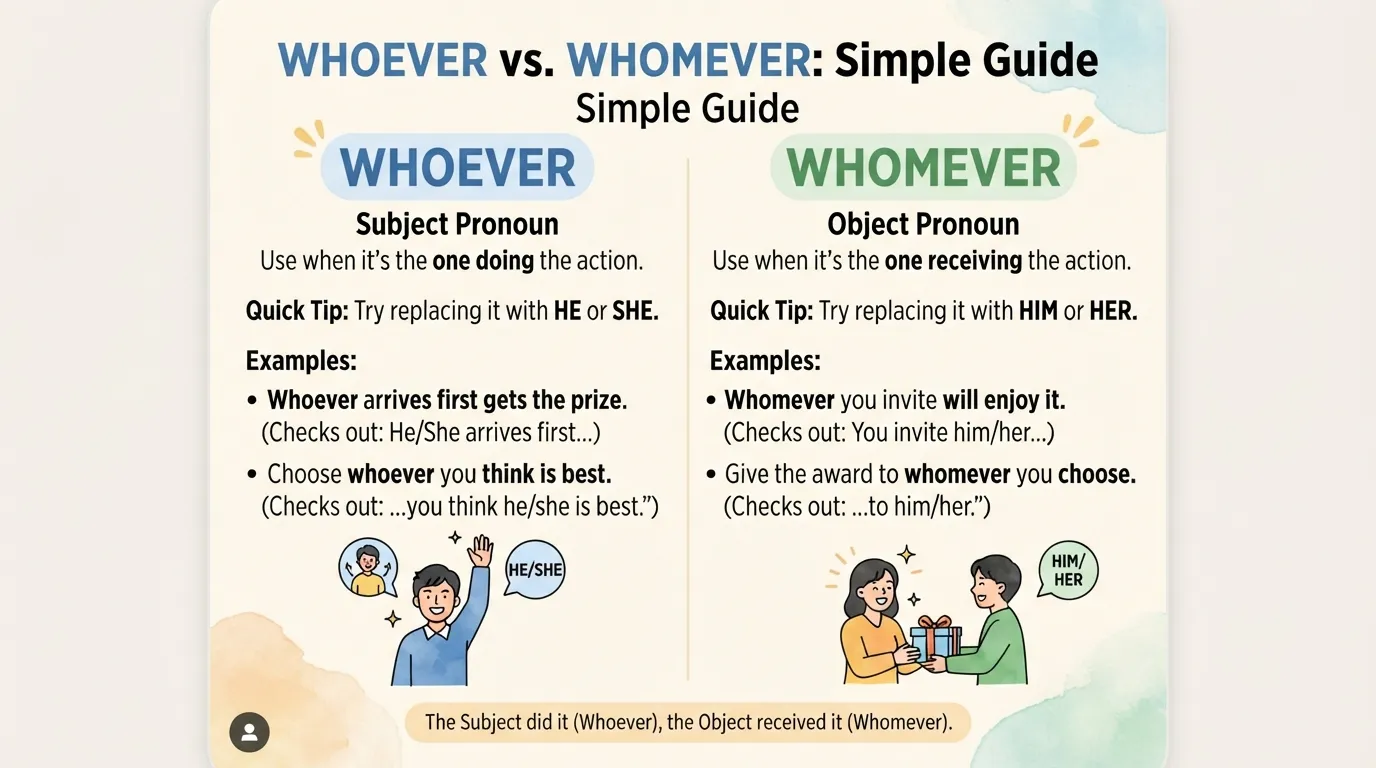
Here’s the quick answer: use whoever when it’s doing the action, and whomever when it’s receiving the action — but only inside its own little clause, not the sentence around it.
That last part is where almost everyone goes wrong, and it’s the whole reason this pair feels so slippery.
Once you see the trick, you’ll never guess again.
Table of Contents
- Did You Know?
- Quick Answer Box
- Quick Rule in One Line
- The Real Difference Between Whoever and Whomever
- The Grammar Rule (And the Exception Everyone Misses)
- Whoever or Whomever Comparison Table
- The Easiest Memory Trick
- 18 Real Example Sentences
- Common Mistakes
- When to Use Each Form
- Expert Tip
- Quick Quiz
- FAQs
- Conclusion
- Key Takeaways
Did You Know? 🔍
Whom has been losing ground in everyday English for decades, and whomever is fading even faster. Careful editors still use it correctly, but plenty of professional writers now dodge it entirely by rewriting the sentence — a habit worth knowing about, since it’s a perfectly legal way out when you’re not sure.
Quick Answer Box
Whoever is the subject form — use it when the word is doing the action (“whoever calls first”). Whomever is the object form — use it when the word is receiving the action (“give it to whomever you trust”). The catch: check its job inside its own clause, not the sentence around it.
⚡ Quick Rule in One Line
“Whoever does the action, whomever gets it done to them — check the small clause, not the big sentence.”
The Real Difference Between Whoever and Whomever
Whoever is a subject pronoun and whomever is an object pronoun; the choice depends on the job the word does inside its own clause, not on any word that comes before it in the sentence. Both words point to an unnamed or unknown person — “whoever wins” means “the person who wins,” whoever that turns out to be.
They’re built from the same root as who and whom, just with “-ever” tacked on to make them indefinite. That’s why the who/whom trick (swap in he or him) still works perfectly on both.
The Grammar Rule (And the Exception Everyone Misses)
Whoever acts as a subject — it performs the verb in its clause. Whomever acts as an object — it receives the verb’s action or follows a preposition within its own clause. The part almost every guide glosses over: this holds true even when the whole clause sits after a preposition like to or for.
That last point is the real trap. Look at this sentence:
Give the prize to whoever finishes first.
It looks like “whomever” should follow “to,” since “to” usually wants an object. But “to” isn’t grabbing the pronoun directly — it’s grabbing the entire clause “whoever finishes first,” and inside that clause, “whoever” is the one doing the finishing. So “whoever” stays correct, preposition or not.
Now compare:
Give the prize to whomever the judges choose.
Here, inside the clause, “the judges” are the ones doing the choosing — “whomever” is what’s being chosen. Object job, so “whomever” is correct.
The fix is always the same: isolate the clause, ignore everything before it, and ask who’s doing what to whom inside that clause alone.
Whoever or Whomever Comparison Table
| Feature | Whoever | Whomever |
|---|---|---|
| Grammatical role | Subject | Object |
| Answers to | He / she / they | Him / her / them |
| Typical position | Right before the verb | Usually followed by another noun/pronoun, then the verb |
| Example | Whoever calls, tell them I’m out. | Whomever you call, be polite. |
| Formality | Neutral, used everywhere | Formal, common in careful writing |
| Common in speech? | Yes, very | Rare — often replaced with “whoever” |
The Easiest Memory Trick
Swap the mystery word for he or him inside its own clause. If he fits, use whoever. If him fits, use whomever. Both end in “m” together — him and whom(ever) — so match the “m” to the “m.”
Try it on a tricky one:
I’ll vote for whoever/whomever earns my trust.
Isolate the clause: “___ earns my trust.” Swap in a pronoun: “He earns my trust” works, “him earns my trust” doesn’t. So it’s whoever.
18 Real Example Sentences
Whoever (subject) examples
- Whoever left this umbrella can pick it up at the front desk.
- Tell whoever answers the phone that I’ll call back.
- Whoever finishes the report first gets to leave early.
- Invite whoever wants to come to the party.
- Whoever said honesty is the best policy never had to give feedback on a bad haircut.
- The job goes to whoever performs best in the interview.
- Whoever is responsible for this mess needs to clean it up.
- Give the extra ticket to whoever shows up on time.
- Whoever wins gets bragging rights for a year.
Whomever (object) examples
- Send the invitation to whomever you think will enjoy it.
- Whomever the manager hires will need training first.
- You can bring whomever you like to the wedding.
- This message is for whomever it may concern.
- Choose whomever you trust most for the project.
- Whomever she recommends, I’ll gladly interview.
- The award goes to whomever the committee selects.
- I’ll work with whomever you assign to the team.
- Report the issue to whomever handles customer complaints.
Common Mistakes
❌ “Give it to whomever asks first.” ✅ “Give it to whoever asks first.” (whoever is the subject of “asks”)
❌ “Whoever you choose will do a great job.” ✅ “Whomever you choose will do a great job.” (whomever is the object of “choose”)
❌ “This is for whomever wants it.” ✅ “This is for whoever wants it.” (whoever is the subject of “wants”)
❌ “I’ll hire whoever the team recommends.” ✅ “I’ll hire whomever the team recommends.” (whomever is the object of “recommends”)
When to Use Each Form
Use whoever when the word starts a clause and is immediately followed by a verb it controls — “whoever wins,” “whoever calls,” “whoever decides.” Use whomever when another noun or pronoun sits between it and the verb, meaning it’s on the receiving end — “whomever you pick,” “whomever they trust.” In casual speech and informal writing, “whoever” is now widely accepted for both roles; save the strict distinction for formal writing, professional emails, and academic work.
Expert Tip 💡
For resumes, cover letters, legal writing, or anything academic, keep the whoever/whomever distinction exact — it’s one of those small details hiring managers and professors do notice. For everyday emails, texts, or blog posts, it’s genuinely fine to default to “whoever” if you’re unsure; native speakers do this constantly, and it rarely reads as wrong in casual contexts.
Quick Quiz
- “Give the notebook to ___ needs it most.” (whoever / whomever)
- “___ you decide to trust, tell them the truth.” (whoever / whomever)
- “The scholarship goes to ___ writes the best essay.” (whoever / whomever)
Answers: 1. whoever (subject of “needs”) · 2. whomever (object of “trust”) · 3. whoever (subject of “writes”)
FAQs
1. Is “whomever” grammatically correct?
Yes. It’s the standard object form of “whoever,” used correctly in formal and careful writing.
2. Is it OK to just always use “whoever”?
In casual speech and writing, yes — most native speakers do this, and it rarely sounds wrong. Formal writing still expects the distinction.
3. How do I know if whoever/whomever is the subject or object?
Isolate the clause it starts, ignore the rest of the sentence, and swap in “he” (whoever) or “him” (whomever) to test it.
4. Does the word before “whoever/whomever” decide which one to use?
No — this is the biggest misconception. A preposition like “to” or “for” governs the whole clause, not the pronoun inside it directly.
5. Is “whomever” becoming outdated?
It’s used less often in everyday speech than it used to be, though it remains standard in formal and edited writing.
6. What’s the difference between who/whom and whoever/whomever?
“Who” and “whom” usually refer to a known, specific person or ask a direct question. “Whoever” and “whomever” refer to an unknown or unspecified person and often start a clause.
7. Can “whomever” start a sentence?
Yes, if it’s the object of the clause that follows — for example, “Whomever you choose will represent the team.”
8. Is there a British vs. American difference in whoever/whomever usage?
No — the rule is the same in both American and British English; this isn’t a regional spelling difference.
9. What’s a quick way to avoid the choice entirely?
Rewrite the sentence with “the person who” or “whoever” — for example, “whomever signs up first” can become “the person who signs up first.”
10. Is “whoever” a formal word?
It’s neutral — appropriate for both formal and casual writing, unlike “whomever,” which leans more formal.
11. Is “whoever” one word or two?
One word. “Whoever” is always written as a single word; “who ever” as two separate words is a common misspelling, not a correct alternate form.
12. What are “whomsoever” and “whosoever”?
These are older, more formal versions of “whomever” and “whoever.” They still follow the same subject/object rule but sound archaic in modern writing, so “whoever” and “whomever” are the standard choices today.
13. Is “whoever” a pronoun?
Yes. “Whoever” and “whomever” are both indefinite relative pronouns, referring to an unspecified person rather than a named one.
Conclusion
The whoever/whomever choice isn’t really about the whole sentence — it’s about the small clause the word belongs to.
Ask whether that word is doing the action (whoever) or receiving it (whomever), test it with “he” or “him,” and ignore whatever preposition sits in front.
Get that habit down, and this pair stops being a guessing game. And if you’re ever still unsure, defaulting to “whoever” in casual writing won’t cost you much — just save the precise distinction for the writing that really counts.

Hi, I’m Daniel Carter. I’m passionate about helping learners improve their English with practical grammar tips and clear writing advice.