The words into and in to sound alike in many situations, so it is easy to confuse them. However, they serve different grammatical purposes.
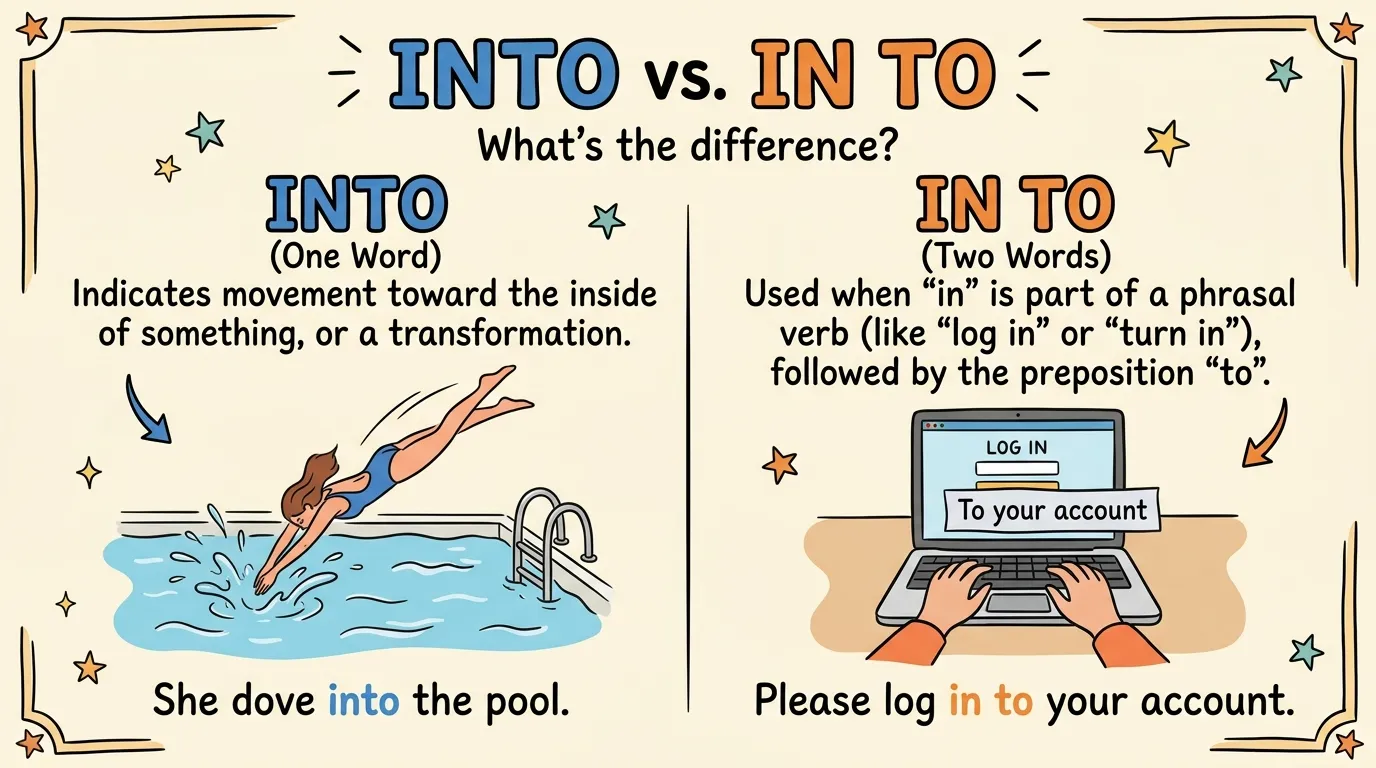
Into is a single preposition. It commonly shows that someone or something moves inside a place, changes into something else, or becomes involved in an activity.
In to consists of two words that happen to appear next to each other. Often, in is part of a phrasal verb, while to begins an infinitive phrase or introduces the next part of the sentence.
| Expression | Meaning | Example |
| Into | Movement inside | The cat jumped into the box. |
| Into | Change or transformation | Water turned into ice. |
| Into | Interest or enthusiasm | He is into photography. |
| In to | Separate grammatical functions | She came in to help. |
| In to | Following a phrasal verb | Please log in to your account. |
| In to | Following a verb meaning to submit | Turn the form in to your teacher. |
Quick rule: If you mean “to the inside of,” into is usually correct. If in belongs to a verb or expression and to serves a separate purpose, keep them apart.
What Does Into Mean?
Into is a preposition that describes movement, direction, contact, transformation, or involvement. Its exact meaning depends on the context.
Here are the most common uses.
1. Movement From Outside to Inside
Use into when someone or something moves from the outside to the inside of a place or object.
Examples:
- She walked into the kitchen.
- The dog jumped into the swimming pool.
- He put his keys into his pocket.
- The children ran into the classroom.
- Pour the milk into the glass.
In each sentence, into shows where the person or object moves.
Compare these two sentences:
- The boy is in the room.
- The boy walked into the room.
The first sentence describes a location. The second describes movement toward the inside of that location.
2. Change or Transformation
Use into when one thing changes into another form, state, or condition.
Examples:
- The caterpillar turned into a butterfly.
- The company transformed an old building into a hotel.
- The rain changed into snow.
- She turned her hobby into a business.
- The discussion developed into an argument.
Here, into connects the original state with the resulting state.
3. Interest or Enthusiasm
Into can also describe a person’s interest in an activity, subject, or hobby.
Examples:
- I am really into music.
- She is into photography.
- My brother is into video games.
- They are getting into gardening.
- He has always been into science.
In these sentences, into does not describe physical movement. Instead, it means someone enjoys or is interested in something.
4. Collision or Contact
Use into when something hits or comes into contact with another object.
Examples:
- The car crashed into a tree.
- I accidentally walked into the door.
- The cyclist ran into a parked vehicle.
- The ball bounced into the wall.
The word helps describe the direction or result of the action.
5. Division in Mathematics
Into can also appear in mathematical expressions.
Examples:
- How many times does 4 go into 20?
- Six goes into 30 five times.
- How many times does 3 go into 18?
This is another established use of the word, although it is less relevant to everyday spelling questions.
What Does In To Mean?
In to is not a single preposition. It is a combination of two separate words, and each word has its own role in the sentence.
A common pattern occurs when in forms part of a phrasal verb and to introduces an action or identifies the recipient of something.
1. When In Belongs to a Phrasal Verb
A phrasal verb combines a verb with a word such as in, out, up, or off. Together, the words create a particular meaning.
Examples include:
- Log in
- Give in
- Turn in
- Hand in
- Drop in
- Check in
- Tune in
When to follows one of these expressions for a separate grammatical purpose, you may need to keep the words apart.
Examples:
- I need to log in to check my messages.
- She refused to give in to pressure.
- Please turn the assignment in to your teacher.
- We dropped in to say hello.
- He tuned in to listen to the announcement.
In these examples, in remains part of the preceding expression, and to serves a separate purpose.
2. When To Introduces a Purpose
Sometimes, in is part of a verb phrase and to introduces an action that explains why someone did something.
Examples:
- She came in to help with dinner.
- He went in to see the doctor.
- I stopped in to ask a question.
- They called in to discuss the problem.
- We dropped in to visit our neighbors.
Consider this sentence:
He went in to get his coat.
Here, went in describes entering a place, while to get his coat explains the purpose.
You can often test the meaning by replacing to with in order to:
He went in in order to get his coat.
The wording is a little longer, but the meaning remains clear. That is a useful clue that in to is correct.
3. When To Identifies a Recipient
Use separate words when in belongs to a verb such as turn in or hand in, and to identifies the person receiving something.
Examples:
- I turned the paperwork in to my manager.
- She handed the keys in to the office.
- The student turned the assignment in to the teacher.
These sentences describe handing over or submitting something.
Compare:
- She turned the room into an office.
- She turned the paperwork in to her manager.
The first sentence describes a transformation. The second describes submitting paperwork to someone.
The extra space changes how the sentence is understood.
Into or In To: Example Sentences
Seeing the words in context makes the difference easier to understand.
Examples Using Into
- The children ran into the playground.
- She poured the juice into a glass.
- The small business grew into a successful company.
- He accidentally bumped into his friend.
- My sister is really into painting.
- The snow melted into water.
- Put your phone into your bag.
- The conversation turned into a debate.
- The bird flew into the open window.
- The team moved into the next round.
Each example uses into to show movement, transformation, contact, or involvement.
Examples Using In To
- I logged in to check my email.
- She came in to help us.
- He gave in to the pressure.
- Please turn the report in to your supervisor.
- We dropped in to say hello.
- I tuned in to watch the program.
- She went in to speak with the manager.
- They checked in to collect their room keys.
- The student handed the assignment in to the teacher.
- He stopped in to ask for directions.
In these examples, in belongs to a verb or expression, while to performs a separate function.
Remember: Do not decide based only on how the words sound. Look at the meaning and grammatical structure of the entire sentence.
Log Into or Log In To?
Both forms appear in everyday writing, especially when people talk about websites, apps, and online accounts.
For example:
- Log in to your account.
- Log into your account.
The form log in to your account makes the structure especially clear: log in is the verb phrase, and to your account identifies the destination or system.
However, log into is also widely used and accepted in common usage. Many dictionaries and style guides differ in how strictly they treat this construction.
For clear, consistent writing, especially in instructional content, log in to your account is a good choice.
More examples:
- Please log in to continue.
- You must log in to access your dashboard.
- I logged in to update my profile.
- Log into the website to view your settings.
The last example is widely used, but a style guide that prefers a strict distinction may recommend log in to the website.
The key is to follow your chosen style guide consistently and make the intended meaning clear.
Common Mistakes to Avoid
Even experienced writers can mix up into and in to. These common errors show why context matters.
Mistake 1: Using Into When You Mean a Purpose
Incorrect: She came into help us.
Correct: She came in to help us.
Why? The sentence means she entered and then helped, or came in for the purpose of helping. The phrase to help expresses purpose; it does not describe movement inside something.
Mistake 2: Using In To for Movement Inside
Incorrect: The cat jumped in to the box.
Preferred: The cat jumped into the box.
Why? The cat moved from outside the box to its interior. Into expresses that direction.
Note that jumped in can be correct when the destination is understood from context. For example, “The cat jumped in.” But when naming the destination, into the box is the clear choice.
Mistake 3: Confusing Transformation With Submission
Compare these sentences:
- She turned the garage into a studio.
- She turned the documents in to her supervisor.
The first describes changing one thing into another. The second describes submitting documents to someone.
Using the wrong form can change the meaning or make the sentence confusing.
Mistake 4: Assuming In To Is Always Incorrect
Some writers believe into is always correct because it looks like a single, complete word.
That is not true. In sentences such as “Please turn the assignment in to your teacher,” the words have separate grammatical roles.
Mistake 5: Assuming Into and In To Are Regional Spellings
This is not an American-versus-British spelling difference. Both forms are used in both varieties of English.
The correct choice depends on grammar and meaning.
A Simple Trick to Remember Into vs. In To
Use these two quick tests when you are unsure.
Test 1: Try “Inside”
If inside or to the inside of fits the sentence, into is probably correct.
Example:
The child climbed into the treehouse.
Try:
The child climbed to the inside of the treehouse.
The meaning is similar, so into makes sense.
Test 2: Try “In Order To”
If replacing to with in order to preserves the intended meaning, you may need the separate words in to.
Example:
She came in to help.
Try:
She came in in order to help.
The sentence still expresses a purpose, so the separate words are appropriate.
This test is a helpful guide, not a perfect rule for every sentence. Some constructions, especially phrasal verbs, require you to look at the whole expression.
Quick Quiz: Into or In To?
Choose the correct form in each sentence.
1. The dog ran _____ the house.
- A. into
- B. in to
2. She came _____ ask a question.
- A. into
- B. in to
3. The caterpillar changed _____ a butterfly.
- A. into
- B. in to
4. Please turn your homework _____ your teacher.
- A. into
- B. in to
5. I am really _____ photography.
- A. into
- B. in to
6. He gave _____ the demands.
- A. into
- B. in to
Answers:
- A — into
- B — in to
- A — into
- B — in to
- A — into
- B — in to
FAQs
1. Is into or in to correct?
Both are correct, but they serve different grammatical purposes. Into is a single preposition, often showing movement or transformation. In to consists of two separate words used when in and to perform different functions.
2. What is the difference between into and in to?
Into often means moving inside something, changing into a new state, or being interested in something. In to appears when in belongs to a verb or expression and to serves a separate role.
3. Is it log into or log in to?
Both forms are widely used. Log in to your account clearly separates the phrasal verb log in from the following phrase. Log into your account is also common. Follow your preferred style guide consistently.
4. Is it turn into or turn in to?
Both can be correct, depending on the meaning. Turn into means to become or transform into something. Turn in to can mean submitting something to a person or organization, as in “Turn the form in to your manager.”
5. Is into one word?
Yes. Into is a single word and functions as a preposition. For example, “She walked into the room.”
6. Is in to ever correct?
Yes. Use in to when the words have separate grammatical roles. For example, “He came in to help” and “She gave in to the pressure.”
7. Is into a preposition?
Yes. Into is a preposition that can describe movement, direction, transformation, contact, and interest. For example, “The bird flew into the cage.”
8. Is into or in to different in American and British English?
No. The distinction is grammatical rather than regional. American and British English both use into and in to according to the meaning and structure of the sentence.
9. How can I remember when to use into?
Think of movement toward the inside of something. If you can replace into with “to the inside of” without changing the main meaning, into is probably right.
10. How can I tell whether to write in to?
Check whether in belongs to a phrasal verb, such as give in, turn in, or log in, and whether to introduces a separate phrase. If so, write the words separately.
Conclusion
The difference between into and in to is easier to understand when you focus on the role each word plays.
Use into to describe movement inside something, transformation, collision, or interest. For example, “The dog ran into the yard” and “She turned her hobby into a business.”
Use in to when in belongs to a verb or expression and to serves a separate purpose. For example, “She came in to help” and “Please turn the assignment in to your teacher.”
Both forms are correct in the right context. The best way to choose is to read the entire sentence, identify the intended meaning, and check whether in and to work together or separately.
When in doubt, try the “inside” test for into or the “in order to” test for in to. These simple checks can help you write more clearly and confidently.

Hi, I’m Sophia Bennett. My goal is to make grammar easy, clear, and useful through simple explanations and real-life examples.