You’re finalizing a contract, typing “the vender agrees to deliver,” and something about that spelling looks slightly off, even though you’ve typed it that way for years.
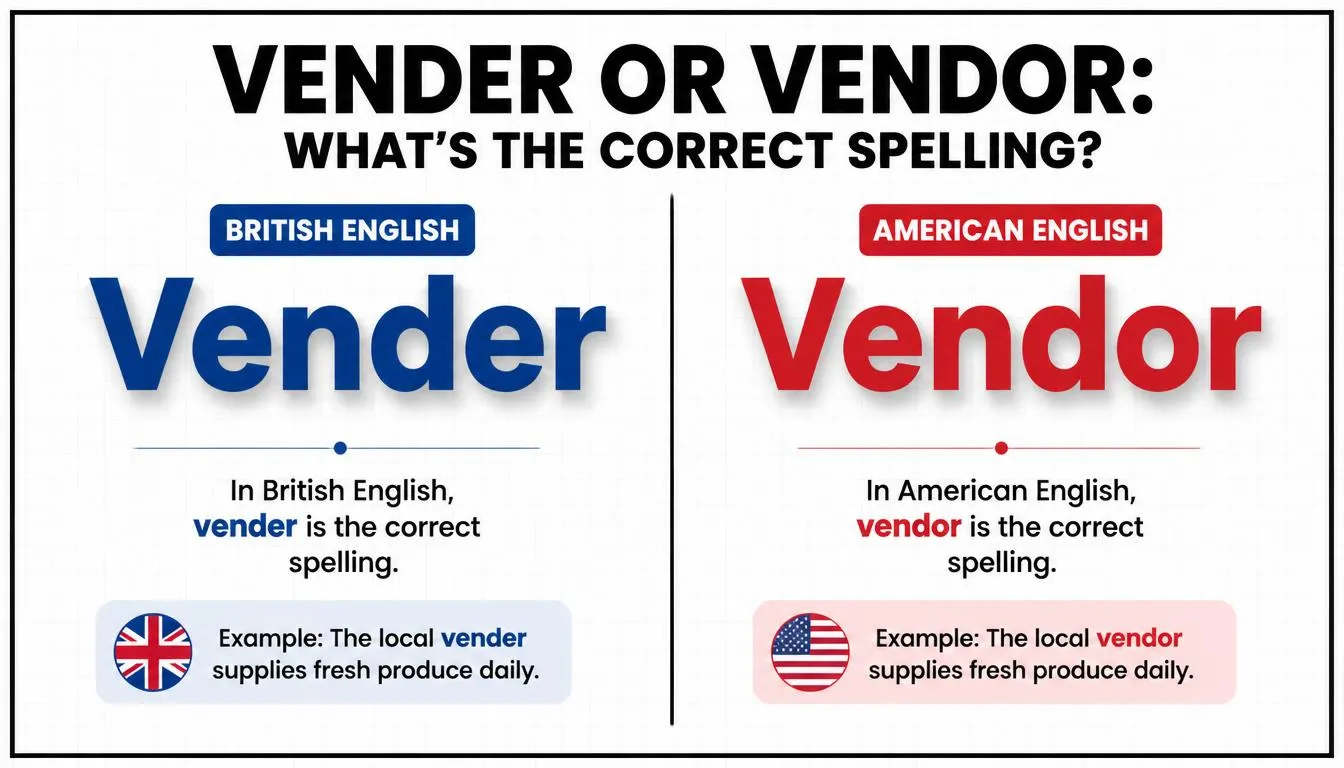
Quick answer: The correct spelling is “vendor,” with an O.
“Vender” is an outdated, rarely used variant that most modern dictionaries and style guides no longer treat as standard.
Table of Contents
- Quick Answer Box
- Quick Rule in One Line
- The Difference Explained
- Grammar Rule: The -OR Ending Pattern
- Vendor Etymology: Where Does the Word Come From?
- Comparison Table
- What’s the Plural of Vendor?
- Memory Trick
- Example Sentences
- Common Mistakes
- When to Use Each Form
- Expert Tip
- FAQs
- Conclusion
Quick Answer Box
“Vendor,” spelled with an O, is the correct, standard spelling in both American and British English.
It refers to a person or company that sells goods or services.
“Vender,” spelled with an E, is a rare historical variant.
Major dictionaries, including Cambridge and Oxford, list only “vendor” as the standard entry.
⚡ Quick Rule in 1 Line
“Vendor has an O, the same as vending and vendee.”
The Difference Explained
“Vendor” comes from the Latin “vendere,” meaning “to sell.”
As English absorbed vocabulary from Latin through French, many words describing a person who performs an action took the “-or” ending: actor, doctor, editor, vendor.
“Vender,” with an E, appeared as a spelling variant in older English texts but never became the accepted standard.
Today, it reads as either a typo or a rare historical spelling, not an alternative modern form.
There’s no American vs British split here either; both regions have long agreed on “vendor.”
Grammar Rule: The -OR Ending Pattern
English has two common endings for nouns describing a person who does something: “-or” and “-er.”
Words derived more directly from Latin often took “-or”: actor, doctor, editor, vendor, professor.
Words with more Germanic or French roots often took “-er” instead: teacher, worker, baker.
“Vendor” firmly belongs to the Latin “-or” group, alongside its related word “vendee” (the buyer in a sale).
Because “-er” is the far more common ending overall in English, writers sometimes default to it out of habit, which is exactly how “vender” ends up as a common typo.
Vendor Etymology: Where Does the Word Come From?
“Vendor” traces back to the Latin verb “vendere,” meaning “to sell.”
English picked it up through Latin-based legal and business vocabulary, the same path that gave English related words like “vendee” and “vending.”
That Latin root is exactly why “vendor” keeps the “-or” ending instead of the more common “-er” ending most English speakers expect.
Comparison Table
| Feature | Vendor | Vender |
|---|---|---|
| Status | Correct, standard spelling | Rare, outdated variant |
| Origin | Latin vendere (“to sell”) | Older English spelling variant |
| Dictionary support | Cambridge, Oxford, Merriam-Webster | Rare or unlisted |
| Regional split? | No, standard in both US and UK | No, considered nonstandard everywhere |
| Example | We hired a new software vendor. | Not standard in modern writing |
What’s the Plural of Vendor?
The plural of vendor is vendors, spelled the same “-or” way. Just add an “s.”
The possessive singular is vendor’s, as in “the vendor’s invoice.”
The possessive plural is vendors’, as in “the vendors’ booths.”
“Venders,” with an E, is never correct, whether singular, plural, or possessive.
Memory Trick
Connect it to “vending machine.” Both words share the same O, and both come from the identical Latin root.
If a vending machine sells snacks, a vendor sells goods and services, same O, same idea.
Example Sentences
- We hired a new software vendor for the project.
- The local festival featured dozens of food vendors.
- Please confirm the vendor’s delivery schedule.
- Our company reviews each vendor contract annually.
- The vendor agreed to the updated payment terms.
- She manages vendor relationships for the marketing team.
- The city requires permits for all street vendors.
- This vendor has worked with us for over five years.
- The procurement team is evaluating three new vendors.
- Each vendor must submit updated compliance documents.
Common Mistakes
❌ We need a new vender for our software needs.
✅ We need a new vendor for our software needs.
❌ The food vender parked near the stadium entrance.
✅ The food vendor parked near the stadium entrance.
❌ Please review the vender agreement before signing.
✅ Please review the vendor agreement before signing.
❌ Venders or vendor’s used as the plural.
✅ Vendors is the correct plural.
When to Use Each Form
Always use “vendor” in contracts, emails, business documents, and everyday writing.
There’s no modern context, casual or formal, where “vender” is the expected or preferred spelling.
Expert Tip 💡
Before finalizing any contract or procurement document, do a quick search for “vender” and correct any instance to “vendor.”
A misspelled vendor name or reference in a legal document can look careless and undermine the professionalism of the entire agreement.
FAQs
Is “vender” ever correct?
It appears occasionally as a rare historical spelling variant, but it’s not standard in modern English, business writing, or dictionaries.
Is “vendor” the same in American and British English?
Yes. Unlike words such as “colour” versus “color,” there’s no regional split for this word; “vendor” is standard everywhere.
What is a “vendee”?
A “vendee” is the buyer in a sale, the counterpart to the “vendor,” who is the seller.
Both words share the same Latin root and “-or/-ee” pattern.
Why do people misspell “vendor” as “vender”?
Mostly because “-er” is a much more common ending overall in English, so writers default to it out of habit rather than the correct Latin-based “-or” ending.
Do major dictionaries list “vender” at all?
Some comprehensive dictionaries include it as a rare or archaic variant, but it’s marked as nonstandard and isn’t the recommended spelling.
Is “vendor” always about business, or can it apply informally?
It applies both formally (business contracts, procurement) and informally (a street vendor, a farmers market vendor), always with the same “-or” spelling.
What other Latin-based words share this “-or” ending pattern?
Actor, doctor, editor, professor, and inventor all follow the same pattern.
Is “vendor” ever spelled with a hyphen or as two words?
No. “Vendor” is always one word, with no hyphen.
Is “vendor” a word?
Yes. “Vendor” is a standard English noun meaning a person or company that sells goods or services.
What’s the plural of vendor?
“Vendors.” Just add an “s” to the standard spelling. “Venders” is incorrect.
Is it “vendors” or “vendor’s”?
“Vendors” is the plural, used for more than one seller. “Vendor’s” is possessive, showing something belongs to one vendor.
Is “vendoring” a word?
No. “Vendoring” isn’t standard English. Use “vending” for the act of selling, and “vendor” for the person or company doing it.
What does “vandor” mean?
“Vandor” isn’t a real word. It’s a common misspelling of “vendor.”
Conclusion
“Vendor,” spelled with an O, is the only correct, standard spelling in modern English, in both American and British usage.
“Vender” is an outdated variant that reads as a typo to most readers today.
Remembering the shared O with “vending machine” makes this one easy to lock in permanently.

Hi, I’m Ethan Brooks. I create easy-to-follow grammar guides, writing tips, and vocabulary resources to make English learning enjoyable for everyone.