You’re texting a friend. You type, “I don’t live there anymore.” Then you pause. Should that be two words?
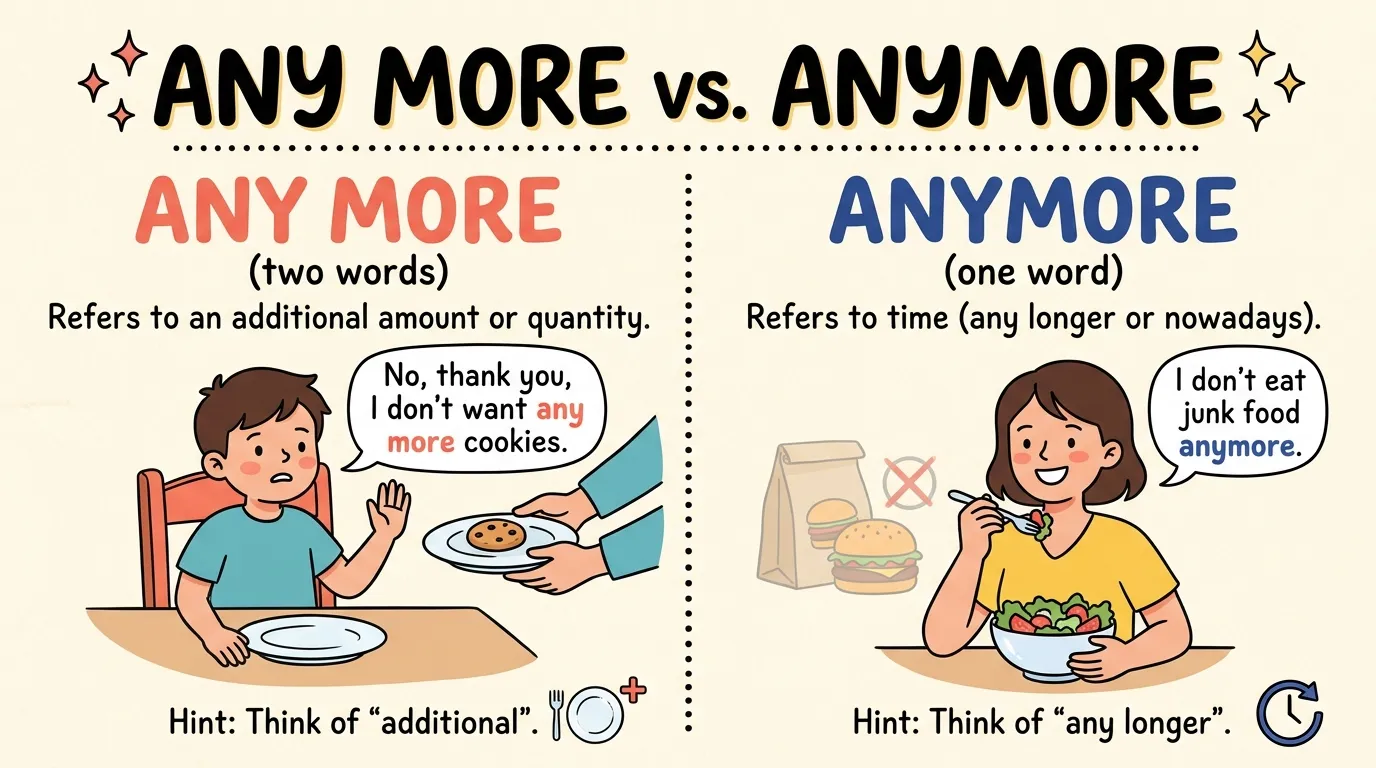
“Anymore” means “no longer,” and it’s the usual US spelling. “Any more” means “any extra” or “any additional.”
That’s the core rule. Here’s a fast test.
If you can swap in “any longer,” use “anymore.” If you can swap in “any extra,” use “any more.”
British writers often use the two-word form for both meanings. So the split isn’t perfectly clean.
That’s why this pair trips up so many people, even in careful emails and essays.
This guide gives you the rule, the exceptions, and plenty of examples. By the end, you’ll know which one fits your sentence.
Table of Contents
- Did You Know?
- Quick Answer
- Quick Rule in 1 Line
- Any More or Anymore: The Difference Explained
- The Grammar Rule Behind It
- US vs UK: Does Region Matter?
- Comparison Table
- The Quick Swap Test
- 20 Example Sentences
- Common Mistakes
- Tricky Cases
- When to Use Each Form
- Expert Tip
- Quick Quiz
- FAQs
- Conclusion
- Key Takeaways
Did You Know? 🔍
Some Americans, mostly in certain regions, use “anymore” in positive sentences to mean “nowadays.” For example, “Anymore, everyone texts instead of calling.”
Dictionaries generally treat that use as regional. In standard writing, “anymore” is mostly used in negative sentences and questions.
Quick Answer Box
“Anymore” is one word and means “no longer” or “any longer.” “Any more” is two words and means “any additional” or “any extra.” In American English, the spelling follows the meaning. In British English, two words are often used for both.
⚡ Quick Rule in 1 Line
“Use anymore for ‘no longer’; use any more for ‘any extra.’ British writers use two words for both.”
Any More or Anymore: The Difference Explained
“Anymore” tells you something stopped. “Any more” tells you about an extra amount. The two spellings carry two different jobs in American English.
Let’s look at each one.
Anymore (one word) means “no longer” or “now.”
- I don’t eat meat anymore.
- She doesn’t call me anymore.
- Do you play the piano anymore?
In each sentence, something used to happen and no longer does.
Any more (two words) means “any extra” or “any additional.”
- Do you want any more soup?
- I don’t have any more time.
- We can’t take any more guests.
Here, “any” describes the amount, and “more” shows the extra.
The two forms look nearly the same. But they answer different questions.
“Anymore” answers, “Is it still true?”
“Any more” answers, “How much extra?”
The Grammar Rule Behind It
“Anymore” is an adverb of time. “Any more” is a quantity phrase made of “any” and “more.” The word class changes the spelling.
Let’s break it down.
Anymore is an adverb.
An adverb tells us how, when, or how often. Here, it tells us when: not now.
It usually appears in negative sentences, questions, or “if” clauses.
- He doesn’t work here anymore. (negative)
- Do you live here anymore? (question)
- If you don’t care anymore, say so. (if-clause)
Any more is a quantity phrase.
It works like “some more” or “a little more.” It asks about or refers to an extra amount.
They often comes before a noun:
- any more cookies
- any more questions
- any more money
It can also stand alone as a pronoun:
- I don’t want any more.
- Is there any more?
Notice a pattern. If a noun follows, you almost always want two words.
“Anymore” does not usually modify a noun. So “anymore cookies” is a common mistake.
US vs UK: Does Region Matter?
Region matters a little. American English usually splits the forms by meaning. British English often writes “any more” as two words in every case.
This is where the pair gets tricky.
In the United States, most style guides prefer:
- anymore for “no longer”
- any more for “any additional”
In the United Kingdom, you’ll often see:
- any more for “no longer”
- any more for “any additional”
For example, a British writer might write, “I don’t live there any more.” An American writer would more likely write, “I don’t live there anymore.”
Some US dictionaries also accept “any more” for the “no longer” meaning. But “anymore” is the usual American choice.
Note that I can’t confirm each dictionary’s exact wording without live research. Check your chosen dictionary or style guide.
The key takeaway is simple.
For “extra amount,” everyone writes two words.
For “no longer,” Americans usually write one word. British writers often write two.
Comparison Table
| Feature | Anymore | Any more |
|---|---|---|
| Number of words | One | Two |
| Part of speech | Adverb | Quantity phrase |
| Main meaning | No longer, any longer | Any extra, any additional |
| Used before a noun? | No | Yes |
| Common in US English? | Yes | Yes (for “extra”) |
| Common in UK English? | Less common | Yes (both meanings) |
| Sentence | Correct form | Why |
|---|---|---|
| I don’t live there ___. | anymore | Means “no longer” |
| Do you want ___ rice? | any more | Means “any extra” |
| He doesn’t care ___. | anymore | Means “no longer” |
| We don’t need ___ chairs. | any more | Noun follows |
The Quick Swap Test
Swap in “any longer” or “any extra” and see which one fits. The phrase that sounds natural tells you the spelling.
Here’s the simple process:
- Read your sentence.
- Replace the word with “any longer.”
- If it makes sense, use anymore.
- If not, replace it with “any extra” or “any additional.”
- If that makes sense, use any more.
Let’s test it.
“I don’t want ___ cake.”
- “any longer cake” makes no sense.
- “any extra cake” works. So: any more.
“She doesn’t visit ___.”
- “any longer” works. So: anymore.
Another trick: look for a noun right after the word. If there’s a noun, you probably need “any more.”
20 Example Sentences
“Anymore” (no longer):
- I don’t watch that show anymore.
- My sister doesn’t live here anymore.
- They aren’t friends anymore.
- Do you still ride your bike anymore?
- He can’t run that fast anymore.
- We don’t talk about it anymore.
- She doesn’t take the bus anymore.
- It doesn’t hurt anymore.
“Any more” (any extra):
- Would you like any more coffee?
- I don’t have any more questions.
- There aren’t any more seats.
- Do you need any more help?
- We can’t spend any more money this month.
- She didn’t want any more drama.
- Is there any more of the pasta?
“Any more” in a British style (no longer):
- I don’t live there any more. (British style)
- He doesn’t play football any more. (British style)
They “Any more than” (always two words):
- He’s not any more tired than I am.
- This route isn’t any more direct than the other one.
Regional positive use (for learning only):
- Anymore, people just text. (Regional; avoid in formal writing.)
Common Mistakes
❌ I don’t want anymore cake. ✅ I don’t want any more cake.
❌ Do you have anymore questions? ✅ Do you have any more questions?
She can’t eat anymore pizza. ✅ She can’t eat any more pizza.
❌ He’s not anymore qualified than I am. ✅ He’s not any more qualified than I am.
We don’t need anymore chairs. ✅ We don’t need any more chairs.
The first three mistakes and the last one share one clue. A noun follows the word, so you need two words.
The fourth uses “any more than,” which is always two words.
In every case, the one-word “anymore” was used where a quantity was meant.
Tricky Cases
“Any more than” is always two words.
This phrase compares two things.
- I’m not any more worried than you are.
- It’s not any more expensive than before.
Never write “anymore than.” It’s a common slip.
“Anymore” in questions.
Questions about “still” often use “anymore.”
- Do you cook anymore?
Many writers would say, “Do you still cook?” Both are fine.
“Any more” before “of.”
When “of” follows, use two words.
- I don’t want any more of this.
“No more” vs. “anymore.”
These are different structures. “No more” is a quantity. “Anymore” shows time.
- No more cookies, please.
- I don’t eat cookies anymore.
Headlines and informal writing.
In casual texts or ads, people sometimes drop the rule. That’s fine for fun. In school or work writing, follow the rule.
When to Use Each Form
Use “anymore” for “no longer,” and “any more” for an extra amount. If you write for a British audience, check their style guide.
Use “anymore” when:
- Something used to happen and doesn’t now
- The word follows a negative or a question
- No noun comes right after it
Use “any more” when:
- You mean “any extra” or “any additional”
- A noun follows (any more time, any more friends)
- You write “any more than”
For British audiences:
- Many writers use “any more” for both meanings
- Follow the publisher’s house style
A good habit is to pick one style and stay consistent in the same document.
Expert Tip 💡
If you write for a company or publisher, check the house style guide first.
Many US guides, such as the AP Stylebook and the Chicago Manual of Style, address this pair. Check the current edition for exact wording.
If a guide is silent, use this simple split:
- “Anymore” for “no longer”
- “Any more” for “extra”
That keeps your writing clear for both US and UK readers.
Quick Quiz
1. Which sentence is correct?
a) I don’t want anymore tea.
b) I don’t want any more tea.
2. Which sentence uses “no longer” meaning in US style?
a) He doesn’t work here any more.
b) He doesn’t work here anymore.
3. Fill in the blank: “She isn’t ___ polite than he is.”
a) any more
b) anymore
Answers: 1) b, 2) b, 3) a
FAQs
1. Is it “any more” or “anymore”?
Both are correct, but they mean different things. “Anymore” means “no longer.” “Any more” means “any extra.”
2. Is “anymore” one word or two?
“Anymore” is one word when it means “no longer.” When you mean “any extra,” write two words: “any more.”
3. Is “anymore” a real word?
Yes. It’s an adverb found in major dictionaries. It means “any longer” or “now,” mostly in negative sentences and questions.
4. What does “any more” mean?
“Any more” means “any extra” or “any additional.” For example, “Do you want any more soup?”
5. Is “any more” correct for “no longer” in British English?
Yes. Many British writers use “any more” for “no longer.” Example: “I don’t live there any more.”
6. Is “anymore” used in British English?
It’s less common. British style usually keeps two words. Some British writers do use it, so follow your publisher’s guide.
7. Can I say “anymore” in a positive sentence?
Some Americans do, as in “Anymore, I just stay home.” Dictionaries treat this as regional. Avoid it in formal writing.
8. Is it “any more than” or “anymore than”?
It’s “any more than,” always two words. Example: “He’s not any more tired than I am.”
9. What’s the difference between “any more” and “no more”?
“No more” is a quantity and means “none left.” “Any more” often appears in negatives. “I have no more time” and “I don’t have any more time” mean the same.
10. Which one should I use in an essay or on my website?
For US readers, use “anymore” for “no longer” and “any more” for “extra.” Stay consistent throughout.
Conclusion
“Anymore” and “any more” look alike, but they do different jobs.
“Anymore” means “no longer.” “Any more” means “any extra.”
In the US, the spelling follows the meaning. In the UK, two words are often used for both.
When you’re unsure, run the swap test. If “any longer” fits, write one word. If “any extra” fits, write two.
Keep your choice consistent in each piece of writing.
With this quick check, you’ll get it right every time.

Hi, I’m Sophia Bennett. My goal is to make grammar easy, clear, and useful through simple explanations and real-life examples.