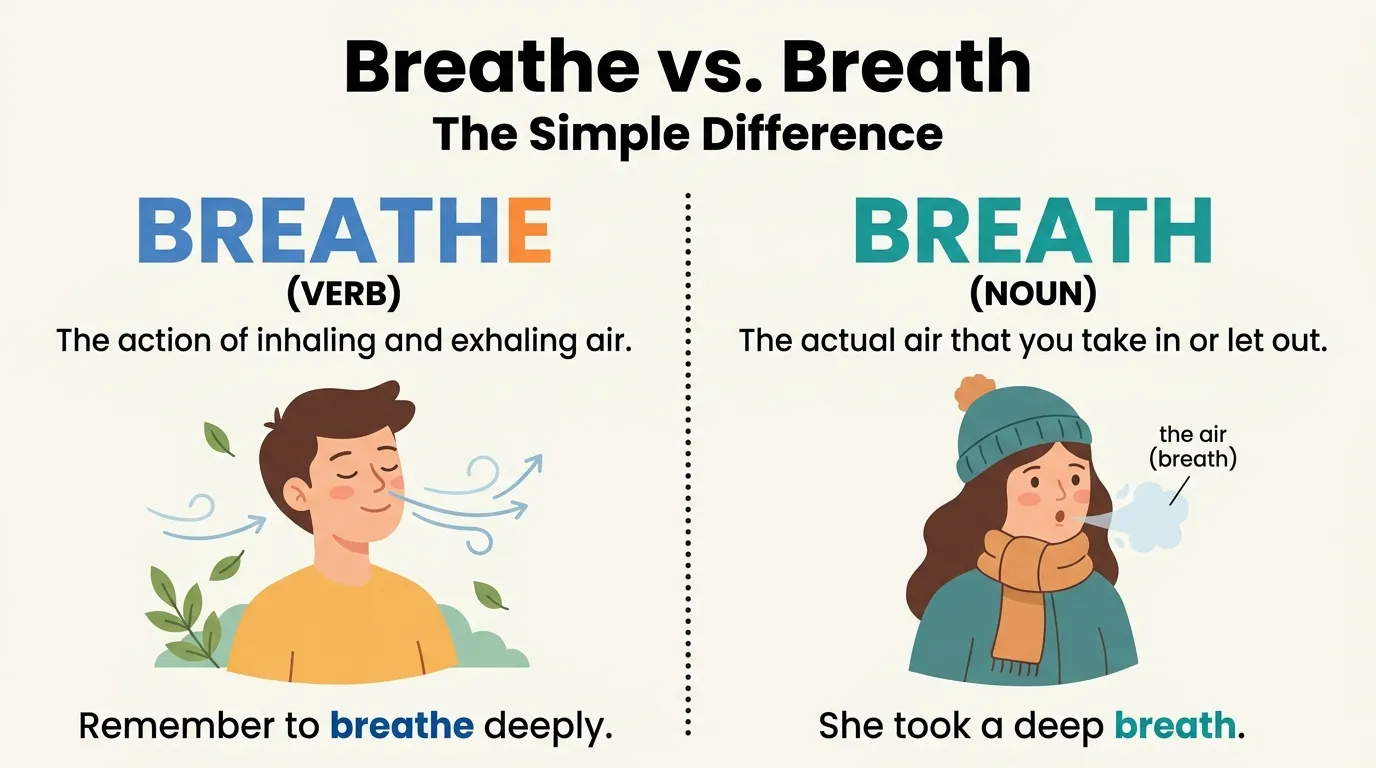
You type, “I just need to breath.” Your spell checker stays quiet, but the sentence is wrong. Breath is the noun, and breathe is the verb.
Both words look almost the same, and both are about air. Even careful writers slip here, especially when typing fast or trusting autocorrect.
Here’s the quick answer to breathe or breath. Use breath for the air you take in or let out, as in “take a deep breath.” Use breathe for the action of taking air in and out, as in “I can’t breathe.”
The extra e is your clue. It also changes the sound of the word. You’ll learn how each word sounds, when to use it, and a few easy memory tricks that really stick.
Table of Contents
- Did You Know?
- Quick Answer Box
- Quick Rule in 1 Line
- Breathe or Breath: What’s the Difference?
- How to Pronounce Breath and Breathe
- Grammar Rule: Noun vs Verb
- Breath vs Breathe Comparison Table
- Memory Tricks to Tell Them Apart
- How to Use Breath (Noun)
- How to Use Breathe (Verb)
- 20 Example Sentences
- Common Mistakes With Breathe and Breath
- Related Words: Breathing and More
- Is There a US vs UK Difference?
- Expert Tip
- Quick Quiz
- FAQs
- Conclusion
- Key Takeaways
Did You Know? 🔍
Breath and breathe follow a spelling pattern you’ll see in other pairs. The noun has no final e, and the verb does.
Think of bath and bathe, or teeth and teethe. Writing guides such as Scribbr point out this pattern.
Quick Answer Box
Breathe or breath? Use “breath” (noun) for the air you take in and out, as in “take a deep breath.” Use “breathe” (verb) for the action of inhaling and exhaling, as in “breathe slowly.” Breath rhymes with “death.” Breathe rhymes with “teethe.” If it’s something you do, it’s breathe.
⚡ Quick Rule in 1 Line
Breath is the thing you take; breathe is the action you do — add the e for action.
Breathe or Breath: What’s the Difference?
Breath is a noun. It names the air you take in and let out. Breathe is a verb. It names the act of taking air in and letting it out. They differ in spelling, sound, and job in a sentence.
Here’s the same idea in two short examples.
- Breath (noun): “I took a deep breath.”
- Breathe (verb): “I need to breathe.”
Notice that “took” needs a thing to take. That thing is a breath. The second sentence needs an action, so it uses breathe.
Merriam-Webster notes that the two words sound different. Because of that, a mix-up in writing is jarring. Readers stop and reread the sentence.
How to Pronounce Breath and Breathe
Breath sounds like “breth,” with a short e and the th from “thing.” Breathe sounds like “breeth,” with a long e and the th from “the.” The sound change is part of what separates the noun from the verb.
| Word | Part of speech | Respelling | IPA | Rhymes with |
|---|---|---|---|---|
| Breath | Noun | breth | /breθ/ | death |
| Breathe | Verb | breeth | /briːð/ | teethe |
The respellings come from Merriam-Webster, and the IPA comes from Oxford Learner’s Dictionaries.
The Two “TH” Sounds
The th in breath is soft and airy, like the th in “thing.” Your voice doesn’t buzz.
The th in breathe is voiced, like the th in “the.” Put a finger on your throat. You’ll feel a small buzz.
Why the Final E Matters
In breathe, the final e is a clue. It goes with the long ee sound and the buzzing th.
If you see that e, say “breeth.” If there’s no e, say “breth.”
Grammar Rule: Noun vs Verb
Breath is a noun, so it follows words like a, the, your, or deep. Breathe is a verb, so it follows words like to, can, will, or must. Ask what job the word does in the sentence.
Here’s a quick test. Can you put “a” or “the” before the word? If yes, it’s a noun, so use breath.
- “Take a breath.” ✅
- “I need to breathe.” ✅
Forms of Breathe
Breathe is a regular verb. Oxford Learner’s Dictionaries lists these forms.
| Form | Word | Example |
|---|---|---|
| Base form | breathe | I breathe through my nose. |
| He/she/it | breathes | She breathes slowly. |
| Past | breathed | He breathed deeply. |
| Past participle | breathed | We have breathed fresh air. |
| -ing form | breathing | They are breathing calmly. |
Notice that the e drops before -ing. It’s “breathing,” not “breatheing.”
Forms of Breath
Breath is a noun. Its plural is breaths, as in “hold the pose for five breaths.”
There’s no verb form of breath. So “I breath” and “he breaths” are always wrong.
Breath vs Breathe Comparison Table
The main difference is simple: breath is a noun, and breathe is a verb. The table below puts the key points side by side so you can check a sentence in seconds.
| Feature | Breath | Breathe |
|---|---|---|
| Part of speech | Noun | Verb |
| Meaning | The air you take in or let out | To take air in and let it out |
| Spelling | 6 letters, no final e | 7 letters, final e |
| Vowel sound | Short e (breth) | Long ee (breeth) |
| Final sound | Soft th, as in “thing” | Voiced th, as in “the” |
| Follows | a, the, your, deep | to, can, will, must |
| Example | Take a deep breath. | Breathe in slowly. |
Memory Tricks to Tell Them Apart
Not sure about breathe or breath? Three quick tricks help. The longer word, breathe, is the verb. Breathe also ends in “-the,” like the th sound you hear. Or use the swap test: try “inhale” in place of the word.
Trick 1: Length
Grammarly points out that the shorter word, breath, is the noun. The longer word, breathe, is the verb.
Short word, short job: it just names a thing. Long word, long job: it describes an action.
Trick 2: The Ending E
Many noun and verb pairs work this way. Scribbr gives bath and bathe as another example.
If the word is a verb, add the e.
Trick 3: The Swap Test
Replace the word with “inhale” or “exhale.” If the sentence still works, use breathe.
“I can’t inhale” makes sense, so “I can’t breathe” is right. Now try “take a deep inhale.” It sounds odd, so you need breath.
Trick 4: Rhymes
Breath rhymes with death. Breathe rhymes with teethe.
Say the sentence aloud. If your mouth makes the long ee, write the e.
How to Use Breath (Noun)
Use breath when you mean the air you take in or let out, or one cycle of breathing. It can also mean a tiny amount of something, like a breath of wind. It’s always a noun.
According to Oxford Learner’s Dictionaries, breath can be uncountable or countable. You can talk about “bad breath” or count “three breaths.”
Common Phrases With Breath
Many idioms use breath. Oxford Learner’s Dictionaries lists these.
- Out of breath: having trouble breathing after exercise
- Hold your breath: to stop breathing briefly, or to wait nervously
- Catch your breath: to pause and breathe normally again
- Take someone’s breath away: to be very surprising or beautiful
- Under your breath: said so quietly that others can’t hear
- A breath of fresh air: something new and exciting
- Waste your breath: to say something no one will listen to
- With bated breath: feeling anxious or excited while waiting
Spelling tip: it’s “bated breath,” not “baited breath.” Bated means held in.
Other Uses of Breath
Breath can also mean a small amount of something. “There wasn’t a breath of wind” is a good example.
You may see “a breath of suspicion” in formal writing.
How to Use Breathe (Verb)
Use breathe when you mean the action of taking air into your lungs and letting it out. It also has figurative uses, such as giving life to an idea. It’s always a verb.
Oxford Learner’s Dictionaries lists several senses. Some are everyday, and some are formal or literary.
Everyday Uses of Breathe
The most common sense is simple: to inhale and exhale. “Breathe in through your nose.”
Fabric can “breathe” when air moves through it. Wine can “breathe” when it’s open to air.
Common Phrases With Breathe
These phrases use the verb.
- Breathe a sigh of relief: to let out a breath because you feel relieved
- Breathe easy: to relax and stop worrying
- Breathe down someone’s neck: to watch someone closely in an annoying way
- Breathe new life into something: to improve it with fresh ideas
- Live and breathe something: to be very enthusiastic about it
- Room to breathe: freedom or space
Notice something about “breathe a sigh of relief.” It uses both ideas. You breathe out a sigh, and a sigh is a kind of breath.
20 Example Sentences
Reading real sentences is the fastest way to feel the difference. The first ten use the noun breath. The last ten use the verb breathe, and one sentence uses both.
Breath (Noun)
- Take a deep breath before you start.
- She was out of breath after the stairs.
- I held my breath underwater.
- His breath looked like smoke in the cold air.
- The view took my breath away.
- He sighed under his breath.
- The garden was a breath of fresh air.
- Don’t hold your breath; the bus is always late.
- Count four breaths as you stretch.
- Don’t waste your breath arguing with him.
Breathe (Verb)
- Breathe in slowly through your nose.
- I can’t breathe in this hot room.
- The doctor told him to breathe deeply.
- Let the wine breathe for a few minutes.
- This fabric lets your skin breathe.
- She breathed a sigh of relief when the test ended.
- The new coach will breathe new life into the team.
- My manager always breathes down my neck.
- You can breathe easy now.
- Take a deep breath, then breathe out slowly.
Sentence 20 uses both words. The noun comes after “take a deep.” The verb comes after “then.”
Common Mistakes With Breathe and Breath
The most common mistake is writing breath where a verb is needed, like “I can’t breath.” The second is writing breathe where a noun is needed, like “take a deep breathe.” Check the job of the word first.
❌ I can’t breath.
✅ I can’t breathe.
❌ Take a deep breathe.
✅ Take a deep breath.
❌ He was out of breathe.
✅ He was out of breath.
❌ Breath in, breath out.
✅ Breathe in, breathe out.
❌ She breath a sigh of relief.
✅ She breathed a sigh of relief.
❌ Don’t hold your breathe.
✅ Don’t hold your breath.
❌ We waited with baited breath.
✅ We waited with bated breath.
Why These Mistakes Happen
The words look alike, and most of us learn them by ear. In fast typing, the final e is easy to drop or add.
Spell checkers often miss the error. Both words are real, so they get no red line.
Related Words: Breathing and More
Breathing is the -ing form of breathe. It keeps the long ee sound and drops the final e. Other family words include breather, a short rest, and breathless, which means out of breath.
Breathing
“Breathing” is both a verb form and a noun. You can say “She is breathing slowly” or “Breathing exercises help many people relax.”
Breathable
Breathable describes fabric that lets air move through it. Grammarly gives the example of athletic clothes that “breathe.”
Breather and Breathless
A breather is a short rest, as in “Let’s take a breather.” Breathless describes someone who is out of breath.
Is There a US vs UK Difference?
There’s no spelling difference. Both words are spelled the same in American and British English. This pair doesn’t follow the usual US vs UK split. You don’t need to switch spellings for your audience.
Both Merriam-Webster and Oxford Learner’s Dictionaries list breath as the noun and breathe as the verb.
If you write for a style guide, this is one rule that never changes.
Expert Tip 💡
Before you publish, search your draft for “breath.” Check each one. This settles breathe or breath for good. If it follows “to,” “can,” “will,” or “must,” it needs an e.
Then search for “breathe.” If a, the, your, or deep comes before it, drop the e.
Quick Quiz
Choose the correct word for each sentence.
- I need to take a deep ______.
- Please ______ slowly and relax.
- She was out of ______ after the race.
Answers:
- breath. “Take a deep” needs a noun.
- breathe. “Please” is followed by a verb.
- breath. “Out of” is followed by a noun.
FAQs ❓
Is it breathe or breath?
It depends on the job of the word. Use “breath” for the noun, as in “take a breath.” Use “breathe” for the verb, as in “breathe in.”
What is the difference between breath and breathe?
Breath is a noun that names the air you take in and out. Breathe is a verb that names the action of doing it. They also sound different.
Is breathe a noun or a verb?
Breathe is a verb. The noun is breath.
How do you pronounce breath and breathe?
Breath sounds like “breth,” with a short e and the th in “thing.” Breathe sounds like “breeth,” with a long e and the th in “the.”
Is it “take a deep breath” or “take a deep breathe”?
It’s “take a deep breath.” You’re taking a thing, so you need the noun.
Is it “I can’t breath” or “I can’t breathe”?
It’s “I can’t breathe.” “Can’t” is followed by a verb.
What is the past tense of breathe?
The past tense is “breathed.” For example, “She breathed deeply.” The -ing form is “breathing.”
Do American and British English spell them differently?
No. Both words are spelled the same in American and British English.
What does “bated breath” mean?
It means feeling anxious or excited while you wait. The word is “bated,” not “baited.”
Is “breath” ever a verb?
No. Breath is a noun. If you need a verb, use breathe.
Conclusion
Breath is the noun, and breathe is the verb. That one rule covers almost every sentence. It really is that simple.
Breath is the air you take. Breathe is the action you do. The extra e in breathe is your clue, and it matches the long ee sound.
When you’re unsure about breathe or breath, try the swap test. If “inhale” fits, write breathe. If “a gulp of air” fits, write breath.
Read your sentence aloud, then check each one. Soon you won’t need the trick at all. Next time you feel stuck, take a deep breath, slow down, and trust the rule.

Hi, I’m Olivia Harper. I love turning complex English grammar into simple, practical lessons that help readers write and speak with confidence.