You’re typing a report. The sentence says “a million has six zeros.”
Then you pause. Shouldn’t it be “zeroes”? Both look right.
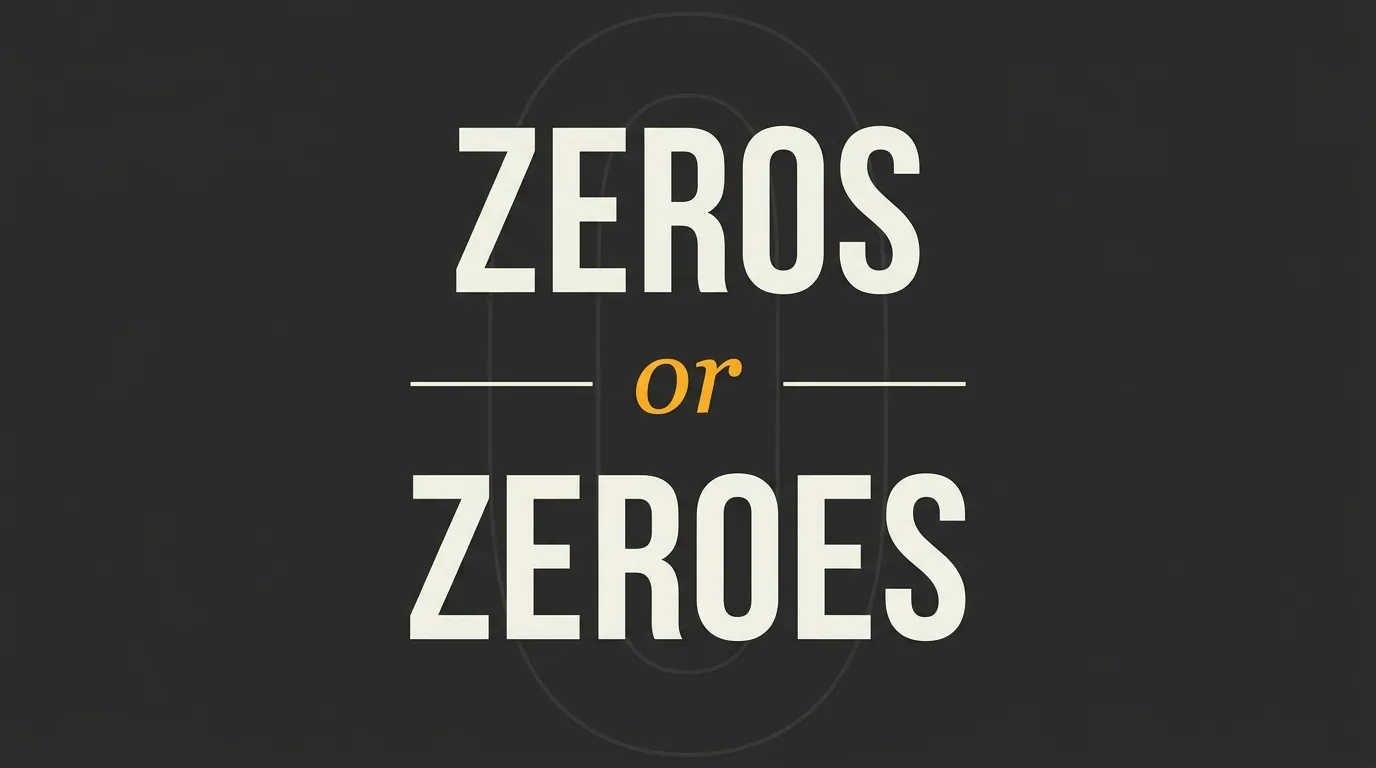
Both “zeros” and “zeroes” are correct plurals of “zero.” “Zeros” is more common and the safer pick for most writing.
For the verb, use “zeroes.” You write “she zeroes in on the answer.”
The confusion comes from words ending in -o.
Some add -s. Others add -es. A few accept both, and “zero” is one of them.
This guide shows you when to use each one.
Table of Contents
- Did You Know?
- Quick Answer
- Quick Rule in 1 Line
- Zeros or Zeroes: The Difference Explained
- The Grammar Rule Behind the Plural
- Comparison Table
- Zeroes as a Verb
- Why Both Spellings Exist
- Memory Trick
- 20 Example Sentences
- Common Mistakes
- When to Use Each Form
- Expert Tip
- Quick Quiz
- FAQs
- Conclusion
- Key Takeaways
Did You Know? 🔍
The word “zero” came into English through Italian.
It traces back to the Arabic word sifr, which also gave us “cipher.”
Quick Answer Box
“Zeros” and “zeroes” are both correct plurals of “zero.”
“Zeros” is more common, especially for numbers and math.
“Zeroes” is the standard verb form, as in “she zeroes in on the target.”
⚡ Quick Rule in 1 Line
“Both are correct plurals, but zeros is safer; for the verb, always write zeroes.”
Zeros or Zeroes: The Difference Explained
Both spellings are correct plurals. The difference is how common each one feels.
“Zeros” is the simpler form. It just adds -s.
“Zeroes” follows the older -es pattern used in words like “heroes.”
Both mean more than one zero.
- Zeros is common in math, science, computing, and news writing.
- Zeroes appears often in everyday writing and in some style guides.
Neither one is a mistake.
This also isn’t a US vs UK difference like “color” and “colour.”
Writers in both countries use both forms.
So how do you pick?
Choose one and stay consistent in the same article.
If you have no style guide, “zeros” is a clean, safe default.
The Grammar Rule Behind the Plural
English nouns ending in -o have no single plural rule. Some add -s, some add -es, and some accept both.
Let’s sort them into three groups.
Group 1: Add -es
- potato → potatoes
- tomato → tomatoes
- hero → heroes
- echo → echoes
- veto → vetoes
2: Add -s
- photo → photos
- piano → pianos
- video → videos
- radio → radios
- solo → solos
Group 3: Both are accepted
- zero → zeros / zeroes
- volcano → volcanoes / volcanos
- tornado → tornadoes / tornados
- mango → mangoes / mangos
- mosquito → mosquitoes / mosquitos
“Zero” belongs to Group 3.
There’s a loose pattern.
Short forms of longer words (photo, video, kilo) usually add -s.
Words ending in a vowel plus -o (radio, video, studio) usually add -s.
Older, everyday words (potato, hero, echo) often add -es.
But there are many exceptions.
That’s why dictionaries, not rules, settle these cases.
For “zero,” major dictionaries list both plurals.
I can’t promise which one each dictionary lists first, so check before you quote one.
Comparison Table
| Feature | Zeros | Zeroes |
|---|---|---|
| Correct plural? | Yes | Yes |
| Used in US? | Yes | Yes |
| Used in UK? | Yes | Yes |
| Common in math? | Very | Less |
| Verb form? | Not usual | Yes |
| Word | Plural | Rule |
|---|---|---|
| potato | potatoes | Add -es |
| photo | photos | Add -s |
| zero | zeros / zeroes | Both |
| volcano | volcanoes / volcanos | Both |
| hero | heroes | Add -es |
Zeroes as a Verb
“Zeroes” is also a verb form. It means “to focus on” or “to set to zero.”
You use it with he, she, it, or a singular noun.
The full verb pattern is simple:
- zero (base form)
- zeroes (he/she/it)
- zeroed (past)
- zeroing (-ing form)
Here are some examples:
- She zeroes in on the main problem.
- The pilot zeroed in on the runway.
- He is zeroing the scale before weighing.
Notice that “zeroes” here isn’t a plural.
It’s a verb, so it needs the -es.
This is the one place where the spelling is clearer and more fixed.
Some dictionaries also list “zeros” for the verb.
Still, “zeroes” is the form most writers expect.
Why Both Spellings Exist
Both spellings exist because English speakers use two different habits for nouns ending in -o.
One habit adds -es, as in “potatoes.”
The other adds -s, as in “photos.”
“Zero” arrived from Italian, where the word has its own endings.
English had to decide how to pluralize it.
Over time, writers used both -s and -es.
Neither one won out completely.
In some fields, one form feels more natural.
Math and computer science writers often prefer “zeros.”
Everyday writers often use “zeroes.”
So the double spelling isn’t a mistake.
It’s a sign that English is still flexible here.
Memory Trick
Zeros are for counting. Zeroes is for action.
Here are two quick ways to remember:
- Numbers, use “zeros.” Think of a bank balance: “five zeros.”
- Action, use “zeroes.” Think of a target: “she zeroes in.”
If you’re writing a plural noun, either works.
If you’re writing a verb, pick “zeroes.”
20 Example Sentences
“Zeros” as a plural noun:
- A million has six zeros.
- The code was a long string of zeros and ones.
- She counted the zeros on the check twice.
- The spreadsheet filled empty cells with zeros.
- Computers store data as zeros and ones.
- The function has two real zeros.
- He added three zeros to the end of the number.
- The report showed zeros across the whole column.
- Remove the extra zeros from the price.
- The scoreboard showed two big zeros.
“Zeroes” as a plural noun:
- She wrote two zeroes after the five.
- The old ledger was full of faded zeroes.
- The kids drew bubbly zeroes on the board.
- He typed three zeroes by mistake.
- The jersey had two zeroes on the back.
“Zeroes” as a verb:
- The camera zeroes in on the singer’s face.
- She zeroes in on errors before anyone else.
- The coach zeroes in on weak spots in practice.
Past and -ing forms for comparison:
- The detective zeroed in on one suspect.
- The nurse was zeroing the scale when I arrived.
Common Mistakes
❌ She zeros in on the problem.
✅ She zeroes in on the problem.
❌ He zeroned in on the answer.
✅ He zeroed in on the answer.
❌ A million has six zero’s.
✅ A million has six zeros.
❌ We saw two zeroe’s on the screen.
✅ We saw two zeroes on the screen.
❌ The page has zeroes and zeros mixed together.
✅ Pick one plural and stay consistent.
The apostrophe mistake is very common.
An apostrophe shows ownership or a contraction.
It never makes a plain plural.
Also, “zeroned” isn’t a word. The past tense is “zeroed.”
When to Use Each Form
Use “zeros” for most plural nouns. Use “zeroes” for the verb.
You can use “zeroes” as a plural too, if you stay consistent.
Use “zeros” when you’re writing:
- Math, science, or tech content
- Business reports and spreadsheets
- News and finance articles
- Content with many numbers
Use “zeroes” when you’re writing:
- The verb (“she zeroes in”)
- A plural noun, if your style guide prefers it
- Casual or storytelling text
Whichever you choose, keep it the same throughout.
A mix of both in one article looks careless.
Expert Tip 💡
Check the house style guide first.
If your publisher or school has one, follow it.
If not, pick “zeros” for plural nouns and “zeroes” for the verb.
That simple split keeps your writing clear and consistent.
Quick Quiz
1. Which sentence is correct?
a) She zeros in on the target.
b) She zeroes in on the target.
2. Which plural is acceptable?
a) zeros
b) zeroes
c) both
3. What is the past tense of the verb “zero”?
a) zeroned
b) zeroed
Answers: 1) b, 2) c, 3) b
FAQs
1. What is the plural of zero?
The plural is “zeros” or “zeroes.”
Both are correct.
2. Is “zeroes” correct?
Yes. It’s an accepted plural noun.
It’s also the standard verb form: “she zeroes in.”
3. Is “zeros” correct?
Yes. It’s the simpler plural and very common.
4. Which is more common, zeros or zeroes?
“Zeros” is generally the more common choice, especially in math and tech.
I don’t have exact usage numbers, so I won’t quote any.
5. Is it zeros or zeroes in American English?
Both are used and accepted.
6. Is it zeros or zeroes in British English?
Both are used and accepted there too.
7. Is it “zeros in” or “zeroes in”?
“Zeroes in” is the usual spelling.
You say “he zeroes in on the details.”
8. What is the past tense of zero?
The past tense is “zeroed.”
Example: “She zeroed in on the problem.”
9. Do all nouns ending in o add es?
No. “Potato” and “hero” add -es.
“Photo” and “piano” add -s.
10. Which one should I use in an essay or on my website?
Use “zeros” for plural nouns and “zeroes” for the verb.
Stay consistent throughout.
Conclusion
“Zeros” and “zeroes” are both correct plurals of “zero.”
Neither is American or British. Both work everywhere.
“Zeros” is the simpler, more common choice for numbers and math.
“Zeroes” is the verb form, as in “she zeroes in.”
When you write, pick one plural and stick with it.
Remember: zeros for counting, zeroes for action.

Hi, I’m Daniel Carter. I’m passionate about helping learners improve their English with practical grammar tips and clear writing advice.