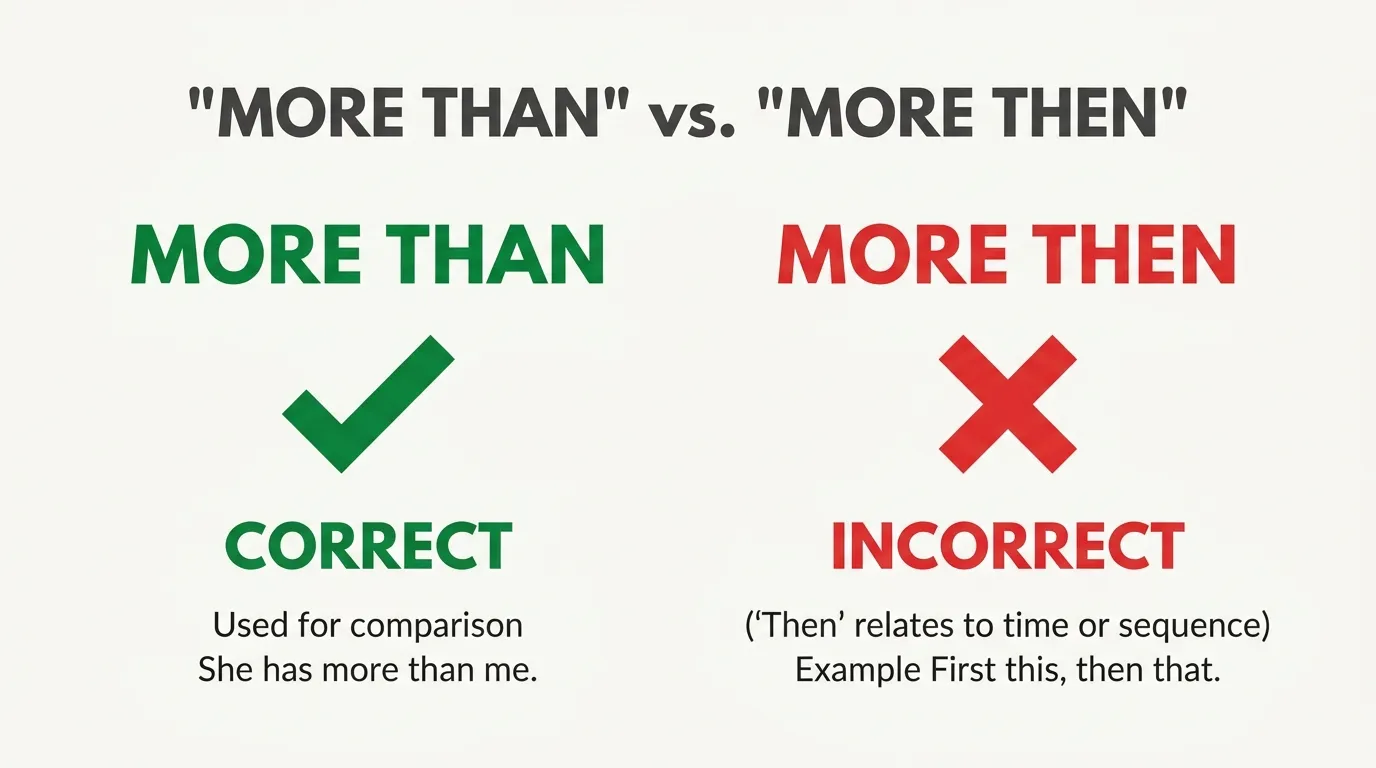
More than is the correct phrase for comparing amounts, sizes, or degrees. More then is almost always a typo.
Then belongs to time, order, and results. Than belongs to comparison. When “more” is part of a comparison, it needs than right after it.
Merriam-Webster lists than as a word for comparisons of inequality. It pairs with comparative words, as in “older than I am.” The word “more” is a comparative word, so it pairs with than too.
Then works in a different way. Merriam-Webster lists it as a word for “at that time,” “soon after,” and “in that case.” It answers the question “when?” or “what happens next?”
Table of Contents
- Did You Know?
- Quick Answer
- More Than or More Then: What’s the Difference?
- The Grammar Rule: Than Compares, Then Tells Time
- A Surprising Exception: When “More Then” Is Correct
- Memory Tricks
- 18 Example Sentences
- Common Mistakes
- More Than in Everyday Phrases
- Expert Tip
- Quick Quiz
- FAQs
- Conclusion and Key Takeaways
Did You Know? 🔍
Than and then started as the same word. Merriam-Webster traces both back to Middle English “than” and “then.” English later split the spellings, so one handles comparisons and the other handles time.
Quick Answer
More than is correct for comparisons, as in “She has more than me.” Then is for time, order, or results, as in “First stir, then pour.” Writing “more then” to compare is a mistake. The only time “more then” is right is when more ends one idea and then starts the next, like “Want more? Then ask.”
⚡ Quick Rule in 1 Line
Use “than” to compare and “then” for time. If yo
Here’s a quick side-by-side look.
| Word | Its job | Question it answers | Example |
|---|---|---|---|
| than | Compares two things | “Compared with what?” | “She is taller than her brother.” |
| then | Shows time, order, or result | “When?” or “What next?” | “Mix the flour, then add the eggs.” |
| more than | Compares amounts or degrees | “More compared with what?” | “I have more than enough.” |
| more, then | Two separate ideas | “More, and what happens next?” | “Take more, then stop.” |
The two words also sound a little different. Merriam-Webster gives than a short “a” sound and then a short “e” sound. In fast speech, an unstressed than can blur into a soft “thun,” and that’s why the mix-up happens so often in writing.
The Grammar Rule: Than Compares, Then Tells Time
Use than after a comparative word such as more, less, taller, or better. Use then for time, sequence, or a result, as in “If it rains, then we’ll stay in.” If you’re comparing, pick than. If you’re counting steps or moments, pick then.
Than is a small word with a big job. It introduces the second part of an unequal comparison. Grammarly gives the example “Amanda is shorter than Annabelle.” It also introduces the option you didn’t choose, as in “I’d rather walk than drive.”
ProWritingAid adds a handy hint. Comparative adjectives such as taller, stronger, and bigger are usually followed by than.
Then has several jobs of its own:
- Time: “We lived in Texas then.”
- Sequence: “She studied, and then she took a break.”
- Result: “If you study, then you’ll pass.”
- Noun: “Since then, things have changed.”
- Adjective: “The then mayor signed the bill.”
Merriam-Webster also records the noun and adjective uses. So then isn’t just an adverb. Still, in every case, it points to time or logic, never to a comparison.
A Surprising Exception: When “More Then” Is Correct
“More then” is correct only when more and then are separate words. More finishes one idea, and then starts the next, often after a comma or a pause. If you can place a comma between them, the sentence may be fine.
Here’s how it works. In “She asked for more, then left,” the word “more” is the thing she asked for. The word “then” starts a new action. They sit side by side by accident, not as a pair.
Look at these correct examples:
- “If you want more, then just ask.”
- “Take one more, then we’re done.”
- “She asked for more, then left the room.”
Now compare them with the mistake. In “I ate more then I planned,” the word “more” and the word “then” form a comparison. That needs than.
Try this quick test. Read the sentence aloud and pause between the words. If the pause sounds natural, you might have two separate ideas. If it sounds broken, you’re comparing, and you need than.
Another test comes from Proofed. If “at that time,” “next,” or “consequently” fits in place of the word, then is right. If none of them fit, you need than.
Memory Tricks
The easiest trick is to match the vowels. Than has an A, like “compare.” Then has an E, like “next.” ProWritingAid shares the A-for-comparison idea. Pick the trick below that works for you.
1. The A trick. Than has an A, and so does “compare.” If you’re comparing, use the A word.
2. The E trick. Then has an E, and so does “next.” If you mean the next moment or step, use the E word.
3. The swap trick. Replace the word with “next.” If the sentence still makes sense, write then. If not, write than.
4. The “subsequently” trick. ProWritingAid suggests testing with “subsequently.” If it fits, use then.
5. The “over” trick. In many number sentences, you can swap “more than” for “over.” “More than 20 people came” means “Over 20 people came.” If “over” fits, “more than” is right. This works often, but not always.
18 Example Sentences With More Than and More Then
Here are 18 sentences to study. Six use more than, three show other comparisons with than, four show then for time, three show the rare “more, then,” and two use both words. Read them aloud.
More than
- “She has more than ten years of experience.”
- “This phone costs more than that one.”
- “I like tea more than coffee.”
- “We need more than luck to win.”
- “He ran more than a mile before breakfast.”
- “Nothing matters more than your health.”
Other comparisons with than
- “My brother is taller than I am.”
- “I’d rather walk than drive.”
- “Everyone came, other than Sam.”
Then for time and results
- “Mix the flour, then add the eggs.”
- “We lived in Texas then.”
- “If you’re tired, then rest.”
- “Back then, phones had cords.”
The rare “more, then”
- “If you want more, then just ask.”
- “She asked for more, then left the room.”
- “Take one more, then we’re done.”
Both words together
- “First I ate more than I planned, then I felt sleepy.”
- “She finished earlier than expected, and then she went home.”
Common Mistakes With Than and Then
The most common mistakes are writing “more then” for a comparison, using then in “rather than,” and using than where a result is needed. Each one is easy to fix. Check this list before you hit send.
- ❌ I ate more then I planned. → ✅ I ate more than I planned.
- ❌ She is taller then me. → ✅ She is taller than me.
- ❌ We waited more then an hour. → ✅ We waited more than an hour.
- ❌ First mix the eggs, than add the flour. → ✅ First mix the eggs, then add the flour.
- ❌ If you study, than you’ll pass. → ✅ If you study, then you’ll pass.
- ❌ I’d rather stay home then go out. → ✅ I’d rather stay home than go out.
- ❌ Other then that, it was fine. → ✅ Other than that, it was fine.
Notice the pattern. Every fix follows one rule: comparison means than, and time or result means then.
More Than in Everyday Phrases
Many common phrases use more than. They all keep the same spelling, because each one still compares something. Learn the main ones once, and you’ll stop second-guessing them in speech and in writing.
| Phrase | Meaning | Example |
|---|---|---|
| more than enough | A bigger amount than needed | “We have more than enough food.” |
| no more than | Only, or at most | “It takes no more than five minutes.” |
| more often than not | Usually | “More often than not, the bus is late.” |
| more than a few | Quite a lot | “More than a few people agreed.” |
| more than anything | Above all else | “More than anything, I want to sleep.” |
| more than that | Beyond what was just said | “It’s cheap, and more than that, it works.” |
In each phrase, than stays. You never write “more then enough” or “no more then five minutes.”
Expert Tip 💡
When you proofread, search your document for “then.” For each one, ask: does it mean “next” or “in that case”? If it doesn’t, change it to than. This one habit catches nearly every mix-up.
Quick Quiz
Try these three, then check the answers below.
- “She is taller ____ her sister.” (than / then)
- “First stir the soup, ____ add the salt.” (than / then)
- “If you want more, ____ ask.” (than / then)
Answers: 1) than, because it’s a comparison. 2) then, because it’s the next step. 3) then, because it’s a result, and “more” stands alone before the comma.
FAQs
Is it more than or more then?
More than is correct for comparisons. More then is a typo in that case. It’s only correct when more and then are separate words, as in “If you want more, then ask.”
Is “more then” ever correct?
Yes, but rarely. It works when more ends one idea and then starts another, often after a comma. In “Take one more, then we’re done,” each word does its own job.
What’s the difference between than and then?
Than compares two things, as in “taller than me.” Then shows time, order, or a result, as in “First mix, then bake.” Merriam-Webster also lists then as a noun and an adjective.
How do I remember which one to use?
Match the A. Than has an A, like “compare.” Then has an E, like “next.” You can also swap in “next” or “in that case.” If it fits, write then.
Is it “rather than” or “rather then”?
It’s rather than. Merriam-Webster lists “rather than” as a use of than, especially after words like prefer. It introduces the option you didn’t choose, as in “I’d rather walk than drive.”
Is it “other than” or “other then”?
It’s other than. Merriam-Webster lists “other than” as a use of than. It means “except.” For example, “Everyone came, other than Sam.”
Is it “more than 20” or “more then 20”?
It’s “more than 20.” You’re comparing an amount to 20, so you need than. In many cases, you can swap in “over,” as in “over 20.”
Do than and then sound the same?
Not exactly. Merriam-Webster gives than a short “a” sound and then a short “e” sound. In fast speech, an unstressed than can blur, which is why the words get mixed up.
Why are than and then so easy to confuse?
They share a common origin. Merriam-Webster traces both to Middle English “than” and “then.” They look alike because they were once one word, and they still differ by one vowel.
Can then be an adjective?
Yes. In “the then mayor,” then means “at that time.” Merriam-Webster and Grammarly both list this use. It’s formal, so it shows up more in writing than in speech.
Conclusion
So, more then or more than? Use more than whenever you compare. Use then for time, order, or results. If “more” and “then” appear together by accident, as in “If you want more, then ask,” the sentence can be correct.
When you’re unsure, use two quick checks. Swap in “next.” If it fits, write then. If it doesn’t, write than. You can also read the sentence aloud and listen for a comparison.
With those checks, you’ll get this pair right every time. Keep the A-for-compare trick handy, and proofread any then you spot. It’s a small fix that makes your writing look sharper and more careful.

Hi, I’m Ethan Brooks. I create easy-to-follow grammar guides, writing tips, and vocabulary resources to make English learning enjoyable for everyone.