You’re typing a workout plan and write “stretch your calfs.” Something looks off.
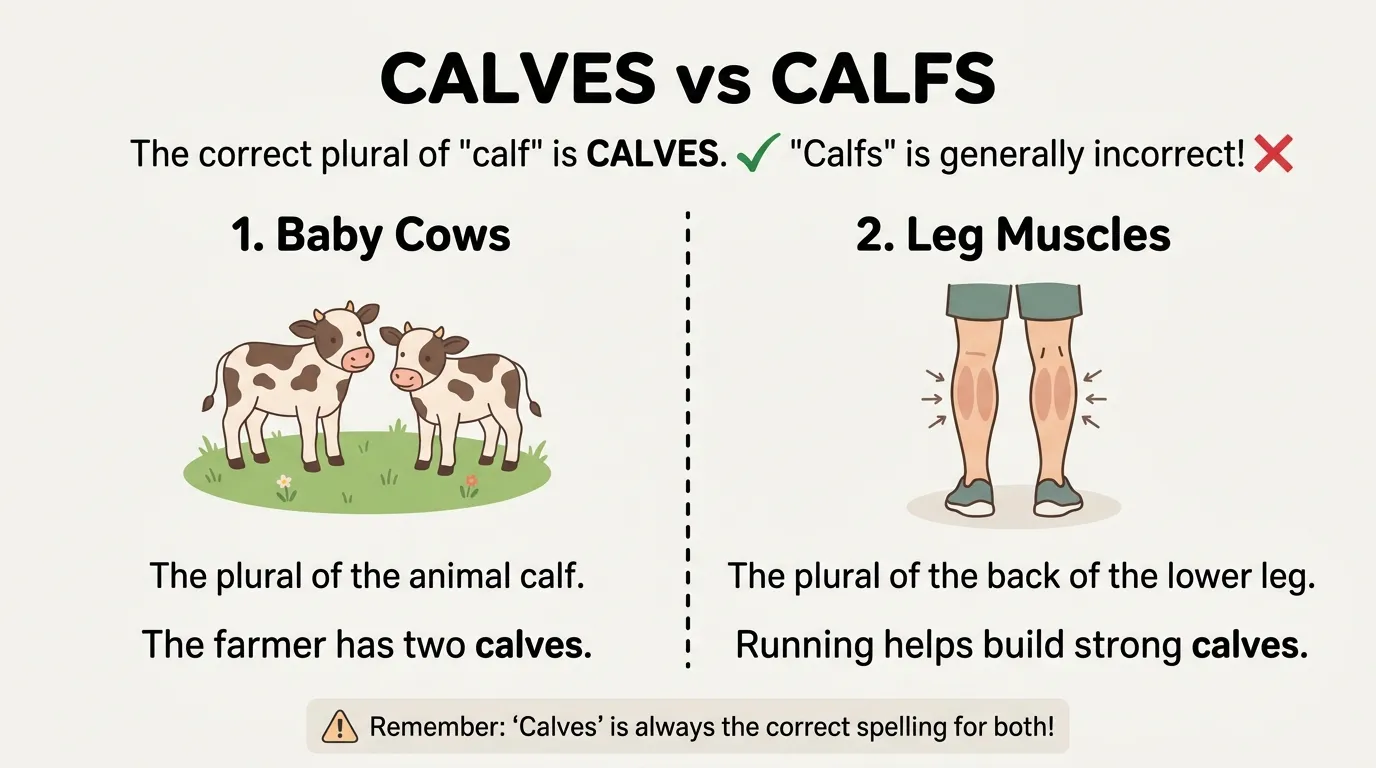
Here’s the answer: the plural of calf is calves, whether you mean baby cows or leg muscles.
Plenty of people pause on this one. After all, English usually just adds an S. Cat becomes cats. Dog becomes dogs. So why not calf and calfs?
The reason is an old spelling pattern, and it covers many words you already know. There’s also one small twist, which you won’t find in most quick guides. Some dictionaries list calfs for a very specific meaning.
Whether you write about farms, fitness, or fashion, this word shows up more than you’d expect. We’ll sort out when the twist matters, and how to remember it.
You’ll also get 20 examples and a short quiz.
Did You Know? 🔍
The two main meanings of calf have different roots. According to Merriam-Webster, the “young cow” meaning goes back to Old English cealf. The “back of the leg” meaning came into Middle English from a Norse source. Same spelling, two separate family trees.
Quick Answer
The correct plural of calf is calves. Use it for young cows, young whales or elephants, and the muscles behind your lower legs. Calfs is a nonstandard spelling. The only place a dictionary lists it is for calfskin leather, and even there calfskins is clearer.
⚡ Quick Rule in 1 Line
Calf drops the F and takes “-ves”: one calf, two calves, every single time you write it.
Calfs or Calves: Which Is Correct?
“Calves” is correct. Every major source we checked agrees it’s the standard plural of “calf” for animals and for leg muscles. “Calfs” shows up in speech and writing, but it’s treated as an error in almost every context.
Grammarly says calves is the better plural, “at least for now.” QuillBot and Grammar Monster both call calves the correct form. Even though people do write calfs now and then, it hasn’t taken over.
The rule applies no matter which meaning you have in mind:
- Baby cows → calves
- Baby whales, elephants, giraffes → calves
- Muscles at the back of your lower legs → calves
And the answer is the same in American and British English. There’s no US/UK split here. Dictionary.com lists calves for both American and British English.
The Three Meanings of Calf
“Calf” can mean a young animal, the fleshy back of your lower leg, or leather made from a young cow’s hide. The first two use the plural “calves.” The third can use “calfs” in some dictionaries, but it’s rare.
Here’s how Merriam-Webster sorts the word:
- A young animal. The young of the domestic cow, and of other large animals like the elephant or whale.
- Calfskin. The hide of a young cow, or leather made from it.
- The leg part. The fleshy back part of the leg below the knee.
Context usually makes the meaning clear. “The calves were born in spring” is about animals. “My calves ache after the hike” is about muscles. “The wallet is made of fine calf” is about leather.
You’ll notice something helpful. Two of these three meanings use calves with no dispute at all. That covers the vast majority of sentences you’ll ever write.
Why Calf Becomes Calves
Calf follows an old English pattern in which some words ending in “f” or “fe” change to “-ves” in the plural. There’s no clever rule for which words do this. You mostly have to learn them, like leaf/leaves and knife/knives.
Grammar Monster puts it plainly: there’s no clever way of knowing which “f” nouns follow which rules. You simply have to know. It gives a neat pair of examples. Gulf becomes gulfs, but calf becomes calves.
So there are two groups.
Group 1: F changes to V (the “-ves” group). This includes calf, elf, leaf, thief, knife, half, wolf, shelf, and loaf.
Group 2: just add S. This includes chief, belief, sheriff, roof, and gulf.
Calf lives in Group 1. Once you see it beside leaf and shelf, it feels far less strange.
A few words can go either way. For example, hoof can be hoofs or hooves. Scarf can be scarfs or scarves. That’s probably why people wonder whether calf might too. Mainstream dictionaries, though, give calves as the standard form.
Comparison Table: Plurals Ending in F
This table puts calf beside other “f” words so you can see the pattern. Words in the first group change F to V. Words in the second group simply add S. A few words accept both forms.
| Singular | Plural | Group |
|---|---|---|
| calf | calves | F → V |
| leaf | leaves | F → V |
| shelf | shelves | F → V |
| thief | thieves | F → V |
| wolf | wolves | F → V |
| knife | knives | F → V |
| half | halves | F → V |
| chief | chiefs | Add S |
| belief | beliefs | Add S |
| roof | roofs | Add S |
| gulf | gulfs | Add S |
| hoof | hoofs or hooves | Both |
| scarf | scarfs or scarves | Both |
Think of the top group as “friends of calf.” If you know leaves and shelves, you already know the pattern.
Is “Calfs” Ever Correct?
Only narrowly. Merriam-Webster lists “calfs” as the plural for the calfskin sense, meaning the hide of a young cow. For animals and leg muscles, “calfs” is considered incorrect. When in doubt, use “calves” or write “calfskins.”
This is the honest, slightly messy part. Here’s what the sources say:
- Merriam-Webster lists calfs under the calfskin meaning, and also notes it as a variant of calves.
- YourDictionary says some dictionaries accept calfs, especially for calfskins. It also notes calfs is accepted in word games.
- QuillBot says calfs is never the correct plural for the animal or the muscle. It mentions the Merriam-Webster hide listing as a rare variant.
- Grammarly shows that calfs does appear in real writing, but calves is still the main plural.
So, is the question settled? Mostly. For nearly every sentence, use calves.
If you’re writing about leather goods, you have a simple workaround. Write “calfskins” or “calfskin hides.” That avoids the whole debate and still reads naturally.
Writing Explained reports that calfs in books since 1800 is so rare it approaches zero on a usage chart. That’s a useful signal. It means readers will probably see calfs as a typo.
Calves the Noun vs. Calves the Verb
“Calves” is also a verb. It’s the third-person singular form of “calve,” which means to give birth to a calf, or for a glacier to break off ice. So “the cow calves” and “the cows’ calves” use the same spelling for different jobs.
Dictionary.com lists both uses. Here’s how they differ:
- Noun: The two calves stood near the fence.
- Verb: The cow calves in early spring.
- Verb (ice): A glacier calves when a chunk of ice breaks off.
QuillBot’s article gives the glacier example, too. It’s a handy reminder that calves has more than one job. If someone writes “calfs” for the verb, that’s still wrong. The verb form is calves as well.
How to Say and Remember Calves
Say “calves” like “kavz,” with a silent L. For memory, link it to “V” words. Calves shares a V with “victory,” and it matches leaf/leaves and half/halves. Victory over the “calfs” mistake starts with a V.
Pronunciation. Dictionary.com shows calves as “kavz” (or “kahvz”). The L is silent, just like in half and walk.
Memory tricks:
- The victory trick. Calves has a V, like victory. Writing Explained suggests it: victory over the misspelling comes from using calves.
- The leaf trick. Leaf turns into leaves. So calf turns into calves.
- The half trick. You wouldn’t say “two halfs.” You’d say “two halves.” Calf works the same way.
- The sound trick. You say “kavz,” not “kafs.” If you hear a V, write a V.
Pick the one that sticks. For most learners, the sound trick works fastest.
Calf’s vs. Calves’: Possessives
Use “calf’s” for something that belongs to one calf, and “calves'” for something that belongs to several. The apostrophe goes after the S in the plural: “the calves’ pen.” Never write “calfs'” or “calves’s.”
Possessives add a second layer, so here’s a clean guide:
| Meaning | Correct form | Example |
|---|---|---|
| One calf owns it | calf’s | The calf’s mother was nearby. |
| Several calves own it | calves’ | The calves’ barn is warm. |
| Plain plural | calves | The calves are sleeping. |
Notice that “calf’s” is not a plural. The apostrophe shows ownership. If you only mean more than one animal, skip the apostrophe entirely.
20 Real Example Sentences
These 20 sentences show calves for animals, muscles, and verbs, plus the narrow calfskin case. Read a few aloud and say “kavz” each time. It helps lock in the spelling.
Calves as young animals (8)
- The farmer fed the calves twice a day.
- Several calves were born in April.
- Humpback whale calves stay close to their mothers.
- Elephant calves can walk soon after birth.
- The rancher sold twelve calves at the fair.
- Giraffe calves are tall at birth.
- The calves drank warm milk from large buckets.
- Wild bison calves hide in tall grass.
Calves as leg muscles (7)
- Hiking uphill made my calves sore.
- Runners often stretch their calves before a race.
- She wore boots that reached her calves.
- Strong calves help you jump higher.
- He felt a cramp in both calves last night.
- The trainer showed us how to build stronger calves.
- Her socks stopped just below her calves.
The Calves as a verb, and calfskin (5)
- The cow calves every spring.
- The glacier calves into the sea each summer.
- The shop sells wallets made from fine calfskin.
- The tannery bought three calfskins this week. (clear and safe)
- Some dictionaries list calfs for hides, but calfskins is easier to read.
Common Mistakes
The most common error is simply adding S to “calf.” Other slips include a doubled V or a wrong apostrophe. These examples show the mistake and the correct form side by side.
❌ The calfs were playing in the field. ✅ The calves were playing in the field.
❌ I need to stretch my calfs. ✅ I need to stretch my calves.
Both calfs’ feet hurt. (wrong apostrophe) ✅ Both calves’ feet hurt.
❌ The glacier calfs every year. ✅ The glacier calves every year.
❌ Two calf were in the barn. ✅ Two calves were in the barn.
The calve’s mother was close. ✅ The calf’s mother was close.
Notice the last one. “Calve” is a verb, not a noun. Don’t turn it into a singular animal.
When to Use Each Form
Use “calf” for one animal or one leg muscle. Use “calves” for more than one, and for the verb.
The Use “calfskin” or “calfskins” for leather. That single habit avoids nearly every confusion with this word.
- One young animal → calf
- Two or more young animals → calves
- One lower leg muscle → calf
- Both lower leg muscles → calves
- Leather from a young cow → calfskin (plural: calfskins)
- Giving birth or ice breaking off → calves (verb, “she calves”)
Following these rules means you never need to type calfs at all.
Expert Tip 💡
Write “calfskin” instead of a bare “calf” or “calfs” for leather. Product descriptions, fashion writing, and craft blogs often use the leather meaning. Using “calfskin” avoids any argument about the plural. It’s also clearer for shoppers who might otherwise picture an animal. For fitness writing, remember that calves covers both muscles at once. You rarely need to say “calf muscles” unless you want extra clarity.
Common Misconception
Myth: “Calves is for animals, and calfs is for the muscle (or the other way around).”
Reality: This idea shows up online, but it isn’t true. YourDictionary points out that calves is the plural for all meanings, whether you’re talking about the baby cow or the leg. The only dictionary-listed exception is calfskin, which is a different sense entirely.
FAQs
1. What is the plural of calf?
The plural of calf is calves. This works for baby animals and for leg muscles. It’s the standard form in American and British English.
2. Is “calfs” a real word?
It appears in some dictionaries, mainly for calfskin hides. For young animals and leg muscles, it’s treated as an error. Most readers will see calfs as a typo.
3. Is it “calves” or “calfs” for leg muscles?
Use calves. “My calves are sore” is correct. Some people believe the muscle takes a different plural, but sources like YourDictionary say that’s a myth.
4. Why isn’t the plural “calfs” like “chiefs”?
English has two patterns for words ending in F. Some add S (chiefs, roofs). Others change to -ves (leaves, calves). You just have to learn which is which.
5. How do you pronounce calves?
Say “kavz,” with a silent L. Dictionary.com shows both “kavz” and “kahvz” for American speakers.
6. Is calves also a verb?
Yes. It’s the third-person form of calve: “The cow calves in spring.” A glacier can also calve when ice breaks off.
7. What’s the plural of calfskin?
Write calfskins. Merriam-Webster lists calfs for the hide meaning, but calfskins avoids confusion. It’s the clearest choice for most writers.
8. Is it calf’s or calves’ for possessives?
Use calf’s for one calf and calves’ for several. The apostrophe signals ownership, so don’t add it to a plain plural.
9. Which other words follow the calf pattern?
Leaf/leaves, shelf/shelves, thief/thieves, wolf/wolves, knife/knives, and half/halves all change F to V. Words like chief, roof, and belief just add S.
10. Is calfs OK in word games?
Some word-game dictionaries accept it, according to YourDictionary. That doesn’t make it standard in everyday writing. Use calves in school, work, and publishing.
Conclusion
So, calfs or calves? Use calves. It’s the standard plural for baby cows, young whales and elephants, and the muscles at the back of your lower legs.
It works the same in American and British English.
The only narrow exception is calfskin. Some dictionaries list calfs for the hide, but writing calfskins removes any doubt.
For everything else, the pattern is the same one you already use for leaf and leaves.
If you forget, say the word aloud. You hear a V, so write a V.
Or think of victory. Either way, you’ll never need to type calfs again. Keep this page nearby for the next time a plural makes you pause.

Hi, I’m Ethan Brooks. I create easy-to-follow grammar guides, writing tips, and vocabulary resources to make English learning enjoyable for everyone.