You text “Were are you?” and your friend answers with a grinning emoji.
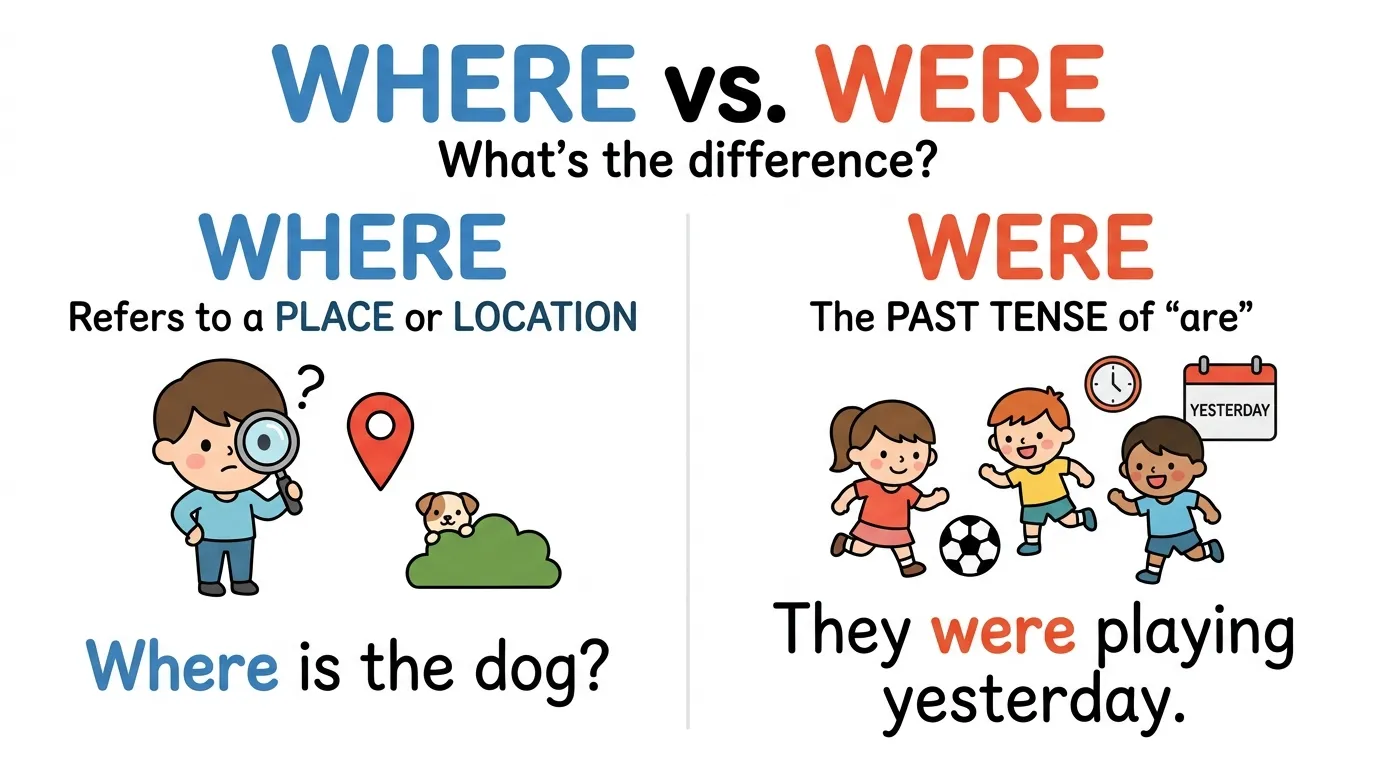
Here’s the fix: where points to a place, and were is the past tense of “be.”
It’s a tiny typo, but almost everyone makes it. The two words look alike. They share most of their letters. Your fingers type one while your brain means the other.
The good news? The difference is easy once you see it. Where answers “which place?” Were tells you what existed or happened earlier.
In this guide, you’ll get the rule, a quick test, and memory tricks. You’ll also see 20 examples, common mistakes, and a short quiz.
By the end, where or were won’t slow you down again. Whether you’re writing a text, an essay, or a work email, getting it right makes you look sharp.
Did You Know? 🔍
Traditional grammar says to write “If I were you,” not “If I was you.” But a usage guide from Washington State University points out that “was” is far more common in everyday speech. So the old rule is still taught, yet real speakers often ignore it.
Quick Answer
Use where to talk about a place or position: “Where is the library?” Use were as the past tense of “be” with you, we, they, and plural nouns: “They were late.” If you can swap in “place,” choose where. If it’s a past-tense verb, choose were.
⚡ Quick Rule in 1 Line
Where means a place, were means the past — and only where wears the extra H.
What Is the Difference Between Where and Were?
Where is an adverb or conjunction that deals with place. Were is a verb, the past tense of “be.”
They have different jobs, different meanings, and different sounds. The only real link is that they look similar on the page and in a hurry.
Think of it like this. Where is a pointer. It points to a spot, a point in a process, or a situation. Were is an action-and-state word. It says that someone or something existed or was in a condition before now.
Most American speakers say them differently, too. Where rhymes with “air.” Were rhymes with “fur.” If you read your sentence out loud, your ear can often catch the error before your eyes do.
Here’s a quick test you can use anywhere. Ask yourself, “Does this word talk about a place or point?” If yes, it’s where. Then ask, “Is this a past-tense verb?” If yes, it’s were.
What Does “Where” Mean?
“Where” means “in, at, or to what place.” It works as a question word (“Where is my phone?”) and as a connecting word inside a sentence (“I know where it is”). It can also point to a stage or situation, not just a physical spot.
Most of the time, where is about location. “Where do you live?” asks for a place. “That’s where I left my keys” points to one.
But where can be less literal. Take this sentence: “He pushed me to the point where I left the room.” Nobody’s talking about a map here. The word marks a moment in a process. ProWritingAid points out this same use.
You’ll see where in three common spots:
- Questions: Where are you going?
- Statements: This is where we met.
- Embedded questions: Can you tell me where the bank is?
Notice that where never needs a subject-verb match. It doesn’t change form. It stays where every time.
What Does “Were” Mean?
“Were” is a past-tense form of the verb “be.” Use it with you, we, they, and plural nouns. It describes a state or condition that existed in the past. It also appears in the subjunctive mood, as in “If I were you.”
Merriam-Webster lists were as the past second-person singular, past plural, or past subjunctive of “be.” That sounds heavy, but it’s simple in practice.
- You were right.
- We were tired.
- They were in the garden.
- The books were on the table.
Were also starts yes/no questions: “Were you at the party?” Here, were is still a verb. It’s just standing at the front of the question.
One more thing. Were never asks about a place. If you want to ask about a place, you need the other word. That’s why “Where were you?” uses both. The first word asks about location. The second tells us it’s in the past.
Where vs Were: Comparison Table
The table below shows the difference at a glance: part of speech, meaning, sound, and a sample sentence for each word. Bookmark it for quick checks while you write or proofread.
| Feature | Where | Were |
|---|---|---|
| Part of speech | Adverb, conjunction | Verb |
| Core meaning | In or to what place | Past tense of “be” |
| Used with | Questions about place; clauses | You, we, they, plural nouns |
| Changes form? | No | Yes (is/are/was/were) |
| US sound (rhymes with) | “air” | “fur” |
| Swap test | Try “place” or “here/there” | Try “are” in the present |
| Example | Where is the station? | They were at the station. |
| Common error | Typing were for a place | Typing where for a verb |
A handy swap test: change the sentence to present tense. If were becomes are, you’ve got the verb. “They were happy” turns into “They are happy.” That works. But “Were is the station?” can’t become “Are is the station?” So the sentence needs where.
Which Subjects Take “Were”?
Use “were” with you, we, they, and any plural subject. Use “was” with I, he, she, it, and singular subjects. The one big exception is the subjunctive, where “were” can join singular subjects like “I” or “she.”
Here’s a simple chart for the past tense of “be.”
| Subject | Past Tense | Example |
|---|---|---|
| I | was | I was home. |
| You | were | You were kind. |
| He / She / It | was | She was early. |
| We | were | We were lost. |
| They | were | They were loud. |
| Plural nouns | were | The kids were asleep. |
Singular “you” matters here. English uses were even when you’re talking to one person. “You were great” is correct whether you mean one person or ten.
Some writers slip into “they was” or “we was” in casual talk. In school, work, and published writing, stick with were.
“If I Were” or “If I Was”?
Use “if I were” when you describe something unreal, unlikely, or wished for. Use “if I was” for a past possibility that could be true. Careful writers choose “were” in the first case. Everyday speech often uses “was” anyway.
This is where the rule gets tricky, and it’s worth being honest about. The subjunctive mood is the reason were shows up with “I.” Merriam-Webster notes that this form is triggered by words like wish, if, and as if. Yet even good writers sometimes use “was” instead.
Here’s the clean version:
- Unreal or imagined: If I were you, I’d call her back.
- Wished for: I wish she were here.
- Possible past fact: If I was rude last night, I’m sorry.
In that last sentence, you honestly don’t know if you were rude. It might be true. So the plain past tense fits.
For tests, essays, and formal writing, follow the traditional rule. For casual chats, “if I was” won’t confuse anyone. Some usage experts even call the subjunctive weak and shrinking in English. Still, it’s a good habit to know the rule so you can choose on purpose.
Easy Memory Tricks
The easiest trick is that “where” hides the word “here” inside it. “Here,” “there,” and “where” are all place words. “Were” has no H, and it often follows “we” — as in “we were.”
Try these three:
- The “here” trick. W-here contains here. Place words travel together: here, there, where.
- The “we” trick. Were starts with we. That reminds you of “we were.”
- The read-aloud trick. Say the sentence slowly. Where sounds like “air.” Were sounds like “fur.” If your sentence sounds odd, you may have swapped them.
A fourth trick helps with speed. When you finish writing, search your draft for “were.” Check that each one is a verb. Then search for “where.” Check that each one points to a place.
20 Real Example Sentences
Here are 20 examples, split by word. Notice how each where points to a place or point, while each were acts like a past-tense verb. Read them aloud once to train your ear.
Sentences with “Where” (10)
- Where did you park the car?
- I don’t know where my glasses are.
- This is where my grandmother grew up.
- Where can I find a good pizza place?
- She asked where the meeting would be.
- Go where the signal is stronger.
- Where there’s smoke, there’s often fire.
- That’s the park where we first met.
- He reached the point where he couldn’t go on.
- Where are you from?
Sentences with “Were” (10)
- We were so happy to see you.
- They were waiting outside the school.
- You were the first person to arrive.
- The roads were icy this morning.
- Were you at the concert last night?
- My parents were born in Texas.
- The cookies were gone by noon.
- If I were you, I’d study tonight.
- I wish it were Friday already.
- Were they ready for the test?
The Sentences with both words
- Where were you yesterday afternoon?
- I asked where the keys were.
- That’s where we were standing.
Common Mistakes
Most errors happen when a typing slip turns “where” into “were,” or the reverse. Spell-check won’t catch them, because both are real words. Here are the mistakes you’ll see most often, with quick fixes.
❌ Were are you going? ✅ Where are you going?
❌ I don’t know were the party is. ✅ I don’t know where the party is.
❌ Where you at home last night? ✅ Were you at home last night?
❌ The students where very quiet. ✅ The students were very quiet.
❌ Were is the nearest bus stop? ✅ Where is the nearest bus stop?
❌ They was at the mall. ✅ They were at the mall.
❌ If I was you, I’d leave now. (formal writing) ✅ If I were you, I’d leave now.
The pattern is clear. If a sentence asks about a place, you need where. If a past-tense verb is missing, you need were.
Where vs Were vs We’re
“We’re” is a contraction of “we are.” It’s pronounced like “weer,” and it’s a third lookalike that causes trouble. Use “we’re” only when “we are” fits the sentence. Otherwise, choose “where” or “were.”
Dictionary.com notes that we’re is a contraction of we are. So it can join the confusion, especially in fast typing.
| Word | Meaning | Test | Example |
|---|---|---|---|
| where | place | Can you say “place”? | Where is the exit? |
| were | past of “be” | Does it work as “are”? | They were late. |
| we’re | we are | Does “we are” fit? | We’re almost there. |
Quick check: replace the word with “we are.” If the sentence still makes sense, write we’re. “We’re going home” becomes “We are going home.” That works. “We were going home” becomes “We are going home.” That changes the tense, so were is the right choice instead.
When to Use Each Form
Choose “where” for places, points, and situations. Choose “were” for past states with you, we, they, and plurals, or for unreal wishes. If a sentence needs both, put “where” first when you’re asking about a place.
- Use where when you ask about a location, point to a place, or mark a stage in a process.
- Use were when you describe the past with you, we, they, or plural nouns.
- Use were for wishes and unreal ideas: “I wish I were taller.”
- Use both in questions like “Where were they?” The first word is the place; the second is the past.
If you still hesitate, rewrite the sentence in the present tense. That small trick reveals the verb every time.
Expert Tip 💡
Proofread by searching, not just by reading. Spell-checkers treat where and were as perfectly fine words, so they stay silent. Use your editor’s Find tool. Search for “were” and ask, “Is this a verb?” Then search for “where” and ask, “Is this a place or point?” This takes about 60 seconds and catches the error that most readers notice first. Professionals in editing roles often do the same for other commonly confused pairs, such as its and it’s.
Quick Quiz
Pick the correct word. Answers are below.
- ______ did you put my book?
- The boys ______ playing soccer yesterday.
- If she ______ my sister, she’d understand.
Answers: 1. Where. 2. were. 3. were (unreal situation, so the subjunctive fits).
FAQs
1. What is the difference between where and were?
Where refers to a place or point. Were is the past tense of “be” with you, we, they, and plurals. One answers “which place?” The other describes the past.
2. Is it “where were you” or “were were you”?
It’s “Where were you?” The first word asks about place. The second is the past-tense verb. “Were were you” is never correct.
3. Are where and were homophones?
No. Most American speakers say where like “air” and were like “fur.” They only look alike on the page, which is why typos happen so often.
4. Can “were” ever start a question?
Yes. “Were you at the park?” is a yes/no question. But were isn’t a question word about place. For location, use where.
5. Is it “if I were” or “if I was”?
Use “if I were” for unreal or wished-for ideas: “If I were taller, I’d play basketball.” Use “if I was” for a real past possibility: “If I was late, I apologize.”
6. Does “were” go with “I”?
Only in the subjunctive, such as “I wish I were there.” In normal past tense, say “I was.”
7. What’s the difference between were and we’re?
We’re means “we are.” Were is the past tense of “be.” Try replacing the word with “we are.” If it fits, use we’re.
8. Can “where” start a sentence?
Yes. “Where is the nearest hospital?” is correct. It’s a standard question opener.
9. Why doesn’t spell-check catch where and were mistakes?
Both are real English words. Spell-check only flags non-words, so it can’t tell which one you meant. Proofread by hand.
10. What’s the fastest way to remember the difference?
Remember that where contains here, and place words go together: here, there, where. Were is the verb that likes we.
Conclusion
Where or were? Now you know. Choose where when you mean a place, a point, or a situation.
Choose were when you need the past tense of “be” with you, we, they, or plural nouns. Save “if I were” for unreal or wished-for ideas.
If you’re ever unsure, try three quick checks. Say the sentence out loud. Swap in the word “place.” Or switch the sentence to the present tense and see if were becomes are.
These small habits catch almost every mistake.
Both words are tiny. Both are common. With the tricks above, you can use them with confidence in texts, emails, essays, and reports.
Keep this page handy, and the next “Were are you?” will never leave your keyboard.

Hi, I’m Sophia Bennett. My goal is to make grammar easy, clear, and useful through simple explanations and real-life examples.