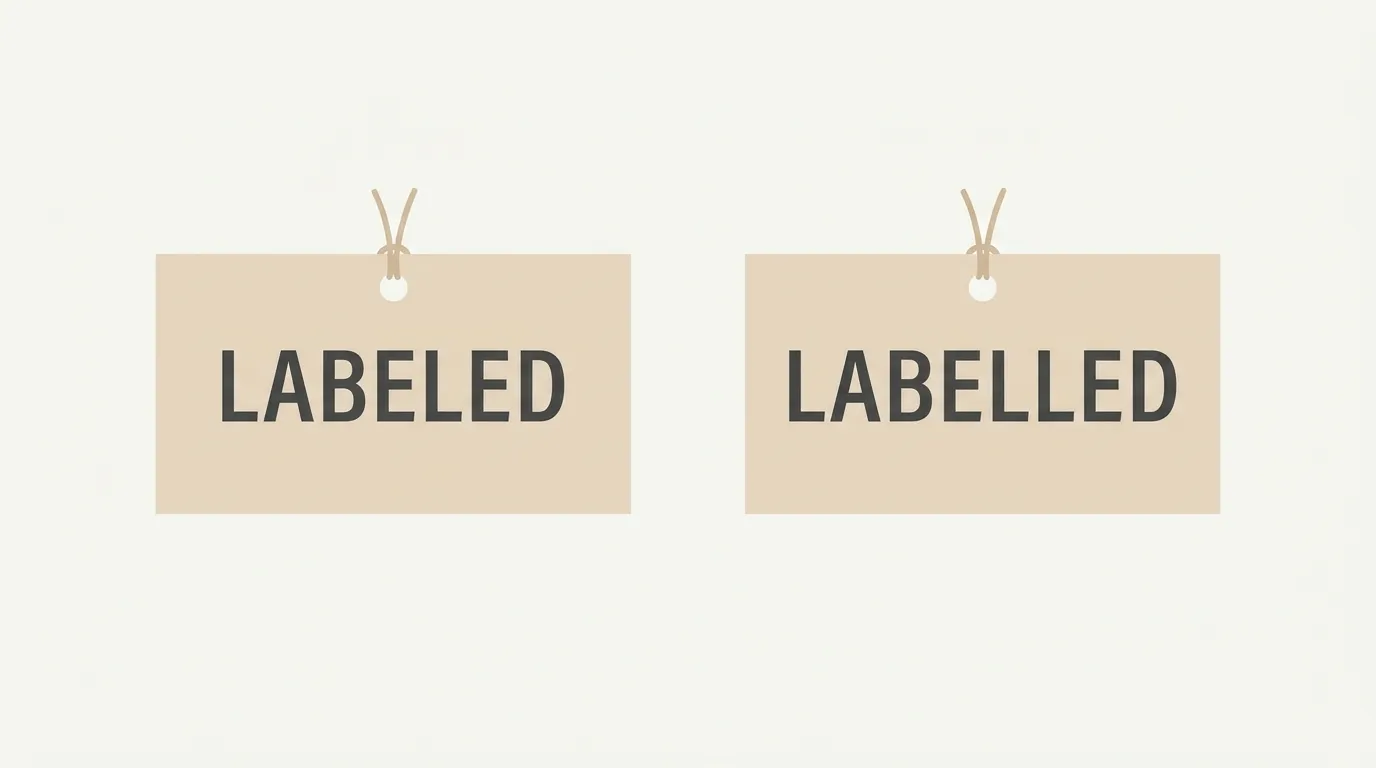
You type “labelled” in your report, and the spellchecker underlines it in red. Both spellings are correct: labeled is American English, and labelled is British English.
The meaning is exactly the same. Only the spelling changes, and it depends on where your readers live. The same split covers labeling and labelling.
You may have seen both on the same day. A US food package says “labeled,” while a UK shop sign says “labelled.” Neither one is wrong. Spellcheckers add to the confusion, because each one follows just one dialect at a time.
Even so, mixing them inside one document looks sloppy. This guide gives you the simple rule, a memory trick, 18 examples, and a quick way to pick the right spelling every time.
Labeled vs Labelled: What’s the Difference?
There’s no difference in meaning. Labeled is the standard American spelling, and labelled is the standard British spelling. Both are past tense forms of the verb “label,” which means to attach a tag or to describe something with a word.
Merriam-Webster lists both forms for the past tense and for the -ing form: “labeled or labelled” and “labeling or labelling.” The noun, “label,” never changes.
Table of Contents
- Did You Know?
- Quick Answer
- Labeled vs Labelled: What’s the Difference?
- Which Spelling Should You Use?
- Why Do Americans Use One L? The Grammar Rule
- Memory Trick
- 18 Example Sentences
- Labeling and Labelling: Two Meanings, One Rule
- Labeled or Labelled in Real-Life Writing
- Common Mistakes
- Expert Tip
- Common Misconception
- FAQs
- Conclusion and Key Takeaways
Did You Know? 🔍
Merriam-Webster is an American dictionary, yet it lists both spellings for the verb: “labeled or labelled.” It doesn’t mark either one as preferred. So labelled isn’t an error in American dictionaries. It’s a recognized variant.
Quick Answer
Both are correct. Labeled (one L) is the standard American spelling. Labelled (two Ls) is the standard British spelling, and Canadian and Australian writers often use it too. The same split applies to labeling and labelling. The base word, “label,” always ends in one L.
⚡ Quick Rule in 1 Line
American English keeps one L. British English doubles it. Match your spelling to your readers.
So you’re choosing between two dialects, not between right and wrong. Here’s the full pattern.
| Word form | American English | British English |
|---|---|---|
| Noun | label | label |
| Base verb | label | label |
| Past tense | labeled | labelled |
| -ing form | labeling | labelling |
| With “mis-” | mislabeled | mislabelled |
| With “un-” | unlabeled | unlabelled |
Here’s a quick habit. Add -ed or -ing and look at the result. One L means American English. Two Ls means British English.
Which Spelling Should You Use?
Use labeled if your readers are in the United States. Use labelled if they’re in the United Kingdom, and in most cases for Canada and Australia too. When you’re not sure, follow your style guide, and then stay consistent through the whole document.
Grammarly says labeled is preferred in American English and labelled is preferred in British English. It adds that labelled is also more common in places such as Canada. Proofed says British and Australian English use the double L.
| Audience | Spelling | Example |
|---|---|---|
| United States | labeled, labeling | “The jars were labeled.” |
| United Kingdom | labelled, labelling | “The jars were labelled.” |
| Canada | usually labelled, labelling | “The jars were labelled.” |
| Australia | usually labelled, labelling | “The jars were labelled.” |
| Mixed or global readers | pick one and stay consistent | “The jars were labeled.” |
Canada and Australia aren’t perfectly uniform. So check any style guide that your school, employer, or publisher uses.
Why Do Americans Use One L? The Grammar Rule
Both varieties usually double a final consonant when the stress falls on the syllable that takes the ending. Label is stressed on its first syllable, so American English keeps one L. British English doubles the L anyway.
Merriam-Webster explains the shared rule. If the stress isn’t on the syllable that takes the suffix, the final consonant isn’t doubled. “Edit” and “edited” are an example.
Now take “refer.” The stress is on the last syllable, so both varieties write “referred.” But “label” is stressed on the first syllable: LA-bel. In American English, that gives you “labeled.”
Proofed notes that British and Australian English double the final L before a vowel ending, even when the stress isn’t on the last syllable. That’s why “labelled” has two Ls.
You may wonder who decided this. Merriam-Webster says some blame and credit go to Noah Webster. But it adds that his dictionaries mostly recorded variants that already existed. His 1806 dictionary lists “cancelled,” and his 1828 dictionary lists “canceled.” The cancel pair follows the same pattern as label.
Memory Trick
Two Ls for the UK. Picture a British double-decker bus: two floors, two Ls. American English keeps things short, with one L. If you know which side of the Atlantic you’re writing for, you’ll know the spelling.
Here’s a second trick for the base word. Label always ends in one L, never “lable.” Proofed says the wrong spelling likely comes from the rhyme with “table” and “cable.”
Say the letters in order: L-A-B-E-L. The B comes before the E, and the E comes before the final L.
18 Example Sentences With Labeled and Labelled
Here are 18 sentences to copy and adapt. Six use American spelling, six use British spelling, and six show forms that never change. Notice how only the ending shifts.
American spelling (one L)
- “The teacher labeled every desk with a name.”
- “She labeled the boxes before the movers arrived.”
- “Our team is labeling the survey data today.”
- “The jar was labeled as organic honey.”
- “He felt unfairly labeled by his old coach.”
- “The store pulled the mislabeled cans from the shelf.”
British spelling (two Ls)
- “The teacher labelled every desk with a name.”
- “She labelled the boxes before the removal van arrived.”
- “Our team is labelling the survey data today.”
- “The jar was labelled as organic honey.”
- “He felt unfairly labelled by his old coach.”
- “The shop pulled the mislabelled tins from the shelf.”
Forms that stay the same everywhere
- “Please read the label before you cook.”
- “The label on the bottle was torn.”
- “Add a label to each folder.”
- “I’ll label the files tonight.”
- “They label every shelf by hand.”
- “Labels help us stay organized.”
Labeling and Labelling: Two Meanings, One Rule
Labeling and labelling follow the same split: one L in American English, two in British English. The word has two main meanings. One is attaching a tag to something. The other is describing a person or thing with a single word.
The first meaning is practical. You label a jar, a folder, or a data chart.
The second meaning is about people. When someone is labeled “lazy” or “shy,” one word has been stuck on them. That kind of labeling can feel unfair, since one word rarely describes a whole person.
In both cases, the spelling rule is identical. Choose labeling or labelling based on your readers.
Labeled or Labelled in Real-Life Writing
Follow your reader first, then your rule book. School essays, business emails, product pages, and research papers each have a likely audience. Pick the spelling that matches it, and stick with it from the first page to the last.
Here’s how that looks in practice.
- Schoolwork: Use the spelling your teacher or school expects. If the assignment doesn’t say, ask.
- Business emails and websites: Match your main market. A US online store would write “labeled,” and a UK shop would write “labelled.”
- Academic papers: Follow the journal’s or university’s author guidelines. They usually name one variety of English.
- Product packaging and data labels: Use the spelling of the country where the product is sold.
- Blogs with global readers: Pick one spelling, and keep it the same on every page of the site.
Don’t switch just because a tool suggests a change. First check which language your spellchecker is set to. A red underline often means the setting is wrong, not the writing.
Common Mistakes With Labeled and Labelled
Most mistakes come from three things: spelling “lable,” mixing American and British forms, and using the wrong form for your audience. Each one is easy to spot. Review this list before you publish.
- ❌ Please lable the boxes. → ✅ Please label the boxes.
- ❌ The cans were mislabled. → ✅ The cans were mislabeled (US) or mislabelled (UK).
- ❌ The jars were labeld. → ✅ The jars were labeled (US) or labelled (UK).
- ❌ He labeled the files and was labelling the folders. → ✅ He labeled the files and was labeling the folders.
- ⚠️ For a US audience: “All products are labelled with ingredients.” → ✅ “All products are labeled with ingredients.”
- ⚠️ For a UK audience: “The diagram was labeled.” → ✅ “The diagram was labelled.”
The last two aren’t true errors. Labelled isn’t wrong in the US, and labeled isn’t wrong in the UK. They just don’t match the audience. Grammarly notes that labeled is the preferred American form.
Expert Tip 💡
Set your word processor’s proofing language to English (US) or English (UK) before you write. Then, before publishing, search your document for “labell” and “labele.” That quick check catches any mixed forms.
Common Misconception
Myth: Labelled is a typo in American English.
Fact: Labelled is the standard British spelling. Merriam-Webster lists it right beside labeled. It’s a variant, not a typo. It just isn’t the usual American choice.
FAQs
Is it labeled or labelled?
Both are correct. Labeled is the standard American spelling, and labelled is the standard British spelling. Pick the one that matches your readers, then use it everywhere in the same document.
Is labelled wrong in American English?
Not exactly. Merriam-Webster lists “labeled or labelled” as equal variants. Still, Grammarly says labeled is the preferred American spelling, so it’s the safer choice for a US audience.
Is labeling spelled with one or two Ls?
Both. Labeling (one L) is American, and labelling (two Ls) is British. It follows the same rule as labeled and labelled, so use whichever matches your audience.
Is “lable” a word?
No. The noun and base verb are always spelled “label,” with one L at the end. Proofed notes that “lable” is always an error, probably because of the rhyme with “table” and “cable.”
Which spelling do Canada and Australia use?
Writers there usually follow the British form, labelled. Grammarly says labelled is more common in places such as Canada, and Proofed says British and Australian English use the double L. Check any local style guide.
Does the noun “label” ever change?
No. As a noun, it’s “label” in every variety of English. The spelling split only appears when you add an ending such as -ed or -ing.
Can I use both spellings in one document?
It’s better not to. Both are correct, but mixing them looks inconsistent. Pick one spelling for your audience and apply it everywhere, including words like mislabeled and unlabeled.
Does the same rule apply to canceled and cancelled?
Yes. Merriam-Webster says canceled and canceling are more common in the US, while cancelled and cancelling are more common in British English. The same one-L, two-L split applies.
How do I make my spellchecker use the right spelling?
Set the language to English (US) or English (UK) in your word processor or editor. The tool will then flag the form that doesn’t match your audience.
Conclusion
So, labeled or labelled? Both are correct. Choose labeled and labeling for American readers, and labelled and labelling for British readers. Canadian and Australian readers usually expect two Ls too.
The noun and base verb stay “label” everywhere, with one L. Once you pick a spelling, use it from the first line to the last. Switching mid-article is the one real mistake here.
If you’re unsure, check your style guide, and set your spellchecker to the right language. Then run one last search for the other spelling before you publish.
That small habit keeps your writing consistent, and it makes your work look polished in any variety of English.

Hi, I’m Olivia Harper. I love turning complex English grammar into simple, practical lessons that help readers write and speak with confidence.