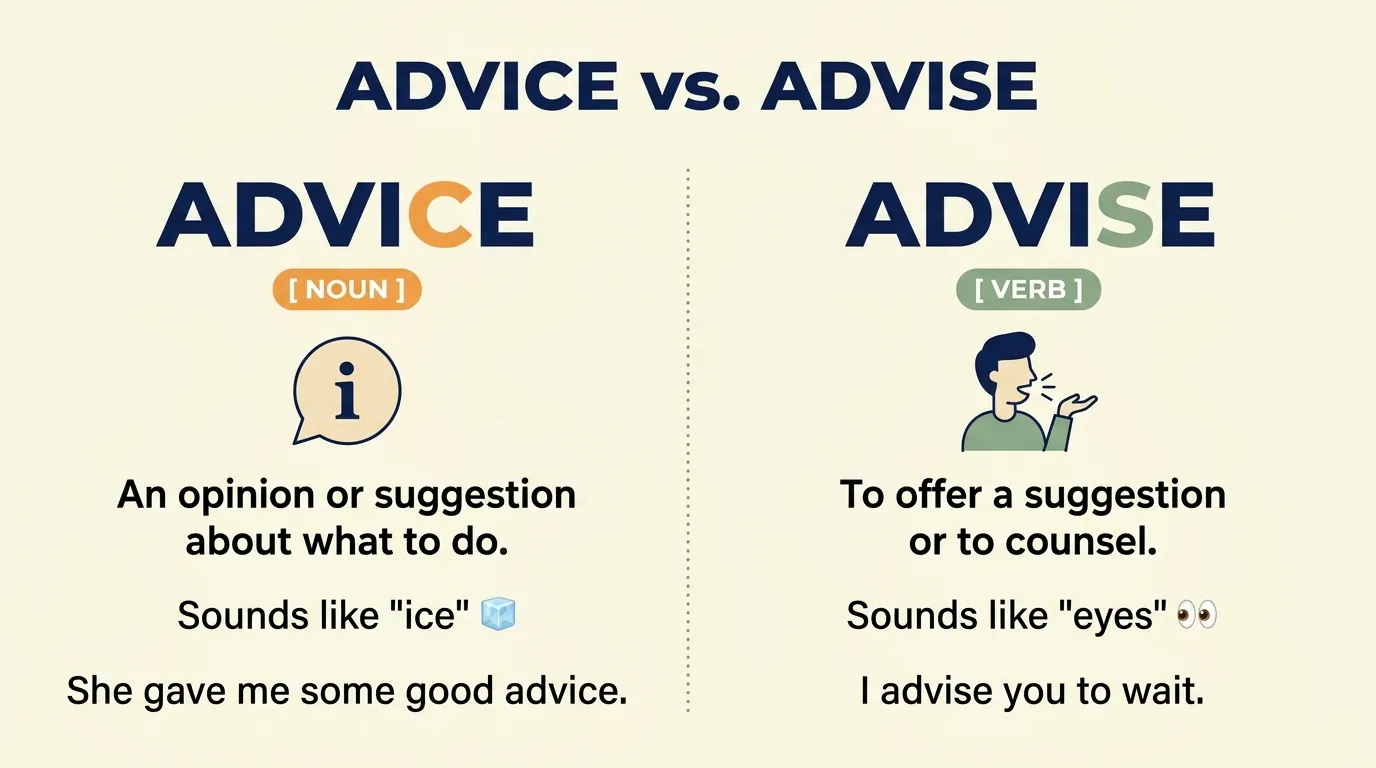
Advice is a noun. It means a suggestion or opinion about what someone should do. Advise is a verb. It means to give that suggestion.
So you give advice, and you advise a person. The spelling follows the part of speech.
Merriam-Webster puts it simply: to advise is to give advice. The noun is the thing. The verb is the action.
The two words also sound different. Merriam-Webster shows advise with a “z” sound at the end and advice with an “s” sound. Advice rhymes with “ice.” Advise rhymes with “size.”
Table of Contents
- Did You Know?
- Quick Answer
- Advice or Advise: What’s the Difference?
- The Grammar Rule: Noun vs Verb
- Memory Tricks That Actually Work
- 18 Example Sentences
- Common Mistakes
- Exceptions and Special Uses
- Advice or Advise at Work and in Email
- Expert Tip
- Quick Quiz
- FAQs
- Conclusion and Key Takeaways
Did You Know? 🔍
Both words are old. Merriam-Webster dates each one to the 14th century, and both came into Middle English from Anglo-French. They split into a noun and a verb, and the spelling followed.
Quick Answer
Advice is a noun. It means a suggestion about what to do, as in “She gave me good advice.” Advise is a verb. It means to give that suggestion, as in “I advise you to wait.” Advice ends with a C and an “ice” sound. Advise ends with an S and a “z” sound.
⚡ Quick Rule in 1 Line
Advice with a C is a thing you get. Advise with an S is something you do.
| Word | Part of speech | Meaning | Ends with the sound | Example |
|---|---|---|---|---|
| Advice | Noun | A suggestion or opinion about what to do | “s” | “Thanks for your advice.” |
| Advise | Verb | To give a suggestion or recommendation | “z” | “I advise you to wait.” |
| Advised | Verb (past tense) | Gave a suggestion | “d” | “She advised us to leave early.” |
| Advising | Verb (-ing form) | Giving a suggestion | “ing” | “He is advising the team.” |
If you say the sentence aloud, your ear often catches the right word. “Thanks for your advize” sounds odd, and that’s your clue.
The Grammar Rule: Noun vs Verb
Use advice when you need a thing, which is a noun. Use advise when you need an action, which is a verb. Advice can follow words like “the,” “some,” or “good.” Advise usually needs a person after it, as in “I advise you.”
Advice is a mass noun. That means you can’t count it the way you count apples. You can’t say “an advice” or “many advices.” Instead, say “some advice,” “a piece of advice,” or “words of advice.”
Advice often pairs with the verbs give, seek, and follow. It also takes adjectives such as good, bad, and unsolicited.
Advise works as an action. It usually takes a direct object, a person you’re advising.
- “I advise you to stay home.”
- “The attorney advised her client not to sign.”
- “Please advise me on how to proceed.”
The past tense is advised, and the -ing form is advising. ProWritingAid points out that “adviced” and “advicing” aren’t words.
Memory Tricks That Actually Work
The easiest trick is this: advICE ends in “ice,” and ice is a thing. Things are nouns. Advise has an S, and S can stand for “suggest,” which is a verb. Pick the trick below that fits the way your brain works.
1. The ICE trick. Advice has “ice” inside it. Ice is a thing you can touch, and advice is a thing you receive.
2. The alphabet trick. C comes before S in the alphabet. Noun comes before verb in a grammar book. So advice (C, noun) comes first, and advise (S, verb) comes second. Merriam-Webster shares this noun-before-verb tip.
3. The “express” trick. Advise has an S, just like the verb “express.” Merriam-Webster uses this match as a cue for the verb.
4. The swap trick. ProWritingAid suggests swapping in a different word. If “suggest” fits, write advise. If “guidance” fits, write advice.
5. The sound trick. Say the word out loud. A “z” sound at the end means advise. An “s” sound means advice.
18 Example Sentences With Advice and Advise
Here are 18 sentences to learn from. Six use advice, six use advise, four use both, and two show other verb forms. Read them aloud and listen to the ending.
Advice (the noun)
- “My coach gave me great advice.”
- “Thanks for your advice.”
- “She asked her teacher for advice about college.”
- “He followed the doctor’s advice and slept more.”
- “Can I give you a piece of advice?”
- “That was some of the best advice I ever got.”
Advise (the verb)
- “I advise you to read the contract first.”
- “The lawyer will advise us on the next steps.”
- “Doctors advise patients to drink more water.”
- “I’d advise against driving in the snow.”
- “Please advise me when the package arrives.”
- “She advises small businesses on taxes.”
Both words in one sentence
- “I advise you to take her advice.”
- “If I advise you wrong, ignore my advice.”
- “Free advice isn’t always good, so I advise you to check it.”
- “The counselor advises students, and students value her advice.”
Other verb forms
- “He advised us to leave early.”
- “She is advising the team this season.”
Common Mistakes With Advice and Advise
The most common mistakes are using advise as a noun, using advice as a verb, and making advice plural. Each one is easy to fix. Check this list before you send your next message.
- ❌ Thanks for your advise. → ✅ Thanks for your advice.
- ❌ Take my advise. → ✅ Take my advice.
- ❌ I advice you to wait. → ✅ I advise you to wait.
- ❌ He adviced me to stay. → ✅ He advised me to stay.
- ❌ She gave me many advices. → ✅ She gave me a lot of advice.
- ❌ I need an advice. → ✅ I need some advice. (or “a piece of advice”)
Notice the pattern. In every “thing” sentence, the word is advice. In every “action” sentence, the word is advise.
Exceptions and Special Uses
The main rule has almost no exceptions, but two special cases surprise people. “Advices” appears in business writing, and “Please advise” stands alone as a polite request. Neither breaks the noun-verb rule. They’re just special uses.
1. “Advices” in business. In everyday English, advice has no plural. Merriam-Webster’s usage guidance calls “advices” incorrect. But the dictionary entry lists a business sense: an official notice about a transaction. That sense appears in the plural, as in “payment advices.” Outside of that niche, stay with “advice.”
2. “Please advise.” You’ve probably seen this at the end of an email. Merriam-Webster notes that “Please advise” alone is common at the end of a letter. Here, advise is a verb, and the object is understood. It means “please tell me what to do.”
3. Advise as “inform.” Advise can also mean to notify someone. Merriam-Webster lists a sense of informing someone, such as of their rights. Grammarly also lists “to notify” as a meaning. “The bank advised me of the fee” means the bank informed me.
4. Adviser or advisor. Both spellings are fine for a person who gives advice. Merriam-Webster lists the noun as adviser or advisor. Pick one and stay consistent.
Advice or Advise at Work and in Email
At work, use advice for the thing you give or receive, and advise for the action you take. Business writing leans on both words, so a quick check saves you from small mistakes that can make a message look careless.
| Phrase | Correct? | Why |
|---|---|---|
| “Thanks for the advice.” | ✅ | A thing you received, so a noun |
| “I’d advise a short delay.” | ✅ | An action you take, so a verb |
| “Please advise.” | ✅ | A verb that asks for direction |
| “Any advise on this?” | ❌ | A noun is needed, so use advice |
| “We advice caution.” | ❌ | A verb is needed, so use advise |
“Please advise” is correct, but it can sound stiff. If you want a softer tone, try “Please let me know what you think.” That’s a style choice, not a grammar rule.
Expert Tip 💡
Check the word right before the blank. If you see “the,” “your,” “some,” or “good,” you almost always need the noun advice. If you see “to,” “will,” “would,” or a subject like “I” or “we,” you almost always need the verb advise.
Quick Quiz
Try these three, then check the answers below.
- “Thanks for your ____.” (advice / advise)
- “I ____ you to wait.” (advice / advise)
- “She gave me some great ____.” (advice / advise)
Answers: 1) advice. It’s a thing you received. 2) advise. It’s an action. 3) advice. “Some great” signals a noun.
FAQs
Is it advice or advise?
Both are correct, but they do different jobs. Advice is a noun for a suggestion. Advise is a verb that means to give a suggestion. Use advice for the thing and advise for the action.
Which one is the noun, advice or advise?
Advice is the noun. It’s spelled with a C. Advise is the verb, spelled with an S. A quick check is the alphabet: C comes before S, and noun comes before verb.
How do you pronounce advice and advise?
Merriam-Webster shows advice ending with an “s” sound and advise ending with a “z” sound. Advice rhymes with “ice.” Advise rhymes with “size.” The spelling follows the sound.
Is “advices” a word?
In everyday English, no. Merriam-Webster’s usage guidance calls it incorrect. Still, its dictionary entry shows a business sense, an official notice about a transaction, that appears in the plural, as in “payment advices.”
Can you say “an advice”?
No. Advice is a mass noun, so it doesn’t take “an.” Say “some advice,” “a piece of advice,” or “a word of advice” instead.
What does “please advise” mean?
It’s a polite request that means “please tell me what to do” or “please let me know.” Merriam-Webster notes that “Please advise” alone is common at the end of a letter. It uses advise as a verb.
Is it advisor or adviser?
Both spellings are correct. Merriam-Webster lists the noun as adviser or advisor. Choose one and use it consistently across your writing.
Is it advised or adviced?
It’s advised. The past tense of advise is advised, and “adviced” isn’t a word. The -ing form is advising, not “advicing.”
What’s the difference between advise and inform?
They overlap. Advise often means to recommend something. It can also mean to notify, as in “The bank advised me of the fee.” Inform is simpler. It only means to give facts.
How can I remember which one to use?
Remember “ice.” Advice has “ice” in it, and ice is a thing, so advice is a noun. Advise is the action word. You can also say it aloud and listen for the “z” sound.
Conclusion
So, advice or advise? Advice is the noun, and it means a suggestion. Advise is the verb, and it means to give one. You give advice, and you advise people.
When you’re stuck, try a quick swap. If “suggestion” fits, write advice. If “suggest” fits, write advise. You can also say the word aloud and listen for the ending sound.
Keep an eye on the special cases too. Advice has no plural in everyday English, and “Please advise” is a correct verb use. With these checks, you’ll pick the right word every time. That small habit will make your emails, essays, and messages look more polished.

Hi, I’m Daniel Carter. I’m passionate about helping learners improve their English with practical grammar tips and clear writing advice.