You’re writing a thank-you note. You type, “I’ve learnt so much from you.” Then you wonder if “learned” looks better.
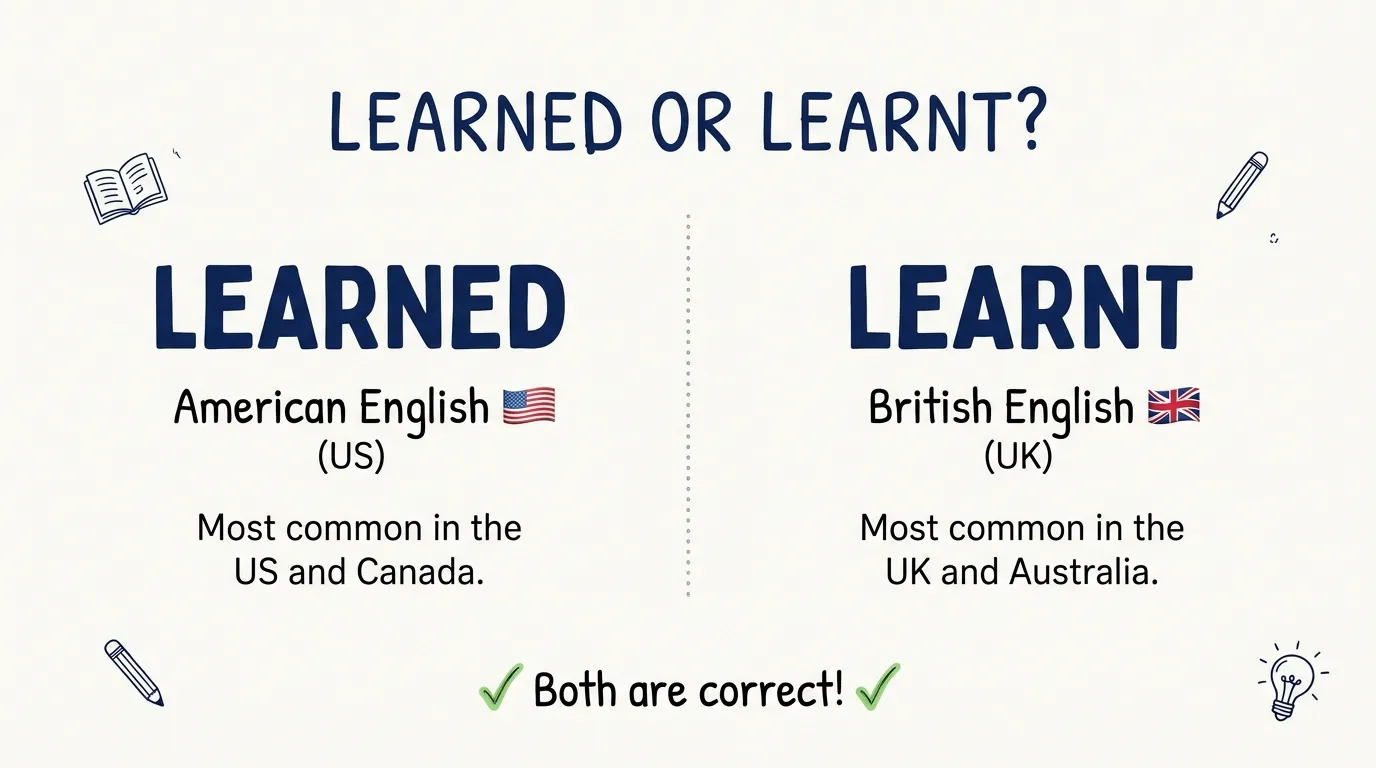
Both “learned” and “learnt” are correct past tense forms of “learn.” “Learned” is the usual US spelling, and “learnt” is common in British English.
So you’re not making a mistake either way.
There’s one catch, though. For the adjective “learned,” meaning “scholarly,” you must use “learned.”
For example, “a learned professor” never becomes “a learnt professor.”
This guide shows you when each form fits, how US and UK writers differ, and a simple way to choose.
By the end, you’ll pick the right one with confidence.
Table of Contents
- Did You Know?
- Quick Answer
- Quick Rule in 1 Line
- Learned or Learnt: The Difference Explained
- The Grammar Rule Behind It
- US vs UK: Does Region Matter?
- Comparison Table
- The “Learned” Adjective Exception
- Memory Trick
- 20 Example Sentences
- Common Mistakes
- When to Use Each Form
- Expert Tip
- Quick Quiz
- FAQs
- Conclusion
- Key Takeaways
Did You Know? 🔍
The adjective “learned” is pronounced with two syllables: LUR-nid. Think of “a learned judge.”
The past tense “learned” is pronounced with one syllable: lurnd. The spelling is the same, but the sound changes with the meaning.
Quick Answer Box
“Learned” and “learnt” are both correct past tense and past participle forms of “learn.” “Learned” is the standard form in American English. “Learnt” is common in British English. For the adjective meaning “scholarly,” always use “learned.”
⚡ Quick Rule in 1 Line
“Learned works everywhere; learnt is a British option. For the scholarly adjective, always write learned.”
Learned or Learnt: The Difference Explained
“Learned” and “learnt” mean the same thing. The difference is regional preference, not meaning. “Learned” is safe in any English-speaking country.
Both forms describe the past of “learn.”
- I learned to swim last summer.
- I learnt to swim last summer.
Both sentences are correct.
The first is the typical American form. The second is the typical British form.
There’s no change in meaning.
Here’s how each one is used in practice:
- Learned appears in American writing, in British writing, and in international English.
- Learnt appears mostly in British, Australian, and similar varieties of English.
If you’re not sure who your readers are, “learned” is the safest choice.
It won’t look odd to anyone.
The Grammar Rule Behind It
“Learn” can be a regular verb (add -ed) or take a -t ending. Both forms work as the simple past and as the past participle.
Let’s look at how the verb works.
Simple past:
- Yesterday, I learned a new word.
- Yesterday, I learnt a new word.
Past participle (used with “have,” “has,” or “had”):
- I have learned a lot this year.
- I have learnt a lot this year.
Past participle (used with “be”):
- The lesson was learned quickly.
- The lesson was learnt quickly.
Most English verbs add -ed in the past. “Learn” follows that pattern, so “learned” is the regular form.
The -t form comes from an older pattern. A small group of verbs have both an -ed and a -t option.
Here are some of them:
| Base verb | -ed form | -t form |
|---|---|---|
| learn | learned | learnt |
| dream | dreamed | dreamt |
| burn | burned | burnt |
| spell | spelled | spelt |
| spill | spilled | spilt |
| leap | leaped | leapt |
| spoil | spoiled | spoilt |
In American English, the -ed forms are usually preferred. In British English, the -t forms are common too.
I can’t give exact usage numbers without live research, so treat this as a general pattern.
US vs UK: Does Region Matter?
Region matters for preference, not for correctness. Americans mostly write “learned.” British writers use both, and “learnt” is quite common.
In the United States, “learned” is the standard form. “Learnt” may look like a typo to some readers.
In the United Kingdom, both forms appear. Many British writers use “learnt,” but “learned” is also correct.
Other countries vary too. Australian and Indian English often follow the British pattern, though writers there use both.
Here’s a simple guide:
- Writing for US readers: use “learned.”
- Writing for UK readers: either works. Check the publisher’s style.
- Writing for a global audience: use “learned.”
Note that dictionaries list both forms for “learn.” US dictionaries tend to list “learned” first, and British dictionaries often list both.
Check your preferred dictionary for exact wording.
Comparison Table
| Feature | Learned | Learnt |
|---|---|---|
| Correct past tense? | Yes | Yes |
| Correct past participle? | Yes | Yes |
| Common in US English? | Yes | Rare |
| Common in UK English? | Yes | Yes |
| Works as the “scholarly” adjective? | Yes | No |
| Safest for global readers? | Yes | Sometimes |
| Meaning | Correct spelling | Pronunciation |
|---|---|---|
| Past tense of learn | learned or learnt | lurnd / lurnt |
| Scholarly (adjective) | learned only | LUR-nid |
| Acquired through experience | learned (or learnt in UK) | lurnd |
The “Learned” Adjective Exception
“Learned” can also be an adjective meaning “scholarly” or “well educated.” For this meaning, “learnt” is never used.
This is the main exception to the “either one works” rule.
- She is a learned professor.
- He wrote a learned article on ancient history.
- The judge gave a learned opinion.
In each sentence, “learned” describes a person or thing with deep knowledge.
You say it with two syllables: LUR-nid.
You’d never write “a learnt professor.”
There’s also a related use: “learned behavior.”
This means a behavior that was picked up through experience, such as a habit.
In this phrase, “learned” is said with one syllable.
British writers may also write “learnt behaviour,” though “learned behaviour” is common too.
The takeaway is simple.
If the word describes a scholarly person, use “learned.”
Memory Trick
Learned has -ed, the normal ending. Learnt is the British extra. When in doubt, take the -ed.
Here are two quick ways to remember:
- Two syllables? Write “learned.” If you say LUR-nid, the word is always spelled with -ed.
- Think of “-ed” as the default. Most verbs end in -ed. “Learned” fits the pattern, so it’s the safe pick.
Another tip: if your reader is American, “learned” is the one they expect.
If you write for a British magazine, check how past issues spell it.
20 Example Sentences
“Learned” (American usage):
- I learned to cook from my grandmother.
- She learned the news this morning.
- We learned a lot from the experiment.
- He has learned from his mistakes.
- The kids learned the song in one day.
- They learned about the storm on the radio.
- I wish I had learned Spanish sooner.
- What have you learned so far?
“Learnt” (British usage):
- I learnt to drive when I was seventeen.
- She learnt the poem by heart.
- We learnt a lot on the school trip.
- He’s learnt his lesson at last.
- They learnt about the match on the radio.
- I wish I’d learnt French at school.
- What have you learnt so far?
“Learned” as an adjective:
- The learned professor gave a short talk.
- She wrote a learned essay on poetry.
- The court heard the learned judge’s opinion.
Related -t / -ed pairs:
- He dreamt of the sea last night. (Also: dreamed.)
- She spelt the word correctly. (Also: spelled.)
Common Mistakes
❌ He is a learnt professor. ✅ He is a learned professor.
I learnd a new word today. ✅ I learned a new word today.
❌ She has learn a lot. ✅ She has learned a lot.
We learnted the song. ✅ We learned the song. (or “learnt” in British style)
❌ I learned the rules, but my friend learnt his. (mixing styles in one piece) ✅ I learned the rules, and my friend learned his.
The first mistake shows the exception. “Learnt” can’t be used for the scholarly adjective.
The next three are spelling or tense errors.
The last one is about consistency. Pick one form and stay with it in the same piece of writing.
When to Use Each Form
Use “learned” for US readers and global audiences.
The Use “learnt” only if you write in a British style and want that regional feel.
Use “learned” when you’re writing:
- School essays for a US class
- Business emails for US clients
- Blog posts with a global audience
- Resumes and applications
- The scholarly adjective (“a learned judge”)
You can use “learnt” when:
- You’re writing for a British publisher or audience
- Your style guide calls for British spelling
- You want a natural British voice, such as in dialogue
Whichever you pick, keep it consistent.
If one paragraph says “learnt” and the next says “learned,” readers may wonder if it’s a typo.
Expert Tip 💡
Check the house style guide before you write.
If you edit for a US publisher, the style guide will almost certainly prefer “learned.” British publishers often allow both, so follow the one they use.
If there’s no guide, use a standard dictionary and pick the first-listed form.
Then use the same pattern for similar verbs, such as “dreamed” and “burned,” so your style stays consistent.
Quick Quiz
1. Which sentence is correct in American English?
a) I learnt to ski last winter.
b) I learned to ski last winter.
2. Which is correct for the scholarly adjective?
a) a learnt scholar
b) a learned scholar
3. Which is correct as a past participle?
a) She has learnd a lot.
b) She has learned a lot.
Answers: 1) b (though “learnt” is acceptable in British English), 2) b, 3) b
FAQs
1. Is it “learned” or “learnt”?
Both are correct. “Learned” is standard in American English. “Learnt” is common in British English. If you’re unsure, choose “learned.”
2. Is “learnt” a real word?
Yes. “Learnt” is a recognized past tense and past participle of “learn.” It’s most common in British English.
3. Is “learnt” correct in American English?
It’s understood, but it’s unusual in the US. Many American readers see “learned” as the normal form, so use that in US writing.
4. What is the past tense of “learn”?
The past tense is “learned” or “learnt.” Both are correct. Example: “She learned (or learnt) to read at age four.”
5. What is the past participle of “learn”?
It’s also “learned” or “learnt.” Example: “I have learned (or learnt) a lot.”
6. Is “learned” pronounced with one or two syllables?
As a verb, “learned” has one syllable: lurnd. As an adjective meaning “scholarly,” it has two: LUR-nid.
7. Can I say “a learnt person”?
No. For the adjective meaning “scholarly” or “well educated,” use “learned.” Write “a learned person,” not “a learnt person.”
8. Do other verbs have -ed and -t forms?
Yes. Examples include dreamed/dreamt, burned/burnt, spelled/spelt, spilled/spilt, and leaped/leapt. Americans usually prefer the -ed forms.
9. Is “learned” correct in British English?
Yes. British writers use both “learned” and “learnt.” Neither is wrong. Check your publisher’s style guide if you write professionally.
10. Which one should I use in an essay or on my website?
For US readers, use “learned.” For a global audience, “learned” is also safest. Use “learnt” only for a British style, and stay consistent.
Conclusion
“Learned” and “learnt” are both correct past forms of “learn.”
“Learned” is the usual US spelling and works everywhere. “Learnt” is a common British choice.
The one firm rule is the adjective. A scholarly person is “learned,” never “learnt.”
When you write, pick one form and stay consistent. If your readers are American, or you’re not sure, go with “learned.”
Remember the simple idea: -ed is the default, and -t is the British extra.
With that in mind, your writing will look clean and confident.

Hi, I’m Ethan Brooks. I create easy-to-follow grammar guides, writing tips, and vocabulary resources to make English learning enjoyable for everyone.